
Driving School Exams — Theory, Road Test & How to Pass
Theory test (25 questions, 43/50 points) and road test (30 min with examiner). Common mistakes, mental prep, and what to do if you fail.
One in three driving school students fails on the first attempt. Not because they can't drive or don't know the rules — but because stress gets the better of them. For most people, the exam is the first time they sit behind the wheel with a stranger who holds their future in their hands. And that feeling can rattle even a confident driver.
This chapter breaks down both parts of the exam — theory and practical — step by step. You'll learn how exam day unfolds from arrival to results, what exactly the examiner evaluates, which mistakes most commonly send students home, and how to prepare mentally so your nerves don't take over. And if it doesn't work out the first time? We've got clear answers for that too.
If you haven't gone through theory prep yet, check out the chapter Theory — How to Study. And for practical preparation, see the chapters Practical Driving Lessons and Maneuvers.
Quick summary:
- Theory test: 25 questions on a computer, 30 minutes, you need at least 43 out of 50 points. The hardest section is traffic situations (intersections) — only 3 questions, but worth 4 points each.
- Practical test: at least 30 minutes of driving in real traffic with an examiner. The result is binary — pass or fail.
- You get 3 attempts for each part. A retake costs CZK 100 for theory, CZK 400 for the road test.
- The main cause of failure isn't lack of knowledge — it's stress. Good preparation and calming your nerves are half the battle.
How Exam Day Works
Exams are organized by the municipal office with extended jurisdiction — not your driving school. Examiners are government employees, independent of the driving school. This is an important detail because it means the examiner has no reason to "fail you" or "let you pass" — they evaluate according to clear rules and don't care which driving school you attended.
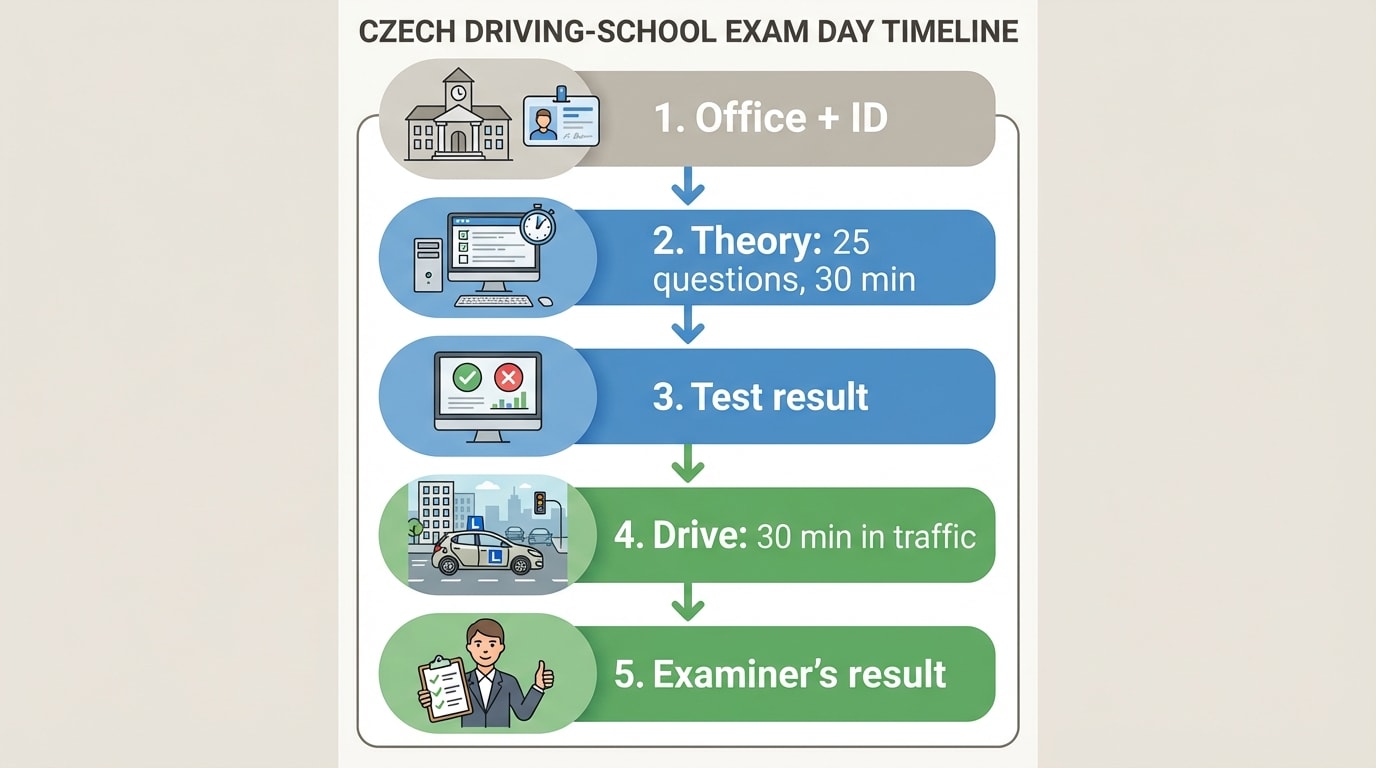
Your driving school registers you for the exam and tells you the date and location. You need to bring a valid ID card and your training completion certificate. Without these, they won't let you take the test.
The day always starts with theory. You arrive at the office, sit down at a computer, and the system generates a random test from a database of over a thousand approved questions. You have 30 minutes. After submitting, the result appears immediately — no waiting. If you fail the theory, you can't take the road test that day. Your next attempt can be no sooner than 5 business days later (Section 39, paragraph 2 of Act No. 247/2000 Coll.).
If you pass the theory, you proceed to the practical test. It takes place either the same day or within 7 days (Section 38 of Act No. 247/2000 Coll. states the exam must be completed within 7 days of starting). You get in the driving school car — your instructor sits at the dual controls, the examiner in the back seat or front passenger seat. The examiner tells you where to go. The drive lasts at least 30 minutes in real city traffic. You find out the result right after getting out of the car.
Theory Test — 25 Questions, 50 Points, 30 Minutes
The test runs on a computer in the Ministry of Transport's eTests system. Questions are randomly generated from a database currently containing over 1,100 approved questions. Each question has one correct answer out of two to four options.
The trickiest part of the whole test is the point distribution. Not all questions carry the same weight — and this is exactly what determines whether you pass.
| Section | Questions | Points/question | Total |
|---|---|---|---|
| Road traffic rules | 10 | 2 | 20 |
| Safe driving principles | 4 | 2 | 8 |
| Traffic signs and signals | 3 | 1 | 3 |
| Traffic situations (intersections) | 3 | 4 | 12 |
| Vehicle operation conditions | 2 | 1 | 2 |
| Other regulations | 2 | 2 | 4 |
| First aid | 1 | 1 | 1 |
| Total | 25 | — | 50 |
See the crucial detail? Traffic situations — typically intersection questions about right-of-way — have only 3 questions, but each is worth 4 points. That's 12 points out of 50. And since you need 43 points to pass, you can lose a maximum of 7 points. One wrong answer on an intersection question costs you 4 points — more than half of your error margin. Two wrong intersection answers and you fail, even if everything else was perfect.
Intersections Decide Your Fate
Three traffic situation questions total 12 points — more than the entire safe driving principles section (8 points). Two intersection mistakes = failure. Practice right-of-way scenarios at etesty.md.gov.cz, where official questions from the real database are available.
A good strategy is to start with questions you're confident about and leave the uncertain ones for later. The system lets you go back to previous questions. Don't rush — 30 minutes is plenty of time for 25 questions. Most people finish in 10–15 minutes, but it's worth reviewing your answers one more time.
Practical Test — 30 Minutes That Decide Everything
The road test is the moment of truth. You're behind the wheel of the driving school car, next to you (or behind you) sits the examiner, and your instructor sits at the dual controls. The examiner chooses the route — you don't know beforehand where you'll go, and that's the whole point. The examiner wants to see how you handle real situations, not a rehearsed route.
The test lasts at least 30 minutes and takes place in regular city traffic. The examiner gives instructions like "turn right at the next intersection" or "park by that curb." They don't tell you how to do it — just where. The evaluation is binary: pass or fail. No point scale, no "many mistakes but still passed." You either drive safely or you don't.
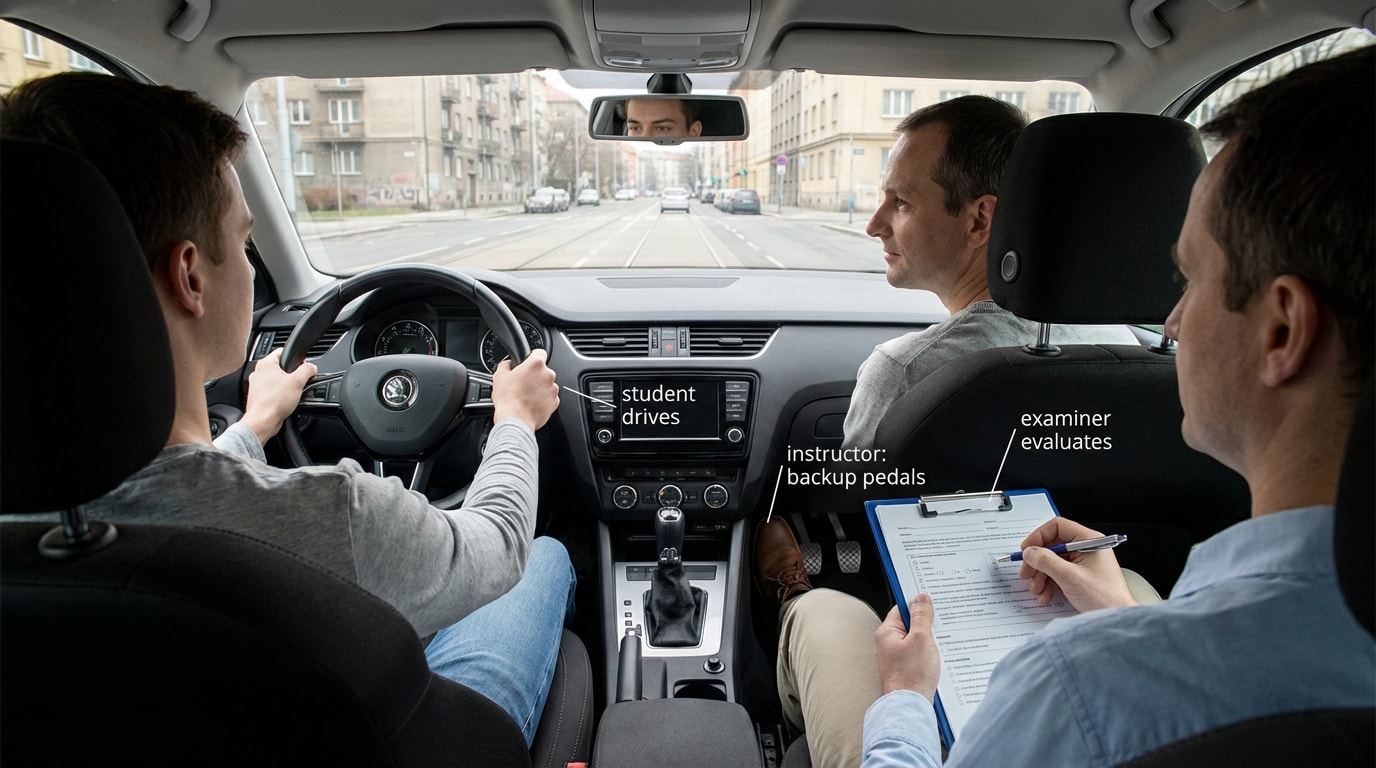
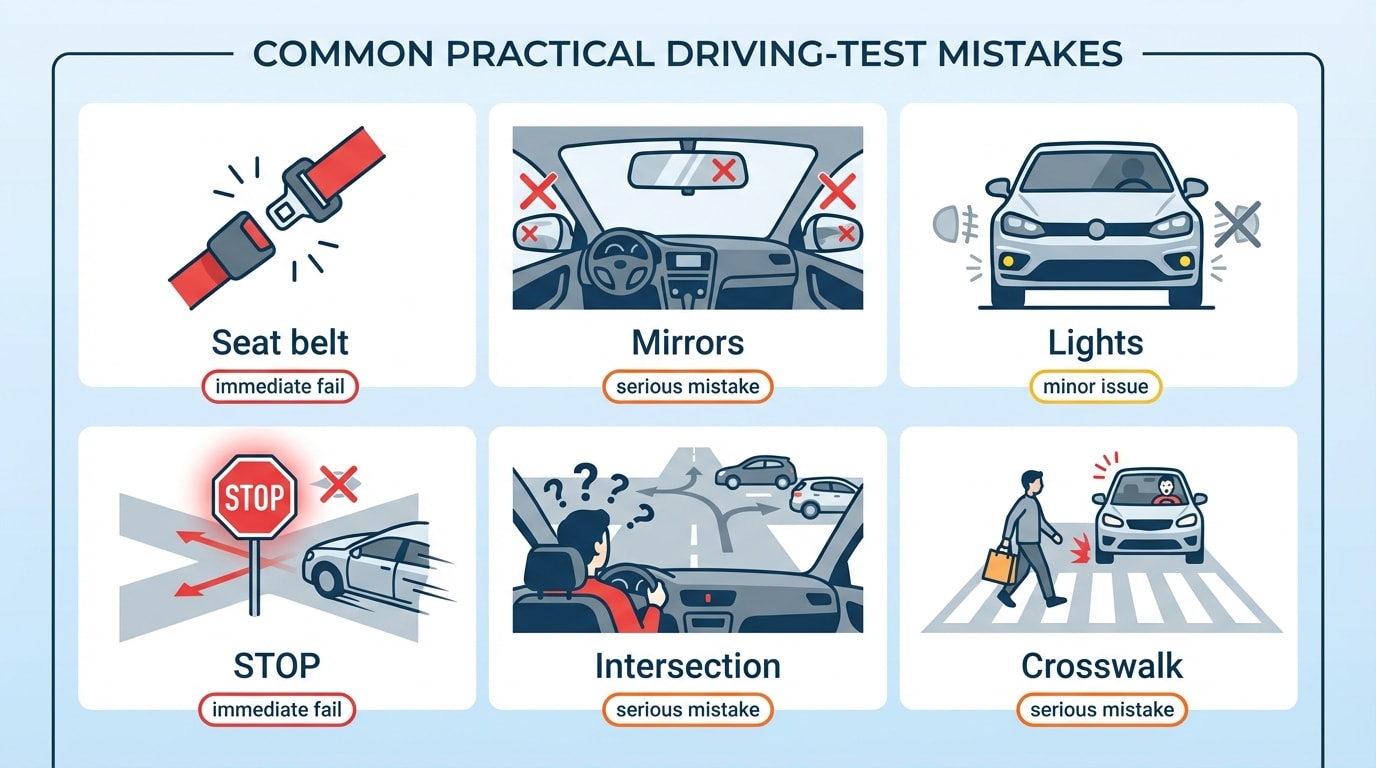
The test begins before you even start driving. The examiner watches whether you put on your seatbelt, adjust the mirrors, and turn on the lights. Daytime running lights have been mandatory in Czechia since 2006 — and forgetting to turn them on under stress is a surprisingly common mistake. Then you start driving and the examiner evaluates your entire performance.
What Exactly the Examiner Evaluates
The examiner has a clear list of criteria according to Decree No. 167/2002 Coll. It's not a subjective "I liked it" or "I didn't" — it's a structured evaluation. Here's what they look at:
Preparation and starting. Seatbelt, mirrors, lights. Smooth start without jerking, correct gear shifting, clutch and gas coordination. On a hill, managing the start without dangerous rolling back — slight rollback of a few centimeters is fine, but a meter backward is a problem. Details on all maneuvers are in the chapter Maneuvers.
Driving in traffic. Obeying the speed limit, maintaining proper following distance, smooth and predictable driving. The examiner doesn't want to see a snail's pace or a racer. Driving too slowly and holding up traffic is a mistake just as much as speeding.
Intersections and right-of-way. Correctly assessing right-of-way — right-of-way from the right, traffic signs, traffic lights. This is where the most people fail. Nervousness leads students to miss a "Yield" sign or enter an intersection without having right-of-way.
Observation and signaling. The examiner checks whether you look in your mirrors — with a visible head movement, not just your eyes. You must use turn signals for every direction change, every overtake, every lane change. The sequence is always: mirror → signal → mirror → maneuver.
Crosswalks and railroad crossings. Stopping for pedestrians at a crosswalk is mandatory (Section 5, paragraph 2, letter f of Act No. 361/2000 Coll.). At a railroad crossing, you must reduce speed to 30 km/h within 50 meters of the crossing.
Parking. The examiner will assign you parallel or perpendicular parking — or both. They evaluate smoothness, accuracy, safety, and vehicle control. Step-by-step procedures for each maneuver are in the chapter Maneuvers.
When the Examiner Immediately Ends the Test
Any intervention by the instructor (verbal command to stop or physical contact with the steering wheel/pedals), serious rule violations (running a red light, driving against traffic), endangering road users, or a collision — all of these mean an immediate fail. No discussion.
Most Common Mistakes — Why Students Fail
Data from Czech driving schools shows that most exam mistakes aren't about lack of knowledge — they're about stress and inattention. Here are the most common ones, ranked by frequency.
In the theory test, students most commonly fail on traffic situations — those three questions worth 4 points each. The second most common mistake is careless reading of the question. In a rush, you miss a key word ("must not" vs. "may," "always" vs. "never") and answer the exact opposite. The third issue is rote memorization without understanding. If you learn answers by heart without grasping the principle, an unfamiliar wording will throw you off. How to effectively prepare for the theory test is covered in the chapter Theory — How to Study.
In the road test, the list is longer. Seatbelt — yes, people forget it under stress. Mirrors — either not adjusting them or not checking them with a visible head turn. Lights — forgetting to turn them on. STOP sign — wheels must come to a complete stop, not even a centimeter of movement. Incomplete stopping at a STOP sign is an automatic mistake. Right-of-way at intersections. Pedestrians at crosswalks. Roundabouts — incorrect signaling, wrong lane. Railroad crossings. Lane changes without mirror checks and signals. Driving too cautiously, holding up traffic. Jerky gear shifting.
From that list, it's clear that most mistakes are small things that can be eliminated with one word: routine. The more driving hours you have under your belt, the more these become automatic habits. If you're not confident before the exam, don't hesitate to ask your instructor for a few extra driving lessons — investing CZK 500–800 per hour is worth more than a retake and more weeks of waiting.
How to Handle Nerves — Mental Preparation
Experts from BESIP (the Czech road safety organization) say it clearly: the main cause of exam failure is stress, not lack of knowledge. And it makes sense. Most students come to the exam with dozens of driving hours behind them, they know the rules — but the moment an examiner sits next to them with a notepad, their brain switches to "danger mode" and their hands start shaking.
The best remedy for exam stress is simple: preparation. Not in the sense of "learn more rules," but in the sense of "have enough driving hours so you drive on autopilot." When you don't have to think about how to shift gears or where the turn signal is, it frees up mental capacity for watching traffic and responding to the examiner's instructions. That's why skimping on driving lessons doesn't pay off — every extra hour is an investment in calmness during the exam.
A few specific tips that work. Sleep well the night before — fatigue amplifies nervousness. Eat a normal breakfast and stay hydrated. Avoid caffeine if you're not used to it — you don't need shaky hands. Arrive at the location calmly, with at least 15 minutes to spare.
Before the actual exam, try a simple breathing technique: inhale through your nose for four counts, hold for four counts, exhale through your mouth for six counts. Repeat three times. It sounds trivial, but deep breathing demonstrably activates the parasympathetic nervous system and lowers cortisol levels. It works.
And most importantly — stop seeing the examiner as your enemy. They're not someone trying to fail you. They're a government employee with a clear evaluation framework. They drive with dozens of students every week — your exam is routine for them. Approach the exam like a normal drive — because that's what it is. There's just someone extra in the car.
Visualization Helps
The day before, calmly visualize the entire exam process — arriving at the office, sitting at the computer, getting in the car, the examiner's instructions. Picture yourself driving calmly and smoothly. Athletes use this technique before competitions, and it works for driving exams too.
What If You Fail
Failing the exam isn't the end of the world. It's unpleasant, but the rules are clear and the way back is straightforward.
Since 2021, Czechia has had the "three strikes" rule (Act No. 191/2021 Coll., Section 39, paragraphs 2 and 3 of Act No. 247/2000 Coll.). You get a total of 3 attempts for each part of the exam — theory and the road test are counted separately. You can take a retake no sooner than 5 business days after failure. Retake fees are low: CZK 100 for theory, CZK 400 for the road test.
If you don't pass on the third attempt, you must complete supplementary training for the part you failed. After the supplementary training, you get 3 more attempts. If you still don't pass (6 failures total), you must complete the full training from scratch.
There's also one important deadline: the entire process — from your first exam attempt to successful completion — must be finished within 12 months (Section 39, paragraph 6). If you don't pass all parts within a year, you have to go through driving school again. In practice, this only affects exceptional cases.
After successfully passing both parts, you receive a certificate. You must apply for your driver's license within 6 months at any municipal office with extended jurisdiction — otherwise the certificate expires and you'll have to retake the exam. Standard processing takes 20 days and costs CZK 200. What awaits you as a new driver — from the point system to mandatory equipment — is covered in the chapter After Getting Your License.
How Much Does a Retake Cost
Theory retake: CZK 100. Road test retake: CZK 400. Initial exam (both parts): CZK 700. A complete breakdown of all driving school costs is in the chapter How Much Does Driving School Cost.
Exam Pass Rates — And What They Mean
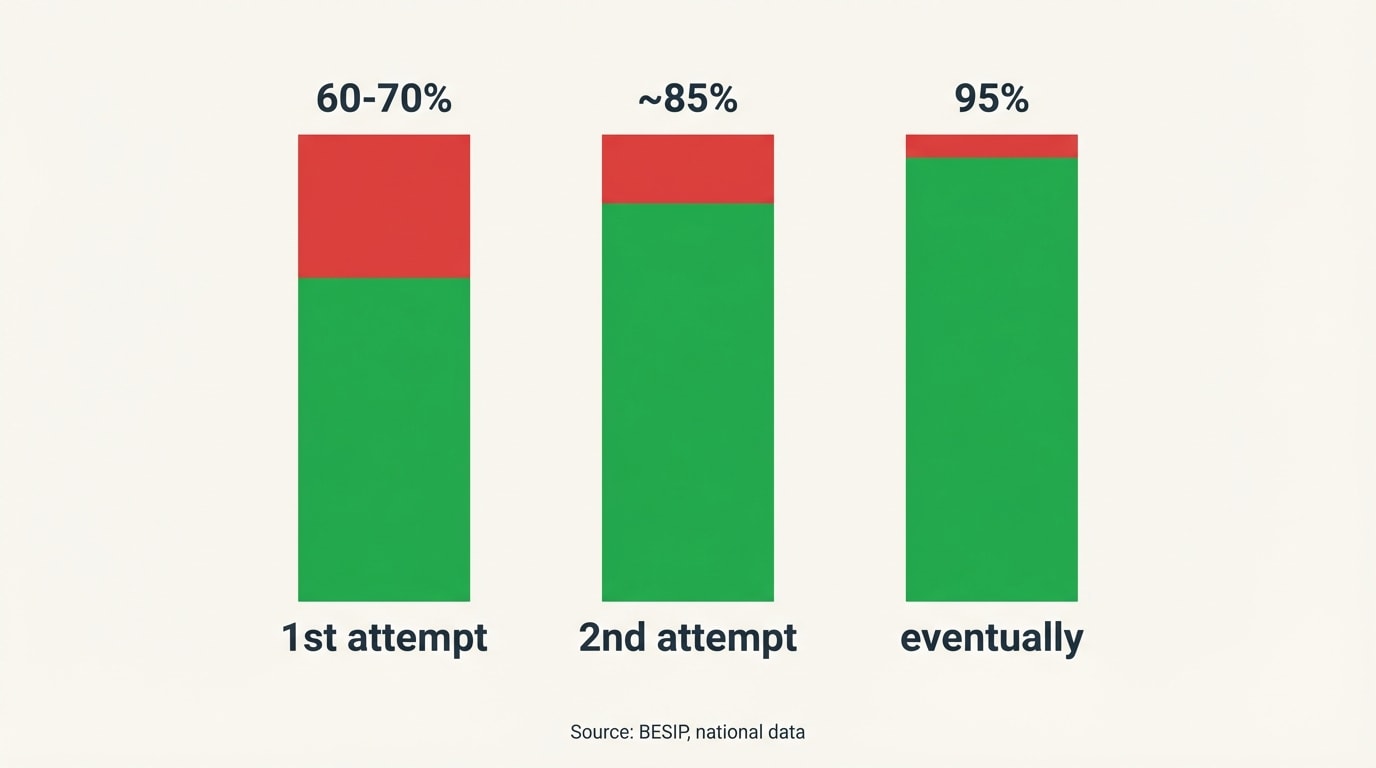
The numbers speak clearly: about 30–40% of applicants fail on the first attempt. In 2016, only 52% of students passed on their first try nationwide. In recent years, the number has improved to roughly 60–70%, but that still means every third student comes back.
What's interesting is that pass rates vary dramatically between driving schools. Some schools have rates above 80%, others below 30%. That's not coincidence — the quality of preparation plays a huge role. A driving school with low exam pass rates is a red flag. When choosing a driving school, ask about pass rates — it's one of the most important criteria.
And one more statistic: only about 5% of applicants never get their license at all. That means 95% of people make it — maybe not on the first try, but they make it. So even if it doesn't work out the first time, the statistics are on your side.
Summary
- Theory test: 25 questions, 30 minutes, you need 43 out of 50 points. Intersections (3 questions worth 4 points) decide the outcome.
- Practical test: at least 30 minutes of driving with an examiner in real traffic. Evaluation is pass/fail — no point scale.
- The examiner evaluates preparation, driving in traffic, intersections, observation, signaling, and parking. It's not subjective — they follow a clear framework per the decree.
- Most common mistakes: traffic situations in the test, forgetting seatbelt/mirrors/lights, incomplete stopping at STOP signs, incorrect right-of-way.
- The main cause of failure is stress. Breathe, see the examiner as a government employee (not an enemy), and make sure you've had enough driving hours.
- You get 3 attempts, retakes cost CZK 100–400. Failing isn't the end of the world — 95% of applicants eventually get their license.
Key Terms
| Term | Explanation |
|---|---|
| eTests | The official computer system of the Ministry of Transport for driving school theory exams |
| Examiner (zkušební komisař) | A municipal office employee who evaluates applicants during the exam — independent of the driving school |
| Traffic situations (dopravní situace) | Test questions about right-of-way at intersections — the hardest section, worth 4 points per question |
| Hazard perception | The ability to recognize danger in a traffic situation before it becomes a problem — a new concept since 2025 |
| "Three strikes" rule (třikrát a dost) | Since July 1, 2021: maximum 3 attempts per exam part. After the 3rd failure, supplementary training is required. |
| Supplementary training (doplňková výuka) | Mandatory re-training in the part where the student failed after 3 unsuccessful attempts |
| 12-month deadline | Maximum time from the first exam attempt to successful completion — after expiry, full re-training is required |
| Section 39 of Act No. 247/2000 Coll. | Legal regulation of professional competence exams — attempts, retakes, deadlines |
| Section 38 of Act No. 247/2000 Coll. | Exams are generally conducted in one day, must be completed within 7 days |
| Dual controls (zdvojené pedály) | A second set of clutch and brake on the instructor's side — instructor intervention = immediate fail |