Bus Driving License — Category D Guide
Category D bus license: age requirements, training cost, professional certificate, salaries, and career opportunities for bus drivers in Czechia.
Czechia is short five thousand bus drivers. Transit companies offer signing bonuses up to 50,000 CZK, cover training and professional certification costs, and the median salary exceeds 40,000 CZK gross. In Prague, an experienced bus driver earns 46 thousand — before night and weekend shift premiums. Driving a bus is one of the best-paid blue-collar professions in the country today. And the entry barrier is lower than most people think.
This chapter walks you through how to get a category D license step by step — from age limits and health requirements through training and the exam to the professional driver certificate, psychological tests, and real career prospects. If you already hold a category C license and are considering switching from trucks to buses, your path is considerably shorter and cheaper. And if you're still deciding whether to go for it — here's everything you need to know.
Quick summary:
- Category D permits driving buses carrying more than 8 passengers — no length or weight restrictions
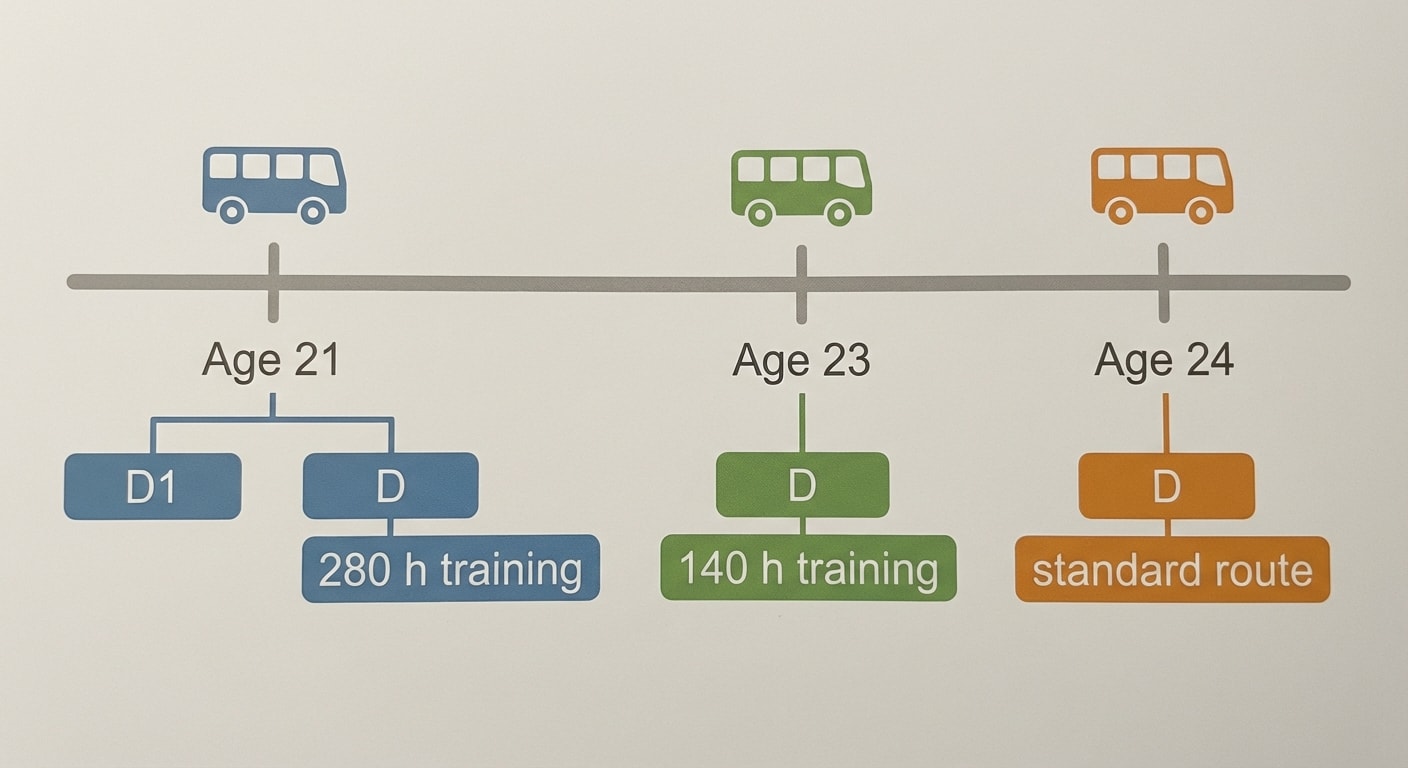
- The standard minimum age is 24, but with a professional certificate you can start from 21 (with 280 h training) or from 23 (with 140 h training)
- You must hold a valid category B license — there's no way around it
- A professional driver certificate, medical examination, and psychological tests are mandatory — but your employer typically covers the cost
What exactly you can drive — and the difference between D and D1
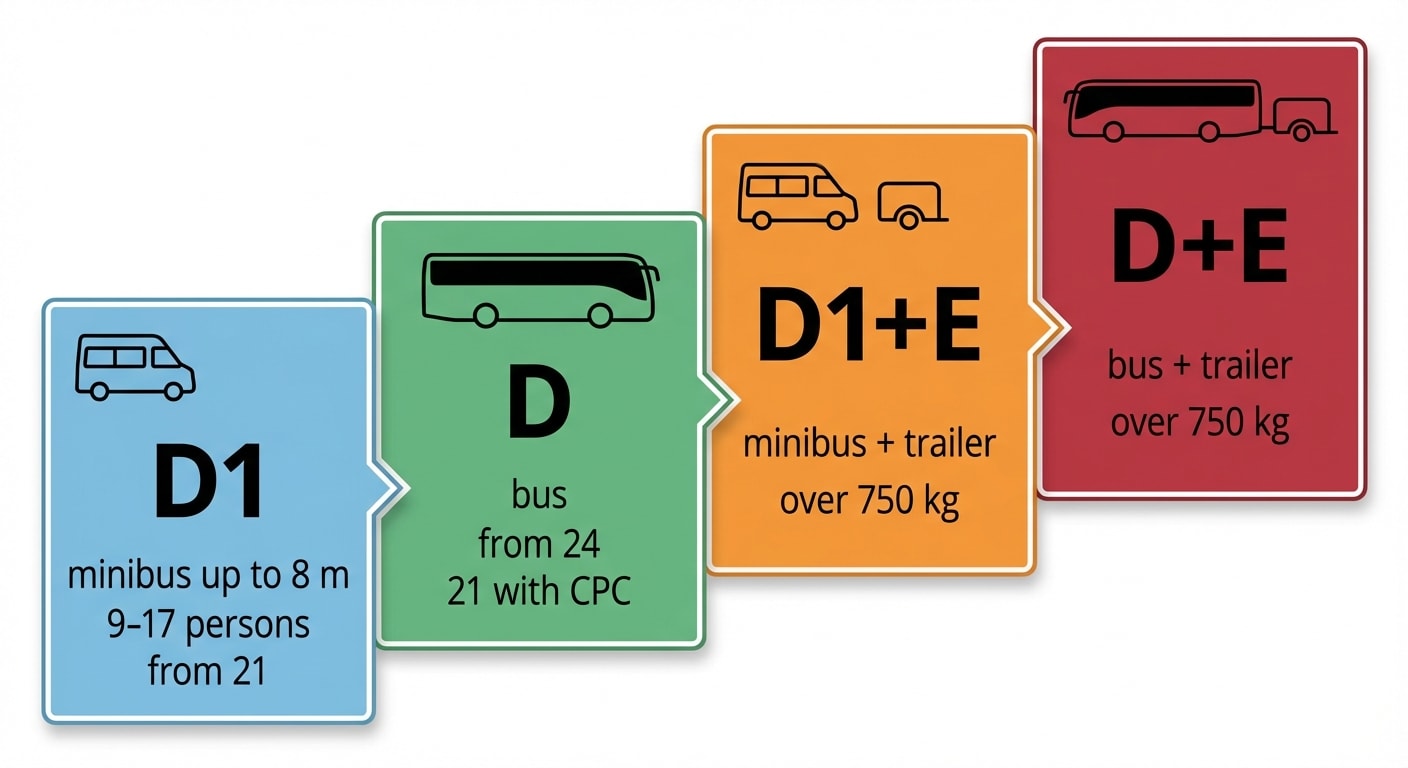
The law (§80a of Act No. 361/2000 Coll.) defines four categories with the letter D. Each covers a different type of vehicle, and before you start training, you need to know which one is yours.
Category D is the main category — it permits driving motor vehicles designed to carry more than 8 persons besides the driver. No length limit, no weight limit. A typical city bus, intercity coach, long-distance bus — all of these fall under D. You can attach a light trailer up to 750 kg. Category D automatically includes D1 and AM.
Category D1 is the "small D" — minibuses up to 8 metres long for 9 to 17 persons (including the driver). Smaller tourist coaches, company shuttles, school minibuses. You can get it from age 21. If you don't need to drive a full-size bus, D1 is a simpler and cheaper entry into the profession.
Category D+E is the extension — a category D bus with a trailer over 750 kg. In practice, this means buses with large luggage trailers or special technical combinations. It's not the most common category, but some operators require it. D+E automatically includes D1+E and B+E. And if you also hold category C, you automatically get CE too.
Category D1+E is a combination of a D1 vehicle and a trailer over 750 kg. The total weight must not exceed the limits set by the type approval.
D vs. D1 — which do you need?
Planning to drive city buses or long-distance coaches? You need category D. Want to drive only smaller minibuses up to 8 metres (max 17 persons)? D1 is enough — and you can start from age 21 without extended training.
From what age — age limits and exceptions
Here's the good news for those who don't want to wait until 24. The law (§83 of Act No. 361/2000 Coll.) sets the standard age for category D at 24, but offers several exceptions that open the door earlier.
From age 21 you can obtain category D if you complete extended initial professional driver training of 280 hours. It's a more demanding option, but realistic for motivated people. Until age 24, the licence is restricted. This route is often used by transit companies that train young drivers themselves.
From age 23 the standard initial training of 140 hours is sufficient. This is the most common option for people who want to start with buses a year earlier.
From age 21 (scheduled routes up to 50 km) there's a special exception for drivers of regular scheduled services on routes up to 50 km. With a professional certificate after 140-hour training, you can drive a bus on short scheduled routes from age 21.
From age 21 (security forces) — drivers for the Czech Police, municipal police, Prison Service, armed forces, fire service, and customs administration can obtain category D from 21, but the licence is restricted to service vehicles.
Category D1 (minibuses) is available from age 21 with no exceptions — no extended training needed.
One common rule applies to all variants: you must hold a valid category B license. Without B, you cannot obtain any D-group category (§82 of Act No. 361/2000 Coll.).
Other requirements — what you must meet
Besides age and a valid category B license, the law requires several additional conditions, all simultaneously (§82 of Act No. 361/2000 Coll.).
Medical fitness is key. Before starting training, you must undergo a medical examination under group 2 — the stricter standard for professional drivers. The doctor checks vision (acuity, colour perception, visual field), hearing, musculoskeletal system, cardiovascular system, and neurological condition. The certificate must be no older than 3 months. The examination costs 500 to 1,000 CZK.
You must not be serving a driving ban and must not have 12 points in the penalty point system. You also need your usual residence in Czechia (or to have been studying here for at least 6 months).
You'll find more on medical examinations, psychological tests, and ongoing oversight in a later section — because for category D, the requirements are stricter than for anything else.
Training — theory, practice, and how long it takes
Category D training is among the most demanding at any driving school. Act No. 247/2000 Coll. sets a minimum of 58 teaching hours — 38 hours of theory and 20 hours of practice. But the actual scope depends on what licence you already hold.
Theory covers five areas: traffic rules (10 h), vehicle operation and maintenance (12 h), driving theory and safe driving principles (10 h), first aid (2 h), and revision with testing (4 h). Theory is the same for everyone — 38 hours regardless of your previous licence.
The practical component is different. How many practice hours you need depends on what you're upgrading from.
| Upgrading from | Driving | Maintenance | First aid | Total practice |
|---|---|---|---|---|
| Category B | 30 h | 8 h | 4 h | 42 h |
| Category D1 | 18 h | 2 h | 4 h | 24 h |
| Category C1 | 16 h | 2 h | 4 h | 22 h |
| Category C | 14 h | 2 h | 4 h | 20 h |
One teaching hour = 45 minutes
The difference is enormous. If you're upgrading from B to D, you face 38 hours of theory and 42 hours of practice — 80 hours total, roughly three months. But if you hold category C, you only need 20 additional practice hours — 58 hours total, one to two months. The route through C is significantly shorter. Many drivers therefore get C first and then extend to D.
Practical training takes place on a real bus — typically a 12-metre urban or intercity vehicle (SOR BN 12, Iveco Crossway Line 12m). You'll learn to handle a large vehicle in traffic, pull up to bus stops, reverse, park, and drive on hills. Judging distances behind the wheel of a bus is a completely different experience from a car.
The exam — three parts, three chances
The final professional competence exam for category D has three parts — the same as for category C.
The theory test is taken electronically at the examining office. It covers traffic rules, maintenance, safe driving, and category D specifics. You can practise with free mock tests at etesty.md.gov.cz.
The oral test on vehicle operation and maintenance is specific to categories C and D — it doesn't exist for cars. The examiner asks you 3 questions, and you must demonstrate both practically and verbally that you know how to take care of a bus — checking brakes, tyres, lights, fluids.
The practical driving test takes place on a training bus in real traffic. The examiner assesses driving smoothness, reactions to traffic situations, handling the vehicle's dimensions, and above all your feel for carrying passengers — pulling up to stops, moving off, navigating intersections.
You have a maximum of 3 attempts at each part (first attempt + 2 retakes). After two failed attempts, you must repeat the relevant part of the training. The entire exam must be completed within 6 months of the first attempt — otherwise everything starts over.
The oral exam isn't that scary
The oral bus maintenance test catches many people off guard, but it's not as hard as it sounds. Go through all the checkpoints with your driving instructor and practise at least twice on a real vehicle. Three questions — you can handle it.
How much does it cost
The price of category D training depends on the region, driving school, and above all which category you're upgrading from. Current prices from driving schools offering category D training are on Kvalty.cz.
Porovnání cen výcviku skupiny D podle autoškol — živá data z Kvalty.cz
| statsTable.columns.license | statsTable.columns.minAge | statsTable.columns.avgPrice | statsTable.columns.minPrice | statsTable.columns.maxPrice | statsTable.columns.schoolCount |
|---|---|---|---|---|---|
| C+E – Truck with heavy trailer | 21 | 37,056 Kč | – | 60,000 Kč | 11 |
| D – Buses | 24 | 28,720 Kč | – | 64,900 Kč | 73 |
| B – Passenger cars up to 3.5 t | 18 | 26,149 Kč | – | 64,500 Kč | 1,066 |
| C – Trucks over 3.5 t | 21 | 25,952 Kč | – | 60,550 Kč | 235 |
| A2 – Motorcycles up to 35 kW | 18 | 25,096 Kč | 3,500 Kč | 64,500 Kč | 495 |
| A – Powerful motorcycles without limits | 20 | 24,756 Kč | 3,500 Kč | 64,500 Kč | 506 |
| C1 – Light trucks | 18 | 24,400 Kč | 19,490 Kč | 28,000 Kč | 7 |
| B+E – Car with heavy trailer | 18 | 24,105 Kč | 10,000 Kč | 35,700 Kč | 8 |
| D1 – Minibuses | 21 | 23,500 Kč | 22,000 Kč | 25,000 Kč | 2 |
| T – Tractors | 17 | 23,287 Kč | – | 59,000 Kč | 214 |
| A1 – Motorcycles up to 125 cc | 16 | 21,241 Kč | 3,500 Kč | 53,500 Kč | 470 |
| B1 – Quadricycles and light motor vehicles | 17 | 19,950 Kč | 17,000 Kč | 22,900 Kč | 2 |
| AM – Mopeds and small scooters | 15 | 18,878 Kč | 3,500 Kč | 53,500 Kč | 422 |
| B96 – Car with medium trailer | 18 | 17,585 Kč | 4,990 Kč | 33,500 Kč | 9 |
Total 3520 schools
Upgrading from C is significantly cheaper than from B. If you already hold category C, D training costs 24,000 to 30,000 CZK. From B, expect 30,000 to 40,000 CZK. There are also combined courses — for example D + CE from C for roughly 42,000 to 45,000 CZK, which is good value if you're planning both.
On top of the training price, add the medical examination (500–1,000 CZK), the administrative exam fee (about 700 CZK), and above all the professional driver certificate — covered in detail in the next section. In total, the investment in a category D licence runs between 40,000 and 70,000 CZK including the CPC.
But here's the key information that few people know about: many transit companies today cover the entire training cost for new employees. DPP Prague, RegioJet, and other major operators actively offer to pay for your licence and CPC if you commit to working for them. And if you're registered with the Labour Office, you can get the entire training through a requalification programme — grants up to 50,000 CZK.
Professional driver certificate — the mandatory ticket to driving buses for money
A category D licence alone isn't enough. If you want to drive a bus as an employee or business owner, you need a Certificate of Professional Competence — code 95 entered in your licence (Act No. 247/2000 Coll., EU Directive 2003/59/EC). Without it, no transit company will let you behind the wheel.
Exceptions exist only for non-public transport — for example, driving a company minibus on private premises — and for security forces (police, military, fire service).
How do you get the CPC? You complete initial training, which ends with an exam. After passing, code 95 is entered in your licence. The training scope depends on your age and whether you already hold a CPC from another category.
| Option | Duration | Approximate cost | Who it's for |
|---|---|---|---|
| Extended (280 h) | 280 hours | 40,000–55,000 CZK | Drivers aged 21–23 (lowers age requirement to 21) |
| Standard (140 h) | 140 hours | ~27,000 CZK | Standard route — D from 23, D1 from 21 |
| Shortened (45 h) | 45 hours | ~15,000 CZK | Extending from C/CE to D (already hold CPC) |
If you already hold a CPC from category C, the shortened 45-hour initial training for roughly 15,000 CZK is enough. That's a major advantage for drivers switching from trucks to buses — the professional system is shared between the C and D groups.
The CPC is valid for 5 years. After that, you must complete periodic training — 7 hours per year, 35 hours over the five-year cycle. It's theory-only, costing 1,500 to 2,500 CZK per one-day session. If you skip the training and your CPC expires, you'll face refresher training of 35 hours.
Medical examinations and psychological tests — stricter than anything else
Category D drivers are subject to the strictest health regime of all categories. And for good reason — behind the wheel of a bus, you're responsible for dozens of people at once.
Medical examinations follow Decree No. 277/2004 Coll. and use group 2 standards (the stricter tier). Until age 50, you go every 2 years. From 50 onwards, every year. The doctor checks vision, hearing, musculoskeletal system, cardiovascular system, and neurological condition. The certificate must be valid before you start training — no older than 3 months.
On top of that come traffic-psychological tests — commonly called "psychotests". They're mandatory for every category D driver before starting employment. They're conducted by a psychologist accredited by the Ministry of Transport. The tests cover reaction time, concentration, decision-making under stress, and stress resilience. You need a valid medical fitness certificate (no older than 30 days) and a driver register extract (no older than 30 days).
Psychological tests are repeated: again at age 50 and then every 5 years. There's no fixed duration for the individual examination — it depends on the psychologist, but typically takes 2 to 3 hours.
Psychological tests aren't that scary
The psychological examination sounds intimidating, but in practice it's standardised tests — reaction time on a computer, concentration exercises, and a short interview. It's not about whether you're 'normal'. It's about whether you can react safely in stressful situations behind the wheel. Most people pass without issues.
For employees, an important rule applies: all regular medical examinations, psychological tests, and professional training are paid by the employer. As a bus driver in employment, health oversight costs you nothing.
Bus driver career — where you can work
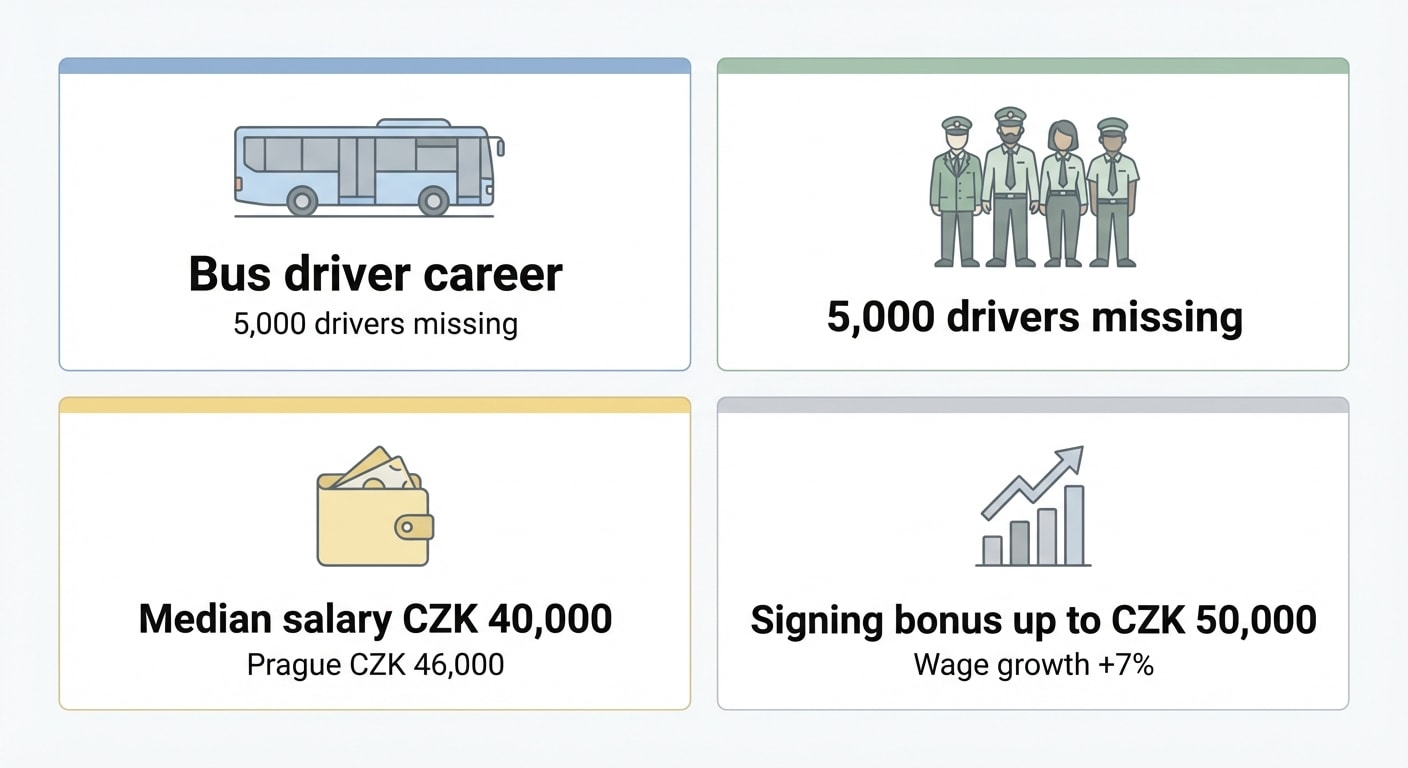
Here's the best part of the whole story. Czechia is currently short approximately 5,000 bus drivers — and that number is growing. The main cause is demographic: ageing drivers are retiring faster than new ones are joining. Ten years ago, the entire professional driver sector was short 6,000 people — today it's 25,000.
For you, this means job security and rising incomes. The median gross salary for a bus driver is around 38,000 to 40,000 CZK. In Prague, the median is 46,000 CZK. Actual earnings are typically 20 to 30 percent higher thanks to night shift, weekend, and overtime premiums. According to some sources, the best-paid drivers can earn up to 100,000 CZK per month.
Where can you work? There's no shortage of options.
Urban public transport — transit companies (DPP Prague, DPMB Brno, DPO Ostrava, and dozens more) are the largest employers. Regular shifts, stability, benefits. DPP Prague offers signing bonuses up to 50,000 CZK.
Regional bus services — Arriva, ČSAD, ICOM Transport, and other regional operators run the backbone network of intercity routes.
Long-distance transport — RegioJet, FlixBus, and Leo Express are constantly looking for drivers for long-distance routes. RegioJet even covers the full training cost for new employees.
Charter transport — travel agencies and contract carriers offer more varied work: tourist trips, sports teams, corporate transport.
School and corporate buses — less demanding shifts, stable routes, ideal for drivers who want to be home every evening.
Step-by-step guide — how to get a bus driving licence
The entire process from decision to your first day behind the wheel looks like this:
- Check the prerequisites — valid category B licence (ideally C too), no driving ban, fewer than 12 points
- Get a medical examination — group 2 certificate, no older than 3 months, cost 500–1,000 CZK
- Enrol at a driving school — deposit usually around 5,000 CZK, remainder paid during the course
- Complete the theory — 38 hours (traffic rules, maintenance, driving theory, first aid)
- Complete the practical training — 20 to 42 hours depending on your previous licence
- Pass the final exam — theory test + oral + practical driving
- Get your professional certificate — initial training (45/140/280 h) + exam → code 95 in your licence
- Complete psychological tests — mandatory before starting employment, about 2,000–3,500 CZK
- Registration in your driving licence — at the municipal authority with extended jurisdiction
The entire process from driving school enrolment to licence registration takes roughly 3 to 5 months — depending on training frequency and exam dates. If you're upgrading from C, it can be as short as 1 to 2 months. A detailed upgrade guide is in the chapter How to extend your driving licence.
Licence validity — shorter than for cars
Driving licences for categories D, D1, D+E, and D1+E are valid for 5 years. That's half the validity of categories A and B, which last 10 years. The reason is simple — for professional categories, the state requires more frequent health verification.
When your licence expires, you exchange the document at the municipal office — the authorisation itself doesn't expire, only the plastic card changes. Exchange upon expiration is free (the 200 CZK administrative fee only applies when changing personal details). But you need a valid medical fitness certificate for the application. A full overview of validity periods and the category system is on the categories overview page.
Don't forget to renew
A category D licence is valid for just 5 years, and the professional certificate is also valid for 5 years — but their expiry dates may not be the same. Track both dates. If your CPC expires, you can't drive commercially even if the licence itself is still valid.
Summary
- Category D permits driving buses for more than 8 passengers — no length or weight restrictions
- Standard age is 24, but with a CPC you can drive from 21 (280 h training) or from 23 (140 h)
- You must hold a valid category B licence, pass a medical examination, and complete psychological tests
- Training lasts 58–80 hours (depending on previous licence) and takes 1–5 months
- A professional driver certificate (code 95) is mandatory — initial training of 45/140/280 h depending on your situation
- The route through category C is significantly shorter and cheaper (20 h practice instead of 42)
- Czechia is short 5,000 bus drivers — median salary 40,000 CZK, Prague 46,000 CZK
- Many transit companies cover training and CPC costs for new employees
Key Terms
| Term | Explanation |
|---|---|
| Category D | Buses for more than 8 passengers (no length/weight limit). Trailer only up to 750 kg. From age 24 (or earlier with CPC). |
| Category D1 | Minibuses up to 8 metres, 9–17 persons including the driver. From age 21. |
| Category D+E | Bus + trailer over 750 kg. Automatically includes D1+E and B+E. |
| Category D1+E | Minibus + trailer over 750 kg. Total weight per type approval. |
| Professional Driver Certificate (CPC) | Code 95 in the licence. Mandatory for commercial bus drivers. Initial training 45/140/280 h, valid 5 years. |
| Psychological tests | Traffic-psychological examination — reaction time, concentration, stress resilience. Mandatory for category D. |
| Initial training (140 h) | Standard scope of professional training. For category D from age 23. Cost approx. 27,000 CZK. |
| Initial training (280 h) | Extended scope — permits category D from age 21. Cost 40,000–55,000 CZK. |
| Periodic training | 7 hours per year (35 h over 5 years). Maintains professional competence. Cost 1,500–2,500 CZK/year. |
| Equivalence | Category D includes D1 and AM. Category D+E includes D1+E and B+E. D+E + C = automatically CE too. |