
Appealing Penalty Points — How to Defend Yourself
How to file objections against point records, appeal deadlines, and court options. When it's worth fighting, the process, and what it costs.
A police officer clocks you doing twenty over on the highway, writes up the fine, you sign — and a week later a letter arrives from the authority saying you've hit 12 points. A year without a license, over CZK 16,000 to get it back, no more commuting to work. But what if the radar wasn't calibrated? What if the fine slip has the wrong date? What if someone else was driving?
Most drivers have no idea they can fight penalty points. And those who do don't know how. Yet Czech law offers several levels of defense — from simply refusing the on-the-spot fine all the way to filing a lawsuit in administrative court. In this chapter, we'll walk through each one, step by step, with specific deadlines and practical advice.
Quick summary:
- Objections against point records can be filed anytime at your municipal authority — and if you have 12 points, filing within 5 business days lets you keep driving
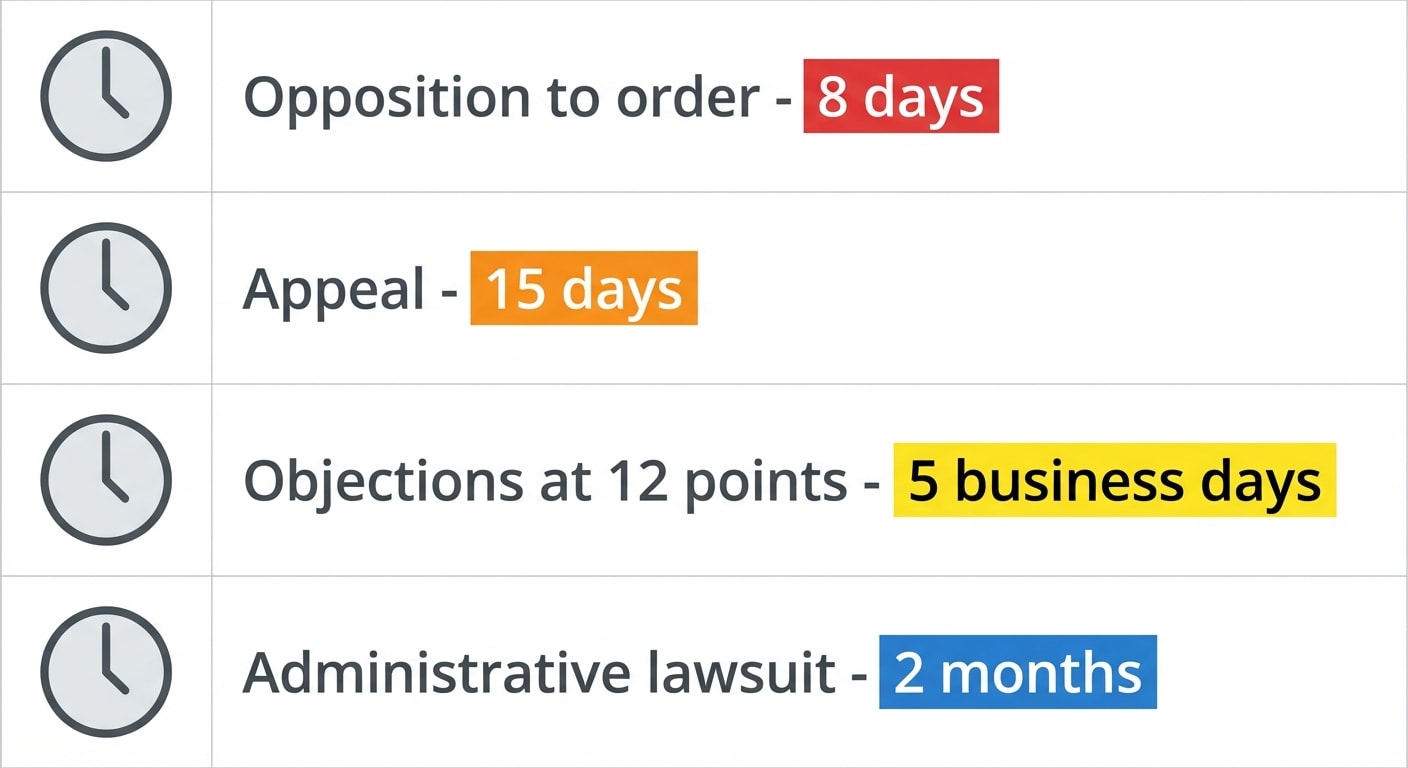
- Opposition to an order has an 8-day deadline, appeal 15 days, court action 2 months
- Fighting makes sense mainly when there are formal errors in the fine slip, incorrect point counts, or driver mix-ups
- A signed on-the-spot fine order is final — it cannot be appealed, only reviewed through extraordinary proceedings
Five Levels of Defense — From Simplest to Court
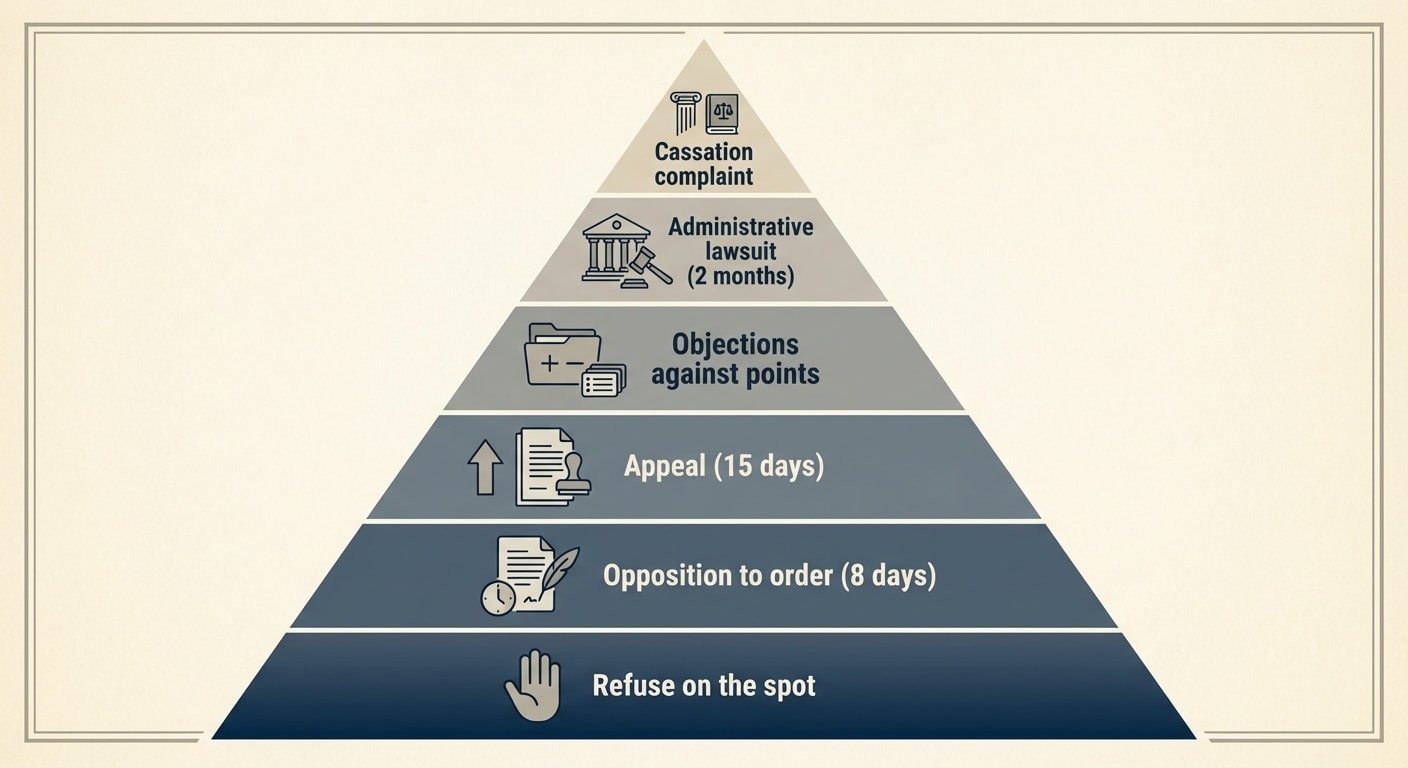
Defending against penalty points isn't a single step. It's a pyramid — you start with the simplest solution and only move up when the previous one doesn't work. Most drivers never need more than the first two levels.
First level: refuse on the spot. A police officer stops you and offers an on-the-spot fine (called a "block fine" in Czech). If you're not sure you committed the offense — or you have doubts about the measurement — don't sign. The moment you sign the order, you agree to everything on it. The decision becomes final and cannot be appealed. The matter then goes to administrative proceedings where you have much more room to defend yourself. Refusing costs you nothing.
Signature = consent = final
A signed on-the-spot fine order is legally final. It cannot be appealed. The only theoretical option is extraordinary review under Section 101 of the Misdemeanor Act, but you have no legal right to demand it. If you're unsure, DON'T SIGN.
Second level: opposition to an order. If the authority sends you a written order (outside on-the-spot proceedings), you have 8 days from delivery to file an opposition. A simple letter stating you disagree with the order is enough. The opposition annuls the order and the matter continues in standard administrative proceedings. The prohibition of reformatio in peius applies — the subsequent penalty cannot be harsher.
Third level: appeal against a decision. If administrative proceedings end with a decision you disagree with, you have 15 days from delivery to appeal to the superior authority (typically the regional authority). An important detail — an appeal in misdemeanor proceedings always has suspensory effect. This means neither the fine nor any driving ban takes effect until the appellate authority decides. The appellate authority reviews the challenged decision in full scope — legality and correctness — regardless of what you specifically argue (Section 90(1) of the Misdemeanor Act).
Fourth level: objections against point records. This is a special tool under Section 123f of Act No. 361/2000. It's not aimed at the fine itself but directly at the point record in the driver registry. You file objections in writing at your municipal authority (ORP). You can file them at any time — you don't need to wait until you reach 12 points. But it's at 12 points that objections are most valuable, because they buy you extra time.
Fifth level: administrative court. If all administrative remedies fail, you can file a lawsuit at the regional administrative court. The deadline is 2 months from delivery of the final appellate decision. The court fee is CZK 3,000. And if the regional court rules against you, there's still a cassation complaint to the Supreme Administrative Court.
Objections Against Points — Your Strongest Tool
Among all defense levels, objections under Section 123f deserve the most attention. First, because you can file them at any time — no need to wait for a decision or delivery of an order. And second, because upon reaching 12 points, filing objections suspends the deadline for surrendering your license.
Normally, after receiving notice of reaching 12 points, you must surrender your license within 5 business days. But if you file objections within that window, the entire process is suspended. You can keep driving until the authority decides. And that can take weeks, sometimes months.
What the Authority Reviews
So what exactly can objections do and what can't they? The authority in objection proceedings examines exclusively the formal correctness of the record. Specifically, it assesses three things: whether the underlying decision (fine slip or misdemeanor decision) became legally final, whether the record relates to the correct driver, and whether the number of recorded points matches the table prescribed by law.
What the authority does NOT review? The factual circumstances of the offense. Not whether you were actually speeding, but whether the fine slip was correctly filled out. That's why the key is to look for formal defects — not to argue about whether the radar was accurate. That's a matter for misdemeanor proceedings, not for objection proceedings.
Check how many points each offense carries — the complete overview is in the offense and points table. If more points were recorded than the legal table prescribes, that's a clear ground for objections.
Filing Process — Step by Step
The entire process works like this. You receive notice from the authority that you've reached 12 points. You have 5 business days to file objections. Objections are filed in writing — by registered mail, data box, or in person at the filing office with a receipt of delivery.
The objections must include your name, surname, date of birth, and permanent residence. Then the authority's name, the reference number (or file number from the notice), a description of your objections — which specific point records you're challenging — the request for correction, date, and signature.
Filing objections suspends the deadline for surrendering your license. From this moment, you can legally drive until the authority decides.
Meanwhile, request access to the file. Obtain copies of all underlying decisions — fine slips, misdemeanor decisions. Read them carefully and look for formal errors: wrong date, missing signature, incorrect offense identification, wrong name. Even a seemingly minor formal defect can lead to the record being annulled.
After reviewing the documents, file a supplement to your objections with specific challenges to the defects you found.
The authority decides in one of two ways. Either it finds the objections justified — and corrects the record within 10 business days. Or it rejects the objections by decision. You can appeal the rejection to the regional authority within 15 days. And if the regional authority also rejects it, an administrative lawsuit at the regional court remains, within 2 months (court fee CZK 3,000).
Access the file
Request access to the file immediately after filing objections. Copy all fine slips and misdemeanor decisions. Formal errors in these documents are your strongest weapon — and the authority is obligated to grant you access.
When Fighting Makes Sense
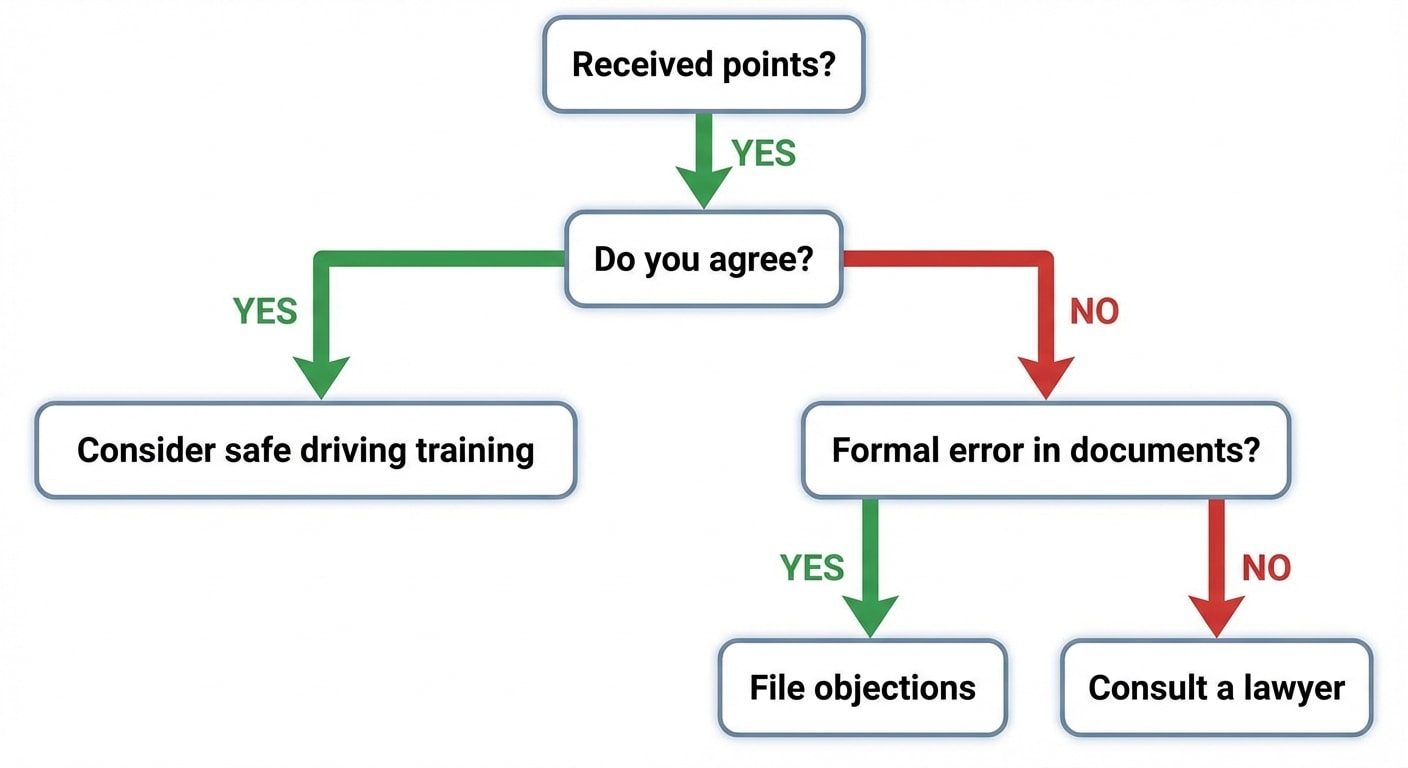
Defense isn't always the right answer. If you demonstrably committed the offense, the fine slip is in order, and the points match the table, fighting won't help — you'll just prolong the process and add stress. But there are many situations where defense is worthwhile.
Formal errors in the fine slip are the most common reason for successful objections. Wrong date, incorrect name, wrong offense identification, missing police officer's signature. Each such error means the underlying decision may be defective — and a defective decision cannot serve as the basis for a point record.
Incorrect number of points happens more often than you'd think. Since January 2024, new point values apply (2, 4, 6 points instead of the original 1–7) and the transition period has caused numerous mix-ups. If more points were recorded for an offense than the current offense table prescribes, you have clear grounds for objections.
Record assigned to the wrong driver can happen with family cars, company vehicles, or name mix-ups. If points were assigned to you but someone else was behind the wheel, objections are clearly warranted.
Underlying decision never became final. An order that wasn't properly delivered isn't final — and a non-final decision cannot serve as the basis for a point record.
Procedural errors by the authority — missed deadlines, missing information about available remedies, incorrect legal provisions cited in the decision.
Real-world example
A driver received a fine on the highway for exceeding the speed limit by 25 km/h. The fine slip listed an incorrect vehicle registration number. He filed objections — and the authority annulled the point record because the underlying decision contained a formal defect and it was impossible to definitively prove which vehicle the offense involved.
When Fighting Doesn't Make Sense
Be honest with yourself. If you clearly committed the offense — doing thirty over, running a red light, holding your phone — and the fine slip is correctly filled out, fighting almost certainly won't help. A signed on-the-spot fine in block proceedings is a final decision. Your signature means consent.
The Supreme Administrative Court has also ruled that "blanket, standardized objections used as a template in all cases" may be assessed as inherently non-credible (extended panel decision 6 As 114/2014-55). Objections must be specific — you need to state which record you're challenging and why.
Instead of a futile fight, there are other ways to improve your situation. Safe driving training deducts 4 points in one day and costs CZK 4,000 to 6,890. Automatic deduction removes another 4 points after 12 months without an offense. And while objection proceedings are ongoing, you can use both of these paths — time works in your favor.
What Defense Costs
Filing objections is free — there's no administrative fee. Appeals are free too. The entire administrative process costs nothing in terms of fees.
But if you decide to go to court or hire a lawyer, costs go up. An administrative lawsuit at the regional court costs CZK 3,000 in court fees. Legal representation for a traffic offense starts at CZK 10,000 and up — depending on the complexity of the case.
When is the investment in a lawyer worth it? Primarily when you're facing license suspension and you need your license for work. A year without a license plus the costs of reinstatement after reaching 12 points (re-examination, doctor, psychologist — roughly CZK 16,000 total) plus lost income — that can easily exceed legal costs. There are also specialized firms focusing on traffic offenses who know the case law and typical formal defects.
| Action | Cost | Note |
|---|---|---|
| Objections against points | Free | Written filing at municipal authority (ORP) |
| Appeal | Free | To superior authority (regional authority) |
| Administrative lawsuit | CZK 3,000 | Court fee at regional court |
| Cassation complaint | CZK 5,000 | To the Supreme Administrative Court |
| Lawyer (traffic offense) | from CZK 10,000 | Depends on case complexity |
Strategic Tips From Practice
Objection proceedings aren't just a legal battle — they're also a matter of strategy. Here are a few things worth considering.
Time is your ally. Objection proceedings can take weeks to months. Throughout the entire period, you can legally drive. And while the proceedings drag on, the clock is ticking — every 12 months without a point-carrying offense, 4 points are automatically deducted. If you're lucky and the proceedings stretch out, you may drop below 12 points before the authority even decides.
Combine with point deduction. Even with pending objections, nothing prevents you from completing safe driving training and getting another 4 points deducted — as long as you meet the conditions (max 10 points, no 6-point offenses). It's another way to reduce your balance while proceedings are underway.
Hunt for formal defects systematically. Read every fine slip word for word. Check the date, signatures, license number, registration plate, the exact wording of the offense. Even a small discrepancy — like a wrong letter in the license plate — can be sufficient grounds to challenge the entire record.
Check your balance first. Before filing anything, log in to the Transport Portal and check your exact point balance. You'll see which specific offenses generated your points and can focus on the ones where you see the clearest errors.
Watch out for template objections
The Supreme Administrative Court has repeatedly ruled that blanket objections 'copied from a template' with no specific relationship to your case can be rejected as non-credible from the outset. Objections must be specific — describe which record you're challenging and why.
Where to Get Help
If you decide to fight, you don't have to do it alone. Here's an overview of where to turn.
Your municipal authority (ORP) based on your permanent residence is the office that maintains your point registry and decides on objections. That's where you file objections and where you can access your file.
The Transport Portal and Driver Portal let you check your point balance online — free and in seconds. That's the first step before taking any other action.
Law firms specializing in traffic offenses know the case law, typical formal defects, and have experience with specific authorities. An investment starting at CZK 10,000 pays off especially when license suspension is threatened.
The Public Defender of Rights (Ombudsman) is there for cases where the authority misses deadlines, doesn't respond to objections, or acts unlawfully. The ombudsman can't overturn decisions but can pressure the authority to act.
Summary
- Don't sign the on-the-spot fine if you're unsure — your signature means consent and the decision is final
- Objections against points are filed at your municipal authority (ORP) at any time, at 12 points within 5 business days
- Filing objections suspends the deadline for surrendering your license — you can keep driving
- The authority examines formal correctness of the record, not the factual circumstances of the offense
- Key deadlines: opposition 8 days, appeal 15 days, administrative lawsuit 2 months
- Objections and appeals are free, court fee for a lawsuit is CZK 3,000
Key Terms
| Term | Explanation |
|---|---|
| Objections against point records | Written challenge of point records in the driver registry under Section 123f of Act No. 361/2000 — filed at the municipal authority (ORP) |
| On-the-spot fine order (block fine) | Decision on an offense at the scene — becomes final upon signature and cannot be appealed |
| Opposition to an order | Remedy against a written order — 8-day deadline, annuls the order and the matter continues in administrative proceedings (Section 150(3) of the Administrative Procedure Code) |
| Appeal | Standard remedy against an administrative decision — 15-day deadline from delivery (Section 81 of the Administrative Procedure Code) |
| Suspensory effect | An appeal in misdemeanor proceedings suspends enforceability — neither fine nor driving ban takes effect until the appellate authority decides |
| Administrative lawsuit | Lawsuit at the regional administrative court — 2-month deadline from delivery of the final decision, court fee CZK 3,000 |
| Reformatio in peius (prohibition) | Ban on making things worse — upon opposition or appeal, a harsher penalty than the original cannot be imposed |
| Municipal authority (ORP) | Municipal authority of a municipality with extended powers — records points and decides on objections |
| Section 123f of Act No. 361/2000 | Section governing the driver's right to file objections against point records in the driver registry |
| Extraordinary review | Extraordinary remedy under Section 101 of the Misdemeanor Act — the only (theoretical) option for a signed on-the-spot fine, but there is no legal right to demand review |