
From L17 to Full License — What Happens at 18
What changes on your 18th birthday, probationary license rules, traffic psychology interview, and mandatory training for new drivers.
You've spent a whole year driving with a mentor beside you. You've racked up kilometers, learned to judge distances, gotten used to night driving and highway rain. And now the day half of all L17 drivers dread — and the other half can't wait for — is approaching. Your 18th birthday. What happens? Do you have to visit the authorities? Take another exam? Get a new license?
No, no, and no. The transition from L17 to a full driving license is the simplest administrative process you'll ever encounter — because there isn't one. The law (Section 83a of Act No. 361/2000 Coll.) handles everything automatically. But watch out: even though the mentor disappears, the law still keeps an eye on you. The probationary license period keeps running — and one bad day behind the wheel can cost you over CZK 12,000 and dozens of hours of your time.
Quick summary:
- On your 18th birthday, mentor records are automatically deleted — no office visit, no changes needed
- Your driving license stays valid for 10 years from the date of issue, no replacement required
- The probationary period runs for 2 years from the date you passed your exam at 17 — not from your 18th birthday
- A single 6-point offense during the probationary period = mandatory training costing roughly CZK 12,400
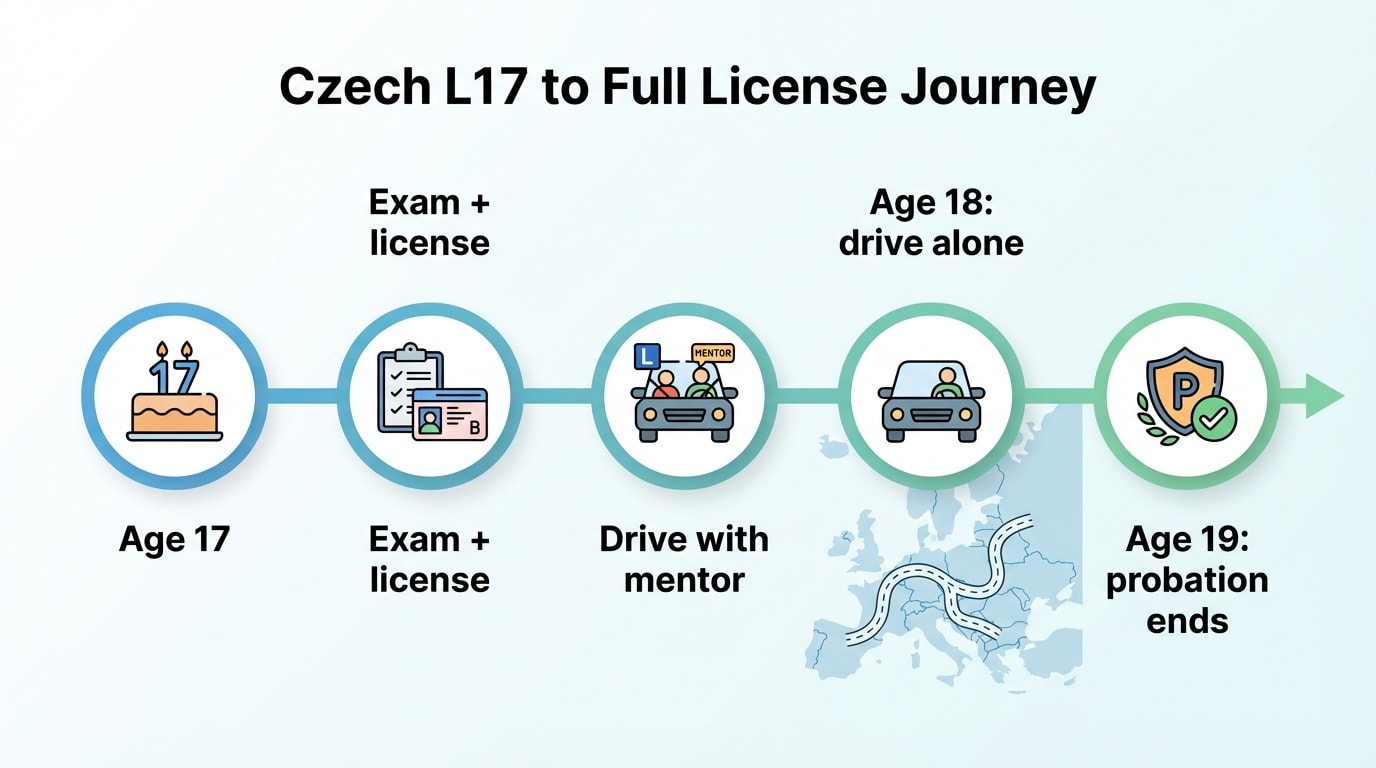
D-Day: what happens on your 18th birthday
Picture this. You wake up, you're 18. Cake on the table, phone buzzing with wishes. And quietly, automatically, one thing happens in the driver registry: your mentor records get deleted. The municipal authority doesn't need to approve anything, and you don't need to file anything. The system does it on its own.
From that moment on, you're a full-fledged holder of a category B driving license. You can drive alone, without anyone in the passenger seat. You can go anywhere — even abroad. Your license, the same plastic card you received at 17, remains valid. You don't need to replace it, apply for a new one, or visit any office. The license is valid for 10 years from the date of issue — and that date counts from when it was first issued, not from your 18th birthday.
It sounds unbelievably simple, and it really is that simple. Act No. 271/2023 Coll. was designed so that turning 18 wouldn't require a single trip to the authorities. The goal was clear: don't pile unnecessary bureaucracy onto a program meant to motivate young drivers, not discourage them.
No paperwork, no exams
On your 18th birthday, you don't have to: visit any office, replace your driving license, take another exam, file an application, or pay any fee. Mentor records in the driver registry are automatically deleted (Section 83a, Act No. 361/2000 Coll.).
What stays and what goes
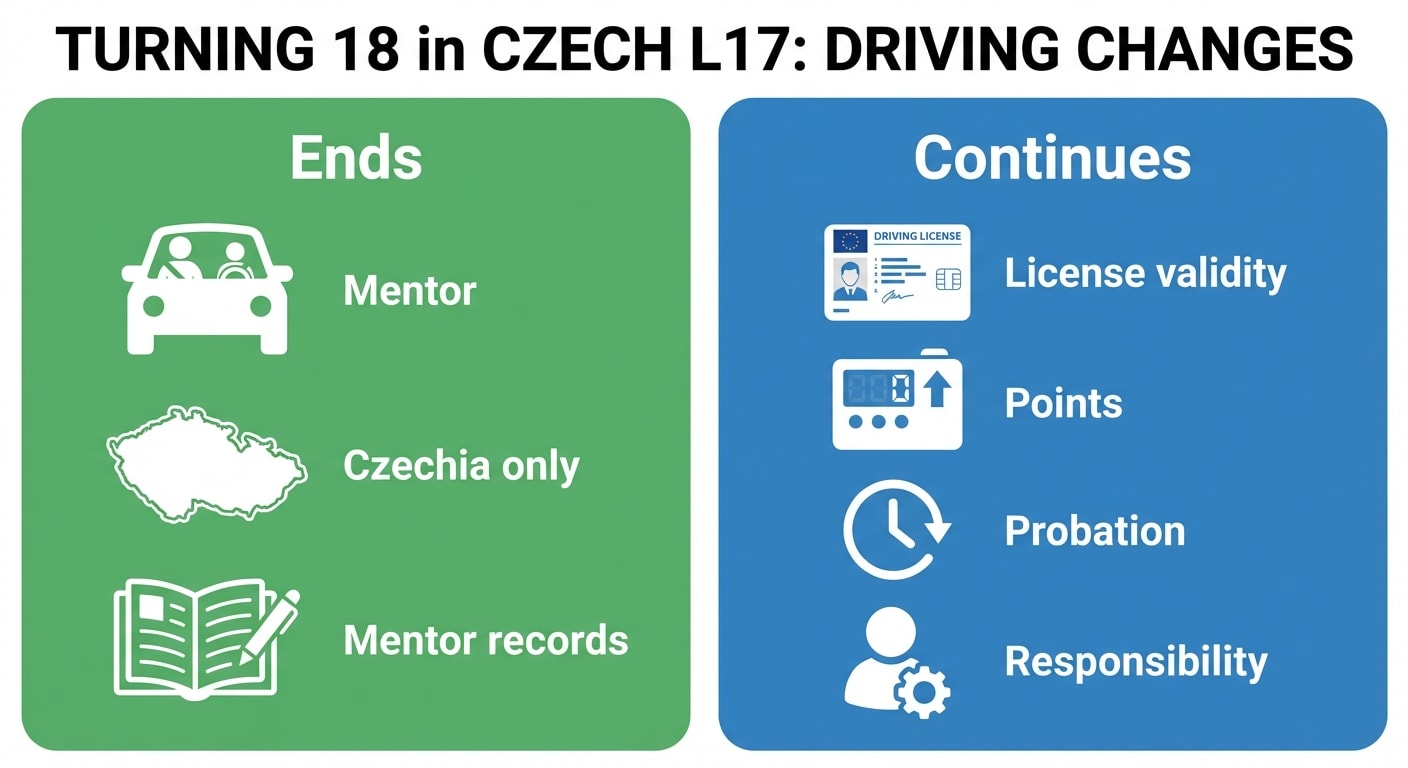
To make it concrete: on one side are the things that disappear on your 18th birthday. On the other side is everything that continues unchanged.
Gone is the requirement to have a mentor beside you — from now on, you drive alone. Gone is the restriction limiting you to Czech territory — you can finally drive to Germany, Austria, or anywhere else. Gone are the mentor records in the driver registry — the system deletes them automatically and your mentors cease to bear any responsibility for your driving.
Continuing is everything else. Your driving license remains valid — 10 years from the date of issue. Your penalty point record continues unchanged. If you committed an offense and received points before turning 18, those points stay. And most importantly: the probationary period continues, which we'll discuss in more detail now. Because that's the part of the transition people often overlook.
Probationary license — the invisible guardian
This one surprises a lot of people. The probationary license has nothing to do with L17 specifically — it applies to all new drivers who obtained their driving license after January 1, 2024. Whether you're 17 or 30, whether you drove with a mentor or without one. Every first-time driver gets a two-year probationary period.
What does this mean in practice? The law (Section 102f of Act No. 361/2000 Coll.) sets a straightforward condition: if you accumulate 6 penalty points within two years of receiving your driving license, you must complete two mandatory requirements — a traffic psychology interview and a training course for new drivers at a driving school. And here's the critical detail that many people get wrong with L17 drivers: the two-year period is counted from the date you passed your exam — meaning from age 17, not 18.
For L17 drivers, this means something important. If you passed your exam at 17, your probationary period ends at 19. Not at 20. One year of those two runs while you're still in the mentor-accompanied driving regime — and that's a huge advantage. The mentor beside you acts as a safety net against risky behavior. They'll point out when you're going too fast. They'll tell you to yield. They'll temper the courage that sometimes outpaces experience at 17. That year of supervised driving helps you get through the first half of your probationary period without accumulating points.
Compare that with a driver who waited until 18. They sit behind the wheel for the first time completely alone — and have to manage both years of probation without a mentor. Data from the first year of the L17 program show the difference clearly. L17 drivers in 2024 committed just 71 point-carrying offenses — only 8.4% of all offenses by new drivers. And accident rates? Drivers who started at 17 with a mentor caused just 6 accidents in the entire year. Novices without a mentor caused over 1,100. You can find a detailed comparison of both approaches in the chapter L17 vs. Waiting Until 18.
Watch out for penalty points
A single 6-point offense — like exceeding the speed limit by 40+ km/h in a built-up area — triggers the mandatory psychology interview and training. If you don't complete them within 3 months, you lose your license. The point system since 2024 has just three categories: 2 points, 4 points, and 6 points.
What happens if you reach 6 points
Let's say things don't go well. You run an amber light once, get caught going 25 km/h over the limit another time — and suddenly you have 6 points. What now?
The authority sends you a notice. You have 3 months to complete two requirements. The first is a traffic psychology interview — a four-hour session with an accredited traffic psychologist. Thirty minutes are an individual conversation where the psychologist explores why you committed the offense and what your relationship with risk behind the wheel looks like. The remaining 210 minutes take place in a group setting, covering the psychology of driving, the dangers of speed, fatigue, phone distraction, and the influence of alcohol and other substances. Cost? Approximately CZK 2,500.
The second requirement is training for new drivers at a driving school. This includes roughly 5 hours — one hour of theory, three hours of practical driving, and one hour evaluating your behavior behind the wheel. The evaluation drive is essentially an assessment of your driving habits: a driving instructor observes how you drive in real traffic and evaluates your decision-making, situational awareness, and driving style. The training costs around CZK 9,900 (including VAT, prices may vary by school).
In total, one bad day behind the wheel can cost you roughly CZK 12,400 — and that doesn't include the fine for the offense itself. If you fail to submit proof of completion within 3 months of receiving the notice, you lose your driving license. That means surrendering your license and starting the entire process over again.
Driving abroad — finally without restrictions
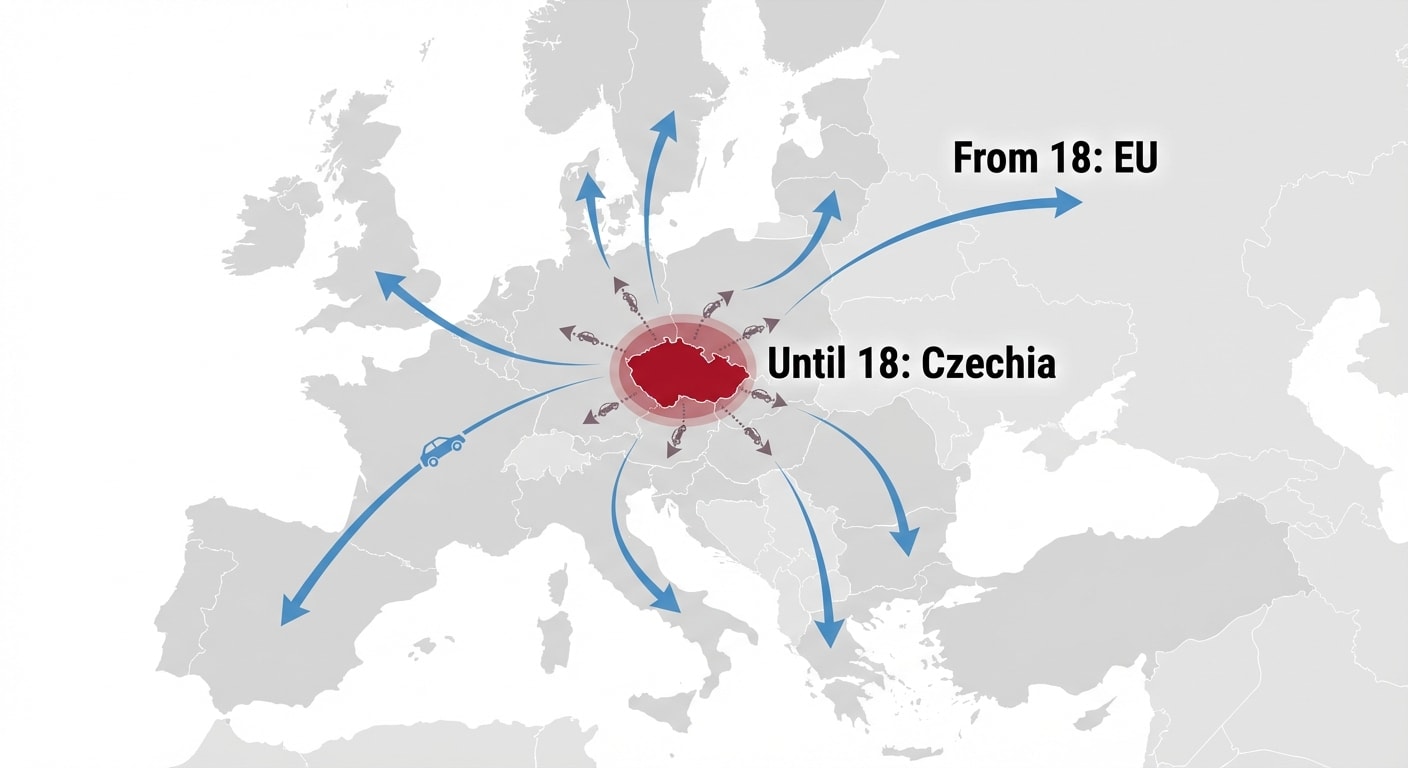
Until you turn 18, you're only allowed to drive within the Czech Republic. It's one of the L17 program's restrictions, and it has a logical reason: foreign countries may not recognize a driving license issued to someone under 18. A Czech L17 license is a valid Czech driving license, but abroad it could run into legal uncertainty.
On your 18th birthday, this restriction drops. Your license is a standard category B license valid across the entire EU and in all countries that recognize Czech driving licenses. You don't need to apply for an international driving permit (that's only needed outside Europe and certain other countries). You can get in a car and drive to Dresden, Vienna, or anywhere else.
But one piece of advice: if you've spent the entire year driving only on Czech roads, be careful on your first trip abroad. Rules differ from country to country. Germany has different highway speed limits. Austria requires a highway vignette. Some countries mandate a reflective vest for every passenger. Prepare in advance — and most importantly, verify that the car you're driving has valid insurance for international travel (liability insurance typically covers EU driving automatically, but it never hurts to double-check).
Insurance after turning 18
Turning 18 doesn't change anything about your insurance — if you've been driving your parents' car, the coverage continues as before. Your parent is the vehicle operator, and liability insurance covers you as an authorized driver. You don't need to change anything.
The change comes when you want to get your own car. And here you'll hit reality: insurance premiums for drivers under 25 are significantly higher than for experienced fifty-somethings. Kooperativa's statistics show that 9 out of 100 young drivers have an insurance claim per year — three times more than drivers aged 52–62. Insurers approach this logically and adjust prices accordingly. A complete overview of what to discuss with your insurer, how much liability insurance costs, and how to start building your own no-claims bonus can be found in the chapter L17 Insurance.
Five things to do after your 18th birthday
The transition is automatic, but that doesn't mean there's nothing to take care of. Here are five steps to help you start driving independently without unnecessary trouble.
First: check your insurance. If you'll be driving your own car, you need liability insurance. If you're still using your parents' car, nothing needs to change — but let your parents know. Also consider comprehensive insurance, especially if the car is newer.
Second: stay careful during the probationary period. You've got a year of driving with a mentor behind you, which is great. But probation isn't over yet — and one major offense can cost you CZK 12,400 in mandatory training plus the loss of your license if you don't complete the requirements on time.
Third: plan your first trip abroad carefully. International traffic is different — different rules, different signs, different customs. Don't overestimate your experience from Czech roads.
Fourth: don't overestimate yourself. Statistics show that ages 18–24 are the highest-risk period for drivers. L17 graduates are better off thanks to a year of practice with a mentor, but confidence grows faster than actual skill. Stay cautious.
Fifth: learn the penalty point system. Since 2024, it has just three categories: 2, 4, and 6 points. Exceeding the speed limit by 40+ km/h in a built-up area is an instant 6 points — and that triggers the probationary regime consequences. A complete overview of the point system and everything you need to know about driving after getting your license can be found in the guide After Getting Your License.
L17 advantage: one year of probation already behind you
Unlike drivers who started at 18, you've already completed a full year of driving with a mentor — and with it, a full year of the probationary period. At 18, you only have one year of probation left. A driver without L17 has both years still ahead of them at 18.
Summary
- The transition from L17 to a full license is automatic — on your 18th birthday, mentor records are deleted, no office visit required
- Your driving license stays valid for 10 years from the date of issue, no replacement needed
- The probationary period runs from the date you passed your exam at 17, not from your 18th birthday — it ends at 19
- At 6 points during probation: mandatory psychology interview (4 h, ~CZK 2,500) + driving school training (~5 h, ~CZK 9,900)
- If you don't complete the requirements within 3 months of the notice, you lose your driving license
- From age 18, you can drive abroad — the Czech-only restriction drops
Key Terms
| Term | Explanation |
|---|---|
| Probationary license | Two-year probationary regime for all first-time drivers since January 1, 2024. At 6 points, mandatory interview and training required (Section 102f, Act No. 361/2000 Coll.). |
| Probationary period | Two-year period from the date your driving license was issued, during which stricter rules apply. For L17 drivers, it runs from 17, not 18. |
| Traffic psychology interview | Four-hour session with an accredited traffic psychologist — 30 minutes individual, 210 minutes in a group. Cost approximately CZK 2,500. |
| Training for new drivers | Roughly 5-hour course at a driving school — theory, practical driving, and behavioral evaluation. Cost approximately CZK 9,900. |
| Evaluation drive | Part of the new driver training — a driving instructor assesses your real-world driving behavior in normal traffic conditions. |
| Penalty point system (since 2024) | Three categories: 2 points (less serious), 4 points (more serious), 6 points (most serious). Reaching 12 points = license revocation. |
| Driver registry | Central records maintained by municipal authorities, where mentors are registered. Records are automatically deleted when the driver turns 18. |