
Probationary License — Rules for New Drivers
New driver + one 6-point offense = mandatory training costing CZK 8,500–15,000. Two-year probation, deadlines, and how to stay out of trouble.
One red light run. One drive with your phone in hand while going twenty over in town. One evening where you thought "I'll be fine" and got behind the wheel after a couple of beers. For an experienced driver, that means points on your record and a fine. For you — a driver who's had your license for less than two years — it means mandatory training at a driving school, a session with a traffic psychologist, and a bill for CZK 8,500 to 15,000. They forgot to mention that at driving school.
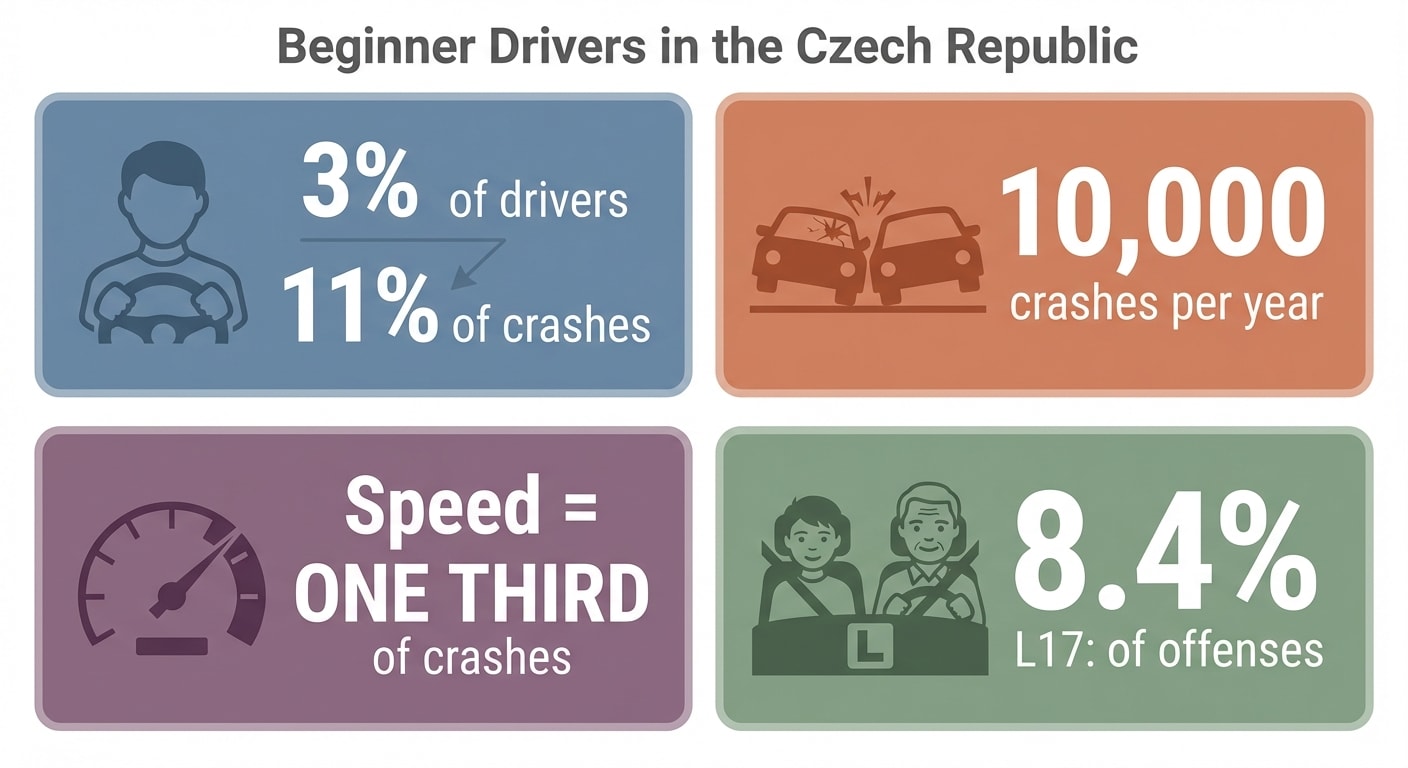
Since January 2024, the Czech Republic has had a probationary driving license system — a probation period lasting two years from the date you receive your first driving permit. During these two years, stricter rules apply to you. Not because the law wants to punish beginners, but because the statistics are clear: drivers with less than two years of experience make up just 3% of all drivers but cause 11% of all traffic accidents. That's around 10,000 crashes per year, 52 fatalities, and 250 serious injuries. The probationary license is an attempt to bring those numbers down — and as the first statistics from 2024 show, it's working.
In this chapter, we'll explain what "probationary license" actually means, what triggers it, how much it will cost you, and how to avoid the whole process.
Quick summary:
- Probationary license lasts 2 years from when you receive your first driving permit — regardless of your age
- One 6-point offense or a driving ban = mandatory driving school training + traffic psychology session
- Total cost of the prevention program: CZK 8,500–15,000 (plus the fine for the offense itself)
- You have 3 months from receiving the official notice to complete it — otherwise you automatically lose your license
What Is a Probationary License and Who Does It Apply To
The name is slightly misleading — you don't get a special license with "probationary" stamped on it. Your driving license looks exactly like any other. The difference is what happens when you commit a serious offense during your first two years behind the wheel.
The probationary license was introduced by Amendment No. 271/2023 Coll., effective from January 1, 2024. It applies to everyone who has held their driving permit for less than two years — regardless of age. Whether you're 17 and riding a motorcycle through the L17 program, or you're 45 and just passed your car test. If your first license is less than two years old, you're a "new driver" and the probationary rules apply.
An important detail: the law has retroactive effect. It applies to all drivers who received their first driving permit from January 2022 onward. If you passed your test in March 2023, you automatically entered the probationary regime in January 2024. However, the sanctions only apply to offenses committed from January 1, 2024 — the new system won't penalize you for anything you did before that date.
And note — the two-year period is paused if you lose your driving permit during the probationary period (forfeiture, suspension, or revocation). After it's returned, the clock picks up where it left off. You can't "wait it out" by simply not driving for a year.
One Offense and the Stress Begins
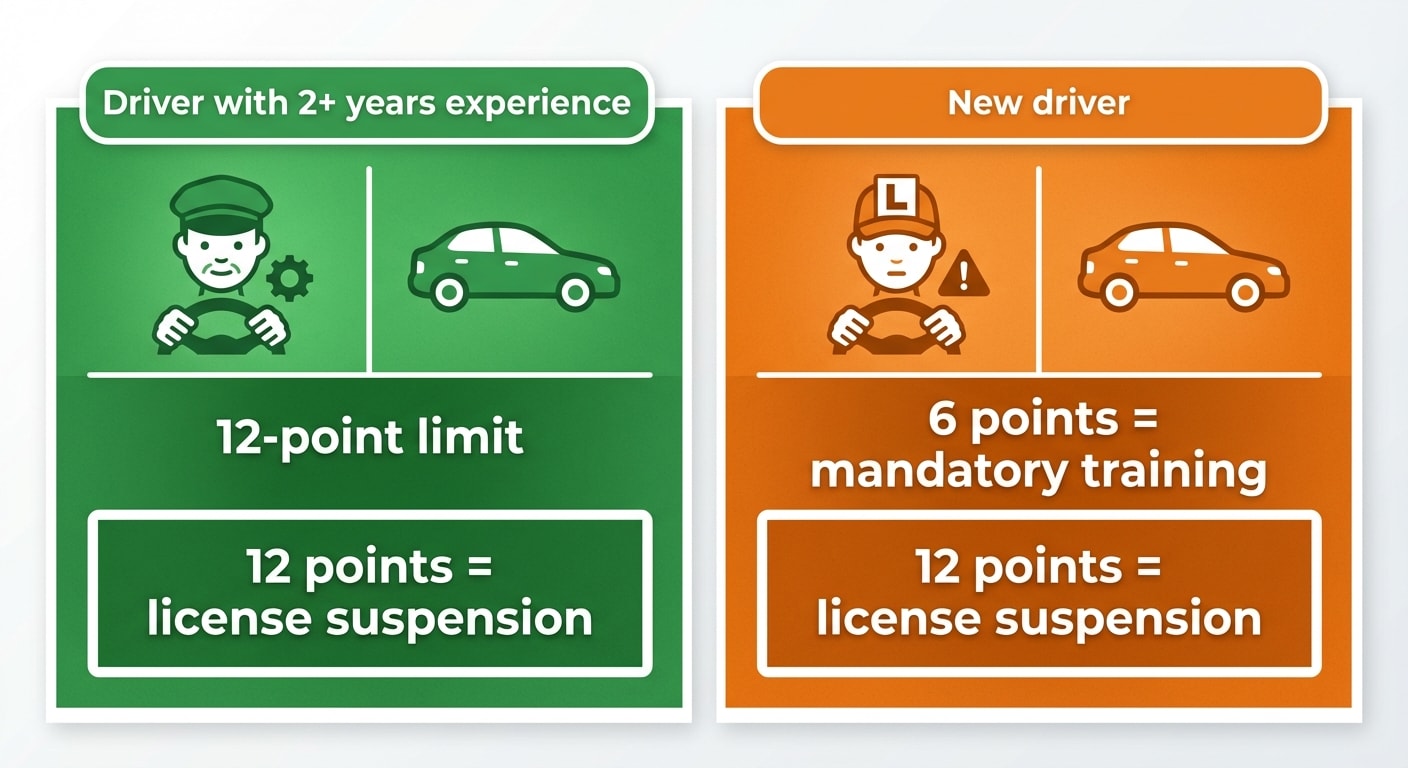
Here's the key difference from regular drivers. While an experienced driver needs to accumulate 12 points to lose their license, all it takes for you is one single 6-point offense to set the whole process in motion. Not license revocation — not yet — but a mandatory prevention program that will cost you thousands of crowns.
Under the new point system since 2024, there are three tiers: 2, 4, and 6 points. Six is for the most serious offenses. Specifically, you get 6 points for:
- driving under the influence of alcohol (above 0.3‰) or drugs
- refusing an alcohol or drug test
- running a red light
- violating an overtaking ban
- exceeding the speed limit by 40+ km/h in town or 50+ km/h outside town
- entering a railway crossing against a prohibition
- making a U-turn, reversing, or driving the wrong way on a motorway
- causing an accident resulting in bodily harm
You'll find the full list in the offense and points table. But note — the mandatory prevention program is also triggered when you receive a driving ban for any offense (regardless of the number of points).
For new drivers, 6 points ≠ license revocation
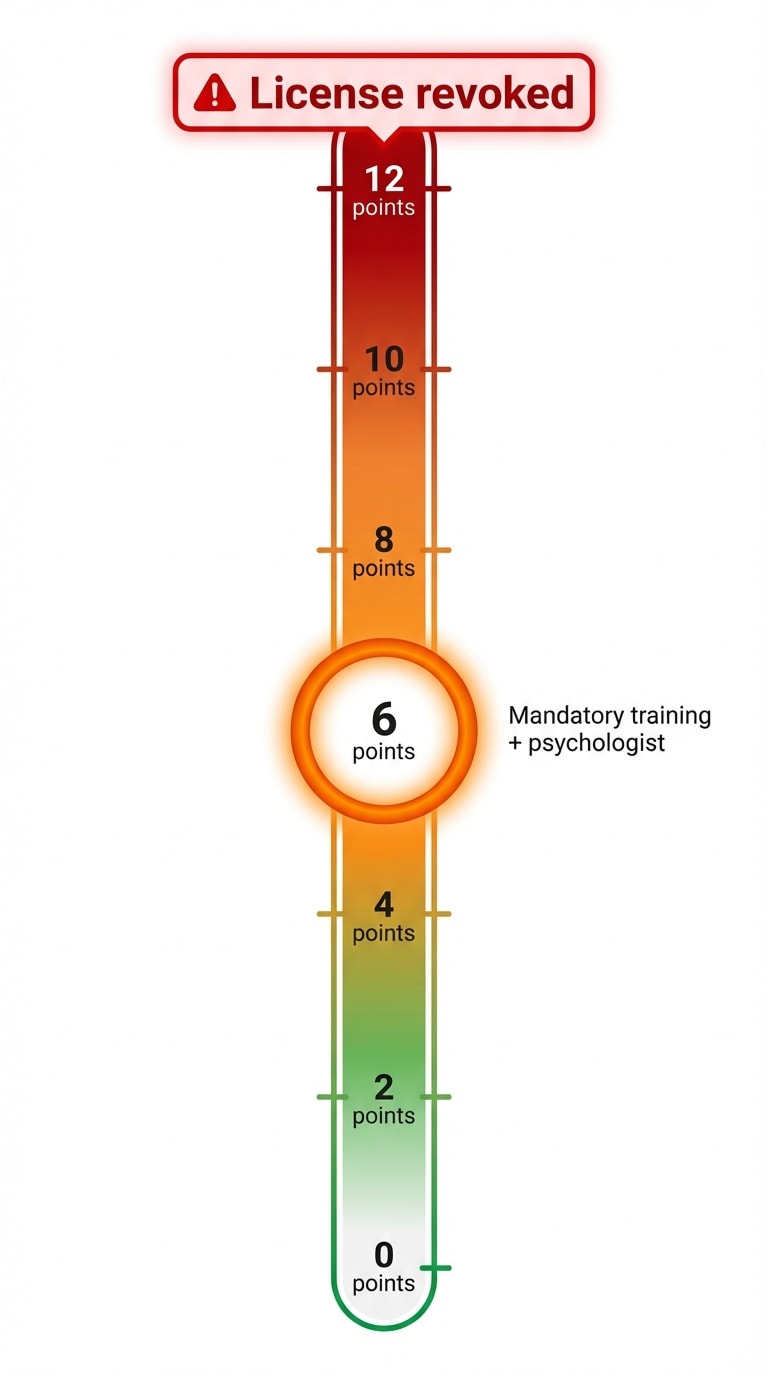
Many people think that 6 points for a new driver means game over — license revoked, a year on foot. That's not true. Six points trigger a mandatory prevention program (training + psychologist). License revocation only happens at 12 points — meaning two 6-point offenses. However, failing to complete the prevention program within 3 months leads to loss of your permit anyway.
What Happens After a Six-Point Offense
So it happened — you get fined for an offense that carries 6 points. What now? The points are recorded in the driver register. The municipal authority of the municipality with extended powers (ORP) where you're permanently registered discovers you're in your probation period and sends you an official notice to complete the prevention program (Section 102f of Act No. 361/2000 Coll.).
From the delivery of the notice, your 3-month deadline starts ticking. During these three months, you must complete both mandatory parts and submit proof of both to the authority. The deadline is fixed — it cannot be extended, and there are no exceptions. Either you make it, or you lose your license.
The whole process looks like this:
- You commit a 6-point offense (or one that results in a driving ban)
- Police forward the case to the authority, which records the points in the register
- The authority sends you a notice to complete the prevention program
- You have 3 months to complete both parts of the program
- You submit proof of both the training and the psychological session to the authority
- If you comply — you keep driving (points remain, probation period continues)
- If you don't comply — you automatically lose your driving permit
Beginner Driver Training — 5 Hours at a Driving School
The first part of the prevention program takes place at a driving school. Not necessarily the one where you learned to drive — you can choose any driving school authorized to conduct beginner driver training.
The training lasts 5 hours and consists of three blocks. The first hour is theoretical — the driving instructor explains the principles of defensive (safe) driving. Not a boring textbook lecture, but practical principles: how to anticipate other drivers' behavior, how to react to unexpected situations, why maintaining a safe following distance matters.
Then comes the core of the training — 3 hours of practical driving in real traffic. You sit behind the wheel with an instructor beside you and drive. The focus is on recognizing risky situations and eliminating them. The instructor continuously points out where you're making mistakes — where you're not seeing danger, where you could react sooner, where you're driving unnecessarily aggressively.
The final hour is an evaluation drive — an assessment of your driving skills. The instructor tells you what to work on and where to improve. At the end, you receive a "Certificate of Completion of Beginner Driver Training," which you submit to the authority.
The cost ranges from CZK 6,000 to 9,900 depending on the driving school and region. It tends to be more expensive in Prague and large cities, cheaper in smaller towns.
Beginner driver training ≠ safe driving training
Don't confuse these! Beginner driver training (5 hours at a driving school, mandatory for new drivers after 6 points) is a completely different thing from safe driving training at a driving center (for deducting 4 points). One does not replace the other. More about point deduction in the chapter How to Remove Points.
Traffic Psychology Session — 4 Hours with a Psychologist
The second mandatory part takes place with an accredited traffic psychologist. There are approximately 200 of them in the Czech Republic — you can find their list on the Ministry of Transport website. The session can be individual or group-based.
It lasts 4 hours in total and is split into two parts. The first two hours focus on analyzing the most common causes of traffic accidents and how to prevent them. The psychologist explains why beginner drivers crash so often, what psychological mechanisms are behind it (overestimating abilities, illusion of control, emotional influence), and what you can do about it.
The second two hours are more personal. You discuss your specific offense — what happened, why it happened, how to prevent it next time. The psychologist goes through emergency situations behind the wheel with you and strategies for handling them safely.
The cost ranges from CZK 2,500 to 5,000 depending on the psychologist and format (group sessions tend to be cheaper).
How Much Will It All Cost
When you add up all the costs, the numbers are unpleasant. And this doesn't even include the fine for the offense itself, which can be several thousand crowns more.
| Item | Cost | Note |
|---|---|---|
| Beginner driver training | CZK 6,000–9,900 | 5 hours at a driving school (theory + practice) |
| Traffic psychology session | CZK 2,500–5,000 | 4 hours with an accredited psychologist |
| Prevention program total | CZK 8,500–15,000 | Not including the offense fine |
| Offense fine (example) | CZK 2,500–25,000 | Depends on the type and severity |
| Realistic total bill | CZK 11,000–40,000 | Program + fine |
Add to that the lost time — at least 9 hours at the driving school and psychologist, plus travel and paperwork. And the stress of the whole ordeal. All because you drove a bit too fast in town or used your phone while driving.
What Happens If You Don't Make the Deadline
Three months sounds like plenty of time. But in practice, it may not be that simple. You need to find a driving school that offers beginner driver training — not every one does. You need to find an accredited traffic psychologist — there aren't many in smaller towns. You need to coordinate schedules. And you need to submit both certificates to the authority in time.
If you fail to submit the certificates within 3 months, you automatically lose your driving permit (Section 102g of Act No. 361/2000 Coll.). It's not a decision made by the authority — it's an automatic consequence of the deadline expiring. On the last day of the deadline, you're required to surrender your driving license at the municipal authority (ORP).
And the way back? It's not simple:
- You must complete the entire prevention program (training + psychological session) — the one you missed
- You must prove medical fitness (medical examination)
- If the permit was lost for more than a year, you must also prove professional competence (re-examination)
- You must apply for the return of your driving permit
Three months fly by faster than you think
Start working on both parts of the prevention program RIGHT AWAY after receiving the notice. Don't put it off — psychologist appointments can be booked out for weeks. Look for a driving school and psychologist simultaneously so you have both certificates in hand with time to spare.
Why This System Exists — and Why It Makes Sense
At first glance, it looks like another way to squeeze money out of drivers. But the numbers tell a different story.
Drivers with less than two years of experience cause around 10,000 accidents per year in the Czech Republic. Although they make up just 3% of all drivers, they're responsible for 11% of all crashes. The main cause is excessive speed — among beginner drivers, it's behind nearly a third of all accidents, while the national average is 17%. The most common type of crash? Running off the road. Nearly half of those cases due to speed.
Behind these numbers are specific causes that every traffic psychologist knows: overestimating one's abilities, underestimating risks, friends in the car, phone in hand, driving late at night after a party. These aren't clichés — they're the statistically most common factors.
And the probationary license is already delivering results. In the very first month (January 2024), 24 drivers lost their license under this system. Full-year 2024 statistics show a decline in fatal crashes and serious injuries among young drivers compared to previous years. The biggest success, though, is the L17 program — drivers who spent a year driving under mentor supervision committed only 8.4% of offenses compared to other new drivers. Having an experienced person beside you simply works.
Five Myths About the Probationary License
There's a lot of misinformation floating around about the probationary license. Let's debunk the most common ones.
"Six points = license revocation." No. Six points mean a mandatory prevention program. License revocation only happens at 12 points — meaning two 6-point offenses. Or if you fail to complete the prevention program within 3 months.
"Just pay the fine and you're done." Not a chance. The fine is one thing, the prevention program is another. Paying the fine doesn't make the obligation to complete the training and psychologist visit disappear.
"The probation period starts from your 18th birthday." Wrong. It starts from the date your first driving permit was granted. If you got a motorcycle license (category AM) at 16, your probation period started then — not at 18 when you passed the car test.
"It only applies to young people." Not at all. The probationary license applies to every first-time driver regardless of age. Whether you're 20 or 50 — if your license is less than two years old, you're a new driver.
"If you miss the three months, you can apply for an extension." You can't. The deadline is absolute. After it expires, you automatically lose your driving permit — no exceptions.
How to Avoid Problems
The best prevention program is the one you never have to take. Here are some practical tips for your first twenty-four months behind the wheel.
Obey the speed limit. Excessive speed is the number one cause of accidents among beginner drivers. In town, going just 40 km/h over gets you 6 points. On the motorway, 50 km/h over. Cruise control is your friend — if your car has it, use it.
Don't touch your phone. Using a phone while driving costs 4 points. On its own, it won't trigger the prevention program, but add another offense and you're in trouble. More importantly — holding a phone while driving increases your accident risk fivefold. Get a holder and use hands-free.
Alcohol = zero. Driving under the influence of alcohol (above 0.3‰) is an immediate 6 points. There's no "one beer and it's fine." For a new driver, alcohol behind the wheel is a one-way ticket to mandatory training.
Check your points regularly. Log in to the Transport Portal regularly and check your point balance. The sooner you know you have points, the sooner you can adjust your driving.
Consider the L17 program. If you don't have your license yet and you're 17, consider the L17 program. A year of driving under mentor supervision gives you experience that can't be taught in driving school. Statistics clearly show that L17 drivers are significantly safer on the roads.
And if you do get points — don't sit on it. Check your point balance and consider whether it makes sense to take safe driving training to deduct 4 points. It's a different thing from beginner driver training, but both help you become a better driver. And if you believe the points were assigned unfairly, study your options for appeals and defense.
Find driving schools that offer this training on Kvalty.cz
Need to complete beginner driver training? On Kvalty.cz, you can find driving schools in your city — including reviews from other students, course prices, and contact details. Compare offers and pick the best one.
Summary
- Probationary license lasts 2 years from your first driving permit — for all first-time drivers regardless of age
- One 6-point offense or a driving ban triggers the mandatory prevention program
- The program has two parts: driving school training (5 hours, CZK 6,000–9,900) and traffic psychology session (4 hours, CZK 2,500–5,000)
- You have 3 months from receiving the notice to comply — the deadline cannot be extended
- Non-compliance = automatic loss of driving permit
- Drivers with less than 2 years of experience make up just 3% of drivers but cause 11% of accidents — the system is statistically justified
Key Terms
| Term | Explanation |
|---|---|
| Probationary license (Řidičák na zkoušku) | A 2-year probation period from the date of receiving the first driving permit — stricter rules for new drivers introduced from January 1, 2024 (Act No. 271/2023 Coll.) |
| Probation period | The two-year period during which stricter rules apply to new drivers — starts when the first driving permit is granted |
| Beginner driver training | A mandatory 5-hour program at a driving school (theory + practical driving + evaluation) — not to be confused with safe driving training for point deduction |
| Traffic psychology session | A mandatory 4-hour session with an accredited psychologist — analysis of accident causes + discussion of the driver's specific offense |
| Prevention program | Umbrella term for both mandatory parts: driving school training + traffic psychology session |
| Section 102f of Act No. 361/2000 Coll. | The legal provision requiring new drivers to complete the prevention program after a serious offense |
| Section 102g of Act No. 361/2000 Coll. | The legal provision setting the 3-month deadline and the consequences of non-compliance (loss of driving permit) |
| L17 program | Driving from age 17 under mentor supervision — proven to reduce accident rates among beginner drivers |
| Municipal authority (ORP) | The municipal office with extended powers — the authority that maintains the driver register, records points, and issues notices |
| Suspension of the deadline | Pausing the two-year probation period while the driving permit is forfeited, suspended, or revoked |