
Towing Boats, Horses & Motorcycles: License & Rules
Transporting a boat, horse, or motorcycle? Which trailer and license you need, insurance costs, and safety tips.
You buy a horse — and a month later find out that a two-horse trailer behind your car makes a combination over 4 tons. You don't have B96, and the B+E course takes a month. In the meantime, you're paying a thousand crowns per trip for someone else to transport your horse to competitions. Every horse owner, boat enthusiast, and biker who bought a trailer knows this story. The license rules are actually the same as for any other trailer — only the combination's weight matters. But horses, boats, and motorcycles add their own layer of rules: animal welfare, water corrosion, cargo insurance.
This chapter shows you which trailer and license you need for each type of cargo, what the law says about transporting animals, and how to insure both your trailer and what's on it. If you're still figuring out which category you need, start with What You Can Tow Without an Extension — that's where you'll learn how to calculate your combination's weight.
Quick summary:
- License rules are the same for all trailer types — the combination's MAW from the registration document decides, not the type of cargo
- Most motorcycle trailers have a MAW under 750 kg → category B is enough
- Horse trailers for 1–2 horses typically require B96, larger ones B+E
- Transporting horses over 65 km requires a driver competence certificate
- Every registered trailer must have its own liability insurance
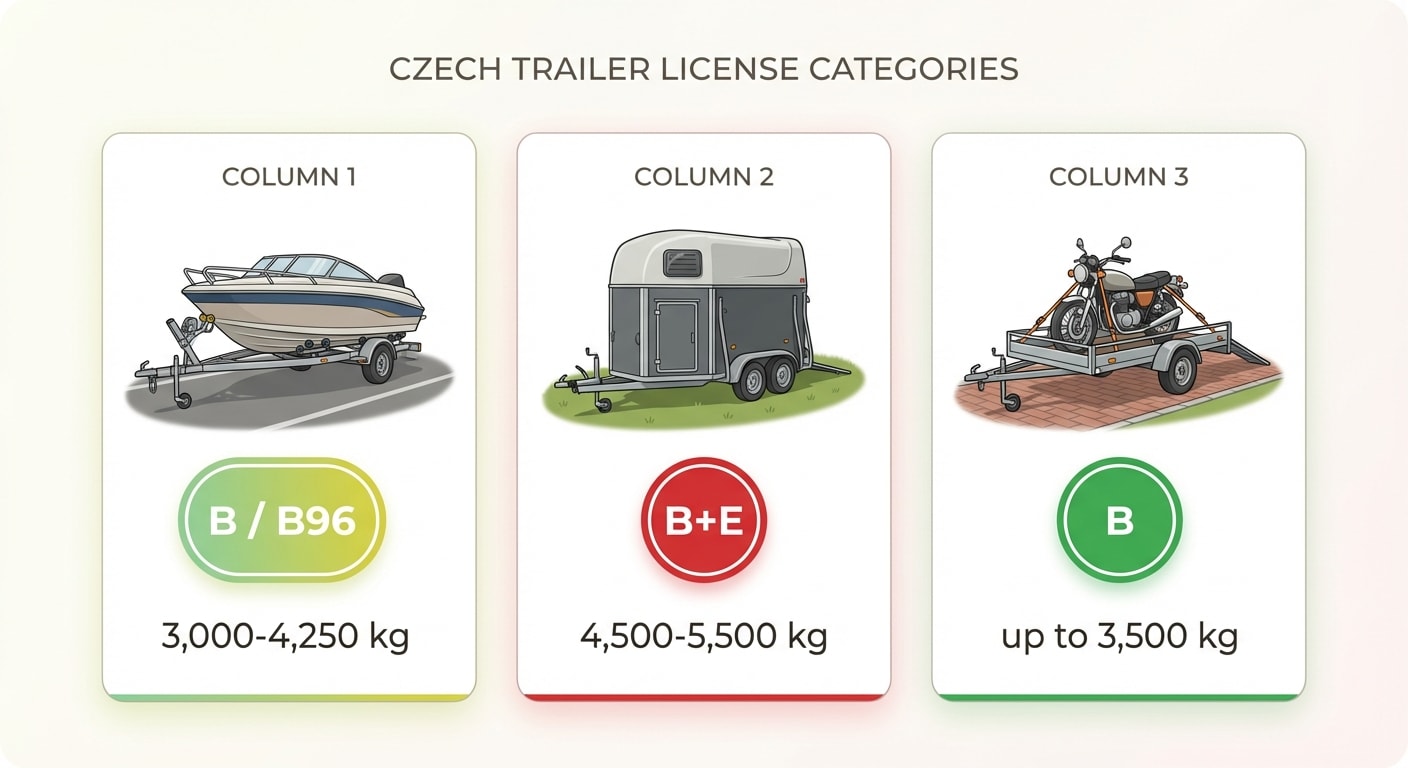
The law doesn't differentiate — weight decides
Whether you're hauling a boat, a horse, or three motorcycles, the law doesn't care about your cargo. Section 80a of Act No. 361/2000 Coll. says one thing: add your car's MAW and the trailer's MAW from their registration documents. Based on the result, you need category B (combination up to 3,500 kg), B96 (up to 4,250 kg), or B+E (up to 7,000 kg).
What does this mean in practice? A lightweight trailer for one motorcycle with a MAW of 450 kg behind a car with a MAW of 1,800 kg makes a combination of 2,250 kg — category B is all you need. But a horse trailer for two horses with a MAW of 2,000 kg behind an SUV with a MAW of 2,500 kg makes 4,500 kg — and you need B+E.
And watch out — always calculate with the MAW from the registration document, not the actual weight. Even if you're hauling an empty trailer, the law uses the MAW. This rule comes up in every chapter of this hub because it's the most common mistake drivers make.
Motorcycle trailers — category B is usually enough
Motorcycle trailers are the simplest option from a license perspective. Most single-axle trailers for one or two motorcycles have a MAW under 750 kg — that's an unbraked O1 category trailer, and category B is all you need without any extension.
A typical single-motorcycle trailer (an open carrier with a rail and wheel chock) weighs around 120–180 kg empty and has a MAW of 300–500 kg. Even with a heavy touring motorcycle (250–350 kg), you'll comfortably stay under the limit. Trailers for two motorcycles have a MAW of 500–750 kg, so even two large BMW R 1250 GS bikes (249 kg each) fit within the limit.
Where it gets more complicated are enclosed transporters. Covered trailers that protect motorcycles from weather and theft have a MAW of 1,000–2,000 kg. Here, your car's MAW matters — with a lighter car, you could exceed 3,500 kg and need B96 or B+E.
Then there are hitch-mounted carriers — not a trailer, but an accessory mounted directly on the tow ball. A single-motorcycle carrier isn't legally considered a trailer, so you don't need anything extra. But watch out: the motorcycle's weight on the carrier adds to the car's weight and affects the rear axle load. Most carriers have a capacity of 150–250 kg — that may not be enough for a heavy touring bike.
Motorcycle trailers — weight and license
| Trailer type | MAW | Typical category |
|---|---|---|
| Hitch-mounted carrier (1 motorcycle) | not counted as trailer | — (part of the car) |
| Lightweight open trailer (1 motorcycle) | 300–500 kg | B (unbraked) |
| Standard trailer (1–2 motorcycles) | 500–750 kg | B (unbraked) |
| Large trailer (2–3 motorcycles) | 750–1,300 kg | B or B96 |
| Enclosed transporter | 1,000–2,000 kg | B96 or B+E |
How to properly load a motorcycle on a trailer
A motorcycle on a trailer is secured using ratchet straps to anchor points — at least four straps in a cross pattern. The front wheel sits in a chock or holder, the straps slightly compress the suspension so the motorcycle doesn't bounce while driving. Don't forget to close the fuel petcock (on older models) and make sure the motorcycle isn't just resting on its side stand — the straps must carry the weight, not the stand. More on proper loading and stability in the chapter Trailer Towing Safety.
Horse trailers — this is where it gets more involved
Transporting horses is a different league from a license perspective. A horse weighs on average 450–550 kg (warmblood) and a single-horse trailer has a MAW around 1,000–1,300 kg. Add a car with a MAW of 2,200 kg and the combination reaches 3,200–3,500 kg — right at the category B limit. With two horses, you need a bigger trailer (MAW 1,500–2,000 kg) and the combination exceeds 3,500 kg. That's B96 territory — and exactly why B96 is so popular among horse owners.
Professional trailers for three or more horses have a MAW of 2,500–3,500 kg. A combination with such a trailer easily exceeds 5,000 kg and you need a full B+E license.
Horse trailers — weight and license
| Trailer type | Trailer MAW | Combination MAW (example) | Category |
|---|---|---|---|
| Light trailer for 1 horse | 750–1,000 kg | 2,750–3,000 kg | B |
| Standard for 1–2 horses | 1,300–1,800 kg | 3,600–4,100 kg | B96 |
| Large for 2 horses | 1,800–2,500 kg | 4,300–5,000 kg | B+E |
| Professional for 3+ horses | 2,500–3,500 kg | 5,300–6,300 kg | B+E |
The most common horse owner mistake
You buy a horse but don't have a trailer yet. You borrow one — and only on the road do you realize the combination exceeds your license limit. Before getting a horse, add up your car's MAW and the trailer's MAW you'll be using. You can get B96 in a few hours for CZK 5,000–8,000 — an investment that pays off sooner than you'd think.
Transporting horses and veterinary regulations
This is where a horse trailer differs from a regular trailer. The Animal Transport Protection Act (No. 4/2009 Coll.) and EU Regulation (EC) No. 1/2005 set rules you must follow — even when transporting your own horse to your own pasture.
If you're transporting a horse over a distance of more than 65 km, you need a driver competence certificate for animal transport. You get it by completing a short course — offered by veterinary authorities and some equestrian organizations. For your own horses over shorter distances, no certificate is needed, but basic welfare rules always apply.
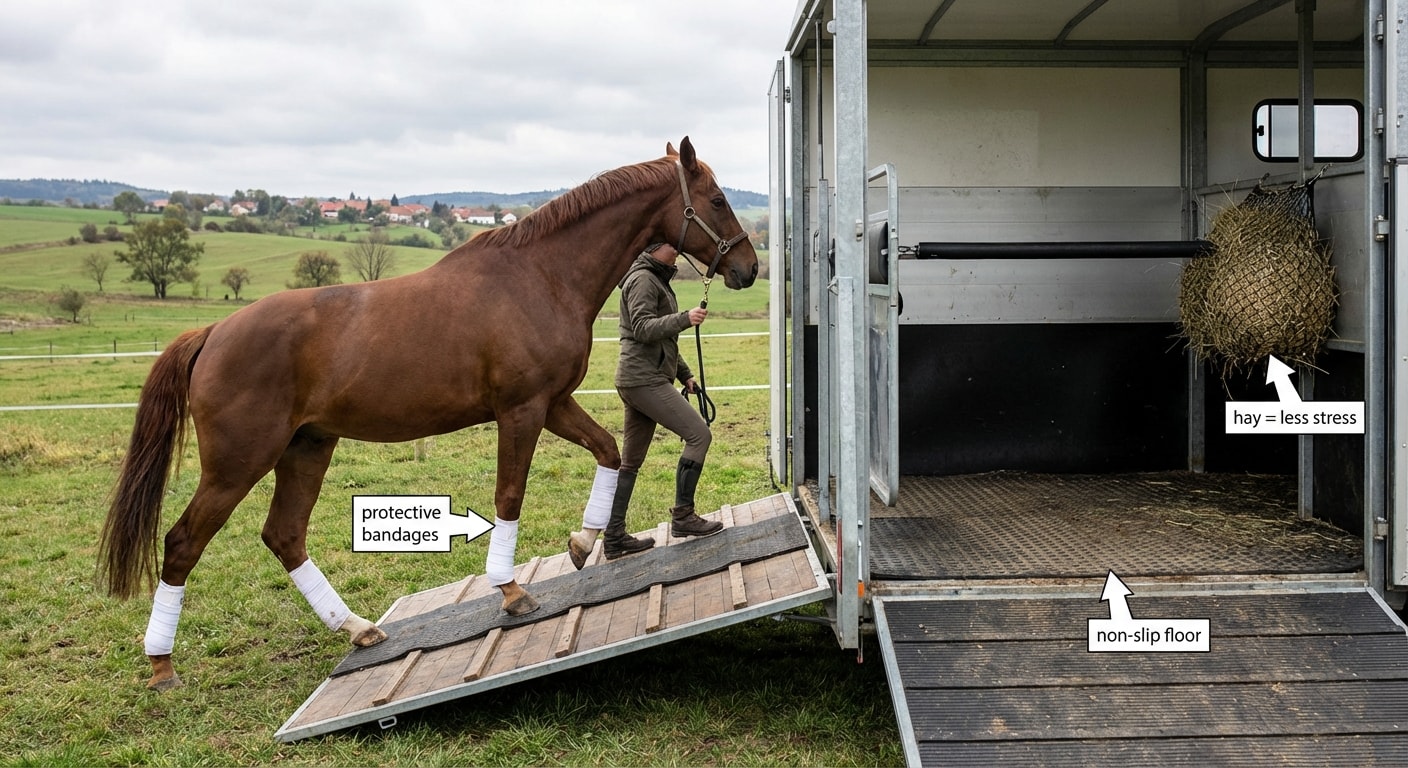
A horse may be transported for a maximum of 24 consecutive hours. Every 8 hours you must stop and water the horse. The trailer must have a non-slip floor (rubber mat or bedding of straw or shavings), adequate ventilation, and enough height for the horse to stand with its head in a natural position.
A few practical tips from experienced horse owners: protective bandages or boots on the legs prevent injuries during transport, hay in the trailer keeps the horse busy and reduces stress, smooth acceleration and braking are essential. And above all — practice loading beforehand. A horse that knows the trailer steps in within a minute. A horse seeing it for the first time can turn loading into an hour-long battle.
Transporting horses over 65 km
For transporting horses over 65 km, you need a driver competence certificate (training course) and a trailer approved by the veterinary authority. Documentation must be kept for 3 years. Violating animal welfare regulations carries fines up to CZK 500,000 under Act No. 246/1992 Coll.
Boat trailers — no special regulations, but specific concerns
From a license perspective, a boat on a trailer is perfectly ordinary cargo. No special regulations, no certificates — just follow the weight limits like any other trailer. But boat trailers have their own practical quirks worth knowing about.
A small dinghy or kayak (under 4 meters) on a lightweight trailer with a MAW of 300–500 kg? An unbraked O1 category trailer and category B is more than enough. A mid-size motor boat (4–6 meters) on a trailer with a MAW of 800–1,500 kg may exceed the category B limit, especially behind a heavier car. And a large sailboat or boat over 8 meters? A trailer with a MAW of 2,500–3,500 kg requires B+E.
Boat trailers — weight and license
| Boat type | Trailer MAW (with boat) | Typical category |
|---|---|---|
| Small dinghy / kayak (under 4 m) | 300–500 kg | B (unbraked) |
| Mid-size motor boat (4–6 m) | 800–1,500 kg | B or B96 |
| Larger motor boat (6–8 m) | 1,500–2,500 kg | B96 or B+E |
| Large sailboat / boat (8+ m) | 2,500–3,500 kg | B+E |
Keep in mind that the boat trailer's MAW includes the trailer + boat + engine + fuel. A motor boat with a full tank weighs significantly more than an empty one — and that difference can catch you off guard.
Corrosion and launching into water
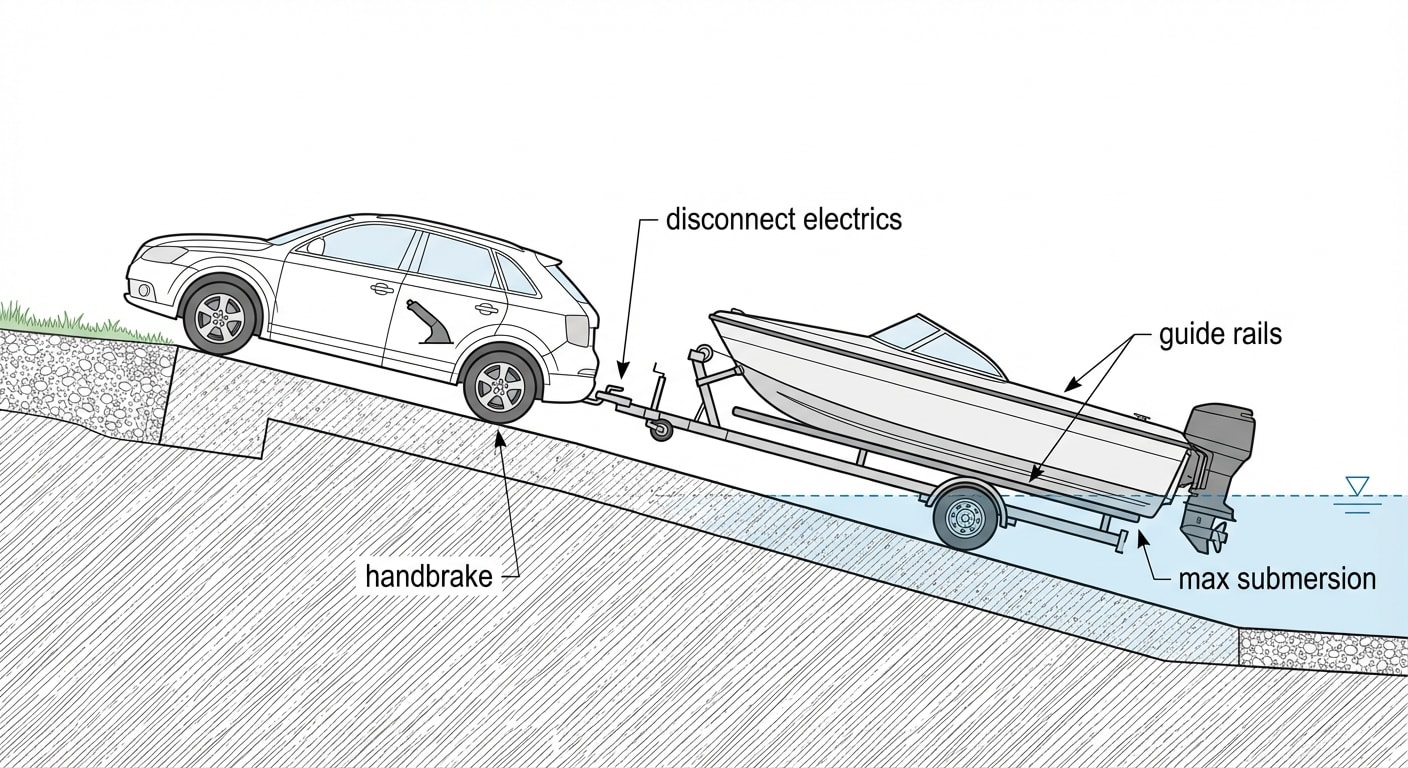
Boat trailers are usually galvanized for corrosion resistance. But no surface treatment lasts forever, especially if the trailer regularly backs into water. After every launch into salt or murky water, you should rinse the trailer with fresh water — otherwise corrosion attacks bearings, brake components, and electrical contacts.
Launching a boat into water is an operation that takes practice. You back the trailer partially into the water, and the boat slides down the guide rails. Don't forget to disconnect the trailer's electrics before submerging it — wet connectors are the most common cause of non-functioning lights.
And watch the height of your combination. A boat on a trailer can be significantly taller than the car alone — especially sailboats with a keel. Before your trip, measure your combination's height and plan a route without low underpasses and bridges.
Trailer insurance — mandatory and cheap
Every registered trailer in the Czech Republic must have its own liability insurance. Act No. 30/2024 Coll. requires this without exception — even a trailer without an engine needs a policy. And the good news: it costs a fraction of what car insurance does.
A lightweight trailer with a MAW up to 750 kg costs CZK 300–600 per year. A heavier trailer over 750 kg runs CZK 600–1,500 per year. Semi-trailers for trucks cost several thousand crowns per year. For this price, you're covered for damage the trailer causes to third parties — exactly the same principle as car insurance.
Trailer liability insurance
Every registered trailer must have its own liability insurance (Act No. 30/2024 Coll.). Cost: CZK 300–600/year (up to 750 kg) or CZK 600–1,500/year (over 750 kg). Without insurance, you can't register the trailer or pass the technical inspection.
Cargo insurance — that's a different story
Trailer liability insurance covers damage caused by the trailer. But it doesn't cover what's on it. Your horse, boat, or motorcycle won't be paid for by the trailer's liability insurance.
For horses, there are specialized animal insurance policies — covering death, veterinary treatment, and liability for damage the horse causes. The price depends on the horse's value and scope of coverage — for sport horses, it can run several thousand crowns per year.
A boat is insured through a watercraft policy that covers damage not just on the water but also during transport on a trailer. And your motorcycle? That's covered by its own liability insurance and optional comprehensive insurance — and those policies apply during trailer transport as well.
Comprehensive insurance for the trailer itself is optional, but definitely worth considering for expensive horse trailers or boat trailers. Not all insurance companies offer it — compare offers on specialized comparison sites.
Trailer behind a motorhome — a combination where weights add up
Have a motorhome and want to hitch a motorcycle or boat trailer behind it? Watch out — the weights add up. A motorhome with a MAW of 3,200 kg + a motorcycle trailer with a MAW of 600 kg = a combination of 3,800 kg. With category B, that doesn't work — you need B96. More about motorhomes and caravans in the chapter Caravans and Motorhomes.
Summary
- License rules are the same for all trailer types — the combination's MAW decides, not the type of cargo (horse, boat, motorcycle)
- Most motorcycle trailers have a MAW under 750 kg → category B is enough without any extension
- Horse trailers for 1–2 horses typically require B96 (combination 3,500–4,250 kg), larger ones B+E
- Transporting horses over 65 km requires a driver competence certificate and compliance with welfare regulations
- Boat trailers have no special regulations — but watch out for corrosion, combination height, and MAW including engine and fuel
- Every registered trailer must have its own liability insurance (CZK 300–1,500/year)
- Cargo insurance (horse, boat) is a separate policy — trailer liability insurance doesn't cover it
Key Terms
| Term | Explanation |
|---|---|
| MAW (Maximum Authorized Weight) | The maximum weight of a vehicle or trailer from the registration document — field F.1. For license categories, MAW is always used, not actual weight. |
| Horse trailer | A towed vehicle specifically designed for transporting horses — non-slip floor, ventilation, safety partitions. MAW from 750 kg to 3,500 kg. |
| Competence certificate | A document required for transporting animals over 65 km. Obtained by completing a course organized by the veterinary authority. |
| Unbraked trailer (O1) | A trailer without its own braking system, MAW up to 750 kg. Category B is sufficient without any extension. |
| Galvanized trailer | A trailer with an anti-corrosion surface treatment — typical for boat trailers that come into contact with water. |
| Trailer liability insurance | Statutory liability insurance — mandatory for every registered trailer (Act No. 30/2024 Coll.). |
| Cargo insurance | Separate insurance for transported goods (horse, boat, motorcycle) — not included in the trailer's liability insurance. |
| Tongue weight | The force the trailer's drawbar pushes down on the tow ball. Should be 5–7% of the trailer's total weight. |
| Welfare regulations | Legal rules for animal protection during transport — EU Regulation (EC) No. 1/2005 and Act No. 4/2009 Coll. |