
Why Young Drivers Pay More for Insurance
Drivers under 25 pay 2–3x more for car insurance. How insurers calculate risk, what drives the price up, and how to bring it down over time.
You pay CZK 7,414 a year to insure a car. Your dad pays CZK 2,874 for the exact same vehicle. That's a difference of over four and a half thousand — just because of your date of birth. It's not a mistake and it's not a punishment. Behind it lies math, statistics, and hard accident data.
This article explains why insurers charge young drivers two to three times more than experienced forty-somethings. You'll understand how risk calculation works, what factors affect your premium, and most importantly — how to gradually escape the higher rate. Because this isn't a life sentence. A few years of accident-free driving will change the situation dramatically.
Quick summary:
- Drivers under 25 pay an average of CZK 8,700/year for liability insurance — 2–3x more than middle-aged drivers
- Main reason: drivers with 0–2 years of experience make up just 3% of all drivers but cause 11% of all accidents (BESIP data)
- Age is the strongest pricing factor, but engine size, residence, car type, and claim-free history also play a role
- The bonus/malus system rewards accident-free driving — after 3–5 years, your premium drops significantly
The Hard Numbers — How Much More You'll Pay
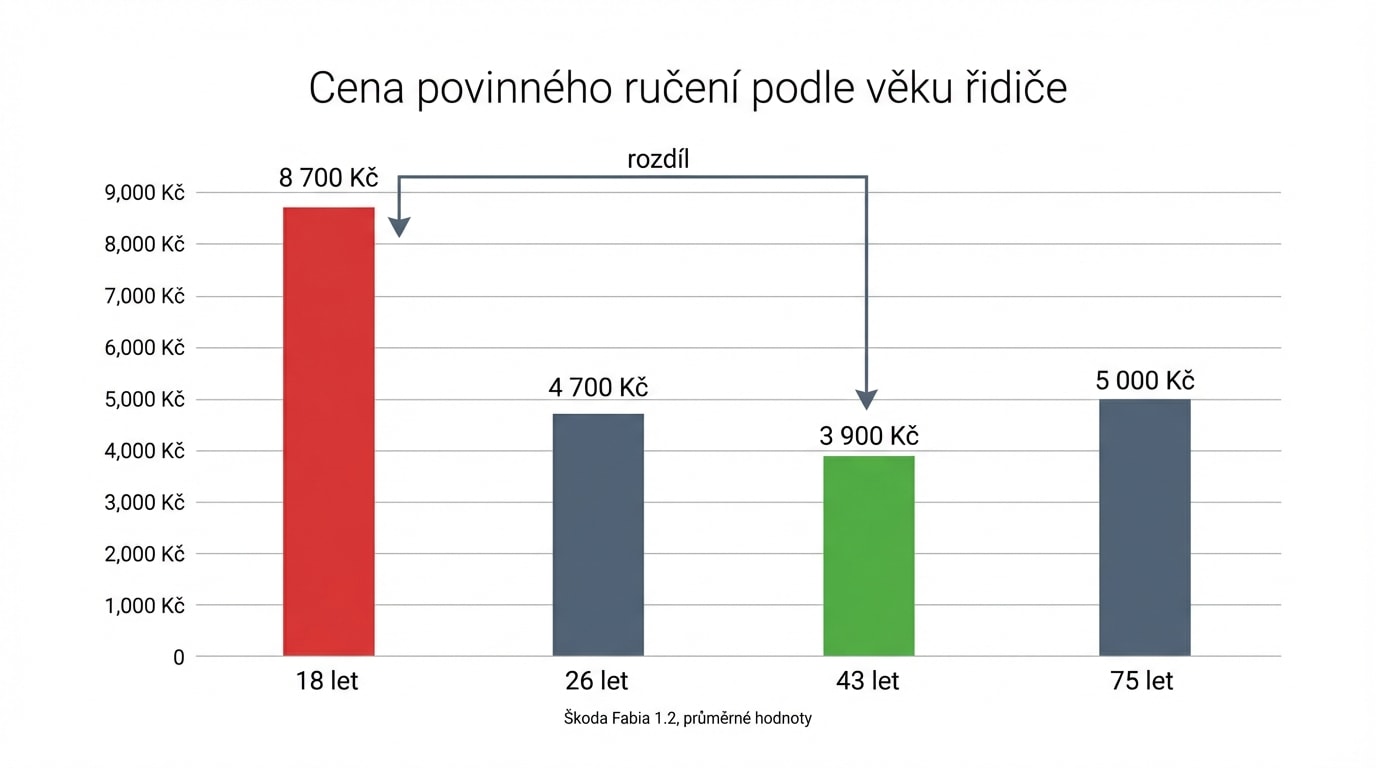
The best way to understand the difference is through specific examples. Let's compare liability insurance prices for the exact same car — a Škoda Fabia 1.2 with 51 kW — across different age groups.
An eighteen-year-old driver pays CZK 6,468 to 11,505 per year for this car. A twenty-six-year-old pays CZK 2,608 to 6,787 for the same vehicle. And a forty-three-year-old? They fit into the CZK 2,340 to 5,803 range. Same car, same specs, same city — only the driver's age changes and the price differs by thousands of crowns.
A 2025 survey by the Klik.cz Group confirmed this on a broader scale: young drivers aged 18 to 24 pay an average of CZK 8,700 per year for liability insurance. That's more than double what drivers aged 35–54 pay. And another comparison from Top-Pojištění.cz shows the same trend: a twenty-two-year-old pays roughly CZK 7,414 for an identical car, while a fifty-four-year-old pays just CZK 2,874.
This isn't an exception or a single case. The 2–3x price difference between the youngest and most experienced drivers holds across insurers, across cars, and across the entire country.
What about seniors?
The price curve isn't a straight line down. Drivers over 60–65 pay more again — insurers account for slower reflexes and higher risk of serious injuries. The lowest premiums go to drivers around 40 from small towns.
How Insurers Calculate Your Price
An insurance company isn't a charity and it isn't a casino. It's a business that calculates risk and sets prices accordingly. The higher the probability that you'll cause an accident and the insurer will have to pay, the more they charge for your policy. They do this through segmentation — sorting drivers into groups based on dozens of factors and assigning each group a different rate.
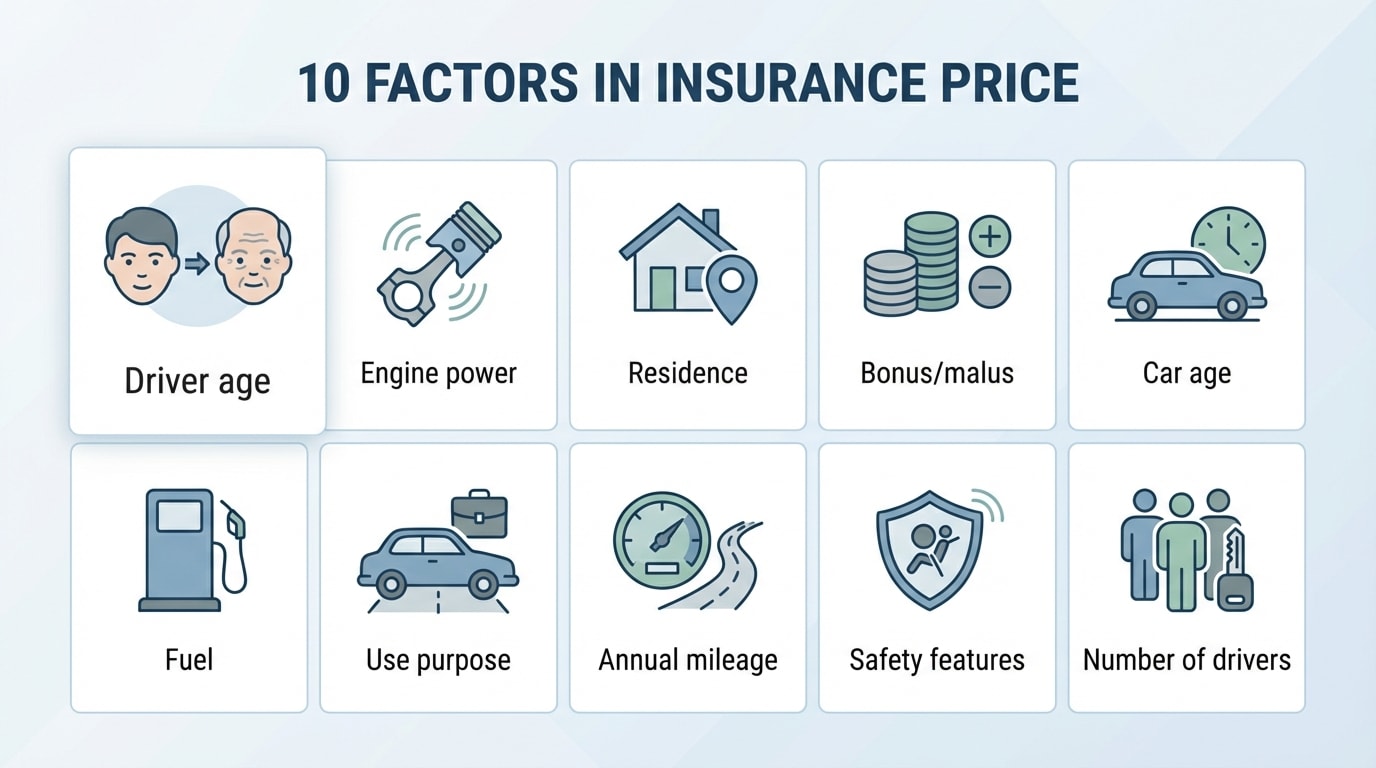
Driver's age is the strongest factor. Insurers have decades of statistical data showing clearly that drivers under 25 cause a disproportionate number of accidents. It's not prejudice — it's math backed by millions of insurance claims.
Engine displacement and power is the second key factor. A car with a 1.0 engine producing 55 kW is cheaper to insure than one with a 2.0 engine producing 140 kW. A more powerful car goes faster, potential damages are higher, and the driver faces greater temptation to step on the gas. Insurers know this and adjust the price accordingly.
Place of residence plays a surprisingly large role. Insurers work with your postal code and compare local accident rates. Prague is the most expensive — heavy traffic, more accidents, more theft. Small rural towns are the cheapest. The difference between Prague and a village can amount to several thousand crowns per year.
Bonus/malus — your personal accident-free driving history. This is crucial for you as a new driver and we cover it in detail below. A new driver has no history, and therefore no discount.
Other factors that enter the calculation: vehicle age and type (newer and more expensive car = higher potential damage), fuel type (diesel tends to be pricier), purpose of use (private vs. commercial), annual mileage (more km = higher risk), vehicle safety features (modern driver-assistance systems can lower the price), and the number of drivers on the policy.
Insurers set their own rates and segmentation criteria. Act No. 30/2024 Coll. doesn't cap prices — it only sets minimum coverage limits (CZK 50 million for both health and property). That's why prices vary between insurers and why comparing always pays off. More on how to bring the price down is in the chapter How to Save on Insurance.
Why You're Statistically Riskier
Now for the most sensitive point. It might feel unfair that you pay more just because you're twenty. But insurers don't draw from impressions — they draw from data. And the data is unambiguous.
According to BESIP, drivers with zero to two years of experience make up just 3% of all drivers in Czechia. But they cause 11% of all traffic accidents. That's nearly four times what would correspond to their share of total drivers. In annual terms, that means over 10,000 accidents caused by young drivers.
And it's not just the number of accidents. Accidents caused by young drivers are roughly twice as severe as average. In 2022, young drivers caused 52 deaths and 250 serious injuries. The most common cause? Excessive speed — in nearly half of all cases. Every fifth motorist aged 18 causes an accident.
Statistically: per 1,000 insured drivers under 30, there are 50 accidents. The overall average is 33 accidents per 1,000 drivers. The insurer knows this and factors it into the price. It's not discrimination — it's actuarial mathematics. Just as an insurer charges more for a car in Prague than in a village, it charges more for a twenty-year-old driver than a forty-year-old. In both cases, it draws from real accident data.
An interesting comparison comes from the L17 programme. L17 drivers can drive from age 17 with a mentor, and statistics show they are demonstrably safer. In 2024, L17 drivers caused just 6 accidents, while 18-year-old beginners caused 1,106. L17 drivers also committed only 8.4% of the traffic offences that 18-year-olds did. Practice with a mentor clearly works — and it's an argument for why insurers might consider lower rates for L17 graduates in the future.
3% of drivers, 11% of accidents
Drivers with 0–2 years of experience make up just 3% of all drivers in Czechia but cause 11% of all traffic accidents annually. That's nearly four times the average. The leading cause is excessive speed — in nearly half of cases. (Source: BESIP)
Bonus/Malus — Why You Start at Zero
The bonus/malus system is the backbone of liability insurance pricing in Czechia. The principle is simple: for every year without an at-fault accident, you earn a discount (bonus); after an at-fault accident, your discount drops or you get a surcharge (malus). Everything is tracked centrally by the Czech Insurers' Bureau (ČKP) and tied to your personal identification number — not to any specific insurer.
For every 12 months of accident-free driving, your bonus grows by roughly 5–10%, depending on the insurer. The maximum bonus is up to 60% off — achievable after approximately 10–12 years without an accident. This means an experienced driver with a full bonus pays less than half the base rate for liability insurance.
And here's the problem for you: as a new driver, you start at zero. No months of accident-free driving, no discount. You pay the full base rate. Your dad with 173 months of claim-free history has a 50–60% bonus and pays a fraction of what you do. Not because he's a better driver — but because he has 14 years without an insurance claim behind him.
If you cause an accident, the situation gets even worse. The insurer deducts 24–36 months from your claim-free history. If the total months drop into negative territory, you move into malus — a surcharge that can increase the premium by up to 200%. One accident in your first year of driving can cost you years of higher payments.
The good news: your bonus transfers when you switch insurers. ČKP passes your claim-free history data to the new insurer. So if you find a better offer elsewhere, your bonus comes with you.
Details on how liability insurance works, how the bonus affects comprehensive insurance pricing, and what happens to your bonus after an accident are in the respective chapters.
Insurance Under Your Parents' Name — A Tempting Trick with a Catch
Three out of four young drivers handle car insurance through their parents. The logic is simple: the parent is older, has years of bonus, and the premium comes out dramatically cheaper. What could go wrong?
Taking out a policy under a parent's name isn't illegal. The law doesn't prohibit it and insurers routinely work with it. But it carries risks that rarely get discussed.
First: some insurers charge a surcharge of roughly 30% when the vehicle's operator is a different person from the policyholder. Since April 2024, Act No. 30/2024 Coll. shifted the insurance obligation from the owner to the operator — and insurers respond to this mismatch.
Second: if the insurer discovers that the car is primarily driven by someone who isn't named on the policy, they can reduce the claim payout in case of an accident. In extreme cases, they can reject the claim entirely. It's not common, but it happens — and when an accident has serious consequences, the insurer investigates more thoroughly.
Third: you're not building your own claim-free history. The bonus accrues to your parent, not to you. Every year you drive on your parent's policy is a year that extends the time before you build your own bonus. When you eventually transfer the policy to your name, you start from zero again.
It's a trade-off. You save now but pay later — and you carry the risk of reduced payouts in case of an accident. Specific strategies for handling insurance smartly and without unnecessary risk are in the chapter How to Save on Insurance.
Watch out for reduced payouts
If the insurer discovers that the car is primarily driven by someone other than the person on the policy, they can reduce or reject the claim payout. Saving a few thousand on the premium could cost you tens of thousands in denied claims.
Telematics — A Modern Way to Prove You Drive Well
Telematics insurance works on the principle of "pay how you drive." Instead of the insurer evaluating you solely by age and statistics, it monitors your actual driving style — and rewards good drivers regardless of how old they are.
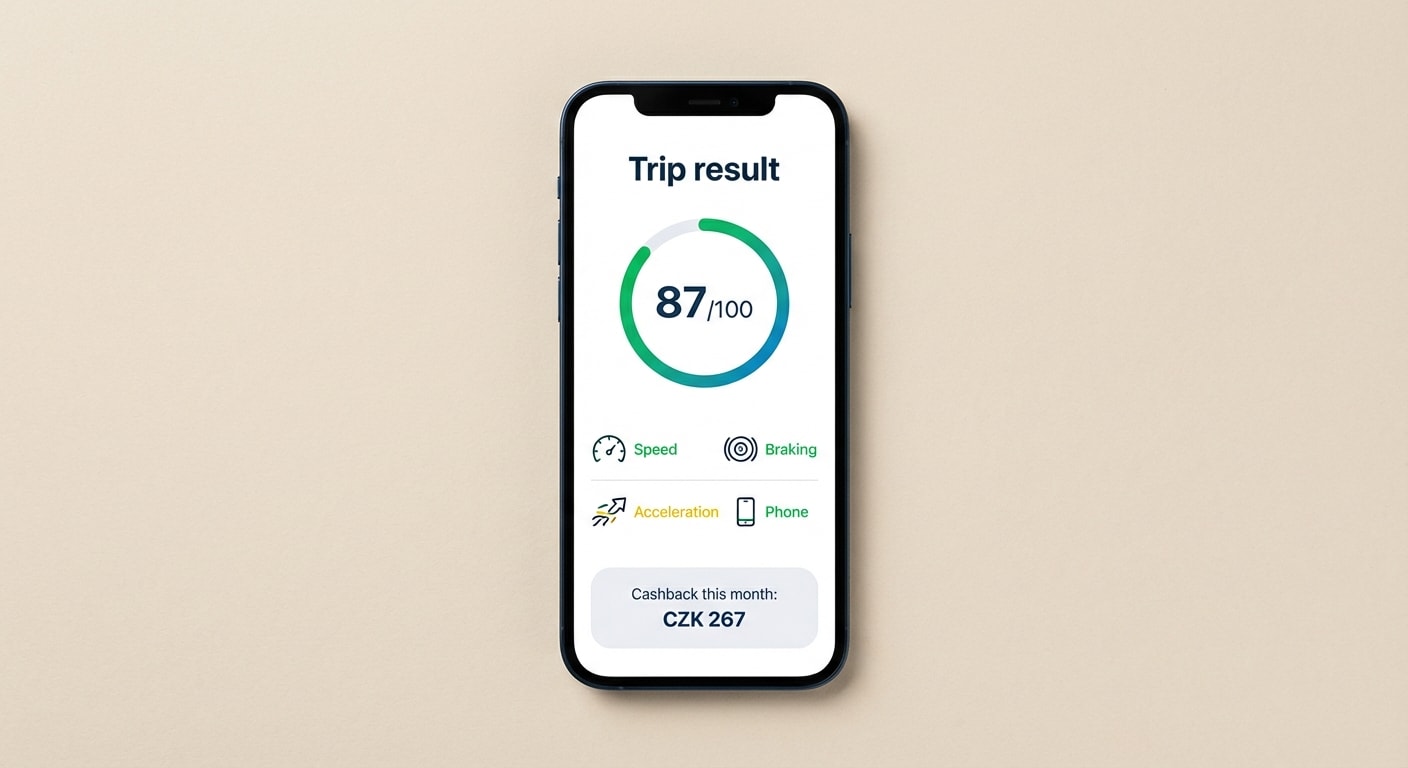
In practice, it works through a mobile app that activates automatically when you exceed 20 km/h. The app monitors speed, braking and acceleration intensity, cornering style, and whether you use your phone while driving. After every trip, you get instant feedback — a score and tips on what to improve.
Kooperativa offers the Koopilot app with cashback of up to 40% on your paid premium. At an annual premium of CZK 8,000, that's a savings of up to CZK 3,200. The average cashback runs around 10%, but young drivers who drive responsibly achieve significantly higher values. Telematics is also offered by Uniqa and Allianz, which factor in kilometres driven and driving style.
For you as a new driver, telematics is a game-changing tool. It compensates for your missing bonus — instead of waiting years for a discount, you can earn a reward for good driving from the very first month. And on top of that, the app teaches you to drive more safely, which pays off not just on insurance but primarily on the road.
When Does It Start Getting Better
Now for the most important part: this situation isn't permanent. The insurance premium changes every year, and for young drivers it drops fast — as long as you drive without accidents.
After your first year of accident-free driving, your bonus grows by 5–10%. After three years, you have a 15–30% discount. After five years, you're at a discount of around 30–50% and the premium approaches what experienced drivers pay. After ten years without an accident, you reach the maximum — a discount of around 60% off the base rate.
At the same time, you're getting older and moving into lower risk groups. Most insurers have a significant price break around age 25 — after your twenty-fifth birthday, the premium drops even regardless of the bonus. And around thirty, you're in the cheapest age category.
In practical terms, this means the first 2–3 years are the most expensive. Then it drops quickly. If you insure your first car at 18, by 23–25 you'll be paying significantly less. And at 30? With a full bonus, you'll be at a fraction of what you're paying now.
The key is not to wreck your bonus with an at-fault accident. One accident in the first few years resets you to the beginning and you pay the full rate again. That's why safe driving isn't just a matter of health — it's a matter of your wallet too. And that's why the probationary driving licence exists — a 2-year probationary period that motivates you to drive carefully.
How to escape the high rate as quickly as possible
Choose a car with a small engine (1.0–1.2). Compare offers from at least 3 insurers. Choose telematics — the cashback compensates for your missing bonus. Drive without accidents — every year of claim-free driving reduces your premium by 5–10%. Specific saving strategies are in the chapter How to Save on Insurance.
Summary
- Young drivers (18–24) pay an average of CZK 8,700/year for liability insurance — that's 2–3x more than middle-aged drivers
- Main reason: drivers with 0–2 years of experience cause 11% of all accidents despite making up just 3% of drivers (BESIP)
- Insurers calculate the price based on dozens of factors — age, engine, residence, bonus/malus, car type
- A new driver starts at zero in the bonus system — no discount, full rate
- Insurance under your parents' name saves money now but carries the risk of reduced payouts and you don't build your own bonus
- Telematics rewards good driving regardless of age — cashback up to 40%
- After 3–5 years of accident-free driving, the premium drops significantly
Key Terms
| Term | Explanation |
|---|---|
| Segmentation (segmentace) | Sorting drivers into risk groups by age, car, residence, and other factors — the basis for premium calculation |
| Bonus | Discount for accident-free driving — roughly 5–10% for every 12 months without an at-fault accident |
| Malus | Surcharge after an at-fault accident — 24–36 months deducted from claim-free history, premium increase |
| ČKP (Czech Insurers' Bureau) | Central registry of bonus/malus data tied to personal identification numbers |
| Claim-free history (bezeškodní průběh) | Number of months without an at-fault insurance claim — the more months, the bigger the discount |
| Telematics (telematika) | Insurance based on monitoring driving style via a mobile app — "pay how you drive" |
| Age coefficient (věkový koeficient) | Surcharge or discount based on driver's age — highest for drivers under 25 |
| Probationary licence (řidičák na zkoušku) | 2-year probationary period for new drivers (since 1 January 2024) — increased pressure for safe driving |
| Cashback | Refund of part of the paid premium for a good driving score in a telematics programme |
| Insurance payout (pojistné plnění) | Amount the insurer pays for a claim — can be reduced if discrepancies are found |