
Practical Driving Lessons — What to Expect
What to expect on your first driving lesson, how lessons progress, and communicating with your instructor. Tips for overcoming driving anxiety.
You sit behind the wheel, place your hands on the gear stick, and have no idea which pedal is the clutch. Your driving instructor sits beside you, says "take it easy" — and you're convinced you'll never get this car moving. This scene plays out thousands of times every day across Czechia. And a few weeks later, the same instructor will tell you "just drive, I'm only sitting here" — and you'll manage. The journey from your first lesson to driving independently isn't mysterious. It has a clear structure, legal rules, and a proven progression. Here's how it all works.
Practical driving lessons are the core of the entire training. Czech law (Appendix 3 of Act No. 247/2000 Coll.) sets a minimum of 28 teaching hours for category B — each lasting 45 minutes, which adds up to 21 hours of actual time behind the wheel. Add 2 hours of vehicle maintenance and 4 hours of first aid training. This article walks you through the whole process: what to expect on your first lesson, how the difficulty gradually ramps up, how to communicate with your instructor, and what to do if you're afraid of driving.
Quick summary:
- Your first lesson takes place on a training ground (closed parking lot) — no real traffic, no stress from other cars.
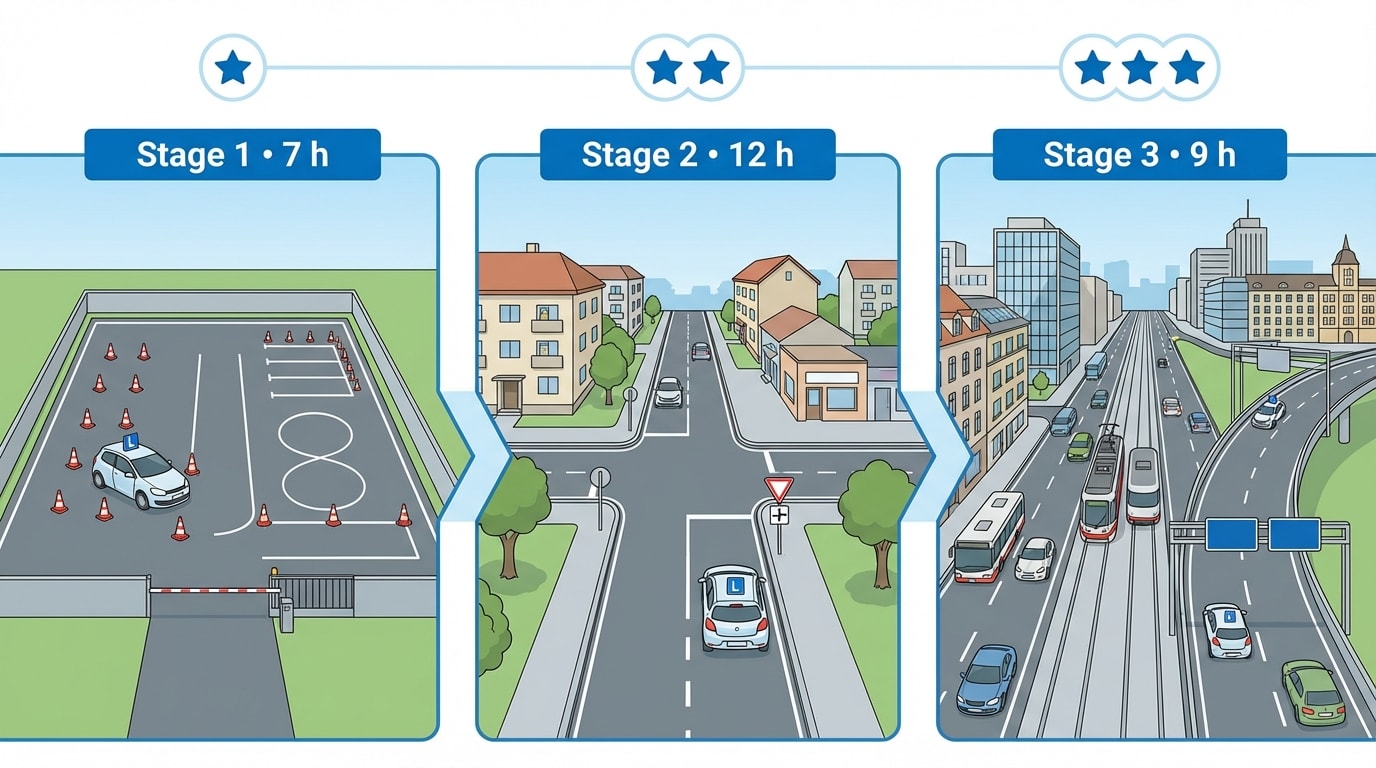
- Training has 3 stages: basics on the training ground (7 hours), lighter traffic (12 hours), heavy traffic and motorways (9 hours).
- Your instructor has dual controls and can intervene at any time — they're responsible for safety, not you.
- You have full right to switch instructors or transfer to a different driving school if the cooperation isn't working.
What to Expect on Your First Lesson
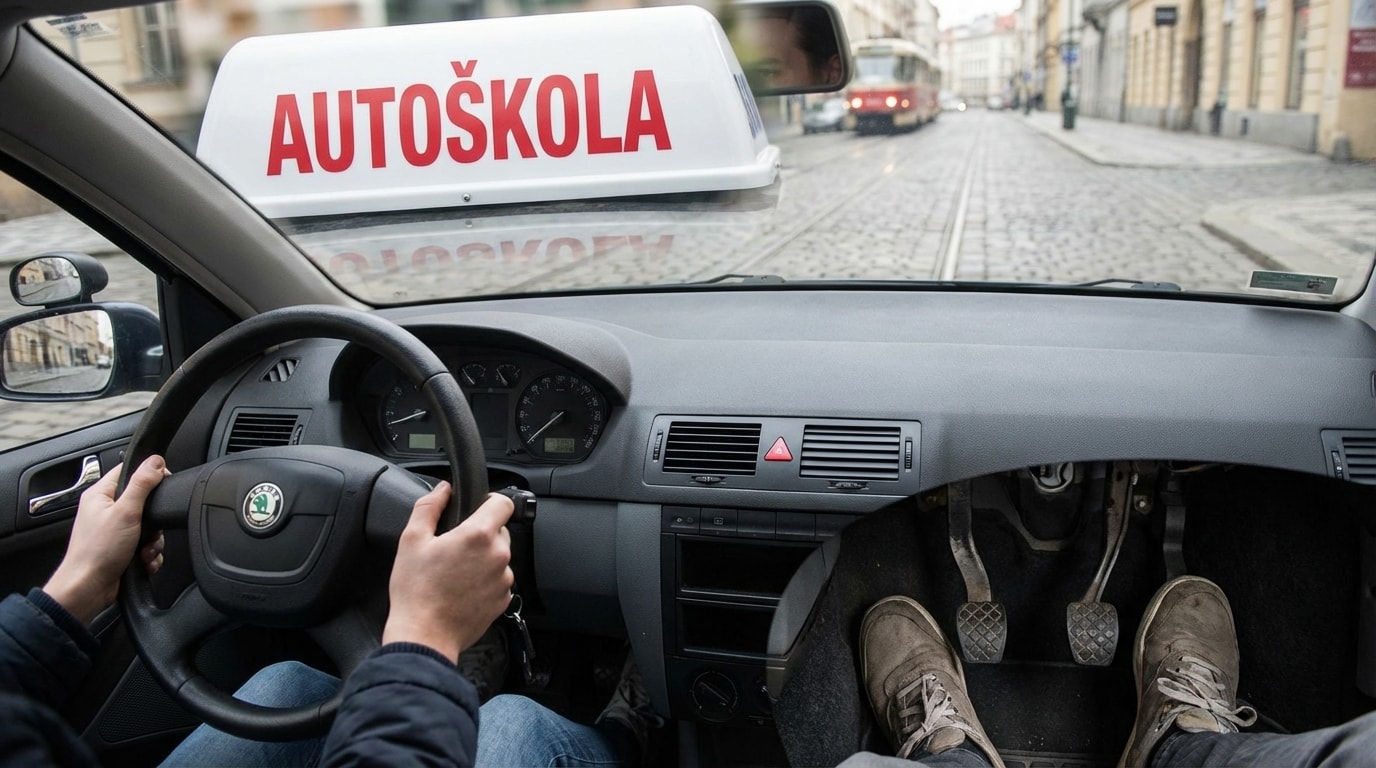
Let's paint the picture so you know exactly what you're walking into. You arrive at the agreed meeting point — usually at the driving school or a parking lot — and your instructor greets you at the car. Training vehicles in Czechia are typically a Škoda Fabia, Octavia, or VW Golf. There's an AUTOŠKOLA (driving school) sign on the roof, and inside is the thing that'll reassure you most: a second set of pedals on the passenger side. Your instructor has their own clutch and brake and can step in at any moment. The car can't do anything the instructor doesn't allow.
The first thing you'll do is adjust your position. You sit behind the wheel and slide the seat forward or back until your feet comfortably reach the pedals — your left foot should be able to push the clutch all the way to the floor without your knee locking out. Then the mirrors: rear-view set so you can see the entire back window, side mirrors so the edge of your own car is barely visible. Then the seatbelt. This routine — seat, mirrors, belt — will become so ingrained within weeks that you'll do it automatically in any car.
Then comes the walkthrough of the controls. Your instructor shows you the three pedals: clutch on the left, brake in the middle, accelerator on the right. The gear stick, handbrake, indicators, wipers, lights. You don't need to memorize everything on the first try — the first lesson is about starting to feel where things are. Your instructor will repeat instructions as many times as needed.
And then the moment arrives — your first pull-away. Left foot pushes the clutch down, shift into first, turn on the lights, signal, slowly release the clutch while gently pressing the accelerator. The car moves. It won't be smooth; the engine will probably stall a few times, maybe you'll jerk forward. That's fine. On the training ground, there are no other cars around you, no pedestrians, no pressure. You drive straight, turn, brake, pull away again. That's how the entire first lesson goes. At the end, your instructor summarizes what went well and what you'll work on next time.
What to bring to your first lesson
Comfortable shoes with a thin sole (no platforms, no flip-flops). You need to feel the pedals. Sunglasses if you're driving during the day. And most importantly — no expectations. Nobody drives well on their first lesson.
Three Stages — How Lessons Gradually Get Harder
Practical training isn't 28 hours of the same thing. Decree No. 167/2002 Coll. (§5) divides it into three stages, each with a different goal, environment, and difficulty level. Your instructor only moves you to the next stage once you've mastered the current one. Nobody throws you into heavy traffic before you can safely turn at an empty intersection.
Stage one takes 7 hours and happens on the training ground or in minimal traffic. This is where you learn to operate the car itself — pulling away, braking, shifting up and down, reversing, basic parking. Some driving schools have a simulator available, which can replace up to 30% of this stage (Appendix 4 of Act No. 247/2000 Coll.) — roughly 2 hours out of 7. Not every school has a simulator, though — it depends on their equipment. During the first stage, you can complete a maximum of 2 teaching hours per day. That means 90 minutes behind the wheel. The law doesn't allow more, and for good reason — beginners tire out faster than they realize.
Stage two is the longest — 12 hours — and moves you into real traffic on quieter routes. You drive on less busy roads, learning to handle intersections, right of way, pedestrian crossings, public transport stops, roundabouts, and railway crossings. Each lesson typically covers a different route so you encounter varied situations. The routes gradually get harder — from side streets to main roads, from small towns to roads outside built-up areas. The two-hour daily maximum still applies here.
Stage three spans 9 hours and is the final preparation for the exam. You drive in heavy city traffic, navigate complex signalized intersections, merge into lanes, enter and exit motorways. At least 1 hour must be spent practicing hazardous situations — emergency braking, skid simulation, evasive maneuvers. At this stage, your instructor mostly observes rather than directs — the goal is for you to make decisions independently. The daily maximum increases to 4 hours, since more advanced students can handle longer driving blocks.
For more on how the entire training fits into the overall timeline from enrollment to exam, check the chapter on Training Process. And if you're interested in specific maneuvers — parking, hill starts, turns — we break them down in the Maneuvers chapter.
How to Communicate With Your Driving Instructor
The quality of your instructor determines your entire driving school experience — that's why we dedicate a whole chapter to it in How to Choose a Driving School. But even with the best instructor, you need to communicate well for lessons to make progress.
The basic rule: ask about everything you don't understand. No question is stupid. If your instructor says "turn left now" and you're unsure whether you need to yield to oncoming traffic — ask. It's better to ask and do it correctly than to guess and do it wrong. Good instructors welcome questions because it shows you're thinking.
Tell your instructor what you're struggling with. If you have trouble with hill starts, say so — they can dedicate an entire lesson just to that. If the pace of instruction doesn't suit you (too fast or too slow), say that too. The instructor should adapt the teaching to your needs, not the other way around. And if you feel unsafe in any situation, say so immediately — the instructor can take over via the dual controls at any time.
Communication works both ways. A good instructor tells you after every lesson what went well and what to work on. They give you feedback throughout, not just at the end. They explain not just "what" to do, but "why" — why you check mirrors before changing lanes, why you brake gradually rather than at the last second, why you signal even on an empty road.
Your instructor is responsible for safety
Under §9 of Act No. 247/2000 Coll., training vehicles must be equipped with dual controls — the instructor has their own clutch and brake. If an accident occurred during training, liability falls on the instructor and the driving school, not the student. You don't need to worry about 'wrecking' anything.
Red Flags — When to Look for a Different Instructor
Not every driving instructor is a professional. Most are, but sometimes the cooperation doesn't work — and sometimes the fault lies with the instructor, not with you. The Driving School Ombudsman (autoskolsky-ombudsman.cz) documents dozens of cases of students dealing with unprofessional instructor behavior. Here are clear signals that it's time to act.
Your instructor uses their phone during your lesson. This should never happen. During training, the instructor must be fully focused on your driving and ready to intervene at any moment. Phone use is not just unprofessional — it's dangerous.
They yell at you or are disproportionately aggressive. Criticism is part of teaching — but it must be constructive, not personal. Phrases like "this is a disaster" or "you'll never manage this" have no place in a driving school. An instructor should guide you, not intimidate you.
They cancel agreed appointments, leave more than two weeks between lessons, or forget about your sessions. Regularity is crucial — long gaps between lessons mean you forget what you've learned and pay for hours spent re-learning instead of progressing.
They push you toward the exam even though you don't feel ready. Some instructors want to cycle through students as quickly as possible. A good instructor recognizes when you're ready and tells you honestly — even if it means a few extra lessons.
Your Rights — Switching Instructors and Transferring Schools
If your cooperation with the instructor isn't working, you don't have to put up with it. The law gives you clear rights and the process is simpler than you might think.
The first step is to request an instructor change within the same driving school. Just tell the school management you'd like a switch — you don't have to justify it, though it helps. Larger schools have multiple instructors and assigning a new one is usually a matter of days.
If the problem isn't with a specific instructor but with the school as a whole, you can transfer to a different driving school. Your original school must issue a certificate of completed hours. A transfer document (formerly required) is no longer necessary — a written request and a valid medical certificate are enough. You can transfer at any time and to any school in the Czech Republic. You don't have to stay in the same city or region.
If the driving school doesn't cooperate, you have several options. First, contact the school management. If that doesn't resolve it: the municipal authority (which issues business licenses for driving schools). In extreme cases, the regional authority or the Ministry of Transport. There's also the Driving School Ombudsman — free advisory and mediation services for driving school students.
Don't put up with a bad instructor
A bad instructor can cost you thousands of crowns extra and months of delay. If you feel your lessons aren't making progress, act now — switching instructors or transferring is your legal right and most driving schools handle it without issues.
Fear of Driving — It's Normal and You Can Overcome It
Are you afraid of driving? You're not alone. According to expert estimates, up to 33% of the population experiences some form of driving anxiety (technically called "amaxophobia"). It doesn't have to be a full-blown phobia — just nervousness that steals your focus and slows your progress. It's normal and you can work with it.
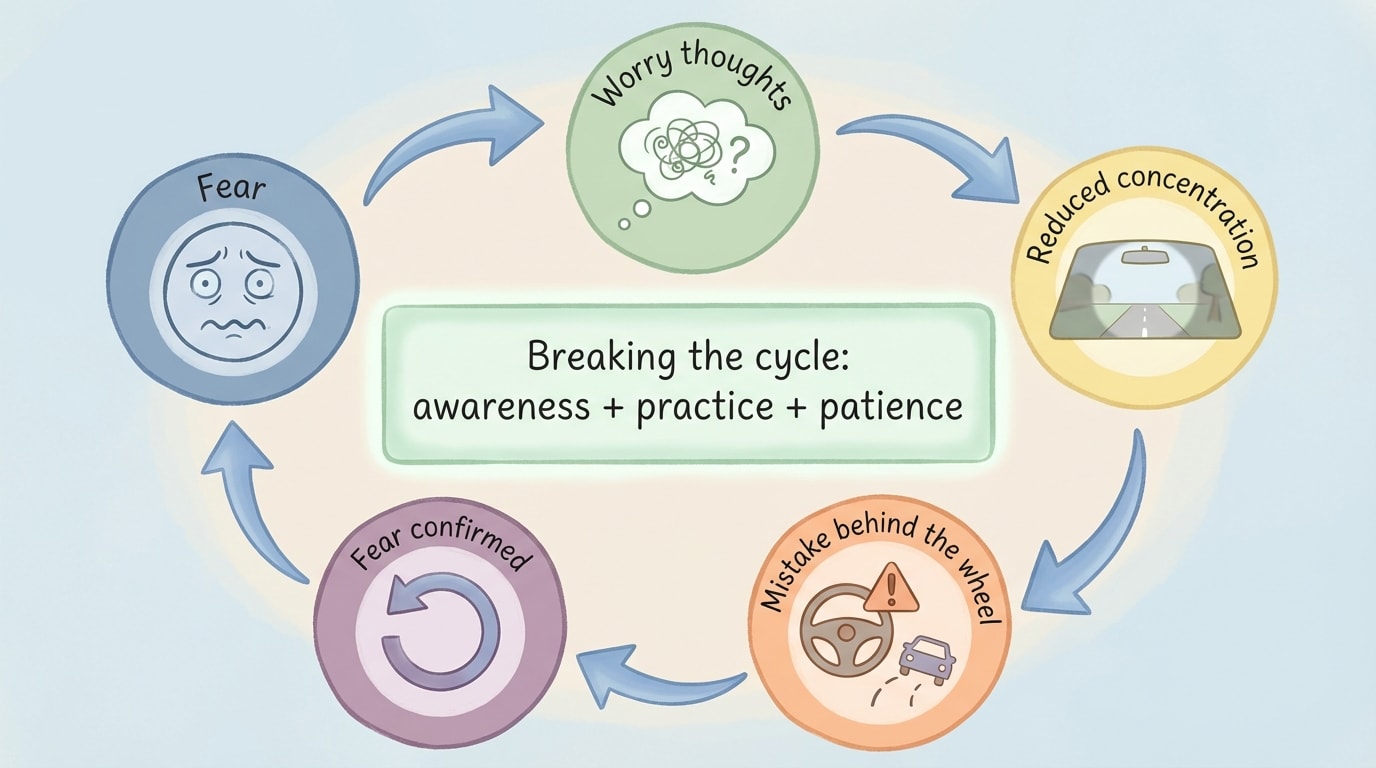
Psychologist Pavel Král from the portal Psychologie.cz puts it simply: "In driving school, you're supposed to learn to drive and you have the right to make mistakes." But fear works as a vicious cycle. You're anxious, so instead of focusing on driving, you're thinking about your fears. This reduces concentration, you make a mistake — and the fear confirms itself. The solution is to break that cycle. To recognize that mistakes are part of learning, not proof of incompetence.
In practical terms, this means a few things. Before your lesson, take a minute for deep breathing — 4 seconds in, 6 seconds out. Tell yourself out loud that you'll manage. It sounds simple, but it works. Tell your instructor you're nervous — a good instructor will adjust the pace and be more patient. Don't compare yourself to other students. Everyone learns at a different speed and that's perfectly fine.
If the fear is so intense that it prevents you from even sitting in a car, or if you experience panic attacks, consider professional help. Cognitive behavioral therapy (CBT) has a 70–80% success rate for driving anxiety over 3 to 6 months. In Prague, there are even specialized courses — for example, the "Bojím se řídit" (I'm Afraid to Drive) program in Čakovice costs CZK 3,600 for a two-part weekend course for up to 10 people. There's no shame in it — it's an investment in yourself.
Most Common Mistakes During Lessons
Every student makes mistakes — that's why it's training, not an exam. But some mistakes repeat so often that it's worth knowing about them in advance. According to Auto.cz and data from test examiners, these are the most common ones.
You forget to fasten your seatbelt. It sounds absurd, but the stress of sitting behind the wheel for the first time can wipe out even the most basic routine. So memorize the sequence: seat → mirrors → belt → only then start the engine.
You don't check the mirrors before driving. Examiners assess this — but it's not just a formality. Poorly adjusted mirrors mean blind spots you can't see. Every time you get into the car: rear-view mirror, left mirror, right mirror. Three seconds that could save a life.
You don't come to a complete stop at a STOP sign. The wheels must come to a dead stop — no slow rolling. Even slow movement counts as "failure to stop" and at the exam it means you fail. In practice, you follow this rule because you can't see what's coming from behind the corner.
You signal when entering a roundabout. Wrong. You don't signal when entering a roundabout — you only signal when exiting. Many students get this wrong because it seems counterintuitive. But the rule is clear.
You check mirrors with just your eyes. When changing direction or lanes, your head turn must be visible, not just eye movement. The examiner sits next to you and can see whether you actually check the blind spot. The procedure for lane changes: mirror → signal → mirror and blind spot check → move over.
Railway crossing — a typical mistake
The maximum speed at a railway crossing is 30 km/h. You may only increase to 50 km/h when the white intermittent light is flashing (meaning the crossing is clear). Many students don't remember that the default limit is 30, not 50.
What If 28 Hours Aren't Enough
The legal minimum of 28 driving hours is just that — a minimum — and for many students it isn't enough. Based on driving school experience and data from the Driving School Ombudsman, it's common for students to complete 30 to 40 hours before feeling ready for the exam. There's nothing wrong with that. Everyone learns at a different pace and it depends on many factors — how often you practice, what traffic conditions you drive in, whether you have some driving experience from another context.
You simply purchase additional hours from your driving school. The price ranges from CZK 800 to 1,200 per 45 minutes, depending on the school and city. It's not cheap, but it's significantly less than failing the exam and paying for a retake (CZK 400 fee plus more preparatory lessons). Moreover, if you fail the practical exam on your third attempt, you must repeat the entire practical training — not the theory, but all 28 hours of driving. That would cost you tens of thousands of crowns.
How do you know you're ready for the exam? A good indicator is that your instructor lets you drive independently and only intervenes rarely. That you can navigate an unfamiliar route without major issues. That you park on the first try. And that you feel calm behind the wheel, not stressed. For details on how the exam works and what the examiner assesses, check the chapter on Exams.
Refresher Lessons — When You Have the License but Haven't Driven in a While
This isn't directly about the initial training, but many people deal with it. You pass the exam, get your license — and then don't drive for a year, two, five. When you sit behind the wheel again, you realize you've forgotten half of it. That's what refresher lessons are for.
Most driving schools offer refresher lessons as advanced training. You don't need any application or medical certificate — just call and book a session. Prices range from CZK 500 to 1,300 per 45 minutes, depending on the city and school. You can choose what to focus on: city driving, motorways, parking, night driving. Some schools even offer lessons in your own car — helping you get used to your specific vehicle.
Summary
- Your first lesson takes place on a training ground — no traffic, no stress. The instructor guides you through everything step by step.
- Training has 3 stages: basics on the training ground (7 h), lighter traffic (12 h), heavy traffic and motorways (9 h). 28 hours is the legal minimum.
- The instructor has dual controls and is responsible for safety. You have the right to make mistakes — that's why it's training.
- Communicate openly: ask about everything, say what you're struggling with, and get explanations of "why," not just "what."
- Up to a third of people experience driving anxiety. Deep breathing, patience, and open communication with your instructor help. In more severe cases, professional help with a high success rate is available.
- You have the right to switch instructors or transfer to a different driving school — a written request and a certificate of completed hours is all you need.
Key Terms
| Term | Explanation |
|---|---|
| Training ground (autocvičiště) | A closed area (parking lot, practice track) where Stage 1 of practical training takes place. No real traffic. |
| Dual controls | A second set of clutch and brake on the instructor's side. Allows them to intervene in driving at any moment. |
| Teaching hour | 45 minutes — not 60. The legal unit for driving school instruction. Lessons are typically booked in blocks of 2 (= 90 min). |
| Training stages | Three phases of practical driving: 1. training ground (7 h), 2. lighter traffic (12 h), 3. heavy traffic (9 h). Total: 28 h. |
| Learner's permit (průkaz žadatele) | A document where the instructor records completed training hours. Serves as proof of training progress. |
| Refresher lessons (kondiční jízdy) | Advanced lessons for license holders who haven't driven in a while. CZK 500–1,300 / 45 min, no application needed. |
| Amaxophobia | The clinical term for fear of driving. Affects up to 33% of the population. Treatable — CBT therapy has a 70–80% success rate. |
| Driving School Ombudsman | A free advisory service for driving school students (autoskolsky-ombudsman.cz). Resolves disputes with schools and unprofessional instructors. |