
Medications and Driving: Which Drugs Affect Driving?
Even a common allergy pill can be a problem. Which medications affect driving, what happens at police checks, and how to verify if you can drive.
You take an allergy pill in the morning, a sleeping tablet at night, and get behind the wheel the next day. Nothing unusual, right? Except this exact scenario can end with a CZK 50,000 fine, a two-year driving ban — or in the worst case, an accident. Up to 10% of traffic accidents in Europe are linked to medications that affect driving. And most of those drivers had no idea they were doing anything wrong.
The law doesn't distinguish between an illegal drug and a prescription medication. If your ability to drive is impaired, you're behind the wheel illegally — no exceptions. The responsibility always falls on you, not on the doctor who prescribed the drug. Here you'll find out which medications are a problem behind the wheel, how to check yours, and what to do if police pull you over.
Quick summary:
- The law prohibits driving under the influence of any substance that impairs driving ability — including prescription medications
- The most problematic categories are sleeping pills, anxiolytics, strong painkillers, and older antihistamines
- The responsibility always lies with the driver — "my doctor didn't tell me" is not a defence
- In the package leaflet, look for the section "Effects on ability to drive and use machines"
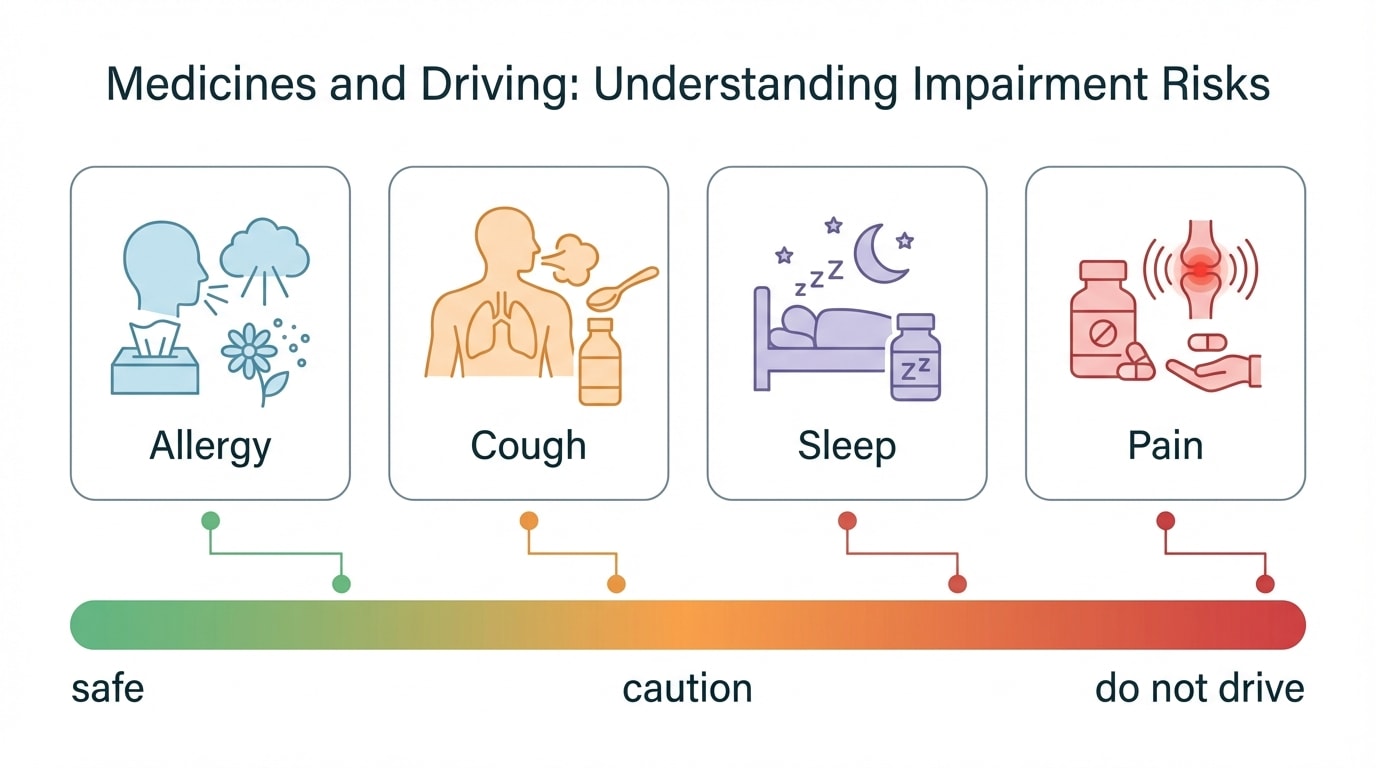
What the law says — and why it's your problem
The Road Traffic Act (No. 361/2000 Coll.) is uncompromising on this. Section 5(2) says two key things. First: you must not drive after taking a narcotic substance or during a period when you could still be under its influence. Second: you must not drive if your driving ability is impaired due to your health condition. And taking medications that sedate or slow you down falls under both categories.
What does this mean in practice? If your doctor prescribes Neurol for anxiety or Stilnox for sleep, you can take it. But you can't drive afterwards. And "afterwards" doesn't just mean an hour after swallowing — some medications affect driving ability even the next morning. The law is clear: as long as your driving ability is impaired, you must not get behind the wheel.
And here's the crucial part — the responsibility is exclusively yours. The law doesn't treat "the doctor must warn the driver" as a condition for your innocence. Doctors are required to inform you, and pharmacists should alert you when dispensing — but in practice, this often doesn't happen. Even if nobody warned you, behind the wheel, you're the one responsible. Didn't read the package leaflet? Your problem. Doctor didn't mention the sedative effects? Still your problem.
The law doesn't wait for you to find out
Even if your doctor didn't warn you about the medication's effect on driving, the responsibility falls on you. Before driving, always check the package leaflet — the section 'Effects on ability to drive and use machines'. You can also find it online at sukl.gov.cz.
Eight categories of medications to watch out for
It's not just about sleeping pills. Medications affecting driving are far more widespread than most drivers expect. Let's go through them.
Anxiolytics and sleeping pills — the highest-risk category
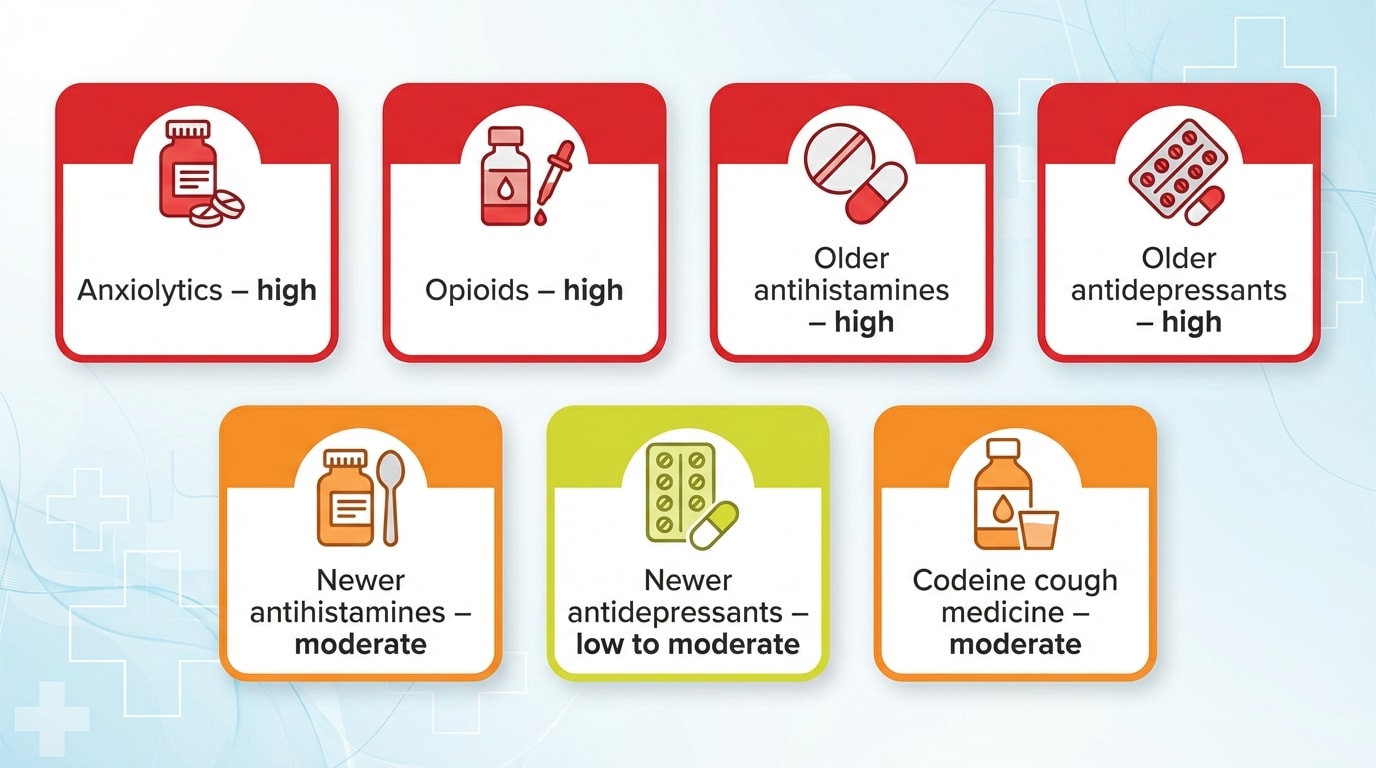
Benzodiazepines — Neurol, Lexaurin, Rivotril, Diazepam — are among the most commonly prescribed anxiety medications in Czechia. And simultaneously among the most dangerous behind the wheel. They slow reactions, reduce attention, and induce drowsiness. Hypnotics have a similar effect: Stilnox, Zolpidem, or Nitrazepam. Research shows that even the most modern sleeping pills nearly triple the risk of an accident. And this persists for many hours after taking them — so you take one at 10 PM and at 7 AM you're still under its influence.
If you take any of these medications regularly, your doctor should tell you whether and when you can drive. For some people, waiting 12 hours after taking the dose is enough; for others, it's individual. But driving an hour after taking Neurol? That's like driving after three beers.
Strong painkillers (opioids)
Tramadol, Doreta, codeine-containing preparations (Korylan, Talvosilen) — these are medications prescribed by almost every doctor for severe pain. They cause drowsiness, a sense of unreality, and significantly slow reaction times. But watch out — they have another tricky effect. Codeine is metabolised into morphine in the body. So if police stop you and run an opiate test, you could test positive. Not because you took drugs, but because your cough syrup contains codeine.
This is one of the most common sources of police problems for drivers on prescription medications. Carrying a doctor's confirmation isn't just a recommendation — it's a necessity.
Antihistamines — treacherous because they seem harmless
Older antihistamines like Dithiaden or Fenistil are strongly sedating. They practically make safe driving impossible. But even newer-generation ones — Zyrtec (cetirizine), Claritin (loratadine) — can cause drowsiness in some people. They're generally considered less sedating, but individual reactions vary. Caution is recommended when taking any antihistamine for the first time.
Stories of drivers who took "just an allergy pill" and then had problems at a police check are more common than you'd think. Antihistamines are among the most frequently detected substances in accidents caused by driver inattention.
Cough and cold medications
Syrups containing codeine (Robitussin), dextromethorphan, or combination products with pseudoephedrine — these are over-the-counter medications you can buy at any pharmacy without a prescription. And yet they can affect driving. Plus, watch out: some liquid medicines and syrups contain alcohol. Check the ingredients.
Antidepressants and antipsychotics
Older tricyclic antidepressants (Amitriptyline, Anafranil) are strongly sedating — drowsiness, blurred vision, slowed reactions. Newer SSRIs (Prozac, Fevarin) are generally less problematic, but side effects can appear in the first weeks of use. Antipsychotics (Chlorprothixene, Haloperidol, Tisercin) cause sedation and confusion — driving on them is extremely risky.
Heart and blood pressure medications
Beta-blockers can cause fatigue, dizziness, and slow heart rate. Diuretics carry a risk of sudden blood pressure changes and dizziness. Amiodarone (an anti-arrhythmic) can affect vision. If you take cardiovascular medications, you'll find details in the chapter Heart Disease and Driving.
Diabetes medications
Insulin and oral antidiabetics carry a risk of sudden hypoglycaemia — a drop in blood sugar that causes trembling, confusion, vision problems, and in extreme cases, loss of consciousness. You'll find a detailed analysis in the chapter Diabetes and Driving.
Medications affecting vision
Eye drops (especially mydriatics that dilate the pupil) will prevent you from driving for several hours after application. But systemic medications like amiodarone, hydroxychloroquine, or isotretinoin can also have adverse effects on vision. More in the chapter Vision Problems and Driving.
Which medications are safe
Not all medications are a problem. Paracetamol (Paralen) has no sedative effects and doesn't affect driving. Ibuprofen (Ibalgin, Nurofen) is generally safe, though it can rarely cause dizziness. Most antibiotics — penicillins, cephalosporins — don't affect driving. And newer antihistamines at recommended doses (Zyrtec, Claritin) are fine for most people — but individual caution is warranted.
The key rule is simple: if you're not sure, read the package leaflet. Always. For every medication.
How to check whether your medication affects driving
In the past, Czech medication packaging used a red triangle with a car — a clear signal that the drug affects driving. Today, it's no longer mandatory. So how do you tell if your medication is a problem?
Every package leaflet must include a section called "Effects on ability to drive and use machines". Find it and read what it says. The wording is standardised: "This medicine has no influence on..." means you're fine. "This medicine may influence..." means increased caution. And "This medicine has a significant influence..." means you have no business being behind the wheel.
If you've lost the package leaflet or thrown it away, no worries. On the SÚKL website (State Institute for Drug Control) you'll find a complete medication database — enter the product name and the package leaflet appears online. Alternatively, you can use the oLécích.cz portal, which is SÚKL's public information site.
And the simplest option? Ask the pharmacist when picking up your medication. It's literally one question: "Can I drive after taking this?" Pharmacists are required to inform you — and unlike your doctor who has five minutes for you, the pharmacist hears this question daily and will answer immediately.
Quick check: can you drive?
Open the package leaflet and find the section 'Effects on ability to drive and use machines'. Don't have it? Enter the drug name at sukl.gov.cz or olecich.cz. Or simply ask your pharmacist.
What happens at a police check
From practice: Codeine and a positive test
You take Talvosilen for toothache. Police stop you and run a saliva test — positive for opiates. The codeine metabolised into morphine. Without a doctor's confirmation, you're explaining to police why your test shows drugs. With the confirmation, you resolve the situation in a minute.
Doctor's confirmation — why you should carry one
The law doesn't explicitly require you to carry proof of prescribed medications. But it's strongly recommended — especially if you take benzodiazepines, opioids, anti-epileptics, or anything that could trigger a positive test.
The confirmation should include your name, the medication name, dosage, and a crucial statement: the doctor's confirmation that you are fit to drive. Ask your doctor — they can usually write it in a few minutes. And keeping it in the car costs you nothing, while its absence can cost you hours of explaining to police.
If you take epilepsy medications — anti-epileptics like valproate, carbamazepine, or lamotrigine — the confirmation is practically essential. These medications suppress the central nervous system and can cause drowsiness or slowed reactions. By the way, your doctor also reviews your medications during the medical exam for your driving licence — if you take anything that affects driving, they should know about it.
Combining medications with alcohol — zero tolerance
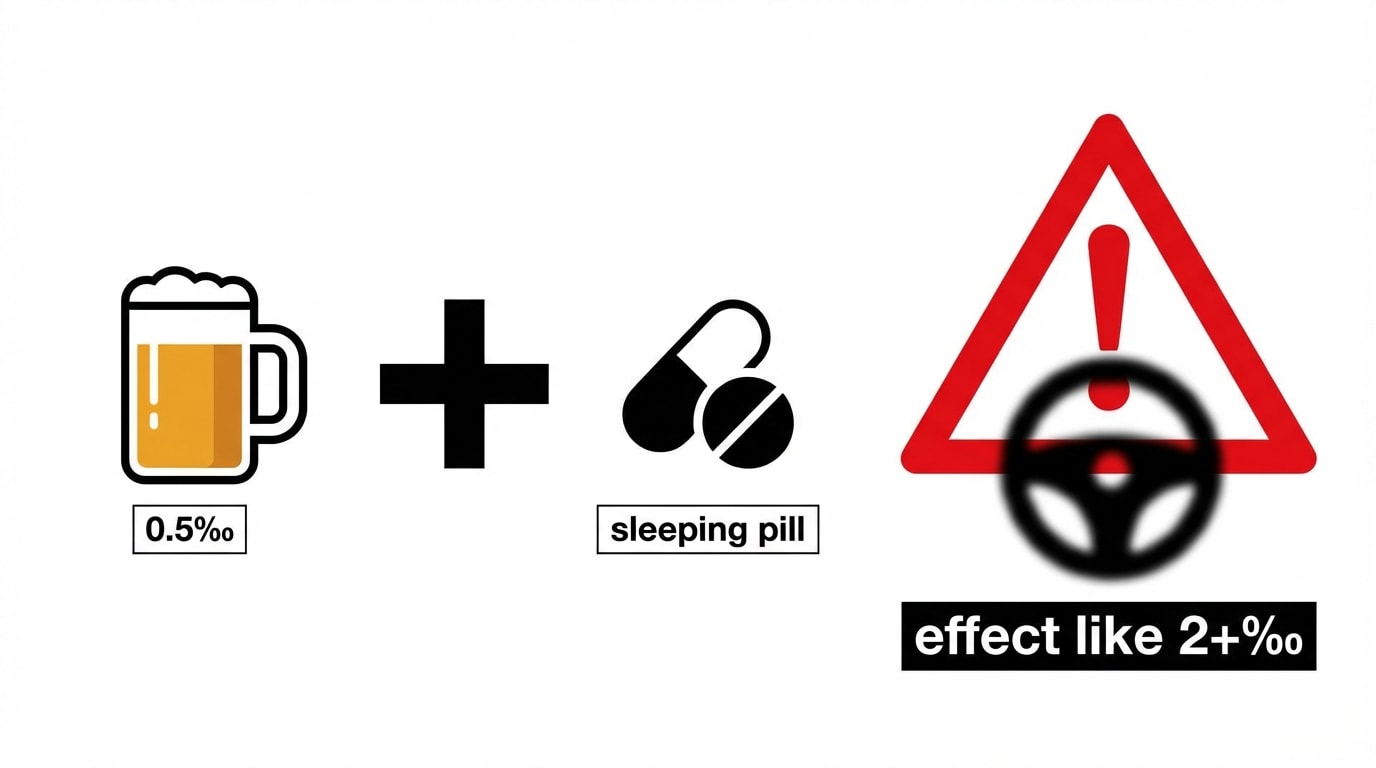
This deserves its own section because it's one of the most dangerous scenarios. Combining medications with alcohol dramatically amplifies the negative effects on driving. Even a small amount of alcohol — say, one beer — combined with an anxiolytic or hypnotic can have fatal consequences.
The effects don't add up — they multiply. One beer by itself is below the legal limit. One Neurol by itself will slow you down but you might still manage. But one beer plus one Neurol? That's a combination that disables you like two per mille of alcohol.
And watch out for hidden alcohol in medications. Some cough syrups and liquid medicines contain alcohol — it's in the ingredients, but hardly anyone reads them. Before driving, check whether your medication contains alcohol.
Fines and penalties — what you risk
The penalties for driving under the influence are steep, and they got even stricter from 1 January 2024. For driving under the influence of a narcotic substance (which includes medications if they impair driving ability), you face a fine of CZK 2,500–20,000, a driving ban of 6–12 months, and 7 penalty points. If the impairment is severe — a state excluding driving fitness — the fine rises to CZK 25,000–50,000, a driving ban of 12–24 months, and again 7 points.
Refusing a test is even worse. If police request a substance test and you refuse, you face a fine of CZK 25,000–75,000, a driving ban of 18 months to 3 years, and 7 penalty points. Refusing a test is by law treated more severely than a positive result.
And if you cause an accident while in a state excluding driving fitness, the offence becomes a criminal act under Section 274 of the Criminal Code. You face imprisonment for up to 1 year (3 years if someone is injured), a driving ban of 1–10 years, and a criminal record. If your licence has been suspended for health reasons and you drive anyway, that's another criminal offence — obstructing enforcement of an official decision (Section 337 CC, up to 2 years). For how to get back behind the wheel legally, see How to Get Your Fitness Back.
Fines for driving under the influence of medications/drugs
| Offence | Fine | Driving ban | Points |
|---|---|---|---|
| Driving under influence (lower level) | CZK 2,500–20,000 | 6–12 months | 7 |
| State excluding driving fitness | CZK 25,000–50,000 | 12–24 months | 7 |
| Refusing a test | CZK 25,000–75,000 | 18 months–3 years | 7 |
| Criminal offence (§274 CC) | Imprisonment up to 1–3 years | 1–10 years | — |
Five myths you shouldn't believe
"A prescription drug can't possibly be a problem." It can. The law doesn't distinguish between a legal medication and an illegal drug. If the medication impairs your driving ability, you're behind the wheel illegally.
"I take it every day, I'm used to it." Tolerance does exist — your body partially adapts to the medication. But that doesn't mean the drug has stopped affecting your reactions. Studies show that even chronic benzodiazepine users have prolonged reaction times.
"My doctor didn't tell me, so it must be fine." Doctors are required to inform you. But even if they didn't, the responsibility for driving is yours. The law is clear.
"Only newer antihistamines are safe." Less sedating doesn't mean safe. Even Zyrtec or Claritin can cause drowsiness in some people. Don't get behind the wheel the first time you take them.
"Cough syrup isn't really medicine." It is. And some syrups contain codeine, dextromethorphan, or even alcohol. Read the labels.
Practical tip
If you take any medication long-term and drive regularly, ask your doctor for written confirmation of your fitness to drive. It takes five minutes of their time — and could save you hours of problems.
Summary
- The law prohibits driving under the influence of any substance that impairs driving ability — including prescription medications (Section 5, Act 361/2000 Coll.)
- Highest-risk categories: anxiolytics, hypnotics, opioids, older antihistamines, sedating antidepressants
- The responsibility for safe driving always lies with you — not your doctor
- In the package leaflet, look for the section "Effects on ability to drive and use machines" — or ask your pharmacist
- Codeine metabolises into morphine — carrying a doctor's confirmation is a practical necessity
- Combining medications with alcohol has a synergistic effect — effects multiply, not add
- From 1 January 2024, driving under the influence carries 7 points, fines up to CZK 50,000, and a driving ban of up to 2 years
Key terms
| Term | Explanation |
|---|---|
| Section 5, Act 361/2000 Coll. | Driver obligations — prohibits driving under the influence of a narcotic substance or in a state of impaired driving ability. |
| Benzodiazepines | A group of anti-anxiety and sleep medications (Neurol, Lexaurin, Rivotril). They significantly slow reactions and cause drowsiness. |
| Opioids | Strong painkillers (Tramadol, codeine). They suppress the CNS and can cause a positive opiate test. |
| Antihistamines | Allergy medications. Older generation (Dithiaden) is strongly sedating; newer ones (Zyrtec, Claritin) less so — but caution is warranted. |
| Package leaflet | A mandatory part of every medication. The "Effects on driving" section states whether the drug affects driving. |
| SÚKL | State Institute for Drug Control — at sukl.gov.cz you can find package leaflets for all medications registered in Czechia. |
| Regulation No. 41/2014 Coll. | Sets limit values for narcotic substances in blood (THC, methamphetamine, amphetamine, opiates, cocaine). For prescription drugs, assessment is individual. |
| DrugWipe 5S | A saliva test used by police during roadside checks. Detects 5 substance groups — can test positive even with legal medications. |
| Section 274, Criminal Code | Endangerment under the influence of a narcotic substance — a criminal offence. Carries up to 3 years imprisonment and a driving ban of 1–10 years. |
| Doctor's confirmation | An optional but strongly recommended document confirming prescribed medications and fitness to drive. |