
Car Insurance — Is It Worth It for New Drivers?
All-risk vs. partial coverage, deductibles, pricing, and exclusions. When comprehensive insurance makes sense for new drivers and when it doesn't.
One summer night, a hailstorm wrecked cars across an entire housing estate. Dented hoods, shattered windows, tens of thousands in damage on every vehicle. Those with comprehensive insurance called their insurer and got their car fixed. Those without paid out of pocket — or simply lived with the dents. All it took was one extra policy.
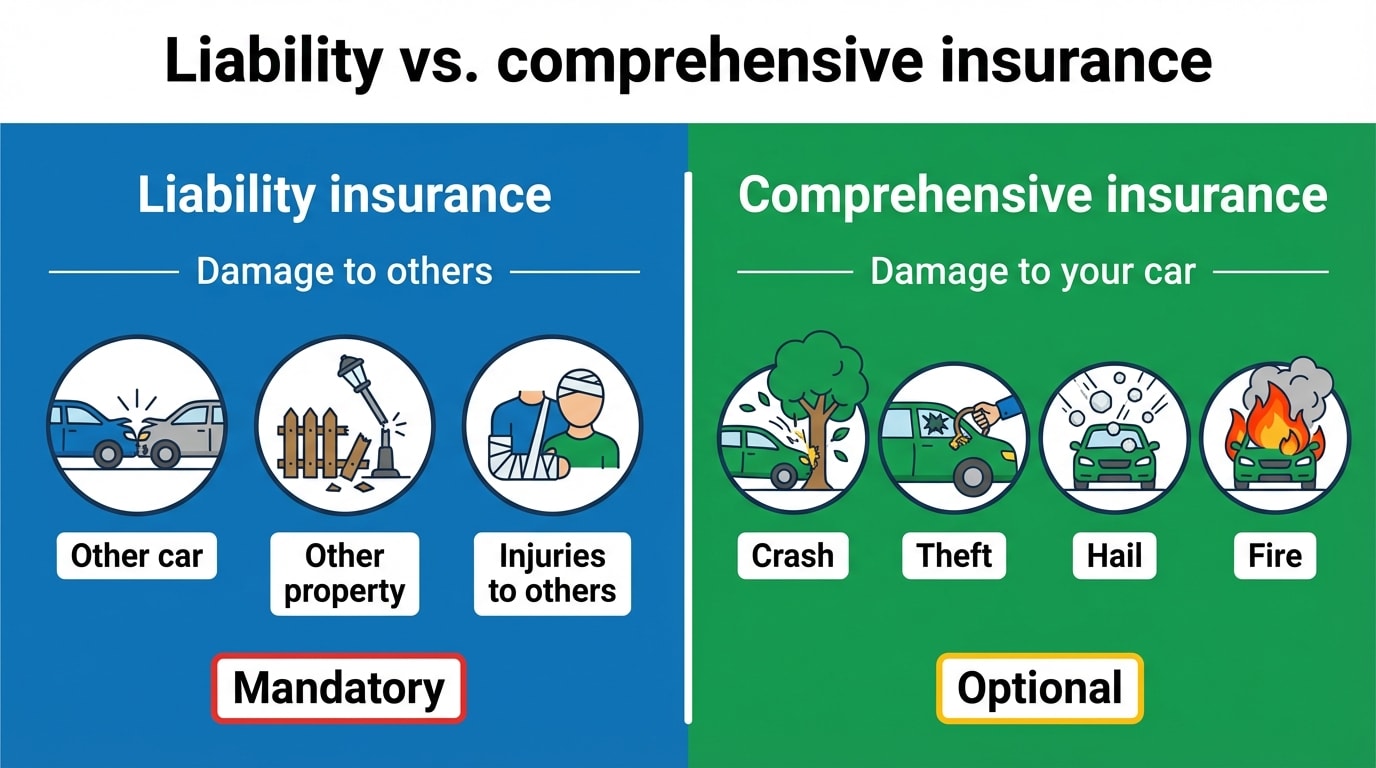
Comprehensive car insurance (havarijní pojištění) protects your own vehicle. Unlike liability insurance, which covers damage you cause to others, comprehensive insurance covers what happens to your car — collisions, theft, vandalism, natural disasters. The law doesn't require it, but for a newer car or one on a lease, it's practically essential. In this chapter, you'll learn what types of comprehensive insurance exist, what a deductible means, how much you'll pay, and most importantly — when comprehensive insurance makes sense and when it's a waste of money.
Quick summary:
- Comprehensive insurance protects your own car — collisions, theft, vandalism, natural disasters
- All-risk covers all risks except exclusions; partial covers only selected risks
- The deductible is the amount you pay from each claim yourself — most commonly 5%, min. CZK 5,000
- For a car worth over CZK 150,000, comprehensive insurance makes sense; below CZK 100,000, it usually doesn't
What Comprehensive Insurance Actually Is
Comprehensive insurance is voluntary coverage for your vehicle. Legally, it falls under property insurance according to the Czech Civil Code (§2849 et seq. of Act No. 89/2012 Coll.) and is governed by the insurance contract and the specific insurer's terms. No special law requires it — unlike liability insurance, which is mandatory by law.
The only situation where someone will force you to get comprehensive insurance is a lease or car loan. The bank needs assurance that if you wreck the car or it gets stolen, they won't be financing a wreck. That's why comprehensive insurance is a standard condition of lease agreements — and it's non-negotiable.
In Czechia, roughly one-third of all vehicles have comprehensive insurance. The remaining two-thirds drive with liability insurance only, risking that in an at-fault collision, theft, or natural disaster, they'll pay everything themselves. The comprehensive insurance market is growing steadily — in 2022, written premiums reached nearly CZK 28 billion.
All-Risk vs. Partial — Which Type to Choose
Insurers offer two basic types of comprehensive insurance, and the difference between them is fundamental.
All-risk (comprehensive coverage) works on a simple principle: everything is covered that isn't explicitly excluded in the contract. At-fault collisions, animal strikes, theft of the entire vehicle and break-ins, vandalism, hailstorms, windstorms, floods, fire, falling trees, landslides — all covered. You don't need to think about what might happen when signing up. Just check the exclusions (more on those in a moment) and you're set.
All-risk is the most popular option, and for good reason. Statistically, about 75% of paid claims come from collisions — and at-fault collisions are exactly the risk that partial insurance doesn't cover. For a newer car up to about 7 years old, all-risk is practically the only sensible choice.
Partial coverage covers only the risks you explicitly choose. Typically, you can select from these modules: theft (entire vehicle theft, break-ins), natural disasters (hail, windstorms, floods, fire, falling trees), vandalism (intentional damage by a third party), animal strikes, and glass coverage. What isn't checked isn't covered. Simple.
Partial insurance is cheaper because it covers less. It works well for an older car where your main risk isn't collisions (you'd handle those out of pocket for an old vehicle) but hail, theft, or vandalism. If your car sits on a Prague street overnight, theft and vandalism coverage makes sense even when all-risk would be overkill.
How to decide?
Car up to 7 years old worth over CZK 200,000 → all-risk. Older car where the main threat is theft or weather → partial. Car under CZK 100,000 → consider whether comprehensive insurance is worth it at all.
Deductibles — How Much You Pay from Each Claim
The deductible is the amount you pay out of pocket with each claim. The insurer covers the rest. It sounds like a disadvantage, but the deductible is a tool that can significantly reduce your annual premium.
The most common option on the Czech market is 5%, minimum CZK 5,000. What does that mean in practice? If the damage is CZK 50,000, the insurer pays CZK 45,000 and you pay CZK 5,000 (5% of 50,000 is CZK 2,500, but the minimum is CZK 5,000 — you pay the higher amount). If the damage is CZK 200,000, the insurer pays CZK 190,000 and you pay CZK 10,000 (5% of 200,000 = CZK 10,000, which exceeds the minimum).
Deductible examples: 5%, min. CZK 5,000
| Damage amount | Your deductible | Insurer pays |
|---|---|---|
| CZK 20,000 | CZK 5,000 (minimum) | CZK 15,000 |
| CZK 50,000 | CZK 5,000 (minimum) | CZK 45,000 |
| CZK 100,000 | CZK 5,000 (minimum) | CZK 95,000 |
| CZK 200,000 | CZK 10,000 (5%) | CZK 190,000 |
| CZK 500,000 | CZK 25,000 (5%) | CZK 475,000 |
Important catch: if the damage is less than your deductible, the insurer pays nothing. With a 10%, min. CZK 10,000 deductible and CZK 8,000 in damage, you cover the entire repair yourself.
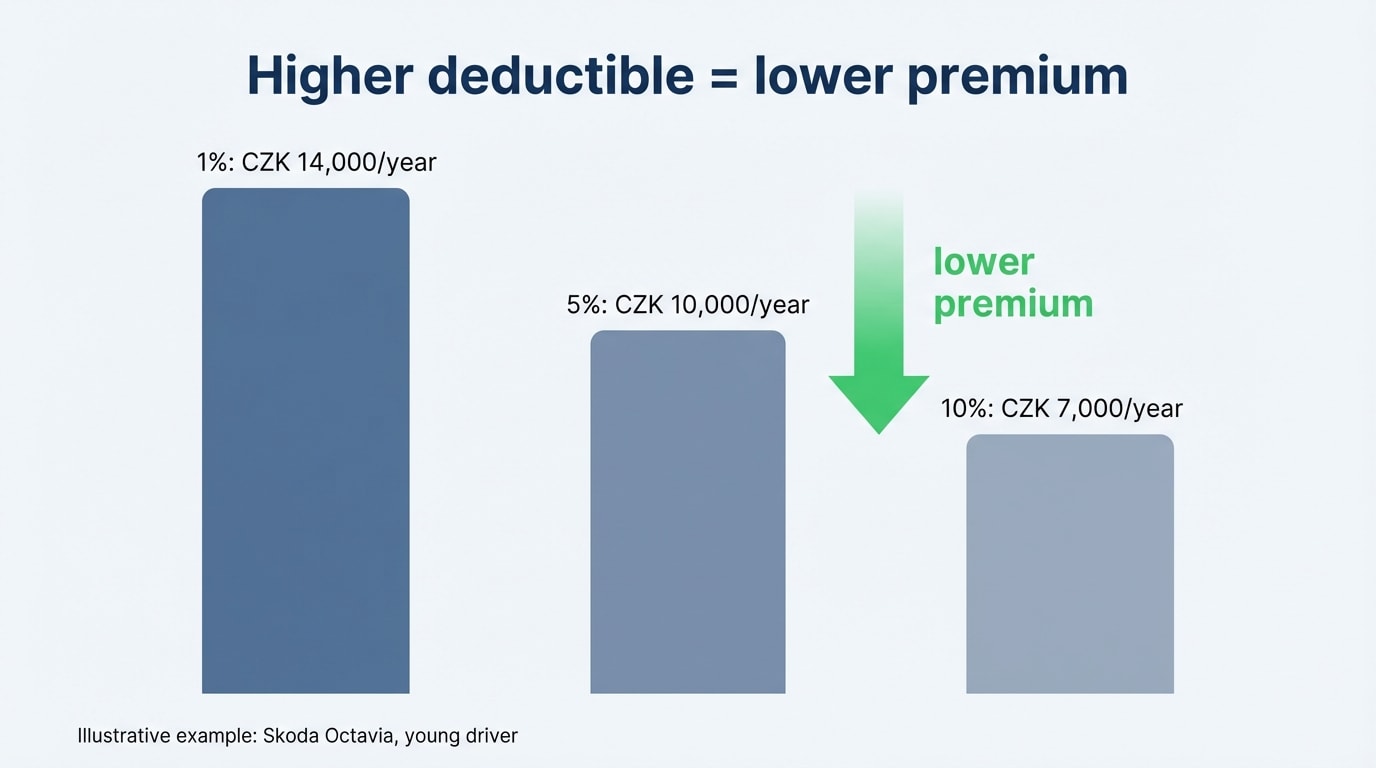
Other common options include 10% min. CZK 10,000 (significantly lower premium, but you need cash for smaller repairs), 1% min. CZK 1,000 (pricier premium, minimal out-of-pocket), and zero deductible (most expensive option — the insurer pays everything). Deductible ranges span from 0 to 30%.
For a young driver, a higher deductible is a smart strategy. Moving from 5% to 10% can cut the annual premium by thousands of crowns. The condition is that you have a financial reserve to cover minor repairs. More strategies for lowering your premium are in the chapter How to Save on Insurance.
What Comprehensive Insurance Doesn't Cover — Exclusions You Must Know
Every insurance contract has exclusions — situations where the insurer refuses to pay. With an all-risk policy, exclusions are the only way the insurer can avoid paying, so make sure you actually read them in the policy terms. Here are the most important ones.
Alcohol and drugs — driving under the influence of alcohol, narcotics, or medications that prohibit driving. If you test positive after an accident, the insurer won't pay a single crown. This applies absolutely and without exception. The same goes for driving without a valid driving license of the appropriate category and driving during a driving ban.
Intentional damage — if you or a member of your household deliberately damages the car, the insurer covers nothing. This also includes criminal activity — damage that occurs while committing a crime.
Wear and maintenance — corrosion, natural wear, breakdowns from neglected maintenance. Comprehensive insurance isn't a service contract. If your engine leaks because you skipped oil changes, the insurer won't deal with it.
Motorsport — participation in races, competitions, or test drives on a circuit. Even a casual track day with friends — if you damage the car on a racing circuit, your coverage doesn't apply.
Expired vehicle inspection — a vehicle that doesn't meet roadworthiness requirements. An expired technical inspection (STK) can be grounds for claim denial.
Water in the engine — if you drive into deep water and the engine inhales water into the combustion chamber, the insurer typically won't cover it. Hail and floods are covered — but actively driving through deep water is a different matter.
Insurers differ in their non-standard exclusions. Some don't cover damage during towing, others have exclusions for damage caused by cargo inside the vehicle. That's why you should always read the General Insurance Terms (VPP) before signing — it's dry reading, but it can save you an unpleasant surprise.
Alcohol = zero payout
Driving under the influence is an absolute exclusion with every insurer. A single positive breath test and the insurer pays nothing — regardless of the damage amount. What's more: with liability insurance, the insurer pays the injured party but then recovers the full amount from you (subrogation).
How Much Does Comprehensive Insurance Cost
The price of comprehensive insurance depends on dozens of factors, but for you as a new driver, two are key: the car's value and your age. The average price ranges between CZK 8,000 and 11,000 per year, but the spread is enormous.
Specific examples for all-risk with a 5%, min. CZK 5,000 deductible: a 2012 Škoda Fabia runs CZK 3,600–4,800 per year, a 2016 Škoda Octavia 1.6 costs CZK 5,900–8,000, a 2014 Škoda Octavia 2.0 runs CZK 8,000–11,000, and a 2019 Škoda Kodiaq (insured value CZK 650,000) costs CZK 21,900–35,900. These prices are for an experienced middle-aged driver with 173 months of claim-free history.
As a young driver under 25–30 with no bonuses, expect a surcharge of 30–60% on top of these prices. Why insurers charge young drivers so much is a topic for a separate chapter — in short: statistically you cause more accidents, you have no bonuses, and insurers factor that into the price.
What else affects the price? The car's make, model, and engine (more powerful = pricier). Age and current value of the vehicle (newer = higher insured value = more expensive premium). Driver's age and claim-free history. Residence — Prague and large cities are pricier due to higher accident rates and theft. Deductible amount. Coverage scope (all-risk vs. partial). Parking method — a garage is cheaper than the street. And whether you're bundling comprehensive insurance with liability insurance at one insurer — the package discount is usually noticeable.
Comprehensive insurance prices have been rising slightly in recent years. The reasons are inflation, more expensive spare parts, and higher repair costs at authorized service centers. Year-over-year increases have stayed in the single-digit percentages.
Bonus/Malus — Building Your Discount
Similar to liability insurance, comprehensive insurance also has a bonus system. For every 12 months without an at-fault claim, you earn a 5–10% discount on the premium. The maximum bonus reaches 50–60% — after 10 or more years without an accident.
You might be surprised that most insurers base the comprehensive insurance bonus on your liability insurance bonus. If you have a 50% bonus on liability insurance thanks to a long claim-free history, you'll get a similar discount on comprehensive coverage. For you as a new driver, though, this means the same thing as with liability insurance — you start at zero, no discount, full price.
When you cause an accident and file a claim, 2–3 years get deducted from your claim-free history. Unlike liability insurance, however, comprehensive insurance doesn't apply a true malus — the insurer can only reduce the bonus to zero, not raise the premium above the base rate. That's at least a small consolation.
Good news: damage caused by natural disasters, vandalism, or theft doesn't reduce your bonus. You're not responsible for those events, so the insurer doesn't penalize you. And when switching to a different insurer, the length of your claim-free history transfers (not the percentage bonus itself — the new insurer recalculates according to their own rules).
When Comprehensive Insurance Is Worth It and When It's Not
This is the key question, and the answer depends on one simple calculation: how much would a total loss cost you out of pocket?
Worth it for a new car up to 5–7 years old, where the value is high and the potential loss is enormous. Worth it for a car on a lease or loan, because the bank requires it outright. Worth it for a car valued over CZK 150,000 — a total loss would be a serious financial blow. And paradoxically, it's worth it precisely for you as a young driver with higher accident risk — even though the premium is pricier.
Not worth it for an old car with low value, where the annual premium plus deductible would represent a substantial portion of the car's price. General rule: if the annual premium exceeds 10% of the car's value, comprehensive insurance doesn't make economic sense. A car worth less than CZK 100,000? After deducting the deductible from a total loss payout, you'll get a fraction, and years of premiums won't make up for it. Better to set the money aside as a financial reserve.
But beware — an old car doesn't automatically mean a worthless car. A well-maintained classic or a popular used car can have a market value in the hundreds of thousands. What matters is value, not age.
Decision example
You bought a used Škoda Octavia for CZK 180,000. An all-risk policy costs you CZK 9,000 per year with a 5%, min. CZK 5,000 deductible. The annual premium is 5% of the car's value — makes sense. But if the car were worth CZK 60,000 and the premium stayed at CZK 6,000, that's 10% of the value — borderline, better to save the money instead.
Watch Out for Underinsurance
A common mistake: you set the insured value lower than the car's actual market value to save on premiums. But if the insured value doesn't match reality, the insurer can reduce payouts even on partial repairs. Conversely, there's no point setting the insured value higher than the market price — the insurer will never pay more than the car is actually worth. You'd just overpay on premiums.
Update your insurance contract at least once every two years — ideally every year. Cars depreciate and the insured value should match the current market price. You can check market value through cebia.cz or by comparing listings on car marketplaces.
GAP Insurance — Protection for New Cars
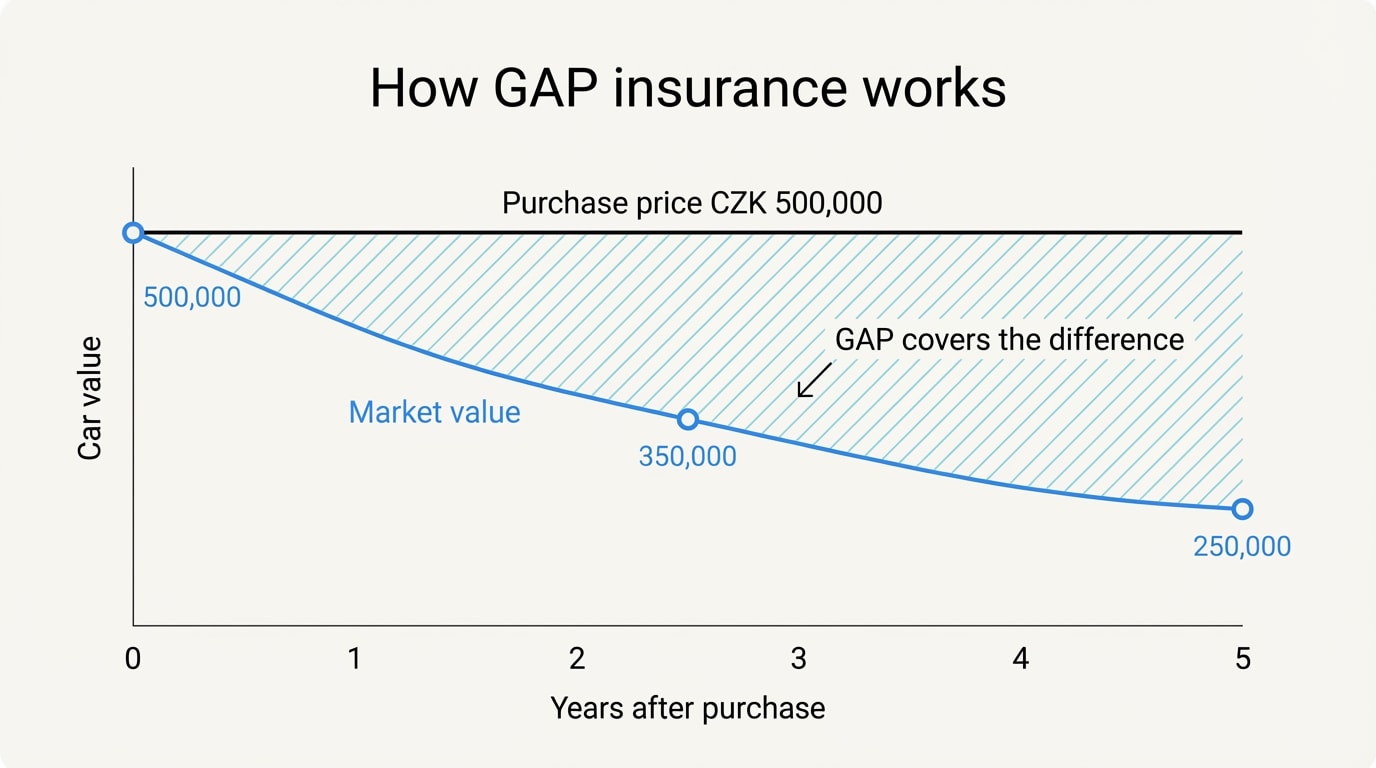
Imagine you bought a car for CZK 500,000. Three years later, someone steals it. The insurer pays the current market value — say CZK 350,000. You're CZK 150,000 short of the purchase price. You can't afford the same class of car anymore.
GAP insurance (Guaranteed Asset Protection) solves exactly this problem. It's supplementary coverage to comprehensive insurance that, in case of a total loss or theft, pays the difference between the market value and the purchase price. In our example, the insurer would pay the missing CZK 150,000.
You typically take out GAP insurance for 2–5 years from purchase (some insurers like UNIQA or Generali offer up to 5–6 years). It's mainly for new and nearly-new cars, where the gap between purchase price and market value is largest. After five years, the car has already lost most of its value and GAP stops making sense.
Additional Supplementary Coverage
You can add several useful extras to your comprehensive insurance. Glass coverage covers the windshield and side windows — usually without a deductible or with a minimal one (around CZK 1,000). Flying stones on the highway are so common that glass coverage is among the most popular add-ons overall.
Driver and passenger injury insurance covers injuries beyond what liability insurance handles (which protects others, not you as the driver). Roadside assistance provides towing, a replacement car, or on-the-spot repair. Luggage insurance covers personal belongings in the car. And legal protection provides a lawyer in case of a traffic dispute. Each add-on costs roughly a few hundred crowns per year and depends on what matters to you.
How to Get Comprehensive Insurance
The fastest route is through online comparison sites — ePojisteni.cz, Srovnejto.cz, Usetreno.cz, or Kalkulator.cz. Enter your car details and personal information, and within minutes you'll have quotes from most insurers in one place. You can also sign up directly on an insurer's website or through an insurance broker — they'll help you choose if you're unsure.
In Czechia, comprehensive insurance is offered by Generali Česká pojišťovna, Kooperativa, Allianz, ČSOB Pojišťovna, UNIQA, Direct, Slavia, and Pillow. Prices for the same car and driver vary significantly — that's why comparing always pays off. And one more tip: get comprehensive insurance together with liability insurance from the same insurer. The bundle discount is usually noticeable and saves you hundreds to thousands of crowns.
If you're looking for more specific strategies to save on insurance, check out the chapter How to Save on Insurance. And if you're curious about how to handle things properly when something happens, read What to Do After an Accident — including how to file a comprehensive insurance claim.
Summary
- Comprehensive insurance protects your own car — unlike liability insurance, which covers damage you cause to others
- All-risk covers all risks except exclusions, partial covers only selected risks — for newer cars, choose all-risk
- Deductible lowers the premium — most commonly 5%, min. CZK 5,000; higher deductible = cheaper policy
- As a young driver, you pay 30–60% more than an experienced middle-aged driver
- Comprehensive insurance makes sense for cars over CZK 150,000, doesn't make sense under CZK 100,000
- Watch out for underinsurance — the insured value must match the car's actual market value
Key Terms
| Term | Explanation |
|---|---|
| Comprehensive insurance (havarijní pojištění) | Voluntary insurance for your own vehicle — covers collisions, theft, vandalism, natural disasters |
| All-risk | Full coverage — covers everything except what's explicitly excluded in the contract |
| Partial | Selective coverage — covers only chosen risks (theft, natural disasters, vandalism, glass, etc.) |
| Deductible (spoluúčast) | The amount you pay from each claim yourself; the insurer covers the rest |
| Insured value (pojistná částka) | Maximum amount the insurer will pay — should match the car's market value |
| Underinsurance (podpojištění) | Insured value set lower than actual vehicle value — the insurer can reduce payouts |
| GAP insurance | Supplementary coverage that pays the difference to the purchase price after a total loss/theft |
| Exclusion (výluka) | Situation explicitly excluded from coverage — alcohol, intent, motorsport, wear, etc. |
| Bonus | Discount for claim-free driving — 5–10% per year, max. 50–60% after 10+ years |
| VPP (General Insurance Terms) | Detailed rules of the insurance contract for a specific insurer |