
What Can You Tow with a Category B License?
You can tow more than you think with a category B license. When the 750 kg limit applies, when it doesn't, and how to calculate your total weight.
"With a category B license, you can only tow a small trailer up to 750 kg." You hear it everywhere — from friends, on forums, sometimes even in driving schools. But it's not true. The rules are more complex and often more favorable than people think. Many drivers pay for an extension they don't need — while others risk a fine of up to 50,000 CZK because they miscalculated their combination weight.
This chapter will explain once and for all what exactly you can tow with a category B license, how the weight limits work, and when your standard license is still enough. No legal jargon — just clear rules, real examples, and a simple process you can do yourself.
Quick summary:
- With a category B license, you can tow a braked trailer over 750 kg — as long as the total MAM of the combination doesn't exceed 3,500 kg
- For licensing purposes, the MAM from the vehicle registration counts, not the actual load weight
- An unbraked trailer up to 750 kg can be towed without further conditions — the combination can weigh up to 4,250 kg
- The key numbers are in your vehicle registration under field F.1 (MAM) and O.1/O.2 (max. trailer weight)
Three Rules You Need to Know
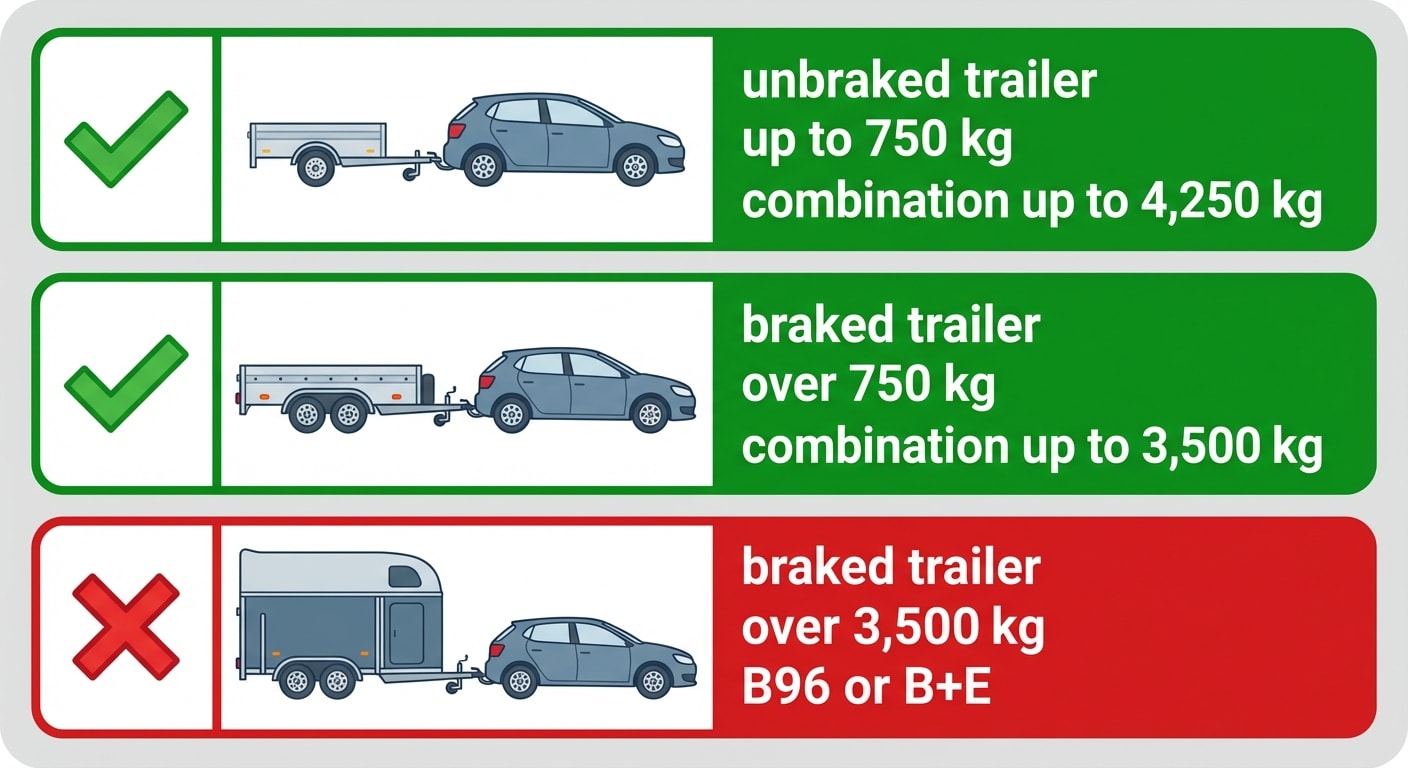
The Road Traffic Act (§80a of Act No. 361/2000 Coll.) defines three situations where you can drive a combination with a category B license. It looks like three paragraphs full of numbers, but it's actually simple logic.
Rule number one applies to small unbraked trailers. If the trailer has a MAM (Maximum Authorized Mass) of up to 750 kg and no brakes of its own, you can tow it without any further conditions. The total MAM of the combination can reach up to 4,250 kg. That means even with a heavy SUV with a MAM of 3,500 kg and a small garden trailer with a MAM of 500 kg, you're fine. This rule covers most of the standard utility trailers you'll find at hardware stores.
Rule number two is the one most people don't know about. With a category B license, you can also tow a braked trailer with a MAM over 750 kg. There's just one condition: the total MAM of the combination (car + trailer) must not exceed 3,500 kg. So if you have a car with a MAM of 2,000 kg and hitch a braked trailer with a MAM of 1,400 kg, the combination is 3,400 kg and your standard license is all you need. No extension, no course, no extra money.
Rule number three defines where category B ends. Once the total MAM of the combination with a braked trailer over 750 kg exceeds 3,500 kg, you need an extension. Up to 4,250 kg, B96 is enough — quick and cheap. Over 4,250 kg, you need a full B+E license.
Quick test
Check your car's vehicle registration, field F.1 (MAM). Do the same with the trailer. Add the two numbers. Result under 3,500 kg? Category B is enough. Result 3,500–4,250 kg? You need B96. Over 4,250 kg? You need B+E.
MAM vs. Actual Mass — Why It Matters
This is where most drivers get confused, yet it's the key to the entire system. There are two different weights, and the law treats each one differently.
MAM (Maximum Authorized Mass) is the number written in the vehicle registration of your car and trailer — field F.1. It's the maximum weight that the manufacturer has authorized for that vehicle. This number doesn't change based on how much you're actually carrying. And it's the MAM that determines which license category you need.
Actual mass is how much the car or trailer currently weighs — with cargo, passengers, and fuel. This weight changes every time you load or unload something. The actual mass must not exceed the MAM (that would be overloading), but it doesn't count toward your license requirements.
What does this mean in practice? Imagine you have a trailer with a MAM of 1,200 kg, but you load only 300 kg of materials and the empty trailer weighs 400 kg. The actual mass is 700 kg. But the law doesn't look at 700 kg — it looks at 1,200 kg from the vehicle registration. For the combination calculation, the MAM always applies.
This is why some drivers run into trouble: the trailer is half empty, but on paper the combination is over the limit. And conversely — the fact that you loaded the trailer lightly doesn't free you from needing the correct category.
Note: roadside inspection
Police check two things separately. Your license category is assessed by MAM from the vehicle registration — nothing gets weighed. But they can measure the actual mass on scales, and if it exceeds the trailer's MAM, that's overloading (fine of approximately 2,000 CZK). You need to watch both.
Where to Find the Right Numbers in Your Vehicle Registration
The vehicle registration looks like an incomprehensible table full of codes, but for our purposes you only need four fields. Each has a standardized code that's the same across the entire EU.
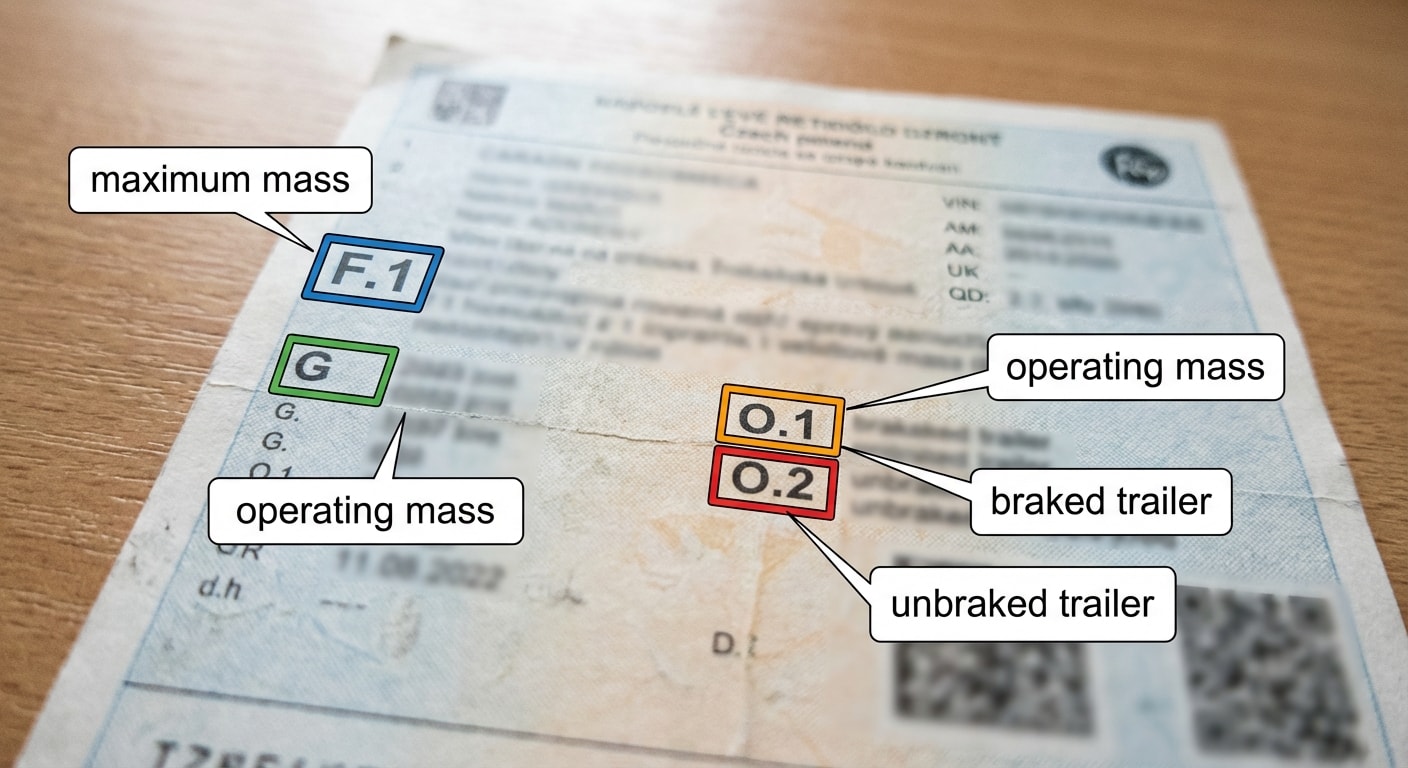
Field F.1 — MAM of the entire vehicle. You'll find this for both the car and the trailer. Add them together and you have the MAM of the combination. This is the field the whole licensing system revolves around.
Field G — unladen mass. This is the weight of the empty vehicle with fluids (oil, coolant) but without passengers or cargo. Useful for estimating how much cargo capacity you have left.
Field O.1 — maximum authorized mass of a braked towed vehicle. This number tells you how heavy a braked trailer you can hitch to your car. It depends on the car's construction and the towbar.
Field O.2 — maximum authorized mass of an unbraked towed vehicle. Usually 500–750 kg. The actual mass of an unbraked trailer must not exceed this value.
In practice, it works like this: add field F.1 of the car and F.1 of the trailer to determine the license category. Then verify that the actual mass of the trailer doesn't exceed O.1 (braked) or O.2 (unbraked) in the car's registration. Both conditions must be met simultaneously.
Braked vs. Unbraked Trailer — What's the Difference
This distinction affects not only your license requirements but also the safety and technical limits of the entire combination. It's not just a formality.
An unbraked trailer (category O1) has no braking system of its own. Only your car's brakes stop it. That's why its MAM is limited to 750 kg — a heavier trailer without its own brakes couldn't be stopped reliably by the towing vehicle. Additionally, Decree No. 209/2018 Coll. requires that your car's unladen mass must be at least twice the weight of the unbraked trailer. So a lighter car with a heavy unbraked trailer is a problem both technically and legally.
A braked trailer (category O2) has its own braking system — most commonly an overrun brake that activates through inertia when the towing vehicle brakes. Thanks to its own brakes, it can have a MAM over 750 kg and up to 3,500 kg. Braked trailers are typical for caravans, boat trailers, horse transporters, and larger cargo trailers.
For license purposes, only the sum of the MAMs matters — it doesn't matter whether the trailer is braked or not. But for technical compatibility (whether your car can "handle" the trailer and stop safely), the O.1 and O.2 values in the vehicle registration and the decree on vehicle combination rules are what count.
Real-World Examples — What You Can Handle with B
Dry paragraphs of law without examples are pointless. Here are six real situations that cover most of what drivers deal with. All the numbers correspond to actual car models and commonly available trailers in the Czech Republic.
What you can handle with category B — examples
| Situation | Car (MAM) | Trailer (MAM) | Combination | License needed |
|---|---|---|---|---|
| Small garden trailer | Škoda Octavia (1,780 kg) | 500 kg | 2,280 kg | B |
| Larger utility trailer | Škoda Octavia (1,780 kg) | 750 kg | 2,530 kg | B |
| Motorcycle trailer | Škoda Kodiaq (2,100 kg) | 600 kg | 2,700 kg | B |
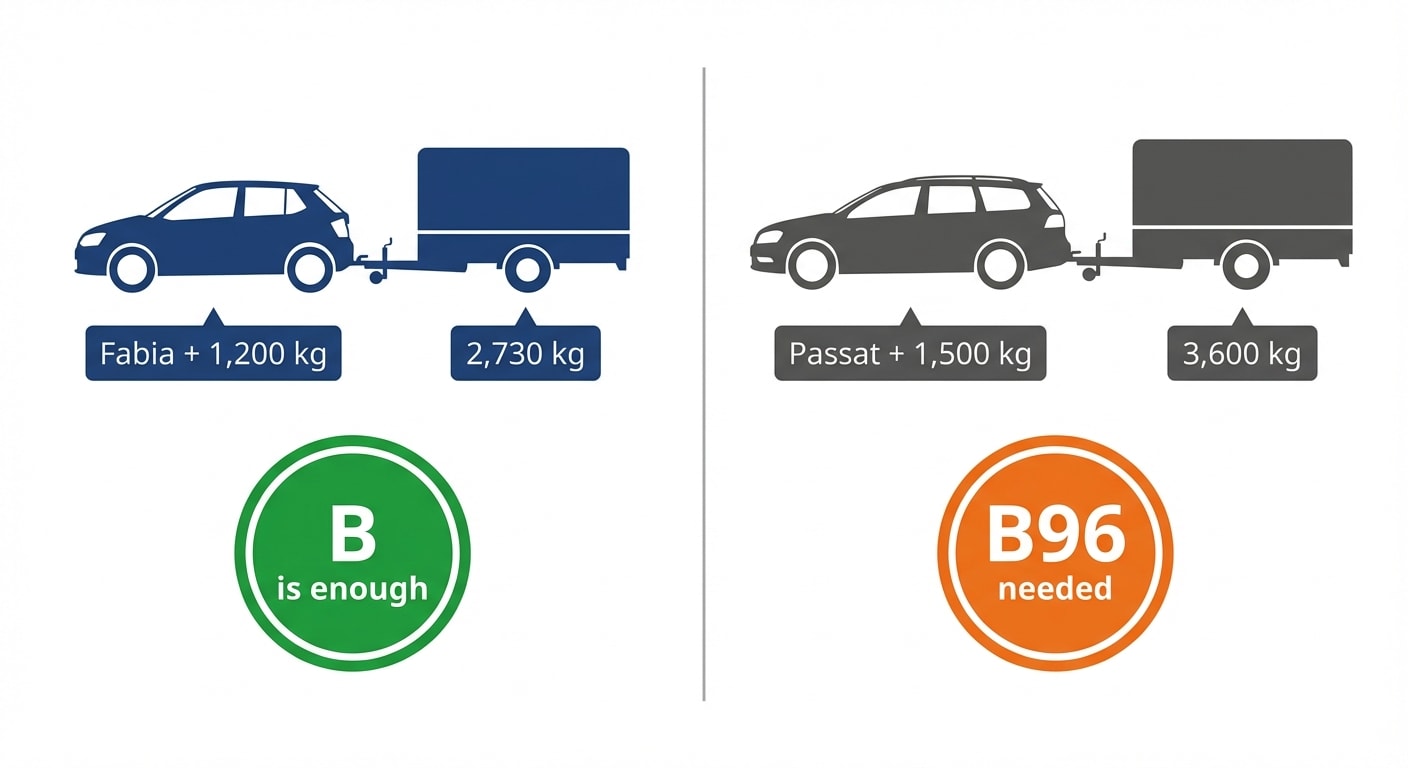
| Braked trailer, lighter car | Škoda Fabia (1,530 kg) | 1,200 kg | 2,730 kg | B |
| Braked trailer, heavier car | VW Passat (2,100 kg) | 1,500 kg | 3,600 kg | B96 |
| Large boat trailer | Ford Ranger (3,270 kg) | 2,500 kg | 5,770 kg | B+E |
Notice the fourth row: a Škoda Fabia with a MAM of 1,530 kg and a braked trailer of 1,200 kg. The combination is 2,730 kg — comfortably under the 3,500 kg limit. You can drive this with a category B license. And the trailer weighs over 750 kg. This is exactly the case most people don't know about.
Conversely, the fifth row shows where category B is no longer enough. A VW Passat (2,100 kg) with a 1,500 kg trailer gives 3,600 kg — a hundred kilos over the limit. You'd need at least B96, which takes just a few hours and costs a few thousand crowns.
How to Calculate It in Under a Minute
You don't need to be an engineer. The whole calculation has seven steps and takes less time than reading this paragraph.
- Get your car's vehicle registration. Find field F.1 — that's your car's MAM.
- Get the trailer's vehicle registration. Find field F.1 — that's the trailer's MAM.
- Add both numbers. This is the MAM of the combination.
- Result up to 3,500 kg and trailer over 750 kg? Category B is enough.
- Result 3,500–4,250 kg? You need B96 (a few hours, a few thousand crowns).
- Result over 4,250 kg? You need B+E (full course).
- Also check field O.1 (braked) or O.2 (unbraked) in the car's registration — the actual mass of the trailer must not exceed it.
Calculation example
Car: Hyundai Tucson, F.1 = 2,110 kg. Trailer: braked motorcycle trailer, F.1 = 1,300 kg. Total: 3,410 kg. Result is under 3,500 kg → category B is enough. Field O.1 in the Tucson's registration: 1,650 kg. Trailer with motorcycle weighs roughly 900 kg → under the O.1 limit. Everything checks out, you're good to go.
Common Myths
There are plenty of half-truths circulating about towing with a category B license. Here are the most widespread ones — and how things actually work.
"With category B, you can only tow 750 kg." This is the most common myth. The 750 kg limit applies to unbraked trailers without further conditions. You can tow a braked trailer over 750 kg as long as the combination's MAM doesn't exceed 3,500 kg. The law states this clearly in §80a.
"It depends on how much I'm hauling." Not for license purposes. The MAM from the vehicle registration is what counts. Even an empty trailer with a MAM of 1,500 kg counts as 1,500 kg in the calculation. Police check the actual mass separately — for overloading.
"I can lower the trailer's MAM so I don't need an extension." This one is surprisingly true. The trailer manufacturer or a vehicle inspection station can administratively reduce the MAM in the vehicle registration. If that brings the total under 3,500 kg, a category B license is all you need. But keep in mind — a lower MAM means you can load less. And not every trailer allows this.
"Braked or unbraked — it doesn't matter for the license." For the licensing calculation, correct — only the MAM counts. But for the technical fitness of the combination, it does matter. An unbraked trailer is limited to 750 kg and the car's unladen mass must be at least twice that of the trailer. A braked trailer can have a MAM up to 3,500 kg, but its actual mass must not exceed the O.1 value in the car's registration.
Towbar — You Can't Go Anywhere Without One
Before you start calculating weights, make sure your car actually has a towbar. It might sound trivial, but many modern cars don't even offer one as an option. And without an approved towbar, you can't hitch a trailer — not even the lightest one.
The towbar must have type approval under regulation EC 94/20 (marking "e") or ECE 55 (marking "E"). Installation is done by an authorized workshop and the change must be recorded in the vehicle registration within 14 days. The recording fee is 50 CZK. The towbar itself costs from about 5,000 CZK for aftermarket brands up to 14,000 CZK and more for an original part with dealer installation.
Before buying a trailer, check with your dealer or in the vehicle registration whether your car supports towing at all. Not all vehicles have non-zero values in fields O.1 and O.2.
When Category B Isn't Enough
Naming the boundary clearly is important. If the combination's MAM exceeds 3,500 kg with a braked trailer over 750 kg, you need an extension. And this doesn't apply only to owners of large caravans or horse transporters. A combination of a standard SUV with a MAM of around 2,200 kg and a mid-weight trailer with a MAM of 1,400 kg is already at 3,600 kg.
In that situation, you have two options. B96 covers combinations up to 4,250 kg and you can get it in 1–3 weeks for 3,500–8,000 CZK. No written tests — just a practical exam. For most caravan owners and drivers with mid-weight trailers, that's all you need.
If the combination exceeds 4,250 kg, you need B+E. That's a full course with theory and a practical exam costing 7,000–15,000 CZK. B+E covers combinations up to 7,000 kg and is the typical choice for large caravans, heavy boat trailers, or transporters for two horses.
One more thing: driving with a trailer without the correct license category isn't a slap-on-the-wrist offense. The fine is 25,000–50,000 CZK, a driving ban for 12–24 months, and 4 penalty points (§125c of Act No. 361/2000 Coll.). A B96 course costs a fraction of that fine.
Change ahead
EU Directive 2025/2205 plans to raise the category B limit from 3,500 kg to 4,250 kg for all fuel types. Member states must implement the rule by November 26, 2027 — the Czech Republic is expected to adopt it around 2027–2029. Until then, current limits apply.
If you're about to tow a trailer for the first time, don't forget to read the chapter on Towing Safety — even with a light combination, it's good to know the rules for proper loading and braking distances. And if you're interested in caravans, you'll find specific examples of small models that fit within category B there.
Summary
- With a category B license, you can tow a braked trailer over 750 kg — as long as the combination's MAM (F.1 of car + F.1 of trailer) doesn't exceed 3,500 kg
- An unbraked trailer up to 750 kg can be towed without further conditions, and the combination can weigh up to 4,250 kg
- For license purposes, the MAM from the vehicle registration is what counts, not the actual load weight
- The actual mass of the trailer must not exceed field O.1 (braked) or O.2 (unbraked) in the car's registration
- The trailer's MAM can be administratively reduced — this may bring the combination under the 3,500 kg limit
- Combination over 3,500 kg → B96 (up to 4,250 kg) or B+E (up to 7,000 kg)
Key Terms
| Term | Explanation |
|---|---|
| MAM (Maximum Authorized Mass) | The maximum weight of a vehicle or trailer from the vehicle registration — field F.1. Determines which license category you need. |
| Actual mass | The real weight of the loaded vehicle at a given moment. Doesn't count for license purposes, but must not exceed the MAM. |
| Unbraked trailer (O1) | Trailer without its own brakes — maximum MAM 750 kg. Stopped only by the towing vehicle. |
| Braked trailer (O2) | Trailer with its own braking system (overrun brake) — MAM over 750 kg, up to 3,500 kg. |
| Field F.1 | Vehicle registration field: MAM of the entire vehicle. Add F.1 of car + F.1 of trailer = MAM of combination. |
| Field O.1 | Vehicle registration field for the car: max. mass of a braked trailer you can hitch. |
| Field O.2 | Vehicle registration field for the car: max. mass of an unbraked trailer you can hitch. |
| Combination MAM | Sum of the car's MAM and the trailer's MAM — the decisive number for determining the license category. |
| Towbar type approval | Official approval of the towbar (EC 94/20 or ECE 55) — mandatory for hitching any trailer. |
| Decree No. 209/2018 Coll. | Regulation on weights, dimensions, and vehicle combination rules — sets the technical requirements for hitching a trailer. |