
What to Do After a Car Accident — Step by Step
On-scene procedure, European accident report, Bouračka app, insurer notification, and impact on future premiums. New rules from July 2025.
The crunch. The scrape of metal. Silence. Then a wave of adrenaline that won't let you think straight. For most new drivers, the first accident is one of the most stressful moments behind the wheel. And right when your brain switches to panic mode, you need to know exactly what to do — step by step, no thinking required.
According to BESIP data, drivers with fewer than two years of experience cause 11% of all accidents on Czech roads, despite making up just 3% of all drivers. That's over 10,000 accidents per year. Statistically, there's a real chance you'll be involved in some kind of accident during your first years of driving — whether it's your fault or not. This article is your cheat sheet. Read through it, save it to your phone. When it happens, you'll know what to do.
Quick summary:
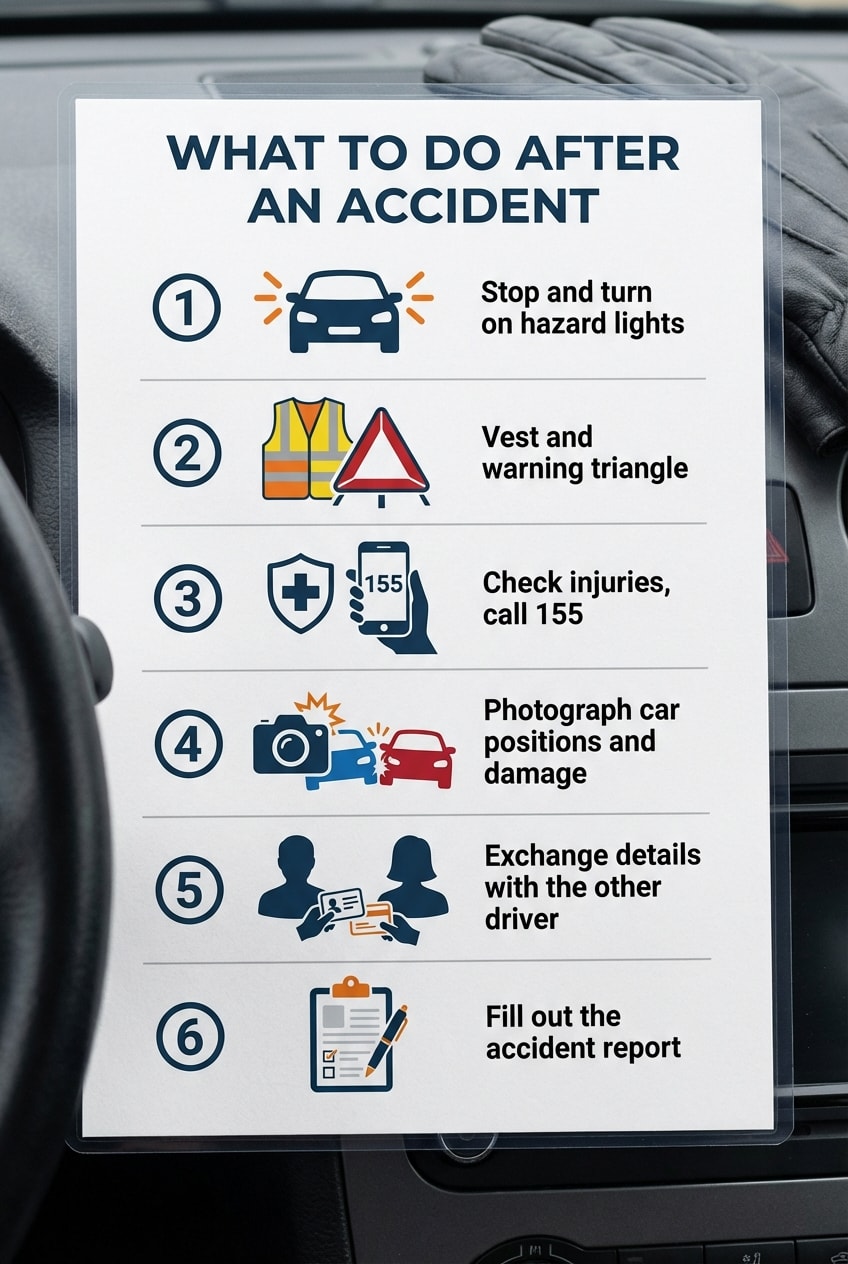
- Stop, put on your vest, set up the warning triangle, check for injuries — always in this order
- Call the police only if someone is injured, the damage exceeds CZK 200,000, or third-party property is damaged — new limit effective July 1, 2025
- Fill out an accident report on paper or via the Bouračka.cz app — the electronic report is automatically sent to insurers
- One at-fault accident will affect your premiums for 3–4 years — as a new driver, you go straight into a malus surcharge
The First Five Minutes Matter Most
Stop. That's the first and unconditional obligation. The law (Section 47 of Act No. 361/2000 Coll.) is clear: every participant in an accident must stop their vehicle, turn on hazard lights, and refrain from consuming alcohol or drugs until the police arrive or the situation is resolved. Yes, you read that right — even one beer after an accident is a traffic offense.
Once you've stopped, put on your reflective vest. You're required to have one in the car by law, and you must put it on before you step out. Then set up your warning triangle at least 50 meters behind your vehicle. On highways, it's at least 100 meters. The triangle protects you and other drivers — secondary collisions are a real danger, especially at night or in poor visibility.
Now check if anyone is injured. If so, immediately call the emergency number 112 or the ambulance service at 155. Failing to help an injured person is a criminal offense — a driver who doesn't provide assistance after an accident faces up to 5 years in prison (Section 151 of the Criminal Code). This isn't meant to scare you. Basic first aid is enough: call an ambulance, stop the bleeding, keep the injured person conscious. Nobody expects miracles — but you must not leave.
Alcohol after an accident = offense
The law prohibits you from consuming alcohol or drugs from the moment of the accident until the police arrive or the investigation is complete. Not even 'one beer to calm down' — if the police test you with a positive result, you'll be in trouble even if you originally did nothing wrong.
When to Call the Police and When Not To
New rules have been in effect since July 1, 2025. The damage threshold requiring police involvement has doubled from CZK 100,000 to CZK 200,000. The reason? Repairs on modern cars keep getting more expensive — even a minor parking lot collision can run into the hundreds of thousands. The old limit meant police had to show up for practically every fender bender.
You must always call the police when someone is injured or killed. That's unconditional. Also when the estimated damage exceeds CZK 200,000, when third-party property is damaged (a fence, wall, utility pole, guardrail, traffic sign), when you can't restore smooth traffic flow, or when you can't identify the other participant. And if you simply can't agree with the other driver on who caused the accident — calling the police isn't mandatory in that case, but it's strongly recommended.
If the damage is under CZK 200,000, no one is injured, and no third-party property is damaged, you don't need to call the police. Just exchange information with the other driver and fill out an accident report. But be careful — "just exchanging phone numbers" isn't enough. Without a proper report, the damaged party has no way to document the incident for their insurer.
Emergency numbers you need to know
112 — general emergency (police + ambulance), 150 — fire department, 155 — ambulance, 158 — police. Save them to your speed dial. You can reach 112 even without a SIM card and from a locked phone.
Photograph Everything — Before Anyone Moves the Cars
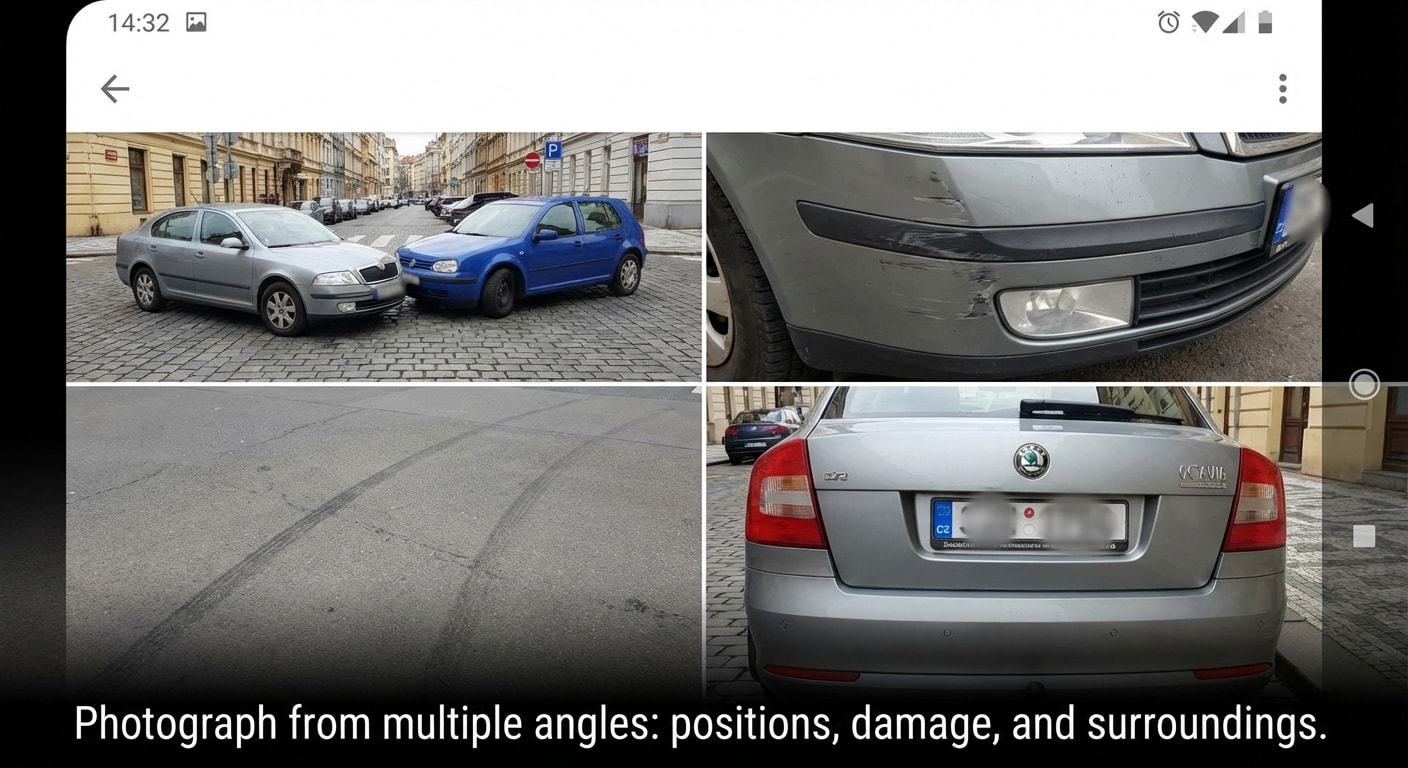
Before anything else gets resolved, pull out your phone and start taking photos. The positions of both vehicles from multiple angles. Damage up close and from a distance. Skid marks on the road. License plates of both cars. Traffic signs in the area. Weather conditions and visibility. The more photos, the better — both the insurer and the police will appreciate detailed documentation.
An important change took effect in July 2025: photographs can now officially replace hand-drawn diagrams in the accident report. That's great news, because sketching an accident scene on a wet hood in the rain was always a nightmare. Quality photos of the vehicle positions now fully suffice.
Don't move the vehicles until they've been documented. The only exception is when the cars are blocking traffic and creating a safety hazard — for example, they're stopped in the middle of a blind curve. In that case, move them, but only after taking photos.
Accident Report — Paper or Bouračka?
Exchange basic information with the other driver: name, address, date of birth, license plate, insurer, and policy number. Then fill out an accident report. You have two options.
The paper European Accident Statement is a standardized form recognized across all of Europe. You're not required to keep one in your car, but it's smart to have one — you can print it from the Ministry of Transport website, your insurer's website, or Cebia.cz. The form has self-copying sheets; each driver keeps one copy. Both drivers must sign it. It includes the date, time, location of the accident, driver and vehicle details, insurance information, a description of circumstances, and a diagram (or photos, starting from July 2025).
Bouračka.cz is the online alternative operated by the Czech Insurers' Bureau (ČKP) since July 2025. It's free, runs directly in your phone's browser, and you don't need to install anything. Only one of the participants needs a phone. The app scans your ID card, reads the license plate from a photo, attaches photo documentation, and marks the location on a map. The other driver confirms the accuracy of the information via an SMS code. The resulting PDF report is emailed to both drivers — and here's the biggest advantage: Bouračka automatically sends the report to both parties' insurers. You don't have to separately call your insurer to report the accident.
For a young driver who has never filled out an accident report before, Bouračka is clearly the more convenient option. It also eliminates errors — the app walks you through the entire process step by step, so you won't skip anything.
Bouračka.cz — your best friend after an accident
This ČKP app is free, works in your browser (no installation needed), scans documents, reads license plates from photos, and automatically sends the report to insurers. Only one participant needs a phone — the other confirms via SMS code. Only valid for accidents without injuries and with damage under CZK 200,000.
Reporting to Your Insurer — Who, How, and by When
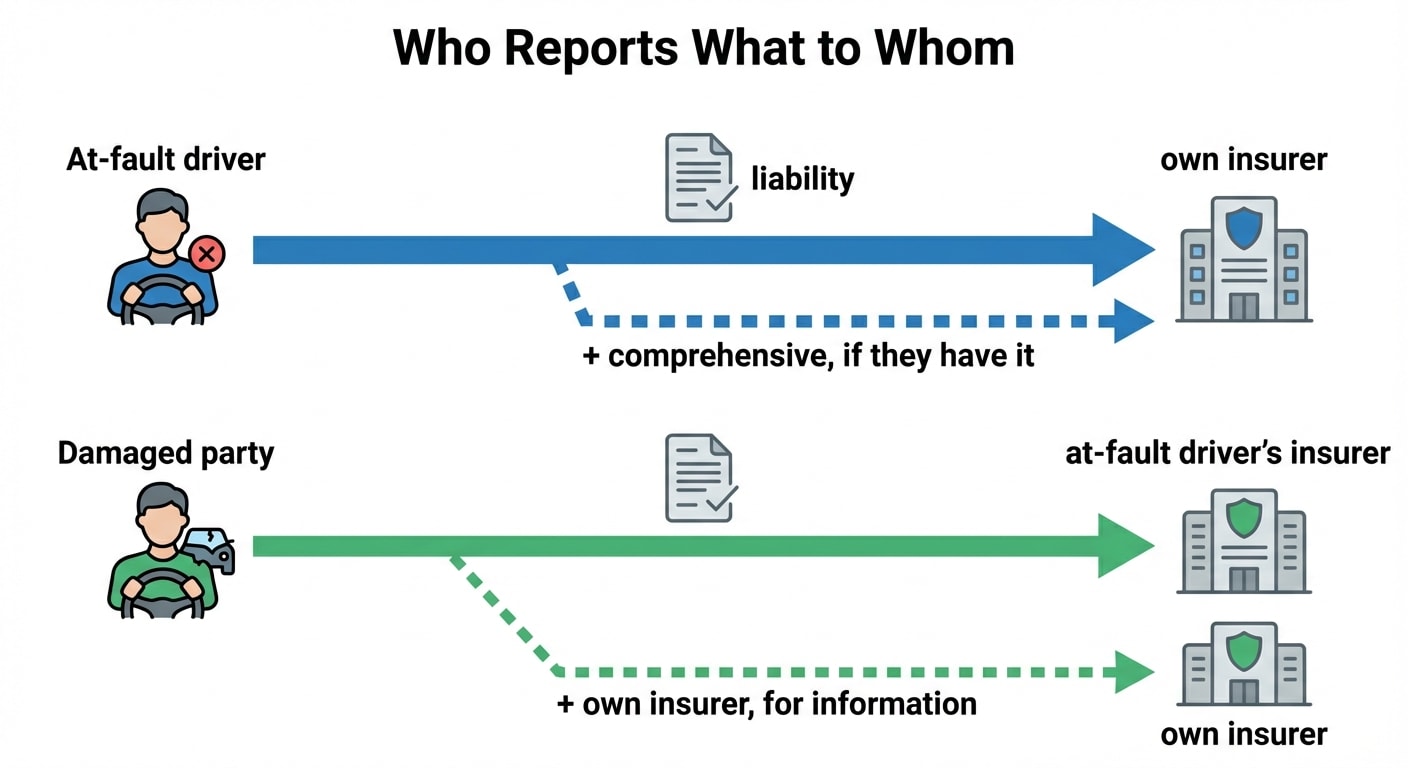
After an accident, you must report the insurance claim to your insurer. But who exactly? It depends on whether you're at fault or the injured party.
If you caused the accident, you report it to your insurer — the one where you have your liability insurance. That's your legal obligation. Your insurer then pays the damaged party's compensation. If you also have comprehensive insurance, you report the damage to your own car separately — under your comprehensive policy.
If you're the damaged party, you file your claim with the at-fault driver's insurer — which is why you need to know their insurer and policy number. Ideally, notify your own insurer as well, even though the at-fault driver's policy is covering the damage. Your insurer can help with communication and speed up the whole process.
The law says "without undue delay" — but doesn't specify an exact number of days. In practice, insurers interpret this as within 15 days. The sooner you report, the better. If you used Bouračka, the report was sent automatically and the insurer already knows about the accident. But it's still a good idea to call and confirm they received it.
You can report via an online form on the insurer's website (fastest), by phone to their assistance line, through the insurer's mobile app, by email with attachments, or in person at a branch. You'll need the policy number, the accident report or police protocol, photo documentation of the damage, details of all participants, and a description of how the accident happened.
The insurer has 3 months by law to complete the investigation and an additional 15 days to pay out the claim. In practice, simpler cases are resolved within 4–8 weeks, more complex ones in 2–3 months. And the statute of limitations? The right to insurance benefits expires after 3 years from the accident (Sections 626 and 629 of the Civil Code). That's plenty of time, but there's no reason to delay.
What an Accident Does to Your Premiums
Here's the painful part. As a new driver, you start with zero bonus — no discount for claim-free driving. And an at-fault accident pushes you into a malus surcharge. We covered how this works in detail in the chapter Why Young Drivers Pay More, but let's look at a concrete example.
For every year without an accident, you accumulate roughly 5–10% off your premiums. The maximum bonus after 10–12 claim-free years is up to 60%. But after an at-fault accident, the insurer deducts typically 24 months from your claim-free record. For a second accident, it's 36–48 months.
Take this example: you're 18, you've had insurance for a year, and you cause an accident. From 12 months of claim-free driving, they deduct 24 months — you're at −12 months. That means a malus, a surcharge on your premium of around 10%. You were paying CZK 8,700 per year? Now it'll be roughly CZK 9,570. And more importantly — it takes another 3–4 years to get back to zero and finally start building a bonus. One accident holds you back financially for years.
Both the bonus and malus are tied to the policyholder (the person on the contract), not the vehicle. When switching insurers, your claim-free history transfers — ČKP maintains a central database. Some insurers offer a "first accident without bonus impact" product — if you have it, one claim won't reduce your bonus. For a new driver, it's worth having. More on strategies to protect your premium can be found in the chapter How to Save on Insurance.
There's one more option: if the damage is small, you can pay out of pocket and not report it to your insurer. Your bonus stays intact. But it's a gamble — you have to be certain the damage estimate is accurate. A scratched bumper might look like a few thousand crowns, but underneath there could be a damaged sensor worth CZK 15,000. Only consider this for truly minor damage.
Example: Tomáš (18) and the parking lot
Tomáš is parking at a supermarket and scratches the car next to him. The damage looks like about CZK 5,000. What now? He doesn't need to call the police (damage under CZK 200,000, no injuries). But he MUST leave contact information on the car or fill out an accident report. Driving away = hit and run = 4 penalty points + fine of CZK 7,000–25,000 + driving ban of 4–6 months.
Leaving the Scene — Never Do It
One in five drivers in Czechia leaves the scene of an accident. Don't do it. Not even if the damage is tiny. Not even if you think nobody saw you. Parking lot cameras, other drivers' dashcams, witnesses in windows — one license plate is all the police need to find you.
The penalty for leaving the scene is harsh: a fine of CZK 7,000–25,000 in administrative proceedings, 4 penalty points, and a driving ban of 4–6 months. And if someone is injured in the accident and you don't provide assistance, it's a criminal offense carrying up to 5 years in prison. On top of that, the insurer can exercise a right of recourse against a driver who left the scene — they'll pay the damaged party, then recover the amount from you.
Compare: if you'd stayed, filled out the report, and notified your insurer, you'd only be dealing with a repair. By leaving, you've turned it into an offense with points, a fine, and a driving ban. No amount of car damage is worth those consequences.
Leaving the scene = points + fine + driving ban
4 penalty points, a fine of CZK 7,000–25,000, and a driving ban of 4–6 months. If someone is injured and you don't provide assistance: criminal offense — up to 5 years in prison. On top of that, the insurer can recover the paid damages from you. Stay. Always.
Prevention — How to Reduce Your Accident Risk
The statistics are unforgiving: the most common cause of accidents among young drivers is excessive speed — in roughly half of all cases. The most typical accident? Running off the road. It's linked to speed, inexperience, and overestimating your own abilities behind the wheel.
A few things that can help. Drive defensively — expect mistakes from others. Adjust your speed to conditions, not just signs. At night and in the rain, slow down more than you think you need to. Don't overestimate yourself — your first year of driving is a learning period, not a race. And if you completed the L17 program with a mentor, you had a massive advantage over other beginners: L17 drivers caused just 6 accidents in 2024 compared to 1,106 by 18-year-old newcomers without a mentor.
Another thing to watch: the penalty point system and traffic fines. As a new driver, you're in a two-year probationary period — any serious traffic violation has stricter consequences for you. Caution isn't weakness. It's the cheapest insurance you can have.
Summary
- Stop, put on your vest, set up the triangle, check for injuries — in this order, always
- Call the police for injuries, damage over CZK 200,000, or damage to third-party property
- Photograph the scene from all angles before anyone moves the cars
- Fill out the accident report via Bouračka.cz (automatically sent to insurers) or on a paper European Accident Statement
- Report the accident to the insurer without undue delay — at-fault driver to their insurer, damaged party to the at-fault driver's insurer
- One at-fault accident will cost you your bonus for 3–4 years as a new driver — protect your claim-free history
- Never leave the scene — the fine, points, and driving ban aren't worth any repair you're trying to avoid
Key Terms
| Term | Explanation |
|---|---|
| Traffic accident | An event in traffic resulting in injury, death, or property damage in connection with vehicle operation (Section 47 of Act No. 361/2000 Coll.) |
| European Accident Statement | A standardized form for recording an accident without police involvement, recognized across all of Europe |
| Bouračka.cz | ČKP's web application for electronic accident reporting — free, browser-based, automatically sends the report to insurers |
| Insurance claim | A random event giving rise to the insurer's obligation to provide insurance benefits — typically vehicle damage in an accident context |
| Bonus | A discount on premiums for each year without an at-fault accident — roughly 5–10% per year, up to a maximum of 60% |
| Malus | A surcharge on premiums after an at-fault accident — the insurer deducts 24+ months from your claim-free record |
| Right of recourse (regres) | The insurer's right to recover paid damages from the policyholder — applied in cases like leaving the scene or driving under the influence |
| Statute of limitations | 3 years from the insurance event — after expiration, the right to insurance benefits ceases (Section 629 of the Civil Code) |
| ČKP | Czech Insurers' Bureau — operates the insured vehicle database, the bonus/malus system, and the Bouračka.cz app |
| Failure to provide assistance | A criminal offense — a driver who doesn't help an injured person after an accident faces up to 5 years in prison (Section 151 of the Criminal Code) |