
Trailer Towing Safety: Tips and Rules
How to load a trailer properly, prevent swaying, and follow speed limits. Practical tips for safe driving with a trailer.
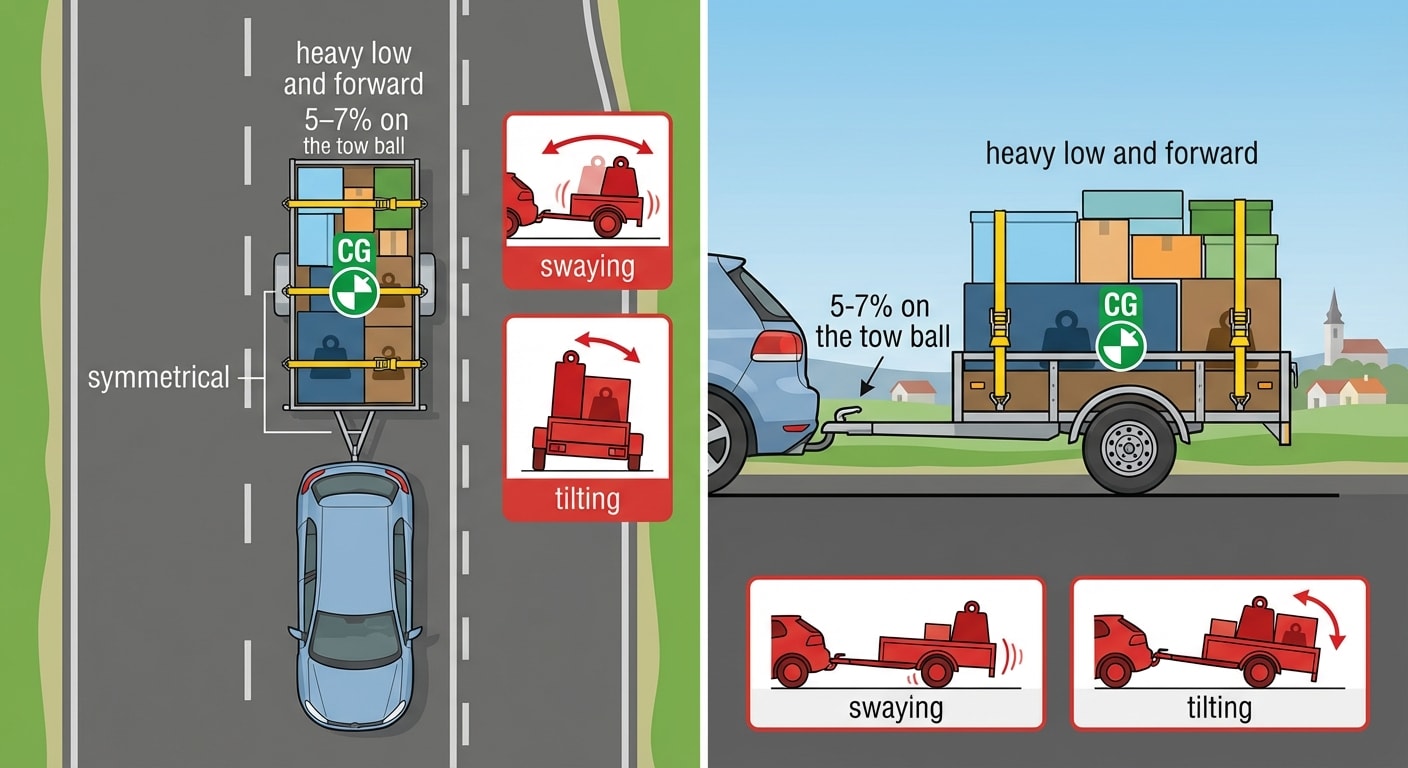
A trailer that starts swaying side to side at highway speed can't be stopped with the steering wheel or the brake. Most drivers instinctively slam the brakes or jerk the wheel — and that's exactly what turns a dangerous situation into a fatal one. Trailer swaying is something you can prevent before you even get in the car. All it takes is loading properly, setting things up right, and driving at a reasonable speed.
This chapter shows you how to safely load a trailer, prevent swaying, what speed limits apply to your combination, and what to do when things go wrong. This isn't theory — it's practical advice that can save your health and your car. If you're still figuring out which license category you need for a trailer, start with What You Can Tow Without an Extension.
Quick summary:
- Proper loading is the foundation of safety — heavy items low and slightly forward, tongue weight 5–7% of trailer weight
- Never fight trailer swaying with the brake or steering wheel — take your foot off the gas and hold the wheel straight
- Heavier combinations (MAW over 3,500 kg) are limited to 80 km/h outside urban areas
- Braking distance increases by 10–30% with a trailer — maintain a 3-second following distance
Speed limits with a combination
Many drivers assume that lower speed limits automatically apply when towing a trailer. It's not that simple — it depends on the total MAW of the combination.
If your combination's total MAW (car + trailer from the registration documents) doesn't exceed 3,500 kg, the same limits apply as without a trailer: 50 in urban areas, 90 outside urban areas, 110 on expressways, and 130 on highways. This surprises most people, but Act No. 361/2000 Coll. (Section 18) states it clearly.
But once the total MAW exceeds 3,500 kg — and that typically happens with combinations requiring B96 or B+E — things change significantly. Outside urban areas, on expressways, and on highways, a uniform limit of 80 km/h applies. In urban areas, the 50 km/h limit stays the same.
Doing 80 on the highway sounds unpleasant, especially when trucks are flying past you. But there's a reason for this speed — a heavier combination has a longer braking distance, is more sensitive to crosswinds, and more prone to swaying. Stick to it. A speeding fine is annoying, but an accident with a heavy trailer at 130 is something else entirely.
Speed limits for combinations
| Road type | Combination MAW ≤ 3,500 kg | Combination MAW > 3,500 kg |
|---|---|---|
| Urban areas | 50 km/h | 50 km/h |
| Outside urban areas | 90 km/h | 80 km/h |
| Expressways | 110 km/h | 80 km/h |
| Highways | 130 km/h | 80 km/h |
One more thing that's often forgotten: you must never exceed the design speed of any vehicle in the combination. If your trailer's registration document lists a maximum design speed of 100 km/h, you can't go faster — even on the highway with a lightweight combination.
Not sure which limit applies to your combination?
Check the registration documents for both your car and trailer — add up the MAW values (field F.1). Up to 3,500 kg you drive as if without a trailer. Over 3,500 kg the maximum is 80 km/h outside urban areas. Exceeding the speed limit while towing is an aggravating factor — fines tend to be higher.
How to load a trailer properly
Proper loading decides whether you'll drive safely or spend the next twenty kilometers fighting a swaying trailer. It's not about piling things on "somehow" and hoping for the best — there are clear rules.
The key number is called tongue weight — the downward force the trailer's drawbar exerts on your car's tow ball. It should be 5–7% of the trailer's total weight. If your trailer is loaded to 1,500 kg, the ball should carry 75–105 kg of downward force. Too little and the trailer starts swaying. Too much and you overload the car's rear axle — worse steering, longer braking distance.
What does this look like in practice? Place the heaviest items on the trailer floor, symmetrically along the centerline and slightly forward of the axle. Lighter items go on top and toward the rear. Think of it as an inverted stability pyramid — a wide, heavy base at the bottom center, light items on the edges above.
Seven rules to remember:
- Center of gravity on the centerline — distribute the load symmetrically left and right, the trailer must never "lean" to one side
- Heavy low, light high — you lower the center of gravity and increase stability
- Main weight slightly forward — ensures the correct 5–7% tongue weight
- No gaps — items packed tightly together so they don't shift while driving
- Don't exceed MAW — neither the total nor the axle weight from the registration document
- Secure against movement — straps, chocks, nets (see section below)
- Rear overhang max 1.5 m — up to 1 m no marking needed, over 1 m requires a red-and-white flag (Decree No. 209/2018 Coll.)
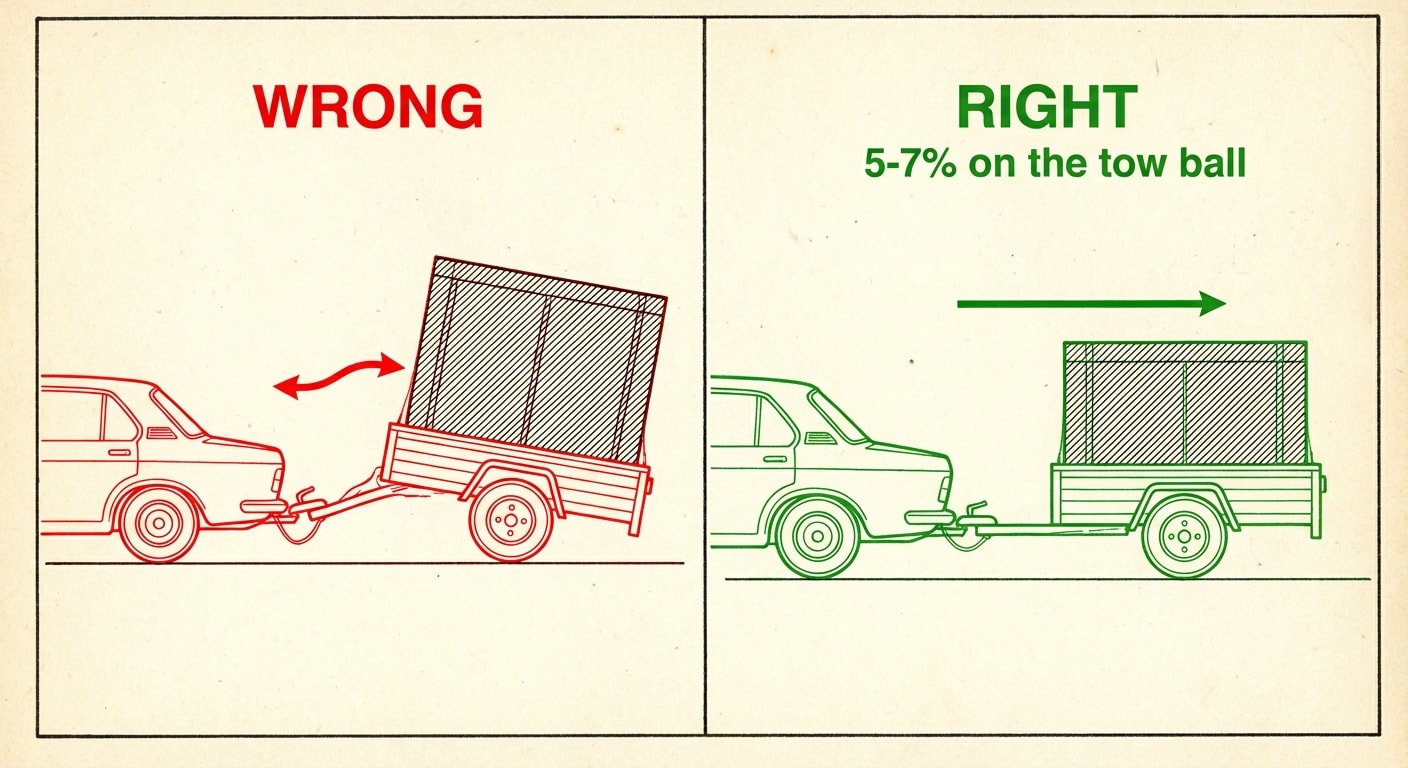
What happens with bad loading
Loading mistakes don't just have theoretical consequences — they show up quickly and dramatically.
When the load is too heavy at the back, the ball lifts and the car's rear axle is unloaded. You lose traction on the rear wheels and the trailer starts swaying side to side. This is the most common cause of trailer accidents, and it's exactly what no driving course tells you — but should.
The opposite extreme is too much weight at the front. The car's rear axle gets overloaded, the front axle gets unloaded. The result? Worse steering, odd behavior in corners, and faster wear on rear tires. Not as dangerous as swaying, but definitely not okay.
Asymmetric loading — more weight on one side — causes the trailer to lean in curves. And unsecured cargo shifts during driving, changes the center of gravity, and can cause even a properly loaded trailer to start swaying.
Securing cargo — no exceptions
Act No. 361/2000 Coll. (Section 52) is clear: cargo must not endanger traffic safety, contaminate the road, or obstruct lights and license plates. In practice, this means every item on the trailer must be secured against movement in all directions — forward, backward, and sideways.
The most common method is ratchet tie-down straps. Before every trip, check their condition — wear, tears in the strap and mechanism. On longer trips, stop and re-tighten the straps, as they loosen slightly during driving. The strap's label shows the maximum load rating — respect it.
For loose materials (sand, gravel, small debris) use protective nets or tarps. For cylindrical objects like barrels or pipes, there are chocks and wheel stops. And if you're transporting a vehicle on a car carrier, put a chock under each wheel and at least four straps across the vehicle.
Checkpoint on longer trips
Every 100–150 km or after an hour of driving, stop and check straps, lights, and the trailer connection. On the highway, that means every other gas station. Straps loosen during driving — retighten them every time, not just at the start.
Trailer swaying — how to prevent it and what to do
Swaying (also called snaking) is when the trailer starts rhythmically oscillating from side to side. The oscillation gradually amplifies — and if you don't react correctly, it can end with the trailer or the entire combination flipping over.
There are multiple causes, but the main one is almost always speed. The faster you drive, the smaller the trigger needed to set the trailer swaying. A gust of crosswind on a bridge, turbulence from a passing truck, or a small road imperfection is enough. Add bad load distribution (center of gravity too far back), incorrect tire pressure, or worn shock absorbers — and you have a recipe for trouble.
Prevention is straightforward and repeats what you already know from the previous section: proper load distribution with tongue weight at 5–7%, correct tire pressure per the manufacturer's recommendation, and reasonable speed. Modern cars also offer TSA (Trailer Stability Assist) — an electronic system that detects swaying and automatically brakes the appropriate wheels. If you're planning to tow regularly and shopping for a car, ask about TSA or ESP with trailer detection.
And what to do when the trailer starts swaying?
Forget everything your instincts tell you. Don't slam the brakes — that makes it worse. Don't countersteer — that amplifies the oscillation. Instead, do three things: hold the steering wheel firmly and straight, take your foot off the gas, and let the combination naturally slow down. That's it. If your car has TSA or ESP, the system will brake the appropriate wheels and help stabilize the combination. Once the swaying subsides, safely pull over and check the load — something has probably shifted.
Trailer swaying — what NOT to do
DO NOT SLAM THE BRAKES. DO NOT COUNTERSTEER. Both reactions are natural, but both make things worse. Hold the wheel straight, take your foot off the gas, and let the combination slow down on its own. ESP/TSA will help — but only if you don't actively fight against the system.
Braking distance with a combination
A trailer extends braking distance — and many drivers underestimate this. A braked trailer (with an overrun brake, categories O2 and up) extends braking distance by 10–30% compared to the car alone. An unbraked trailer (category O1, up to 750 kg) extends it even more — depending on how much it weighs.
The Czech Police recommend the two-second rule as the minimum safe following distance behind the vehicle ahead. With a trailer, you should count on three seconds — and on a wet road, four.
Safe following distance
| Speed | 2 seconds (minimum) | 3 seconds (with trailer) | 4 seconds (wet + trailer) |
|---|---|---|---|
| 50 km/h | 28 m | 42 m | 56 m |
| 80 km/h | 44 m | 67 m | 89 m |
| 90 km/h | 50 m | 75 m | 100 m |
| 130 km/h | 72 m | 108 m | 144 m |
How to picture this? At 80 km/h with a trailer, you should have 67 meters between you and the car ahead — roughly the length of a football pitch from the goal line to midfield. On a wet highway at 130, it's 144 meters — almost a full pitch and a half. Sounds like a lot, but braking with a ton and a half behind you simply takes longer.
Pre-trip check
Before you set off, run through a quick checklist. It takes five minutes and can save your day.
Check the trailer's tire pressure per the manufacturer's recommendation — incorrect pressure is one of the main causes of swaying. Verify that all lights work — turn signals, brake lights, tail lights, fog light. Ask someone to stand behind the trailer while you test all functions. Check that the ball coupling is properly attached, the safety catch engaged, and the breakaway cable or chain connected. The electrical connector (7-pin or 13-pin) must sit firmly.
And adjust your mirrors. With a trailer you need to see further back and to the sides — for wider trailers or caravans, use towing mirrors. If you can't see the end of the trailer in your mirrors, you can't see enough.
Before the season or after a longer break, do a more thorough check: brake condition (overrun brake function), tire tread depth (legal minimum 1.6 mm, but 3 mm is a sensible minimum), wheel bearings, structural frame free of corrosion and deformation, and the condition of the towing mechanism.
Special situations on the road
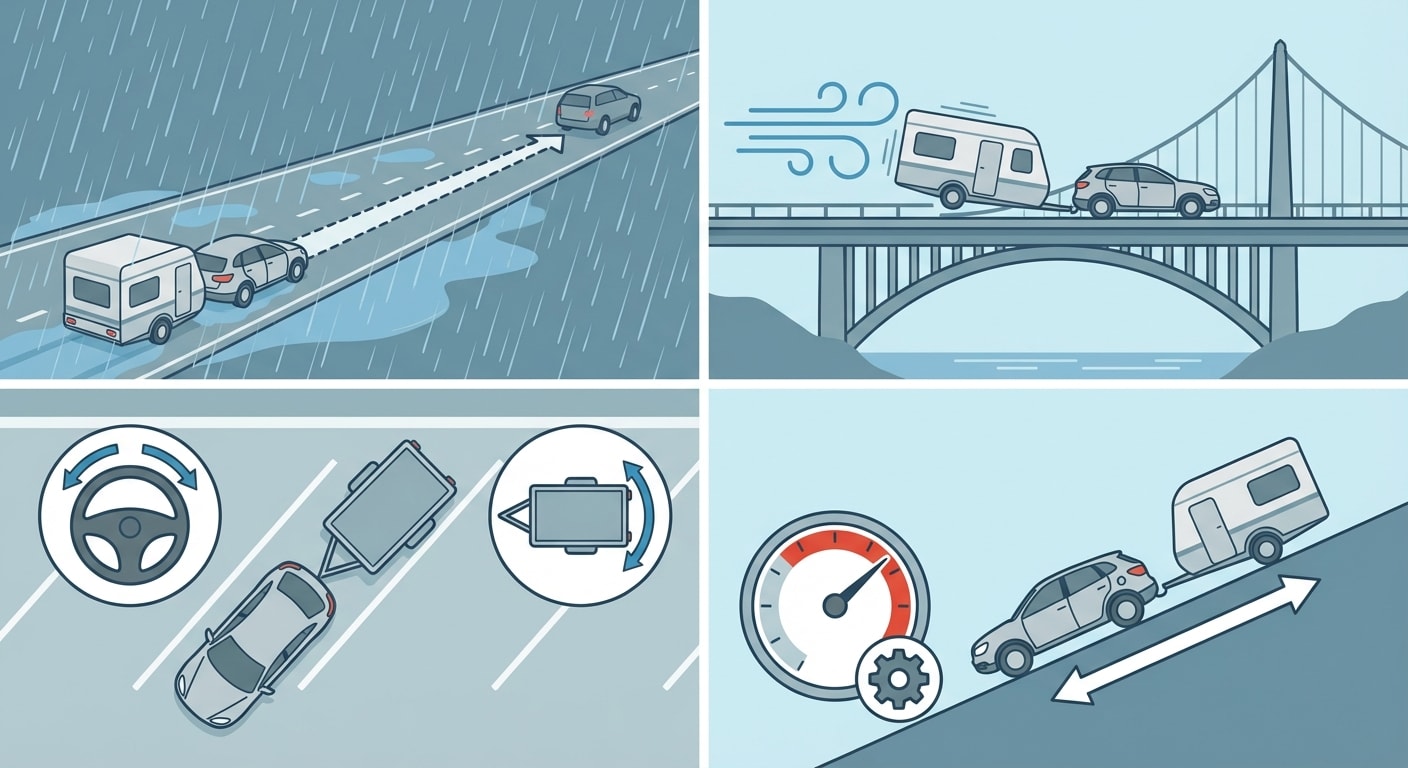
Rain and wet roads
Reduce your speed by 20–30% and increase the following distance to four seconds. The trailer is more susceptible to aquaplaning than the car — it has less weight per wheel, so the tires "float" sooner. If the trailer starts behaving unstably in rain, reduce speed immediately.
Crosswind
A trailer — especially an enclosed caravan or a tall horse transporter — acts like a sail. On bridges, in open landscapes, and at intersections, a gust of wind can catch you off guard. Reduce speed and hold the wheel firmly. A flatbed trailer with low sides is noticeably more stable in this regard.
Reversing with a trailer
When reversing, the trailer goes the opposite direction to where you turn the steering wheel. That's counterintuitive and you need to practice it. Make small corrections — the trailer responds with a delay, and exaggerated movements end up jackknifing. Use your mirrors and ideally have someone outside guiding you. Practice in an empty parking lot before you try it for real.
Hills
When going downhill, use engine braking — shift to a low gear and don't rely solely on the brake pedal. Brakes overheat on long descents and lose effectiveness. When going uphill, try not to stop on a steep incline — starting again with a heavy combination is difficult. When parking on a slope, always engage the trailer's parking brake and put a chock under the wheel.
Summary
- Proper loading is the foundation — heavy items low and slightly forward, tongue weight 5–7% of trailer weight
- Light combinations (MAW ≤ 3,500 kg) have the same limits as without a trailer — heavier combinations max 80 km/h outside urban areas
- Never fight swaying with the brake or steering wheel — take your foot off the gas and hold the wheel straight
- Braking distance with a trailer is 10–30% longer — maintain a 3-second gap, 4 seconds on wet roads
- Before every trip, check tires, lights, ball coupling, breakaway cable, and cargo securing
- In rain, wind, and hills, adjust your speed — a trailer reacts differently than the car alone
Key Terms
| Term | Explanation |
|---|---|
| Tongue weight | The downward force the trailer's drawbar exerts on the tow ball. The correct value is 5–7% of the trailer's total weight — too little = swaying, too much = overloaded rear axle. |
| Swaying (snaking) | Rhythmic side-to-side oscillation of the trailer while driving. Main cause: high speed + poor load distribution. Solution: foot off the gas, wheel straight. |
| MAW (Maximum Authorized Weight) | The maximum weight of a vehicle from the registration document — field F.1. Determines speed limits and the required license category. |
| TSA (Trailer Stability Assist) | An electronic system in modern cars that detects trailer swaying and automatically brakes the appropriate wheels. Part of extended ESP. |
| Overrun brake | A braking system on O2 category trailers — the brake is activated by the trailer's inertia when the towing vehicle brakes. |
| 2/3-second rule | Minimum safe following distance behind the vehicle ahead: 2 seconds without a trailer, 3 seconds with a trailer, 4 seconds on wet roads. |
| Ratchet tie-down strap | The most common tool for securing cargo on a trailer. Tension force is chosen based on the cargo weight — check the strap's label. |
| Design speed | The maximum speed of a vehicle listed in the registration document. The driver must not exceed the design speed of any vehicle in the combination. |