
Vision Requirements for Drivers: Can You Drive?
What vision do you need to drive? Minimum acuity, visual field, glasses and contacts — and what the 01.06 code on your license means.
Nearly every other driver in Czechia sees worse than they think. The BESIP "Do You See Well?" project in 2019 tested over 3,000 drivers — and 44% of them had visual impairments affecting safe driving. About 8% of those tested shouldn't have been behind the wheel at all. Nobody told them, nobody stopped them. They just kept driving.
Now imagine that drivers with poor vision miss up to a quarter of all traffic signs. A quarter. That means on every commute home from work, you pass several prohibitions, restrictions, and warnings that are supposed to help you arrive safely.
This article will tell you exactly what vision you need to drive, what the codes on the back of your license mean, how much you'll pay for breaking the rules, and what to do if your eyesight gets worse. Whether you've worn glasses since childhood, you're considering laser eye surgery, or your ophthalmologist just told you something that made you nervous — you'll find answers here.
Quick summary:
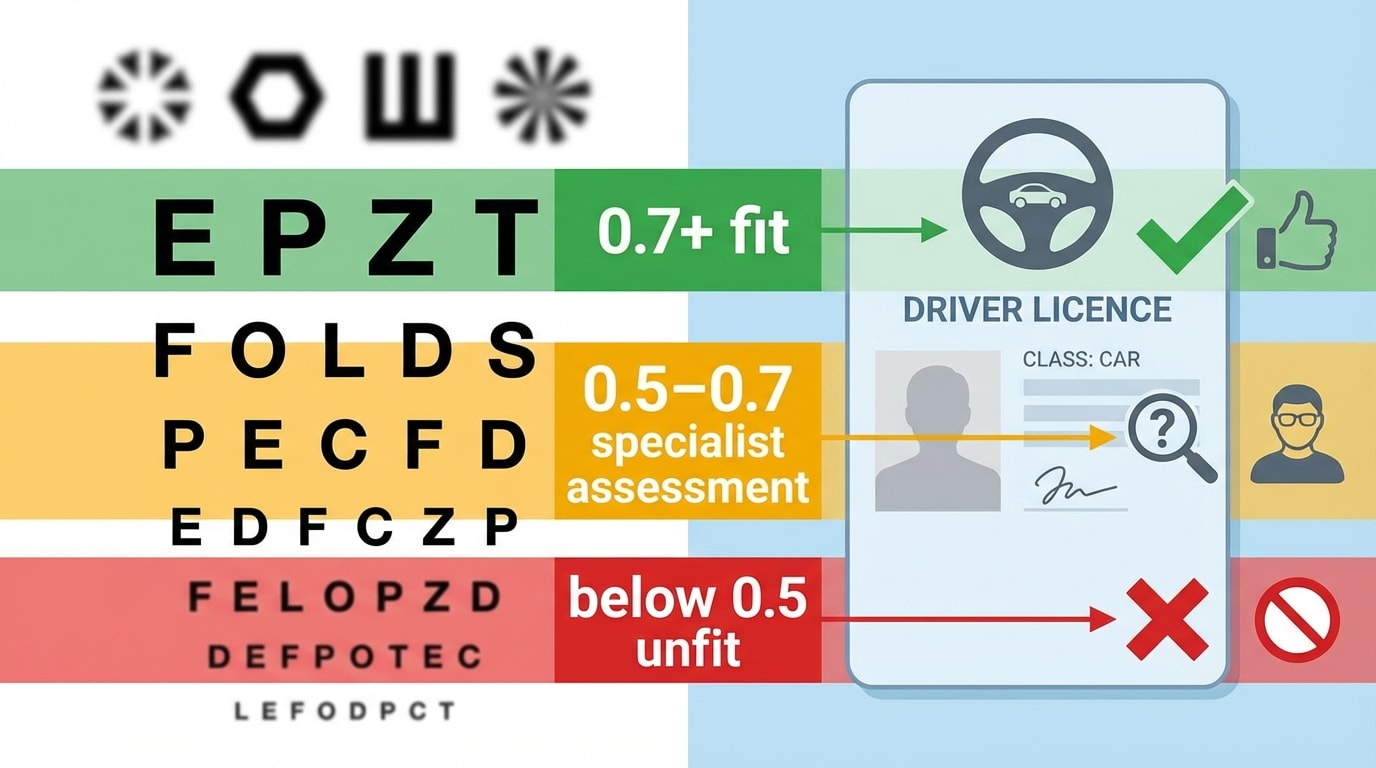
- Minimum visual acuity for regular drivers (group 1): binocular ≥ 0.5 with correction
- Glasses or contacts on your license = harmonized code 01.01, 01.02, or 01.06 — driving without them is an offense (CZK 1,500–2,500)
- Color blindness alone doesn't mean a driving ban — it's assessed individually
- Loss of one eye = 1 year without your license, then a specialist examination
How Much You Need to See — Minimum Vision Requirements
Vision requirements for drivers are set by Decree No. 277/2004 Coll., Annex 3. Just like with diabetes or epilepsy, the law distinguishes two groups of drivers — and the standards differ significantly.
Group 1 (AM, A1, A2, A, B1, B, B+E) covers regular car and motorcycle drivers. The requirements here are reasonable. Binocular visual acuity — meaning how well you see with both eyes together — must be at least 0.5 with correction. If you see 0.7 or better, your GP will pass you without a specialist. If you see between 0.5 and 0.7, they'll send you to an ophthalmologist for a more detailed examination, but you can still drive.
Group 2 (C, C+E, D, D+E, and professional drivers) has significantly higher standards. Your better eye must achieve at least 0.8 acuity and your worse eye at least 0.1 — both with correction. For bus drivers (category D), requirements are even stricter. The spherical equivalent of correction must not exceed +8 diopters. Why so strict? Because a professional driver has dozens of people or tons of cargo behind them — and a mistake behind the wheel carries completely different weight.
For both groups, corrected acuity matters more than uncorrected. You might have -6 diopters in both eyes, but with glasses you see 1.0? Excellent, you qualify. The doctor looks at how you see with the best correction available to you.
Visual acuity requirements — group 1 vs. group 2
| Parameter | Group 1 (A, B) | Group 2 (C, D) |
|---|---|---|
| Binocular acuity (with correction) | ≥ 0.5 | ≥ 0.8 (better eye) + ≥ 0.1 (worse eye) |
| Without specialist | ≥ 0.7 | — (always ophthalmologist) |
| Horizontal visual field | ≥ 120° | ≥ 160° |
| Vertical visual field | ≥ 20° up and down | ≥ 30° up and down |
| Monocular driving | Yes (after adaptation) | Yes, except cat. D |
| Max correction (spherical equivalent) | ±10 D (renewal) | +8 D |
Visual Field — The Forgotten Factor
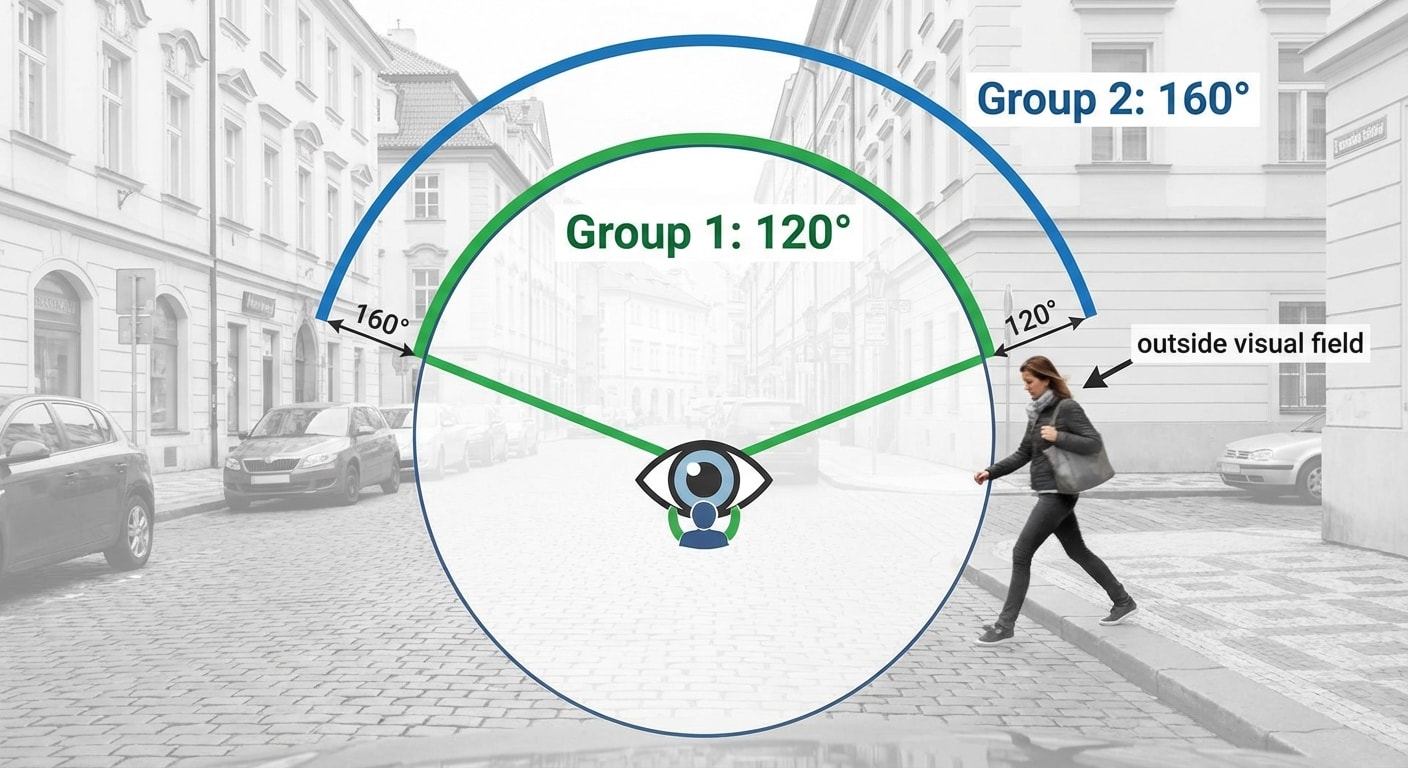
Most people worry about acuity — "Can I see the fifth line? The seventh?" But the visual field is just as important when driving, if not more so. Acuity helps you read a sign. Your visual field helps you register a pedestrian stepping onto a crosswalk from the side. Or a cyclist in your blind spot. Or a car racing from a side street.
For regular drivers (group 1), the minimum horizontal visual field is 120° — at least 50° to each side from center — and vertically, at least 20° up and down. That sounds like a lot, but think about it: if your visual field covers less than 120°, you can't see a car driving next to you in the adjacent lane.
Professional drivers (group 2) need a horizontal visual field of at least 160° — that's 70° to each side. In a bus full of people, you can't rely on rearview mirrors alone — you need to catch everything around you with peripheral vision.
The visual field is measured by perimetry — a specialized test at an ophthalmologist's office where you stare at a central point in a device and report when you notice light stimuli at the edges. It takes about 15–20 minutes for both eyes and it doesn't hurt. Visual field problems are most commonly caused by glaucoma, which gradually narrows vision from the edges — insidiously, without pain, so a person may not notice it for years.
Glasses, Contacts, and License Codes
If you need vision correction to drive, your doctor will enter a harmonized code on your license. You'll find it on the back of the card in column 12, next to the relevant category. These codes are valid across the entire EU — whether you're driving in Prague or Paris, the officer knows what they mean.
Code 01.01 means you must wear glasses. Code 01.02 means you must wear contact lenses. And code 01.06 — the most common — means you can wear either glasses or contacts, your choice. There's also code 01.05 for an eye patch (occluder) and 01.07 for specific optical aids.
An important detail many drivers don't know: if your license has code 01.01 (glasses), you're not allowed to drive wearing contacts. It sounds absurd — contacts correct your vision just the same — but the law is the law. You have both glasses and contacts and want the flexibility? Request a code change to 01.06. It costs CZK 50 at the transport office and you need a confirmation from your doctor that both corrections are adequate.
Driving without prescribed correction is an offense. The fine ranges from CZK 1,500 to 2,500, and police can issue an on-the-spot fine up to CZK 2,000. But here's the kicker — that's not where it ends. If you cause an accident without your glasses, the insurance company can reduce your payout and you bear full liability for damages. A few thousand in fines versus hundreds of thousands for an unrepaired car — the math is clear.
Code 01.01 ≠ 01.06
Is your license coded 01.01 (glasses), but you drive with contact lenses? That's an offense — even though contacts correct your vision just like glasses. Solution: request a code change to 01.06 (glasses or contacts) at the transport office. It costs CZK 50 and requires a confirmation from your ophthalmologist.
Color Blindness — Myth vs. Reality
"Color blind people can't drive" — you'll hear this a lot. And it's nonsense. Most people with color vision deficiencies can drive perfectly legally.
Color vision deficiencies are surprisingly common. Deuteranomaly (reduced green perception) or protanomaly (reduced red perception) affects about 8% of men and roughly 0.5% of women. The vast majority of these people are aware of their condition, have learned to live with it, and have no trouble distinguishing traffic light signals. Why? Because traffic lights have clear positions — red on top, green on bottom. Even if you can't see the color precisely, you can tell the position of the light.
For regular drivers (group 1), it's sufficient to recognize basic color signals. You don't need to see every shade of green — you need to know when the traffic light says "stop" and when it says "go." Complete color blindness (achromatopsia) is rare and may warrant individual assessment, but common color vision deficiencies don't disqualify you from driving.
For professional drivers (group 2), the requirements are stricter. Severe color vision deficiencies may disqualify you — logically, because a truck or bus driver must reliably distinguish not only traffic lights but also color-coded signs, warning lights, and intersection signals.
There is no blanket driving ban for color blind people. Every case is assessed individually. If you have doubts, get a color vision test from an ophthalmologist — it takes a few minutes and gives you certainty.
Driving with One Eye — A Year of Waiting
Loss of one eye is among the most challenging situations a driver can face. Not just because of the vision limitation — but because of the consequences for your license. After losing an eye or significant deterioration of vision in one eye (functional monocular vision), you're automatically unfit to drive for one year.
Why exactly one year? The brain needs time to adapt. Depth perception (stereopsis) works because each eye sees a slightly different angle — and the brain calculates distance from that. With one eye, this disappears. You have to learn to estimate distances differently — using object size, shadows, and movement. And that takes months.
After one year has passed (provided the monocular condition has lasted at least 6 months), you can request reassessment. The functional eye must have acuity of at least 0.5 with correction and the visual field must not be narrowed. An ophthalmologist will perform a complete examination and issue an assessment.
With one eye, you can drive categories A, B, C, E, and T. But category D is excluded — a person with one eye cannot drive a bus. The responsibility for dozens of passengers is too great for the law to entrust to a driver with limited spatial perception. Details about the process for temporary unfitness can be found in the chapter How to Get Your License Back.
Loss of one eye = 1 year without your license
After losing an eye or function of one eye, you must wait at least 12 months. Then you'll undergo a specialist examination — the functional eye must have acuity ≥ 0.5 with correction and an unrestricted visual field. Category D (buses) is permanently excluded with one eye.
Eye Diseases and Driving — What Might Affect You
Some eye diseases are just inconvenient. Others can cost you your license. It depends on how much they affect acuity or visual field — and whether they're treatable.
Nearsightedness, farsightedness, and astigmatism are the most common vision defects. The solution is simple: glasses or contacts. If correction brings your acuity above the required minimum, you drive without issues. Simple.
Presbyopia (age-related farsightedness) comes to practically everyone around age 45. The problem isn't that you can't see the road — but you stop seeing the instrument panel, navigation, and near objects clearly. Reading glasses aren't enough because while driving you need to alternate between near and distant objects. The solution is multifocal glasses or contacts.
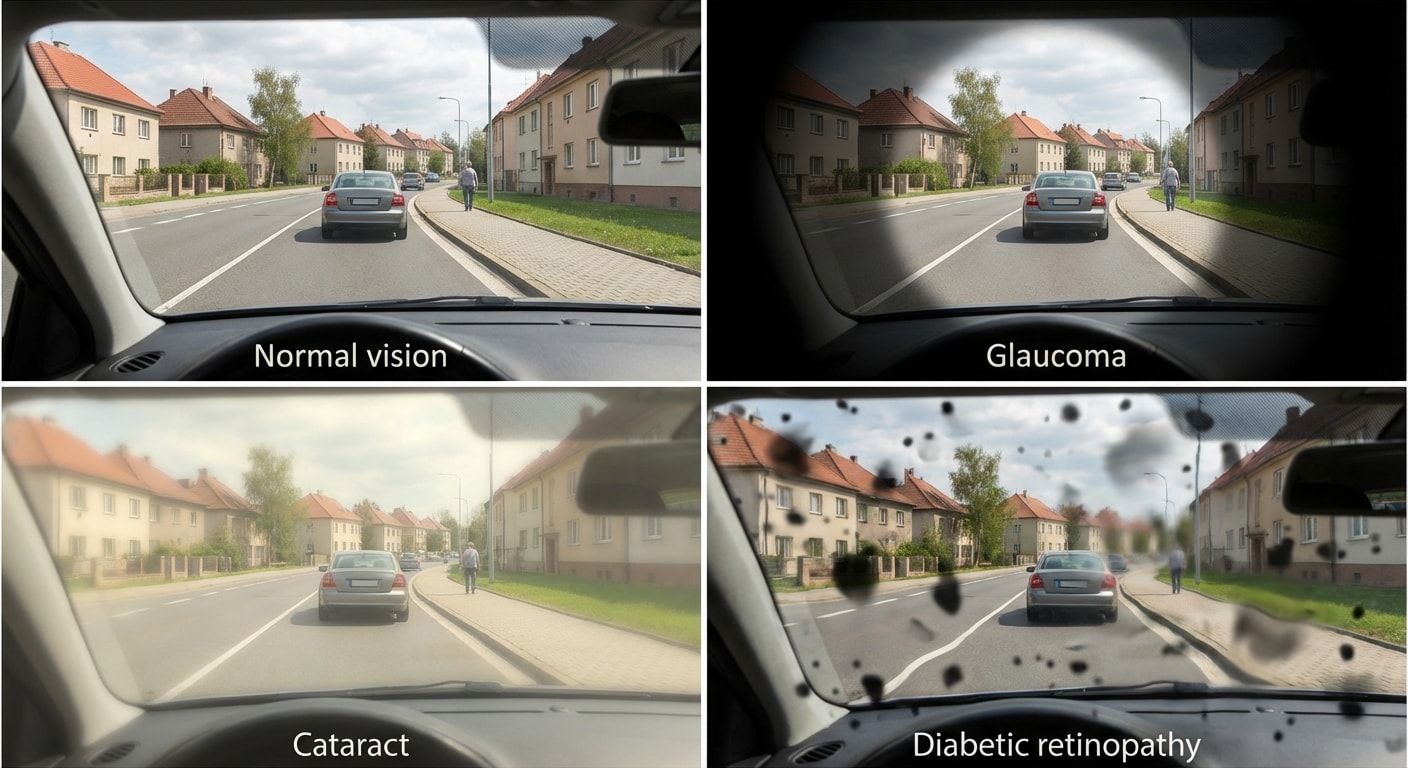
Glaucoma is treacherous. It gradually narrows the visual field from the edges — and because it happens slowly, a person often doesn't notice the deterioration for years. If the visual field drops below 120° (group 1) or 160° (group 2), your license is at risk. Regular checks of intraocular pressure and visual field are key — especially after forty.
Cataract reduces visual acuity, as if you were looking through frosted glass. Good news: cataract surgery is a routine procedure today. After surgery, acuity usually returns to normal values and you can typically drive again within 1–4 weeks. If your license has a correction code, you might not even need it after the operation.
Diplopia (double vision) requires individual assessment. In some cases, an occluder — an eye patch (code 01.05 on the license) — can help. It doesn't fix the cause, but it enables safe driving.
Diabetic retinopathy is a complication of diabetes that damages the retina. It affects about 12% of treated diabetics and can lead to loss of both central and peripheral vision. If you have diabetes, eye exams aren't optional — they're mandatory. More about the connection between diabetes and vision can be found in the chapter Diabetes and Driving.
How the Eye Exam for Your License Works
The eye exam is part of every medical examination for a driving license. Your GP performs an orientation test — typically sitting you in front of a chart with optotypes (letters or numbers that decrease in size row by row) to check whether you can see the required lines. Usually each eye is tested separately and then both together.
If the GP finds an issue — you see less than 0.7 binocularly — they'll refer you to an ophthalmologist. The specialist performs a complete examination: visual acuity on optotypes, visual field by perimetry, color vision (Ishihara plates), contrast sensitivity, and for professional drivers, also twilight vision. Based on the results, they issue an assessment: fit, fit with conditions, or unfit.
The cost depends on the scope. Within the mandatory medical examination (CZK 400–1,000 for the entire check-up), the orientation eye test is included. If the GP refers you to a specialist, the specialized eye examination typically costs CZK 300–500. Health insurance does not cover these examinations as part of the driving medical.
An important note: come to the examination with your current correction. If you wear glasses, bring them. If you wear contacts, bring backup glasses too — the doctor needs to know how much you see with and without correction.
After Laser Eye Surgery — How to Change Your License Code
Laser eye surgery (LASIK, SMILE, PRK) can change your life — and your license. If your card has code 01.01, 01.02, or 01.06 and you no longer need correction after surgery, you can request its removal.
The process is straightforward. After your vision stabilizes (usually 1–3 months post-surgery), get a confirmation from your ophthalmologist that correction is no longer needed. Take this confirmation (no older than 30 days) to the transport office, add a photo and your ID, pay CZK 50 — and you'll have a new license without the condition.
One catch: the doctor's confirmation must not be older than 30 days. Don't let it sit. Schedule your doctor's appointment and visit the office within the next few days.
After laser eye surgery
Wait 1–3 months for your vision to stabilize. Then get a confirmation from your ophthalmologist that you don't need correction (valid for 30 days). At the transport office you'll pay CZK 50 and the code disappears from your license. The whole process takes one morning.
What's Changing — New EU Rules
The EU delegated directive (2024/846) updates vision requirements for drivers. The main change: for drivers with restricted visual fields, individual assessment is now permitted instead of automatic disqualification. The directive also introduces the option of assessment by optometrists — not just ophthalmologists.
In Czechia, these changes must be transposed into Decree 277/2004 Coll. The transposition process takes time, so Czech values currently still apply. But the trend is clear: the EU is moving from blanket bans to individual assessment. If you have borderline results, this could be good news — future legislation will be more flexible.
From January 1, 2026, Czechia shifted the age threshold for mandatory medical examinations from 65 to 70 years (§87 of Act 361/2000 Coll.). If you're 66 and were expecting an exam, you don't need one — until you turn 70. Every such examination includes an eye check as well.
Summary
- Minimum visual acuity for group 1: binocular ≥ 0.5 with correction (≥ 0.7 without needing a specialist)
- Minimum visual acuity for group 2: ≥ 0.8 better eye, ≥ 0.1 worse eye
- Visual field: ≥ 120° (group 1) or ≥ 160° (group 2)
- Glasses/contacts = code 01.01, 01.02, or 01.06 on your license — driving without them carries a CZK 1,500–2,500 fine
- Color blindness alone doesn't prevent driving — assessed individually
- Loss of one eye = 1 year of unfitness + specialist exam, category D excluded permanently
- Glaucoma threatens the visual field — regular checks after forty
- After laser surgery: changing the code on your license costs CZK 50
Key Terms
| Term | Explanation |
|---|---|
| Visual acuity (visus) | The eye's ability to distinguish detail. Measured on optotype charts, 1.0 is normal. For driving (group 1), binocular 0.5 is sufficient. |
| Visual field | Range of vision while looking straight ahead. For group 1 drivers, minimum 120° horizontal; for group 2, minimum 160°. Measured by perimetry. |
| Harmonized code | Numeric code on the back of the driving license (column 12) indicating a condition — 01.01 (glasses), 01.02 (contacts), 01.06 (glasses or contacts). |
| Monocular vision | Vision with one eye — after loss of an eye or function of one eye. Adaptation period of 1 year, then possible to regain license (except cat. D). |
| Perimetry | Visual field examination at an ophthalmologist. You stare at a central point and report stimuli at the periphery. |
| Group 1 | Non-professional drivers (AM, A, B) — less stringent vision requirements. |
| Group 2 | Professional drivers (C, D) — stricter vision requirements, monocular vision excluded for cat. D. |
| Glaucoma | Eye disease that gradually narrows the visual field. Insidious — painless, often symptomless. Risk factor for failing visual field requirements. |
| Decree 277/2004 Coll. | Implementing regulation on medical fitness to drive. Annex 3 contains vision requirements for drivers. |
| §6(8) of Act 361/2000 | Driver's obligation to wear corrective aids while driving if their use is prescribed on the license. |