Category B License — What You Can Drive & Cost
Category B license: age requirements, training cost, what vehicles you can drive, and exam details. The most common driving license in Czechia.
Every year, over 119,000 people in Czechia get their category B driving license. It's by far the most common category — and yet many applicants have no idea what they're actually allowed to drive, how the training works, or how much the whole thing will cost them. The result? Unpleasant surprises at the exam, a poorly chosen driving school, or thousands of crowns wasted on retakes.
This article covers everything you need to know about the category B license. From requirements and training to exams and recent changes like L17 (license at 17) and the probationary license. It's based on the current Czech Road Traffic Act (Act No. 361/2000 Coll.) and data from over 1,000 driving schools on Kvalty.cz.
Quick summary:
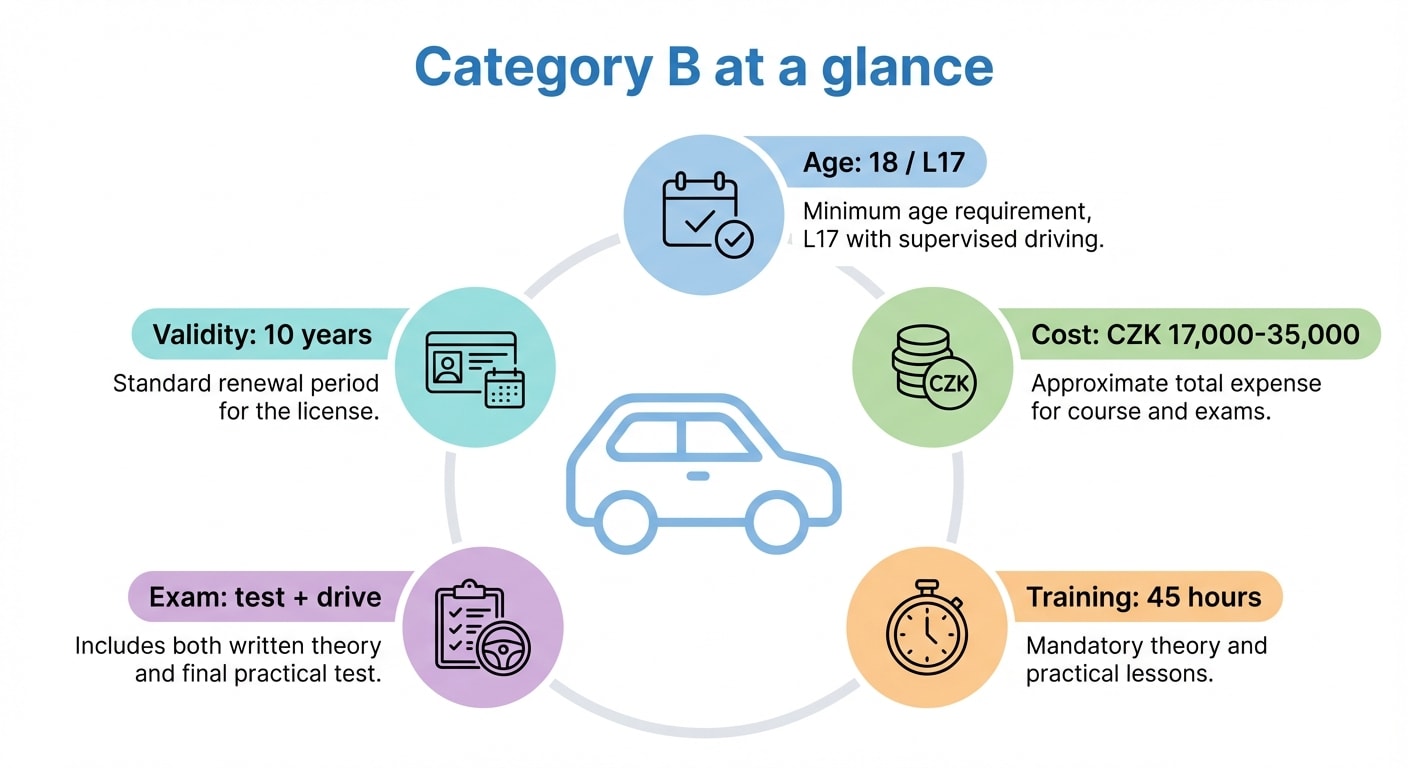
- Category B covers cars up to 3,500 kg — but also vans, motorhomes, scooters up to 125cc, and trikes from age 21
- Standard age is 18, but since 2024 you can start at 17 with a mentor (L17)
- Training takes at least 45 hours (11 theory + 34 practice), typically 5 weeks to 3 months
- You get 3 attempts at the exam within 12 months — after that, you must repeat the entire training
What You Can Drive with Category B
Most people think category B means cars. That's true, but it's far from the whole story. The law (Section 80a of Act No. 361/2000 Coll.) defines category B as motor vehicles with a maximum authorized mass not exceeding 3,500 kg, designed for carrying no more than 8 passengers plus the driver. In practice, that means you can drive regular cars, but also light vans like the VW Caddy or Ford Transit Custom — as long as they stay under 3,500 kg. Motorhomes? Also covered — but be careful, many of them exceed that limit, and then you'd need category C.
On top of that, you can tow a trailer. With category B, you can always tow a trailer weighing up to 750 kg. A heavier trailer is also fine, but only if the total weight of the combination (car + trailer according to the registration certificate) stays under 3,500 kg. Once the combination exceeds that limit, you need either the B96 extension (up to 4,250 kg) or a full B+E license. Trailer rules are covered in detail in the chapter Towing Vehicles — B96 and B+E.
And here's a surprise most drivers don't know about. Thanks to license equivalences in the law (Section 81), with a B license you can also ride mopeds and scooters in the AM category (up to 45 km/h), B1 quadricycles, and from age 21, motor trikes in category A. On top of that, Czechia has a special national exception: with a B license, you can ride a scooter up to 125cc with an automatic transmission. But this only applies within the Czech Republic — abroad, you can't ride a 125cc scooter on just a B license. More about motorcycle categories in the chapter Category A — Motorcycles.
Automatic = Code 78
If you complete your entire training in a car with an automatic transmission, your license will be stamped with code 78 — and you'll only be allowed to drive automatics. Manual cars will be off-limits. Choose wisely. More in the chapter Automatic vs. Manual — Code 78.
How the Training Works
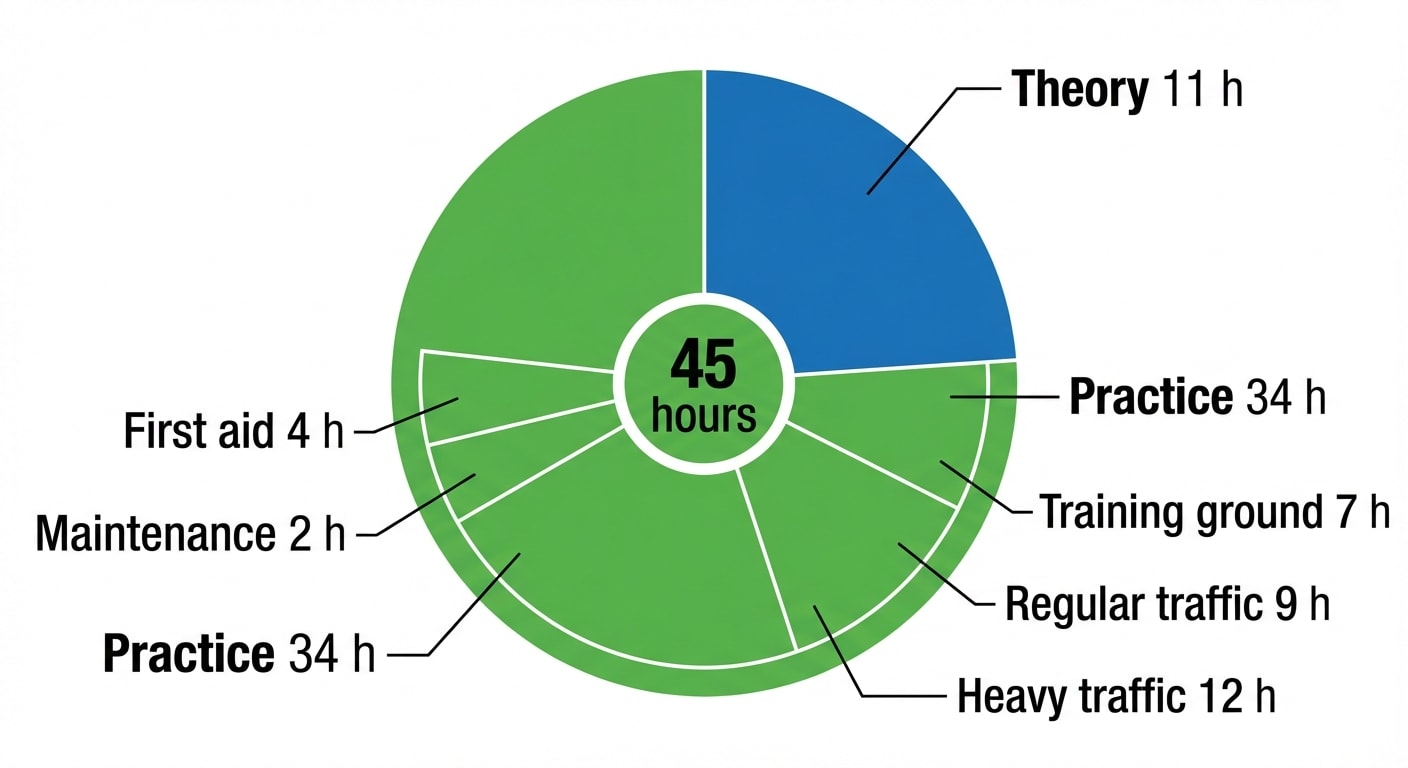
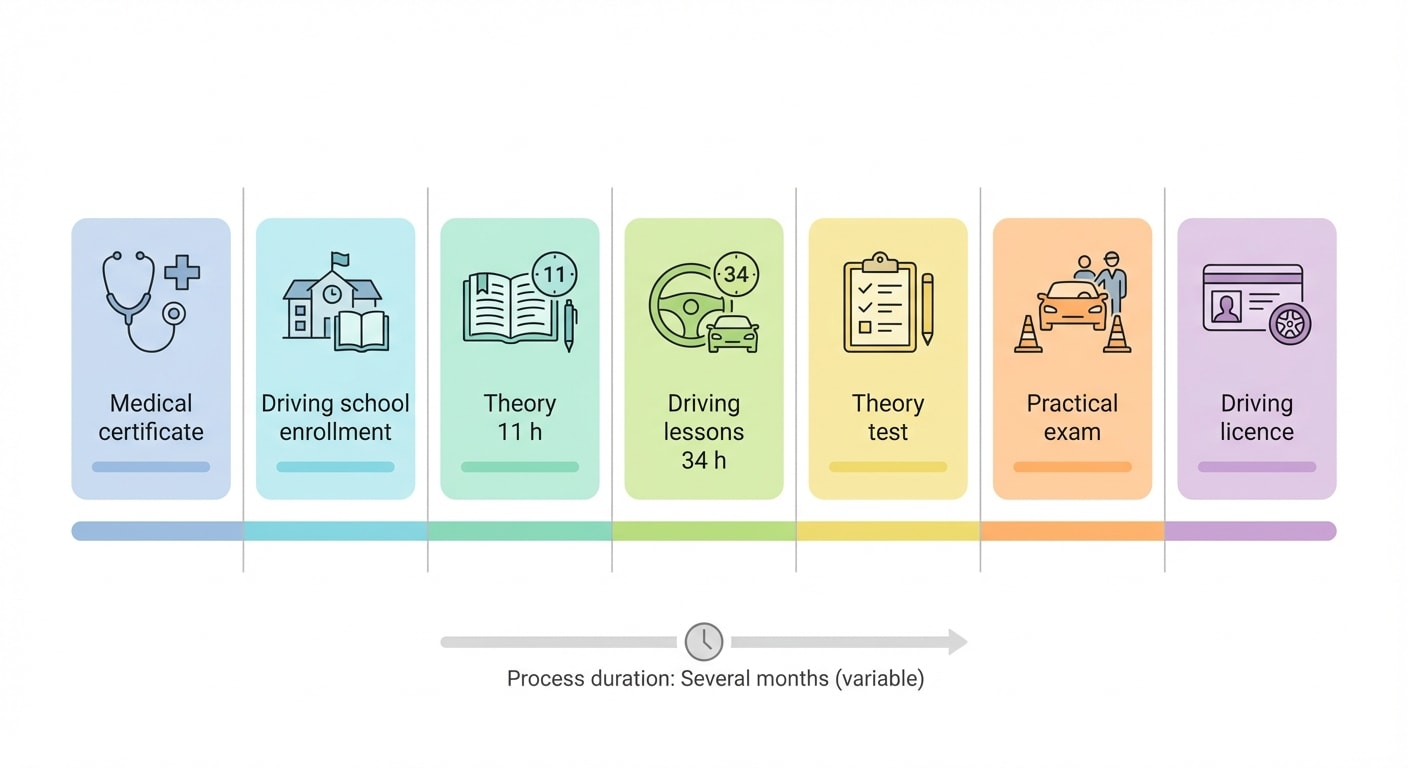
Act No. 247/2000 Coll. sets the minimum training at 45 teaching hours (one hour = 45 minutes). That's 11 hours of theory and 34 hours of practice. Most driving schools offer more driving hours than the legal minimum — and that's a good thing. Those 28 hours behind the wheel are truly the bare minimum.
The theory portion covers road traffic rules (5 hours), driving theory and safe driving principles (3 hours), vehicle operation and maintenance (1 hour), first aid theory (1 hour), and a review session (1 hour). Classes take place either in person at a classroom or, increasingly, through e-learning.
The practical portion is more extensive and structured than you might expect. You start at a training ground or simulator (7 hours), where you learn the basics: starting, shifting, stopping, parking. Then you move into regular traffic (9 hours) and finally into the city, onto the motorway, and driving at night (12 hours). You also complete 4 hours of practical first aid training and 2 hours of vehicle maintenance.
The full course typically takes 5 weeks to 3 months, depending on how often you drive. Intensive courses can compress the training into 2–4 weeks, but expect to pay significantly more. The law doesn't set a maximum duration — but if you don't finish and show up for the exam, the training expires.
The Exam — Theory Test and Driving
The final exam has two parts, and you must pass both. The theory test is computer-based: 25 randomly generated questions, 30 minutes, maximum 50 points. You need at least 43 points (86%) to pass. Questions cover road traffic rules, traffic signs, intersections, safety, and first aid. You can prepare on the official portal etesty2.mdcr.cz — it's free and the questions are identical to the real exam.
The practical exam lasts at least 30 minutes (Decree No. 167/2002 Coll., Section 19). An examiner sits in the car and observes your driving. The first part covers basic maneuvers — starting, stopping, reversing, various types of parking, hill starts. The second part is driving in traffic — signalized intersections, public transport stops, driving outside the city, multi-lane roads.
If you fail, you get a maximum of two retakes (three attempts total). At least 5 working days must pass between attempts. All exams must be completed within 12 months of the first attempt — otherwise, you must repeat the entire training. Failing the theory test means you can't proceed to the practical exam at all.
Each retake costs CZK 700
Every exam attempt costs CZK 700 as an administrative fee. Two retakes mean CZK 1,400 extra — plus any additional practice lessons (CZK 800–1,200/hour). Thorough preparation pays off financially too.
How Much It Costs
The price of category B training depends mainly on the region and the specific driving school. The gap between Prague and a smaller town can be as much as double — and prices can vary wildly even within the same city. Comparing multiple offers is well worth the effort. Current prices by region are shown in the table below.
Aktuální ceny výcviku skupiny B podle krajů — živá data z autoškol na Kvalty.cz
| statsTable.columns.location | statsTable.columns.avgPrice | statsTable.columns.minPrice | statsTable.columns.maxPrice | statsTable.columns.schoolCount |
|---|---|---|---|---|
| region Prague | 29,975 Kč | 12,990 Kč | 64,500 Kč | 111 |
| South Bohemian Region | 29,111 Kč | 15,000 Kč | 59,000 Kč | 70 |
| Central Bohemian Region | 26,617 Kč | 15,000 Kč | 55,000 Kč | 159 |
| Ústí nad Labem Region | 26,324 Kč | 15,000 Kč | 44,500 Kč | 73 |
| Pardubice Region | 26,238 Kč | 15,000 Kč | 50,000 Kč | 50 |
| Vysočina Region | 25,998 Kč | 15,100 Kč | 57,000 Kč | 53 |
| Hradec Králové Region | 25,813 Kč | 16,000 Kč | 50,000 Kč | 58 |
| Olomouc Region | 25,242 Kč | – | 58,000 Kč | 65 |
| South Moravian Region | 25,086 Kč | 15,000 Kč | 40,000 Kč | 117 |
| Karlovy Vary Region | 25,071 Kč | 17,800 Kč | 38,000 Kč | 17 |
| Plzeň Region | 25,018 Kč | 15,000 Kč | 39,000 Kč | 48 |
| Zlín Region | 24,985 Kč | 15,200 Kč | 38,900 Kč | 76 |
| Liberec Region | 24,169 Kč | 16,500 Kč | 36,999 Kč | 49 |
| Moravian-Silesian Region | 21,924 Kč | 15,000 Kč | 39,500 Kč | 120 |
Total 1066 schools
On top of the course fee, add the exam administrative fee (CZK 700), a medical certificate from your GP (CZK 400–800), and any retakes. Intensive courses cost roughly double the standard price, and training on an automatic tends to be a few thousand crowns more expensive than on a manual.
Over the past decade, training prices in Czechia have more than doubled. The reasons include rising operating costs for driving schools — fuel, insurance, vehicle maintenance — and higher salaries for driving instructors. Czech inflation between 2020–2025 significantly exceeded the EU average (peaking at 19.6% in 2022), which hit this sector too. The price of a driving school today also depends on whether it has its own classroom, how many vehicles it operates, and its team size. On Kvalty.cz, we compare driving schools across the entire Czech Republic — prices, reviews, locations — and help you find the right one.
Medical Fitness
Before you enroll in a driving school, you'll need a medical certificate from your GP. It costs CZK 400–800 and is valid for 3 months from the date of issue. The doctor performs a basic examination as required by Decree No. 277/2004 Coll.: overall health assessment, vision (acuity and color perception), hearing, visual field, balance, and a neurological screening.
Good news: as a non-professional category B driver, you won't need any mandatory checkups until age 70. Previously it was 65, but the threshold was raised effective January 1, 2026. After seventy, you go every two years. And since 2026, the medical certificate is stored digitally — you don't need to carry the physical document.
License at 17 — The L17 System
Since January 1, 2024 (amendment by Act No. 271/2023 Coll.), you can get a category B license at age 17. The condition? Until your 18th birthday, you drive exclusively with a mentor sitting in the front passenger seat. The training and exams are exactly the same as for 18-year-olds — no shortcuts.
The mentor must meet strict requirements. They must have held a B license for more than 10 years and continuously for the last 5 years. They must not have lost their driving privileges in the past 5 years and must have zero penalty points. Up to 4 mentors can be registered for a single young driver. Since 2026, mentors can be registered and deregistered electronically via the Transport Portal.
In its first year, 24,048 seventeen-year-olds obtained their category B license through L17. The demand is clearly massive. If you want to dig deeper into L17 — conditions, mentor registration, penalties for violations — check out our complete L17 guide.
Driving without a mentor before age 18
If you're caught driving without a mentor before your 18th birthday, you face a fine of CZK 2,500 in administrative proceedings and a driving ban of 6–12 months. Not worth the risk.
Probationary License — The Two-Year Trial Period
Since 2024, every first-time driver (not just L17 participants) faces a two-year probationary period. During that time, you're under closer scrutiny. If you accumulate 6 or more penalty points, or lose your license during those two years, you must complete a mandatory traffic psychology lecture and an evaluation drive (4 hours) at a driving school. Only then will your license be reinstated.
In practice, this means that as a fresh driver, you can't afford even one serious offense. Six points can add up fast — for example, using a phone while driving (4 points) plus speeding in a built-up area by 20+ km/h (4 points) — and that's already enough to trigger the whole process. More about how the penalty point system works in our dedicated guide.
License Validity and Renewal
A category B driving license is valid for 10 years from the date of issue. When it expires, you exchange the document at any municipal office of a municipality with extended powers, or — as of recently — online via the Transport Portal. Your driving entitlement remains — you're just replacing the plastic card.
You can apply for renewal as early as 90 days before expiration. Standard processing takes 20 days. Express processing within 5 working days costs CZK 700. Renewal due to expiration is free. For a change of details or loss, you pay CZK 200. Since 2026, a new rule applies: you can drive immediately after being entered in the driver registry — no need to wait for the physical card.
In 2026, 557,566 driving licenses will expire. If yours is among them, make sure to apply for renewal in time.
Extending Your Category B License
For many, category B is just the beginning. If you later find you need to tow a heavier trailer, drive a truck, or operate a bus, you can extend your license. You don't have to start from scratch — extension courses are shorter and cheaper. For example, extending to B96 for trailers costs just a few thousand crowns. Extending from B to C (trucks) involves roughly 37 hours of training. The full process of extending your license is described step by step in the chapter How to Extend Your License.
And if you're wondering whether to go the automatic or manual route, read the chapter Automatic vs. Manual — Code 78. The decision you make when choosing your driving school will stay with you for years.
Summary
- Category B covers cars up to 3,500 kg, light vans, motorhomes under the limit, scooters up to 125cc (in Czechia), and trikes from age 21
- Minimum age is 18 (17 with a mentor under the L17 system)
- Training: 45 hours (11 theory + 34 practice), typically 5 weeks to 3 months
- Exam: computer test (25 questions, 86% to pass) + practical driving (min. 30 minutes)
- You get 3 attempts at each part — all within 12 months
- First-time drivers face a two-year probationary period
- License validity is 10 years, renewal upon expiration is free
Key Terms
| Term | Explanation |
|---|---|
| Category B | Driving license for motor vehicles up to 3,500 kg, max 8 passengers + driver |
| L17 | License-at-17 system with a mentor in the passenger seat (since 2024) |
| Probationary license | Two-year trial period for every first-time driver (since 2024) |
| Mentor | Experienced driver accompanying a 17-year-old — min. 10 years with B license, 0 penalty points |
| Code 78 | License restriction — you may only drive vehicles with automatic transmission |
| B96 | Extension of category B for towing combinations weighing 3,500–4,250 kg |
| B+E | Separate license for towing heavy trailers over 4,250 kg total combination weight |
| Equivalence | With a B license, you can automatically drive AM, B1 vehicles and A trikes from age 21 |
| Evaluation drive | 4-hour driving session required for new drivers who accumulate 6+ penalty points |
| Teaching hour | Unit of driving school training — lasts 45 minutes |