
Medical Exam for Driving License: Cost & Process
What does the driving license medical include, how much does it cost? New 2026 rules: exams from age 70 and digital health certificates.
Without a health certificate from a doctor, no driving school will accept you. And yet most people only learn about the mandatory medical exam when they're holding the enrollment form and realize they're missing that one document. The exam itself is nothing complicated — it takes half an hour, costs around 500 CZK, and the vast majority of applicants pass. But there are situations where the doctor sends you to a specialist, sets a condition, or even tells you that you can't drive.
This article tells you exactly what the exam involves, where to get it, how much you'll pay, and what happens when the result isn't what you expected. And if you're 70 or older, we have news for you — the rules changed in 2026.
Quick summary:
- Every driving license applicant needs a health certificate — it must be no older than 3 months
- The exam costs 400–1,000 CZK (typically around 500 CZK), not covered by health insurance
- Since 2026, mandatory exams for seniors start at age 70 (previously 65) — then every 2 years
- New certificates from 2026 are recorded digitally — you don't need to carry them
Who Needs the Exam and When
This is simpler than it looks. The law (§85 and §87 of Act 361/2000) distinguishes three groups of people who need a health fitness certificate.
Driving license applicants — meaning everyone enrolling in a driving school. Age and license category don't matter. Before the driving school accepts you, you must attach a certificate that's no older than 3 months. This also applies to license extensions — for example, when you already have category B and want to add A2 for motorcycles.
Professional drivers — this includes holders of categories C, C+E, D, D+E, professional drivers, driving school instructors, and drivers of vehicles with emergency lights. These people undergo regular exams. Until age 50, every two years; after 50, every year. They must complete an initial exam before starting their professional activity. The employer covers the costs (§87 para. 5).
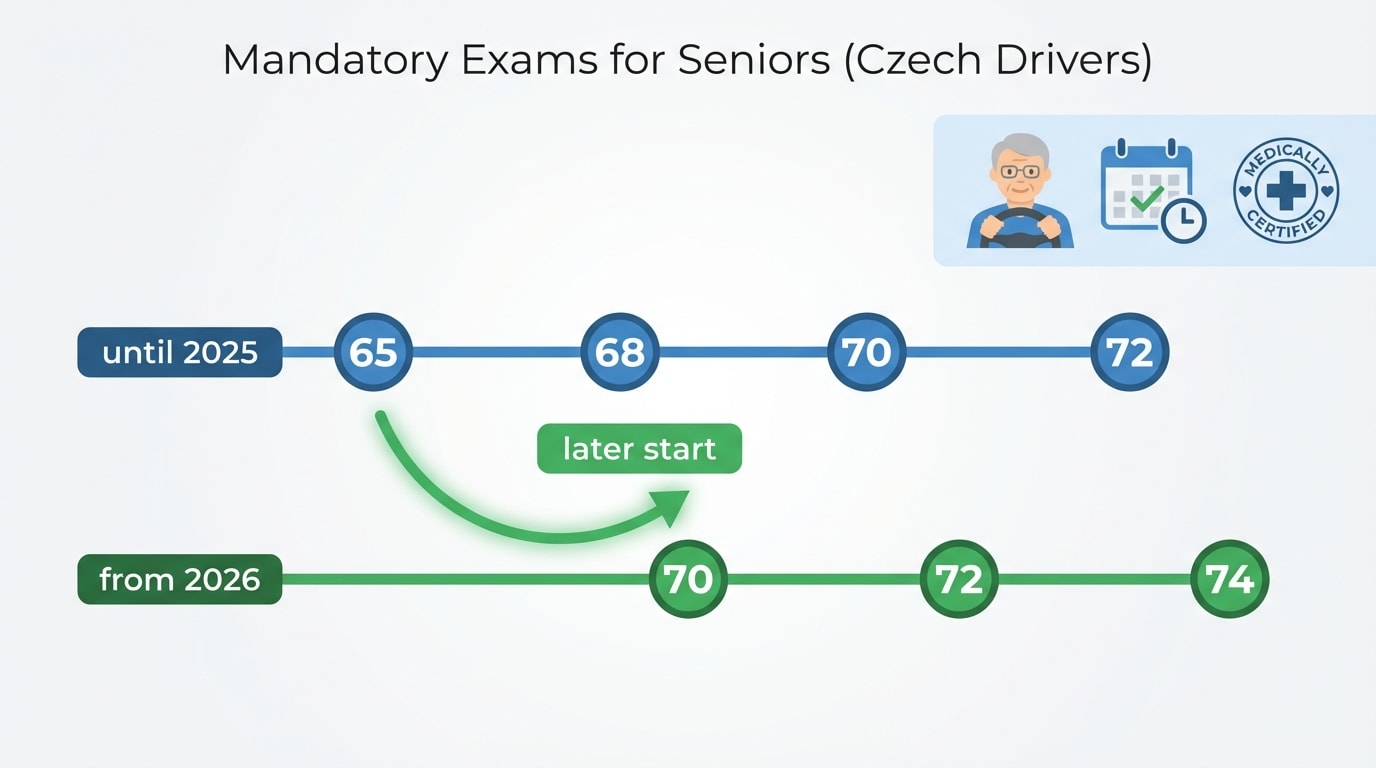
Drivers aged 70 and older — since January 1, 2026, every driver aged 70 or more must have a valid health certificate. First exam no later than their 70th birthday, then every two years. It used to be from 65 — more on this change in a moment.
If you're under 70 and not a professional, you don't need regular exams. But be aware — if your GP discovers a health issue that could affect driving, they have the right (and obligation) to shorten your exam interval or report your unfitness directly to the municipal authority (§86).
Group 1 vs. Group 2
The law distinguishes two driver groups. Group 1 (AM, A, B — personal drivers) has less strict health criteria. Group 2 (C, D — professionals) has stricter criteria. For example, a professional driver needs 0.8 visual acuity in the better eye, while a car driver only needs 0.5 binocular.
What the Exam Involves — Step by Step
The whole exam typically takes 15 to 30 minutes. Nothing painful, no blood draws, no waiting for results. The doctor follows Decree 277/2004 and the exam has a clear structure.
First, you fill out the applicant's health declaration — a form per Appendix 1 of the decree. You list your illnesses, medications, any surgeries or injuries. Be honest — the doctor has access to your health records and concealing a condition won't protect you. On the contrary, if it came to light after an accident, it could work against you.
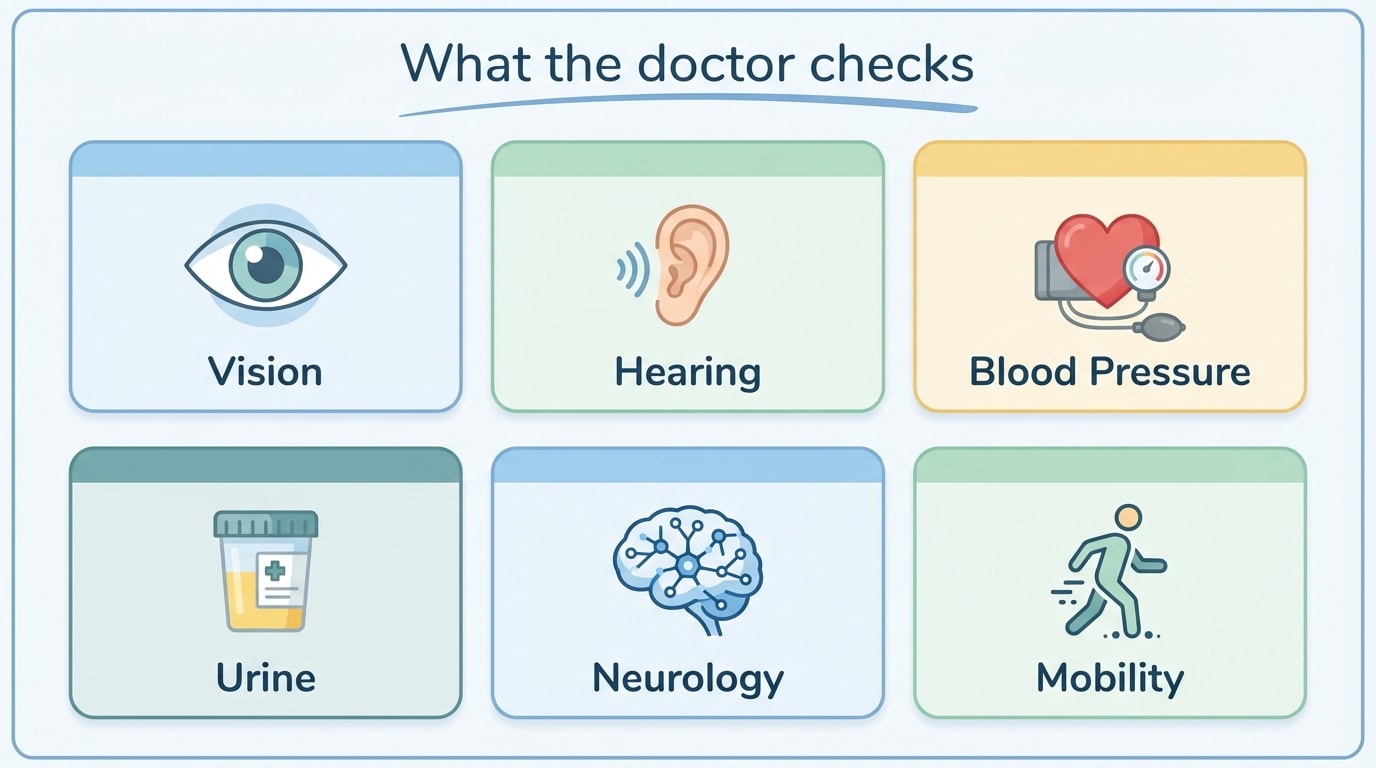
Then comes the general examination. The doctor listens to your heart, measures blood pressure, checks your urine, and examines you from head to toe. They're looking for anything that could affect your ability to drive safely — from mobility issues to visible neurological problems.
Vision testing is a key part. The doctor tests visual acuity (you read letters from a chart), color vision (Ishihara plates — can you spot the numbers in the dots?) and visual field. For Group 1 drivers, the minimum is binocular visual acuity of 0.5. Details on vision requirements are in the chapter Vision Problems and Driving.
Hearing testing is done as a screening — the doctor tests you with whispered speech from a few meters away. Professional drivers (Group 2) must meet audiometric criteria since Decree 445/2024: maximum loss of 40 dB HL at frequencies 500, 1000, 2000, and 4000 Hz.
The doctor also performs a quick neurological screening — checking balance, coordination, and basic reflexes. It's not a marathon of tests, more of a quick overview.
If the doctor suspects a specific condition during the exam, they'll refer you to a specialist — neurologist, cardiologist, ophthalmologist, or another expert. This doesn't mean you've failed. It means the doctor needs more information to make a responsible decision. Specialist examinations can take days to weeks, so start the process early.
Where to Get the Exam
The most common choice is your general practitioner — the one you're registered with. They have your complete health records, know your history, and can handle the exam fastest. Call and book an appointment — you'll typically get one within a week.
If you're a professional driver and an employee, the exam is arranged by the occupational health physician. Your employer selects them and pays for you.
The law (§85) also allows the exam at any outpatient physician authorized to assess health fitness. In practice, though, there's little reason — your GP is the quickest and cheapest option.
How Much the Exam Costs
The price isn't set by law — each doctor determines their own rate. Still, you can count on a fairly narrow range.
For a driving school exam, you'll pay 400 to 1,000 CZK. The most common price is around 500 CZK — less than one driving lesson costs at most driving schools. In Prague and larger cities, prices tend to be a bit higher; in rural areas, lower.
The senior exam (from age 70) typically costs 200 to 600 CZK. Some doctors charge less because for a registered patient they've known for years, the exam takes less time.
Health insurance does not cover the exam. Some insurers previously contributed from prevention funds, but these contributions were discontinued in mid-2025. You pay out of pocket.
For professional drivers in employment, the employer covers all costs — including any specialist examinations the doctor orders.
Save on the exam
Ask your GP about the price when booking. Differences between doctors in the same city can be as much as 300 CZK. And if you're a student — some driving schools have negotiated discounted rates with doctors for their students.
Three Outcomes — What the Doctor Can Decide
After the exam, the doctor fills out the health fitness certificate (Appendix 2 of Decree 277/2004) and places you in one of three categories.
Fit to drive — you can drive without restrictions. This is the result for the vast majority of driving license applicants. The doctor issues the certificate and you attach it to your driving school enrollment.
Fit with conditions — you may drive, but only while meeting a specific condition. Most commonly, this means vision correction. The doctor records a harmonized code in the certificate, which then appears on your driving license. Code 01.01 means glasses, 01.02 contact lenses, 01.06 glasses or contacts (your choice). Conditions can also include a hearing aid, vehicle modification, or daytime-only driving. There's no stigma attached — millions of drivers in Czechia have a condition recorded on their license and drive completely normally.
Unfit to drive — the doctor determines that you currently cannot drive. They have a legal obligation to immediately notify the municipal authority (§86). The authority initiates administrative proceedings and you must surrender your driving license. This sounds drastic, but in most cases it's a temporary state. Once your health stabilizes or treatment succeeds, you can apply to get it back — we describe the full process in the chapter How to Get Your License Back.
Driving without a valid certificate
If you drive without a valid health fitness certificate, you face a fine of 5,000–10,000 CZK and a driving ban of 6 months to 1 year (§125c/1e/4 of Act 361/2000). And if you cause an accident, the insurer can seek reimbursement from you.
What Changed in 2026
The year 2026 brought two fundamental changes affecting hundreds of thousands of drivers.
Age threshold shift from 65 to 70. Until the end of 2025, every driver had to complete their first exam at 65, the second at 68, and then every two years. From January 1, 2026, the first mandatory exam is on the day of your 70th birthday. If you're currently 66 or 68 and have a valid certificate from before — you don't need an exam until you turn 70.
This change responds to reality. Today's 65-year-olds are in a completely different health condition than the generation thirty years ago when the age threshold was established. The Ministry of Transport estimates the change will save hundreds of thousands of exams per year.
Digital certificates. Doctors now record the certificate directly in an electronic system. The data automatically syncs to the driver registry. You don't need to carry any paper — police verify your fitness directly in the information system. You can also find your certificate in the EZKarta app or on the eHealth Portal.
But watch out for the transition period: only certificates issued from January 1, 2026 are recorded digitally. If you have an older certificate, you still need to carry it physically. When you next complete an exam, the doctor will record it in the system and you won't need the paper anymore.
Decree 445/2024 Amendment — What's New Since 2025
Besides the age threshold change (which concerns the Act), an amendment to Decree 277/2004 — Decree 445/2024 — took effect on January 1, 2025. It brought several important refinements.
Stricter audiometric criteria. For professional drivers (Group 2), hearing is now tested audiometrically: maximum loss of 40 dB HL at frequencies 500, 1000, 2000, and 4000 Hz. Previously, a screening test was sufficient. For regular drivers (Group 1), nothing changes.
Revised cardiovascular criteria. The amendment specifies under what conditions you can drive after a heart attack, with arrhythmia, or with a pacemaker. Rules differ for Group 1 and Group 2 — details in the chapter Heart Disease and Driving.
Pervasive developmental disorders. The amendment explicitly addresses for the first time the assessment of drivers with autism spectrum disorders without intellectual disability. Fitness is assessed individually based on specialist examination.
Expanded assessors. Clinical and traffic psychologists can now assess health fitness — previously only physicians could.
Exam for Driving School Students — Practical Guide
Heading to driving school and need a certificate? Here's the step-by-step process.
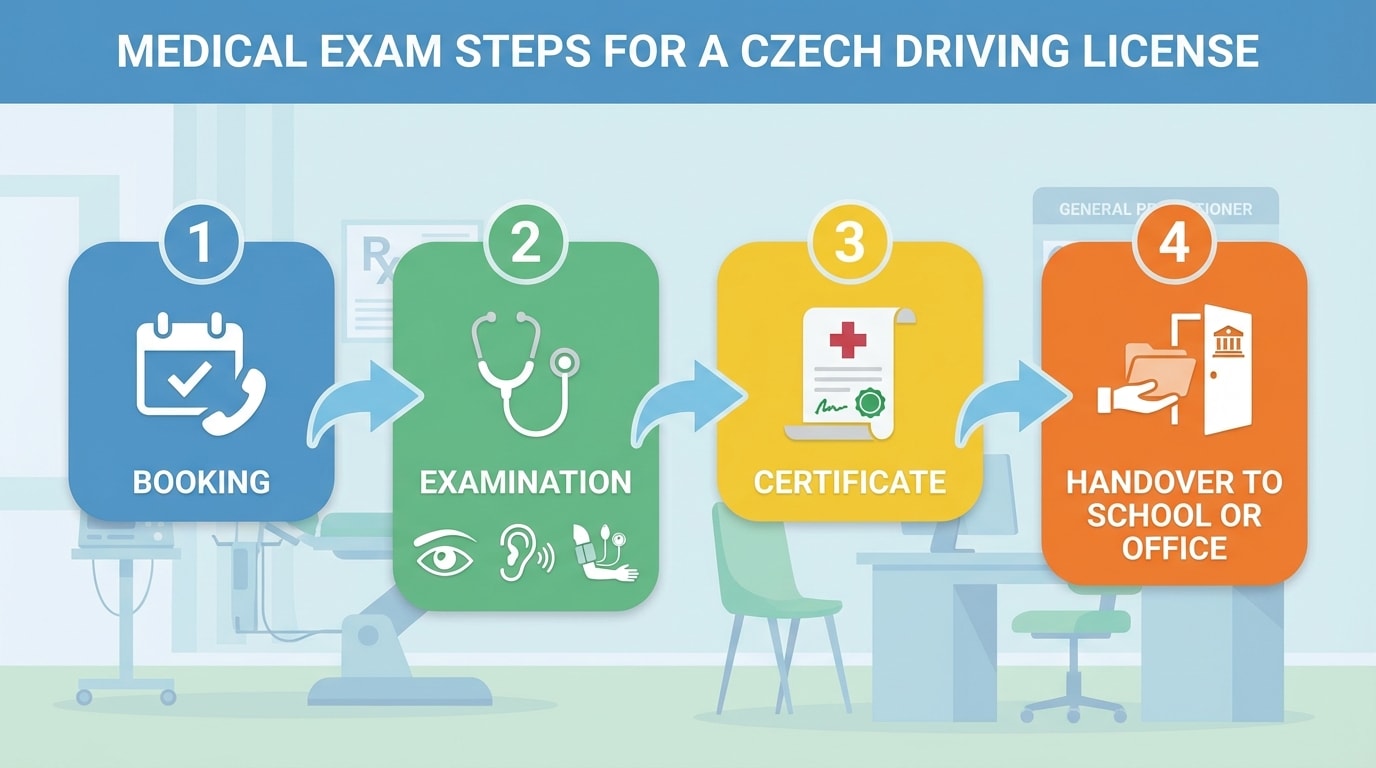
Call your GP and book an appointment for a driving license exam. Tell the receptionist it's about a health fitness certificate for driving — they'll know what you mean. You'll usually get an appointment within a week.
Bring your ID card to the exam. You don't need any other documents. If you wear glasses or contact lenses, bring them along.
At the doctor's office, you'll fill out the health declaration and undergo the exam. The whole thing takes 15 to 30 minutes. The doctor examines your vision, hearing, heart, blood pressure, urine, and overall condition.
The doctor issues the certificate. From 2026, they also record it in the electronic database. You attach the certificate to your driving school enrollment. Make sure it's no older than 3 months on the day you submit your application.
If the doctor refers you to a specialist (for example, an ophthalmologist), the whole process takes longer. Keep this in mind and book your exam preferably a month before you plan to start driving school.
Exam for Seniors — What to Know After Seventy
Got a letter or someone told you that you need an exam? First, make sure you're actually 70 — since 2026, the previously mandatory exam at 65 may no longer apply to you.
If you're 70 or older, book an appointment with your GP ideally 1–2 months before your birthday (or before the expiration date of your current certificate). The exam is identical to the one for driving school students — the doctor additionally considers the complete health records they've kept on you.
The result can be one of three: fit, fit with conditions, or unfit. If the doctor finds you unfit, they must report it to the municipal authority. But if you just have mildly reduced vision, you'll probably get a condition (glasses) and continue driving.
After the exam, you return for a check every 2 years. The doctor can shorten the interval if your health requires it.
Certificates issued before 2026
If you have a certificate issued before December 31, 2025, you must carry it while driving. The new electronic system only applies to certificates from January 1, 2026. At your next exam, the doctor will record it digitally and you won't need the paper anymore.
When It Doesn't Go Well — What to Do
The doctor told you that you're unfit, or set a condition and you're not sure what's next? Stay calm.
Unfitness doesn't mean the end. Most commonly it's a temporary state — unstable diabetes, a recent heart attack, an epileptic seizure, ongoing treatment. Once your condition stabilizes and a specialist confirms it, you can request a new certificate and get back behind the wheel. We describe the entire process in the chapter How to Get Your License Back.
A condition on your license is completely normal. Harmonized code 01.06 (glasses or contacts) is held by a huge number of drivers in Czechia. You simply put on your correction and drive. Driving without the prescribed correction is an offense with a fine of 1,500–2,500 CZK — but that's the same as driving without a seatbelt. The rule makes sense.
If you have a diagnosis that affects driving — whether it's epilepsy, diabetes, vision problems, heart disease, or medications you take — check the relevant chapter in this guide. You'll find the exact conditions for your situation.
Fines and Penalties
The law is uncompromising here. If you drive without a valid certificate and the police stop you, it can't be settled on the spot.
Driving without a valid certificate (§125c/1e/4 of Act 361/2000): fine of 5,000 to 10,000 CZK in administrative proceedings plus a driving ban of 6 months to 1 year. The offense isn't recorded in the point system, but the driving ban is painful enough on its own.
You don't have the certificate with you, but a valid one exists: on-the-spot fine up to 1,500 CZK. From 2026, this is gradually becoming irrelevant — if you have a digital certificate, police can verify it in the system.
Insurance consequences: if you cause an accident without a valid certificate, the insurer pays the injured parties. But they can seek reimbursement from you — a so-called recourse claim. For a serious accident, this can amount to millions of CZK.
Summary
- You need a health fitness certificate for driving school (max 3 months old), from age 70 (every 2 years), and as a professional driver (every 1–2 years)
- The exam includes vision, hearing, heart, blood pressure, urine, and overall condition testing — takes 15–30 minutes
- Cost is 400–1,000 CZK for driving school (typically 500 CZK), not covered by insurance
- Since 2026, mandatory senior exams start at age 70 (previously 65) and certificates are recorded digitally
- Three possible outcomes: fit, fit with conditions (glasses, etc.), or unfit
- Driving without a valid certificate = fine of 5,000–10,000 CZK + driving ban of 6–12 months
Key Terms
| Term | Explanation |
|---|---|
| Health fitness certificate | A document from a doctor confirming you can drive. Required for driving school, seniors 70+, and professionals. |
| Harmonized code | A numeric code on the driving license indicating a condition (e.g., 01.06 = glasses/contacts). Valid across the EU. |
| Group 1 | Non-professional drivers (AM, A, B) — less strict health criteria. |
| Group 2 | Professional drivers (C, D) + professional drivers — stricter criteria. |
| Decree 277/2004 | Implementing regulation on driver health fitness. Contains the list of conditions and form templates. |
| Doctor's reporting obligation | A doctor must report a driver's unfitness to the municipal authority (§86 of Act 361/2000). |
| ELP (electronic medical certificate) | From 2026, certificates are recorded digitally — drivers don't need to carry them. |
| §125c/1e/4 | Offense of driving without a valid certificate — fine of 5,000–10,000 CZK + driving ban. |