Drunk Driving in Czechia — Fines & Penalties 2026
Zero tolerance for alcohol in Czech Republic: fines CZK 7,000–75,000, 6 points, driving ban up to 3 years. Above 1.0‰ it's a crime. Penalties and recovery.
One beer after work, a short drive home, "it's no big deal." Then the blue lights flash. The device reads 0.4‰. Result: a fine starting at CZK 7,000, six penalty points, a driving ban of 6 to 18 months, and your license confiscated on the spot. If you'd caused an accident on that drive, your insurance company would demand every crown of the damage back from you — potentially hundreds of thousands.
The Czech Republic has zero tolerance for alcohol behind the wheel. Not 0.5‰ like Germany or Austria — zero. And since 2024, the penalties have gotten even tougher. Refusing a breathalyzer costs CZK 25,000 to 75,000. Above 1.0‰, it's no longer an administrative offense — it's a criminal one. In this chapter, you'll learn exactly what fines and penalties apply at each alcohol level, how the breathalyzer test works, what happens if you refuse, and how to get your license back after a driving ban.
Quick summary:
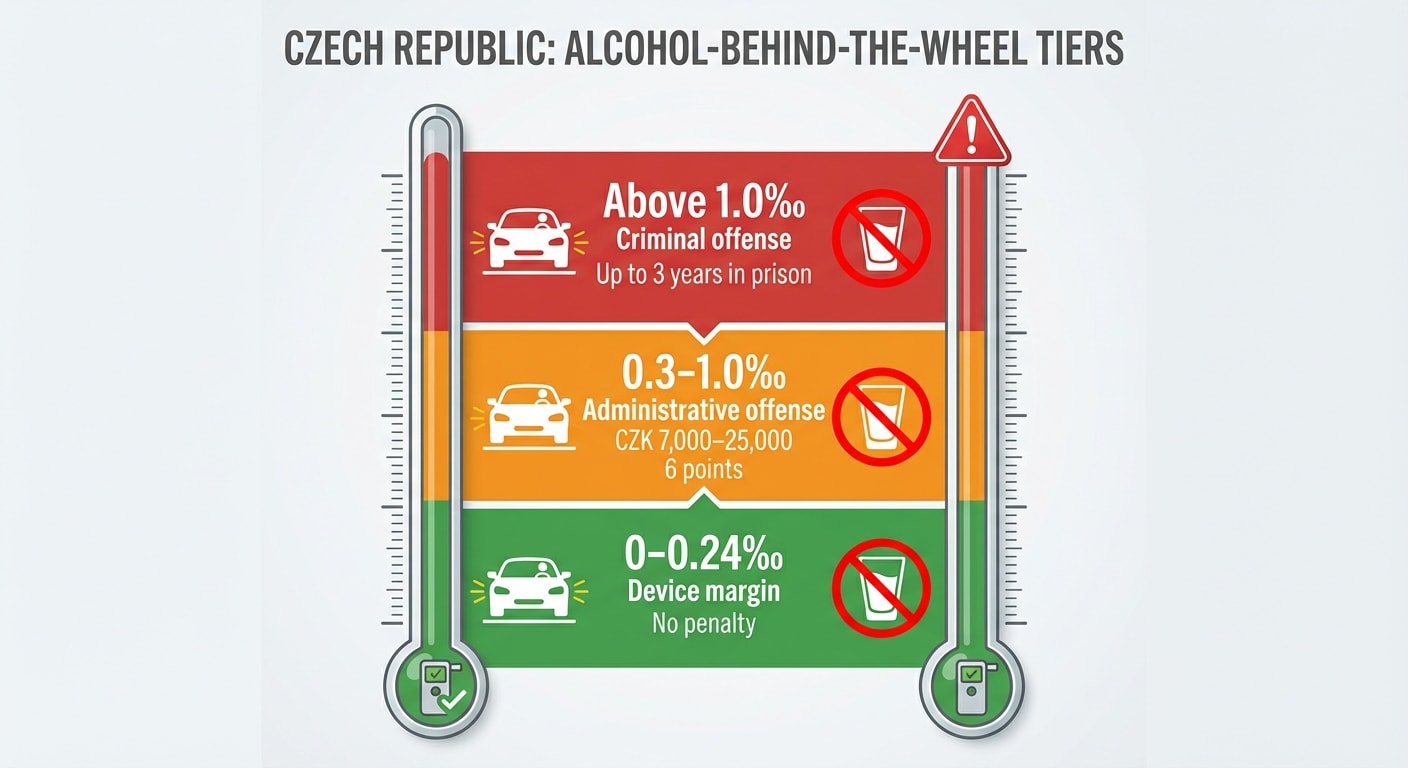
- The Czech Republic has zero tolerance — any alcohol while driving is an offense (from roughly 0.3‰ after the device margin is subtracted)
- Fine of CZK 7,000–25,000, 6 penalty points, and a driving ban of 6–18 months
- Refusing the breathalyzer is paradoxically worse: fines up to CZK 75,000 and a driving ban of up to 3 years
- Above 1.0‰ it becomes a criminal offense — up to 3 years in prison
Zero Tolerance — What It Actually Means
Czechia is among the strictest countries in Europe when it comes to alcohol and driving. Act No. 361/2000, §5(2)(b) states clearly: a driver must not operate a vehicle immediately after consuming alcohol or during any period when they could still be under its influence. No 0.5‰ like neighboring Germany or Austria. No "one beer is fine." The limit is zero.
But here's a practical nuance — the so-called protective margin. The Dräger breathalyzer has a technical tolerance. If it reads up to 0.24‰, the result is not considered proof of alcohol consumption. For a blood test, the margin is 0.20‰. This doesn't mean you can have a small beer and drive. The margin exists to protect someone who didn't drink but whose test showed a minor deviation — perhaps due to mouthwash or medication. If you tell the officer you did drink, the margin doesn't apply.
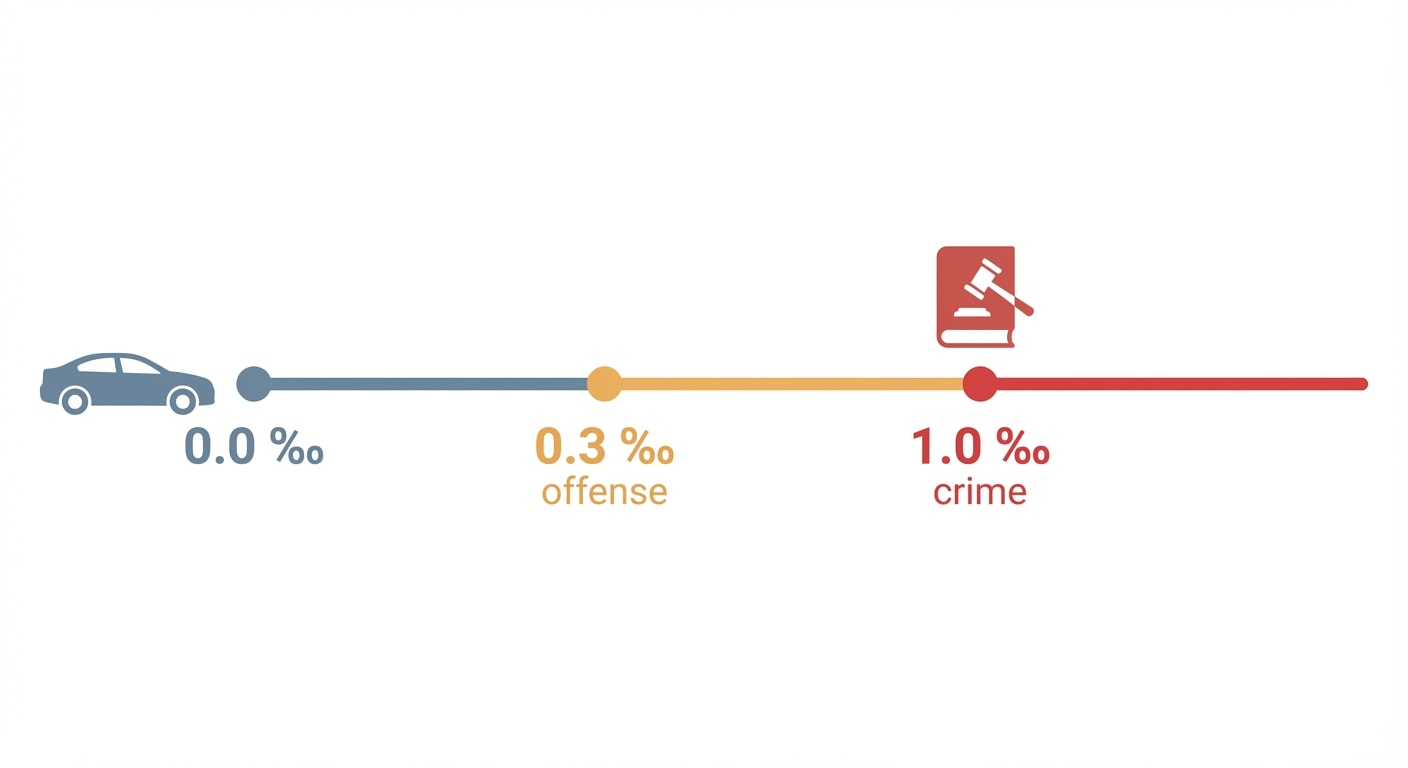
In practice, real penalties kick in at measured values around 0.3‰. Below this threshold, it's treated as an offense without penalty points; above it, you face the full weight of sanctions.
Fines and Penalties by Alcohol Level
How hard alcohol behind the wheel hits you depends primarily on the measured level. Since 2024, tougher rates apply under Amendment 271/2023. Here's the breakdown:
Penalties for Drunk Driving from January 1, 2024
| Alcohol Level | Classification | Fine | Points | Driving Ban |
|---|---|---|---|---|
| Up to 0.3‰ | Offense | CZK 7,000–25,000 | 0 | 6–18 months |
| 0.3–1.0‰ | Serious offense | CZK 7,000–25,000 | 6 | 6–18 months |
| Above 1.0‰ | Criminal offense (§274 CC) | Court-imposed fine | 6 | 1–10 years |
| Refusing the test | Serious offense | CZK 25,000–75,000 | 6 | 18–36 months |
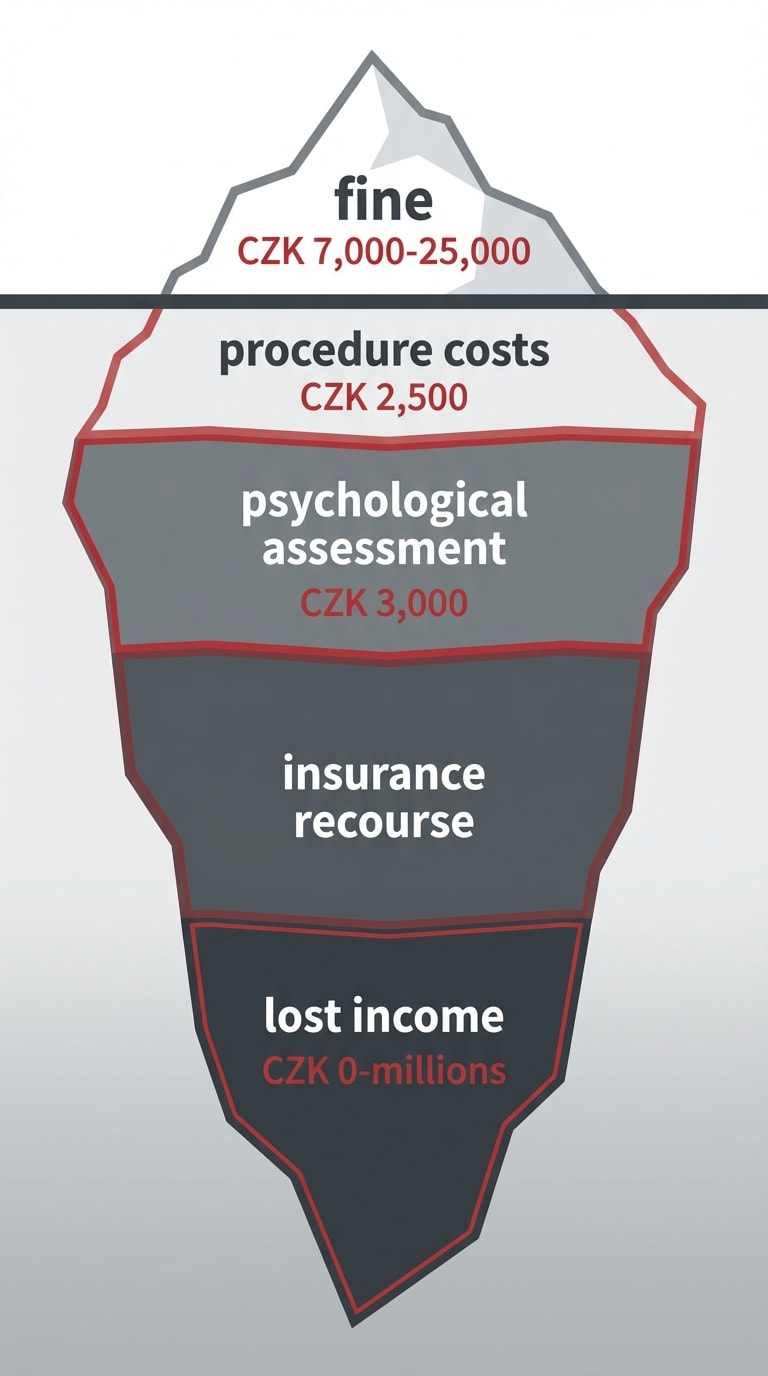
Notice an important detail: since 2024, alcohol offenses can no longer be settled on the spot with an officer. All alcohol-related offenses are handled exclusively through administrative proceedings. This means that even a relatively low reading leads to formal proceedings at a government office, an official decision, and an additional CZK 2,500 in procedural costs on top of the fine.
Six penalty points for alcohol above 0.3‰ is the maximum you can receive for a single offense. Two such offenses within 3 years — say alcohol and then running a red light — and you lose your license under the "two strikes and you're out" rule. A complete overview of the point system is in the Penalty Point System guide.
Six points = halfway to losing your license
Alcohol above 0.3‰ earns you 6 penalty points — that's half the 12-point limit. One phone call behind the wheel (4 points) or a minor speeding offense (2 points) and you're at 12. New drivers during their probationary period are at even greater risk of losing their license.
When It Becomes a Crime
The 1.0‰ threshold is established in Czech case law as the "state excluding the ability to drive." Once you cross it, it's no longer an administrative offense — it's a criminal offense of endangerment under the influence of an addictive substance under §274 of the Criminal Code. That's a completely different league.
The basic sentence (§274(1)) means imprisonment for up to 1 year, a monetary penalty, or a ban on the activity (driving) for 1 to 10 years. In practice, first-time offenders usually receive a suspended sentence and a fine. But one aggravating circumstance doubles the range.
The qualified sentence (§274(2)) — 6 months to 3 years of imprisonment — kicks in when you make it worse. For example, you cause an accident or injury, the damage exceeds CZK 100,000, you're driving a public transport vehicle (bus, tram), or you've been convicted of the same offense within the past 2 years.
And if drunk driving ends in a fatal accident, §143 of the Criminal Code kicks in — involuntary manslaughter. The penalty: 2 to 10 years of imprisonment. More on criminal traffic offenses in the chapter Criminal Traffic Offenses.
How the Breathalyzer Test Works
The test follows clear rules. You have the right to know what's happening at each step — and especially to know your rights.
The officer stops you and requests a breath test. They use a certified Dräger device — you blow into it. After five minutes, a second measurement follows. If the results differ by more than 10%, a third measurement is taken. The valid result is the one where the deviation between measurements is below 10%.
The officer then subtracts the protective margin of 0.24‰ from the measured value and tells you the result. If the result is positive after the subtraction, further steps follow — your license is confiscated, and you're prohibited from continuing to drive.
You have the right to request a blood test instead of a breath test. Blood is drawn at a hospital and is more precise — the protective margin is only 0.20‰. The draw costs approximately CZK 1,000. A blood test can be advantageous if you're certain you didn't drink but the breath test showed a borderline value — perhaps due to mouthwash.
What can skew a breathalyzer result
False positives can be caused by mouthwash, throat spray, certain medications (drops and syrups containing alcohol), or consuming overripe fruit. If you haven't been drinking and the device shows a positive value, insist on a blood test — it's more accurate.
Why Refusing the Test Makes No Sense
Many drivers think: "If I refuse to blow, they can't prove anything." The exact opposite is true. Refusing a breath test or medical examination is a separate offense under §125c(1)(d) — and the penalties are paradoxically higher than for actual alcohol below 1.0‰.
Compare the numbers: refusal costs CZK 25,000 to 75,000, while alcohol below 1.0‰ is only CZK 7,000 to 25,000. The driving ban for refusal: 18 to 36 months, versus just 6 to 18 months for alcohol below 1.0‰. The points are the same — 6. The law treats refusal as an admission that you were driving under the influence — and punishes it more harshly.
Since 2024, penalties for refusal have gotten even steeper. The maximum fine rose from CZK 50,000 to 75,000, and the maximum driving ban extended from 2 to 3 years. The only scenario where refusal theoretically makes sense is when your blood alcohol is well above 1.0‰ — because a criminal offense carries a criminal record and potentially prison time. But even then, the police can order a blood test, and your refusal won't prevent it.
What Happens Step by Step
Here's the whole ride from flashing blue lights to picking up your license again:
The officer stops you and requests a breath test. You blow — the device reads above 0.3‰. The officer immediately confiscates your driver's license under §118a. From this moment, you're not allowed to drive. You must secure the car — either someone else drives it away, or you call a tow truck.
If the level is below 1.0‰, the matter is handled as an administrative offense. The authority initiates proceedings and sends you a penalty order. You have 8 days to file an objection — if you do, the order is annulled and full proceedings begin where you can mount a defense. If you don't file, the order becomes legally binding. More on defense strategies in the chapter How to Fight a Fine.
If the level is above 1.0‰, the police refer the case to the public prosecutor. Criminal proceedings follow — you'll either receive a penal order (against which you can file an objection within 8 days) or go straight to a court hearing.
In both cases — administrative offense or criminal offense — a driving ban applies. For the entire duration of the ban, you must not operate any motor vehicle. And if the police catch you driving while banned, it's a criminal offense of obstruction of an official decision (§337 of the Criminal Code).
How to Get Your License Back
The driving ban has expired. What now? You won't get your license back automatically — you need to meet several conditions and actively apply for it.
The first step is a medical examination. You need a certificate of fitness to drive that is no older than 90 days at the time of application. Schedule an appointment with your general practitioner or occupational health physician.
The second step is a psychological assessment — a transport psychology examination. It's mandatory for anyone whose driving ban lasted 6 months or longer. The assessment takes approximately 3 hours and costs CZK 2,500 to 3,500. It tests attention, reaction time, decision-making under stress, and personality profile. You can complete it about a month before the ban ends — you don't have to wait until the last day.
The third step is a re-examination at a driving school, but only if your ban lasted 12 months or longer. The re-examination includes a traffic rules test and a practical driving test. On Kvalty.cz, you can find a driving school in your city that offers re-examinations.
Finally, submit an application for the return of your driver's license at the municipal authority with extended jurisdiction. Attach the medical certificate, psychological assessment confirmation, and — if applicable — proof of re-examination. The authority will decide within 30 days.
Early termination of the ban
After serving half the ban period, you can apply for early termination. For administrative offenses, you apply to the administrative authority; for criminal offenses, to the court. There's no legal entitlement — the decision depends on whether you've 'reformed.' But if you've behaved well, the chances are real.
Alcohol and Insurance — The Hidden Bomb
Most drivers know about the fine and the driving ban. But few think through the insurance consequences — and financially, they can be far worse than anything else.
If you cause a traffic accident while under the influence of alcohol, your mandatory liability insurance (povinné ručení) will pay the injured party's damages. However, the insurer will exercise a so-called recourse claim — meaning they'll demand you pay back every crown they disbursed. For an accident involving serious injury or total damage to an expensive vehicle, we're talking hundreds of thousands to millions of crowns. And recourse claims have no upper limit.
Comprehensive insurance (havarijní pojištění) is even more straightforward. The insurer simply won't pay for damage to your own vehicle. Alcohol behind the wheel is a standard exclusion in every comprehensive policy. Your car is wrecked and the repairs come out of your own pocket — on top of the fine, the driving ban, and potential criminal prosecution.
And this isn't theoretical. According to insurance industry data, approximately 5% of all insurance events involve accidents under the influence of alcohol or drugs. The average damage from an alcohol-related accident is significantly higher than from a regular one, because alcohol impairs reaction time and increases crash severity.
More about insurance for new drivers in the New Driver Insurance hub.
The Numbers Speak Clearly
In 2023, the Czech Police recorded over 4,800 accidents caused under the influence of alcohol — that's 5% of all traffic accidents. These accidents killed 34 people. Alcohol-related accidents carry more than double the risk of injury and death compared to sober accidents.
The good news: the tightening that took effect in early 2024 is working. In the first nine months of 2024, alcohol-related offenses dropped by 10%. More importantly, fatal accidents involving alcohol fell by 53%. That's dozens of lives saved. Higher fines work. But the reality remains that drivers under the influence cause over 5,000 accidents annually and kill dozens of people.
Young drivers especially are at risk — alcohol is one of the leading causes of their accidents. New drivers during their probationary period face even greater danger — one alcohol offense at 6 points plus any other offense and they're at 12 points.
What Changed in 2024
Since January 1, 2024, an amendment (Act No. 271/2023) has introduced three fundamental changes:
First — the elimination of on-the-spot fines for alcohol. Previously, officers could resolve some alcohol offenses on the spot. Now all are handled exclusively through administrative proceedings. This means higher fines, a formal decision, and an additional CZK 2,500 in procedural costs.
Second — tougher penalties for refusing a breath test. The maximum fine rose from CZK 50,000 to 75,000. The maximum driving ban extended from 2 to 3 years. The legislature made it clear that refusing the test should not pay off.
Third — an adjustment to the point system. Alcohol above 0.3‰ now carries 6 penalty points (previously 7). That might sound like a relaxation, but it's part of a broader reform that simplified the system to three tiers (2, 4, and 6 points) and introduced the "two strikes" and "three strikes" rules — making the overall impact actually stricter.
Summary
- The Czech Republic has zero tolerance for alcohol behind the wheel — real penalties start from roughly 0.3‰ (after the device margin is subtracted)
- Fine of CZK 7,000–25,000, 6 points, and a driving ban of 6–18 months for an offense
- Refusing the breathalyzer is worse: CZK 25,000–75,000 and a driving ban of 18–36 months
- Above 1.0‰ it's a criminal offense — up to 3 years in prison and a driving ban of 1–10 years
- The insurer pays damages but demands them back (recourse claim) — potentially millions
- Getting your license back requires a doctor, psychological assessment (CZK 2,500–3,500), and a driving school re-examination for bans of 12+ months
- The 2024 tightening is working: fatal alcohol-related accidents dropped by 53%
Key Terms
| Term | Explanation |
|---|---|
| Zero tolerance | Czech drivers must have zero blood alcohol — unlike most EU countries |
| Protective margin | Technical device tolerance: 0.24‰ for breath, 0.20‰ for blood — values below this aren't considered proof |
| Breath test (orientační dechová zkouška) | Dräger device measurement — two readings 5 minutes apart, constitutes valid evidence |
| Blood test (krevní zkouška) | More accurate alternative to the breath test — drawn at hospital, approx. CZK 1,000 |
| License confiscation (zadržení ŘP) | Officer confiscates the license on the spot when alcohol above 0.3‰ is suspected (§118a) |
| Endangerment under influence (§274 CC) | Criminal offense at levels above 1.0‰ — imprisonment up to 3 years |
| Recourse claim (regresní nárok) | Insurer pays the injured party but demands full reimbursement from the at-fault drunk driver |
| Transport psychology exam (psychotesty) | Mandatory psychological assessment for driving bans of 6+ months — costs CZK 2,500–3,500 |
| Driving school re-examination | Mandatory for bans of 12+ months — rules test + practical driving test |
| Early termination of ban | After half the ban period, you can apply for early termination — decided by authority or court |