
10 Tips for a Safe Probationary Period
99 out of 100 new drivers pass without issues. Defensive driving, safe distance, point monitoring, and free track courses for beginners.
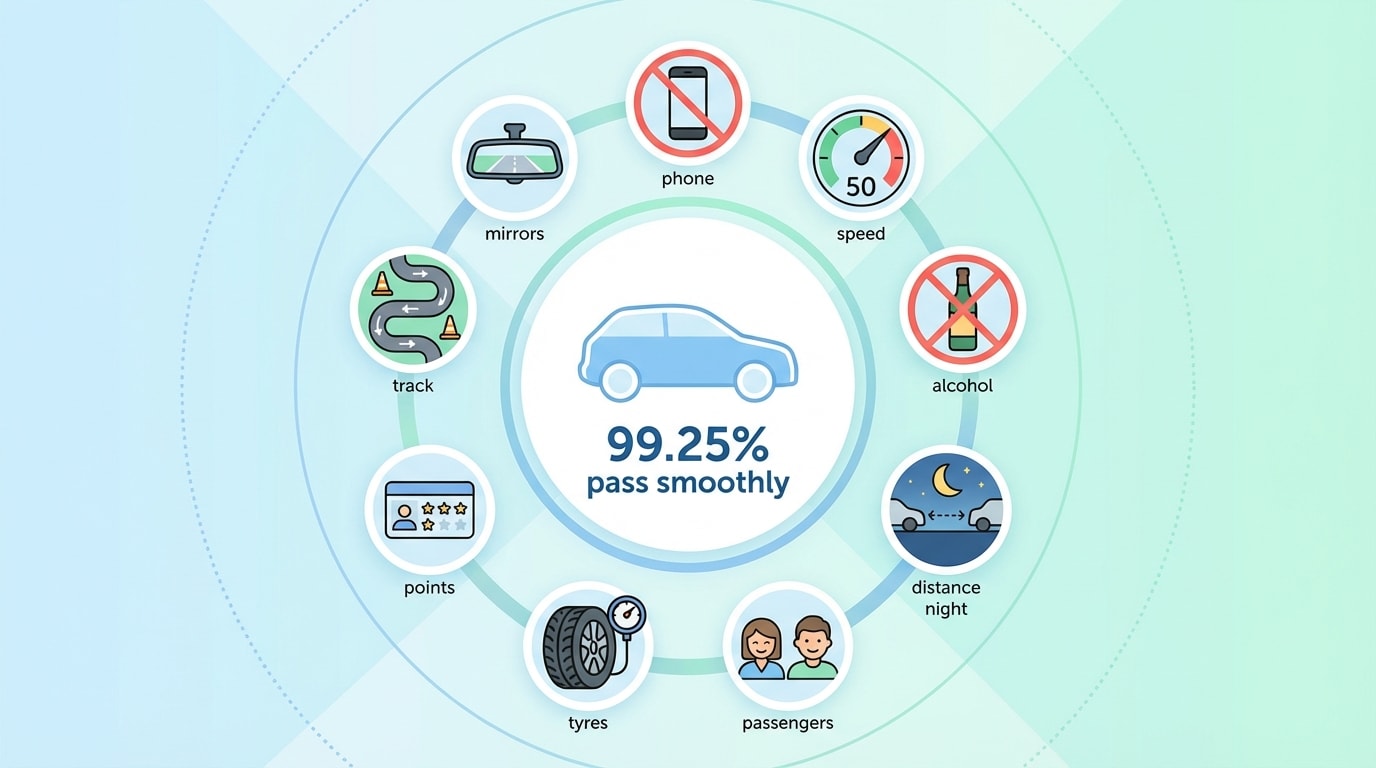
Out of 437,280 drivers who went through the probationary system in its first two years, 3,260 violated the rules. That's 0.75 percent. In other words — 99 out of every 100 new drivers get through their two years on probation without a single issue. The remaining one most often got behind the wheel after drinking. This article isn't a list of orders. It's ten things that work — backed by data, not opinions.
You don't need to be a perfect driver. You just need to avoid a few stupid mistakes that others make. That's what this chapter is about — practical advice you can start using the moment you finish reading. From keeping your phone in your pocket to monitoring your points to free track courses where you'll practice situations no driving school ever taught you.
Quick summary:
- 99.25% of new drivers pass their probationary period without issues — the most common cause of trouble is alcohol (68%)
- Phone use, speeding, and unbuckled seatbelts make up over 60% of all point-penalized offenses in the Czech Republic
- The two-second rule will save you in traffic — double it to four in the rain
- The Start Driving program offers free track courses for drivers aged 18–24
Phone in Your Pocket, Eyes on the Road
Let's start with the simplest tip that also saves the most points. Using a phone in your hand while driving is the second most common point-penalized offense in the Czech Republic — it costs 4 points and a fine of CZK 2,500 to 3,500. For a new driver in the probationary period, that means one phone call burns two-thirds of the way to a 6-point offense that triggers mandatory training.
But it's not just about points. When you're texting, your brain stops registering the road for two to five seconds. At 50 km/h, that's like driving blindfolded across an entire football pitch. And even hands-free calls still consume part of the attention that you, as a new driver, need entirely for driving.
The solution is simple. Turn on "Do Not Disturb While Driving" — you'll find it on both iOS and Android. The phone automatically silences notifications and replies that you're driving. And if you need navigation, set it up before you start and place your phone in a holder.
'Do Not Disturb While Driving' mode
On iOS: Settings → Focus → Driving. On Android: Settings → Digital Wellbeing → Driving Mode. It activates automatically when the phone detects vehicle motion.
Start Easy and Build Up Gradually
The first weeks behind the wheel are like the first days at a new job — everything is new and your brain is running at full capacity. Navigation, shifting, other cars, signs, pedestrians — you process all of it consciously because you don't have automatic habits yet. The fewer additional stress factors you add, the better.
Start by driving on routes you know. The grocery store, the commute to work, your parents' place. On a familiar road, you can focus more on the actual driving because you're not figuring out where to turn. Add longer and more challenging routes gradually — first during the day, in good weather, outside rush hour.
And limit the number of passengers for the first few weeks too. Friends in the car mean distraction, showing off, and social pressure. BESIP data shows that 41% of crash victims involving young drivers are passengers. In the first weeks, drive alone or with one experienced person who will help you — not someone who'll egg you on to drive faster.
Safe Distance and Speed — Two Keys to Survival
Speeding in town by 10 to 19 km/h is the most common point-penalized offense in the Czech Republic — nearly a third of the 355,898 offenses recorded in 2024. At 2 points, it might seem trivial, but points add up fast. And more importantly — speed kills. Among young drivers, excessive speed accounts for 36% of crashes, while for drivers over 25 it's only 19% (CDV).
The law states (Section 18 of Act No. 361/2000 Coll.) that you must adjust your speed to conditions — road surface, visibility, weather, and traffic. A 50 km/h speed limit in town doesn't mean fifty is always safe. A narrow street by a school in the rain calls for thirty. A wet road means twice the braking distance.
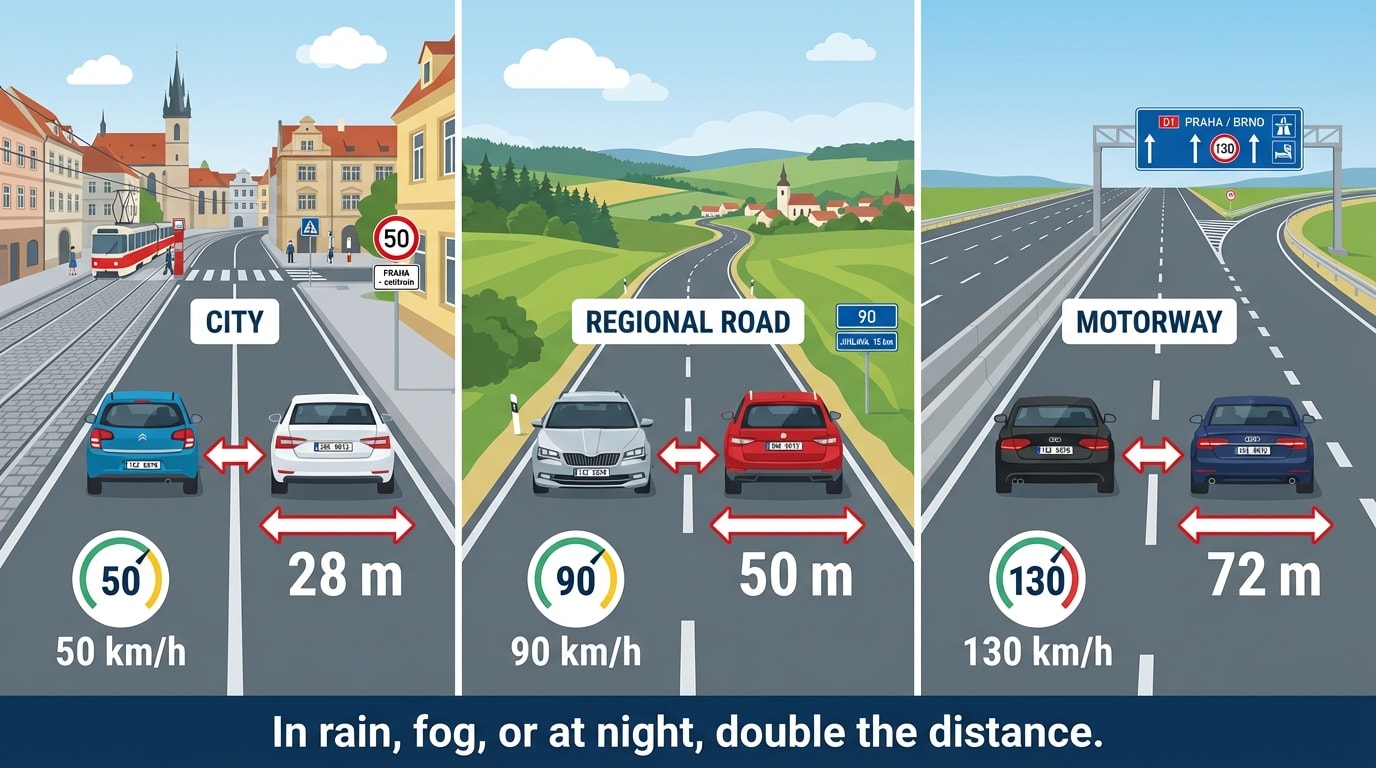
Along with speed comes safe following distance. The rule is simple — keep at least two seconds of gap behind the car in front of you. How to measure it? Pick a fixed point on the road — a post, a tree, a shadow. When the car ahead passes it, start counting. If you pass that point in under two seconds, you're too close. In concrete terms: at 50 km/h that's 28 meters, at 90 km/h it's 50 meters, at 130 km/h on the highway it's 72 meters. In rain, fog, or at night, double it to four seconds.
Safe following distance in numbers
50 km/h = 28 meters (2-second rule) · 90 km/h = 50 meters · 130 km/h = 72 meters. In rain or at night: double to 4 seconds. Failing to keep a safe distance is the most common cause of chain-reaction crashes.
As for night driving — avoid it in the first few months if you can. Visibility drops dramatically, oncoming headlights throw off even experienced drivers, and wildlife appears on forest roads. If you must drive at night, look at the right edge of the road rather than into oncoming lights, and plan stops every hour.
Alcohol: The Easiest Tip in the World
Don't drink and drive. That's it. It sounds like a cliché, but this single tip would solve 68% of all probationary period violations. Of the 3,260 drivers who broke the rules in the program's first two years, 2,227 got behind the wheel under the influence of alcohol or drugs.
The Czech Republic enforces zero alcohol tolerance for all drivers (Section 5, paragraph 2, letter b of Act No. 361/2000 Coll.). One beer puts most people around 0.5‰ — and above 0.3‰, it's a 6-point offense. For you as a driver on probation, that immediately triggers the mandatory program costing CZK 8,000 to 16,000. On top of that, you'll get a fine of CZK 7,000 to 25,000 and a driving ban of 6 to 18 months. Above 1.0‰, it becomes a criminal offense.
Alcohol also removes inhibitions — 45% of crashes under the influence are caused by excessive speed. The two worst causes of accidents combine. More on why alcohol is problem number one in the chapter Common Mistakes by New Drivers.
One beer = 6 points + CZK 15,000
One beer (0.5 l) ≈ 0.5‰ = a 6-point offense. During probation: mandatory training (CZK 8,000–16,000) + fine (CZK 7,000–25,000) + driving ban. One beer can cost you CZK 15,000–40,000 total. Above 1.0‰, it's a criminal offense.
Your Car Needs to Be in Shape Too
Young drivers drive cars that are on average over 11 years old — often without modern safety systems like ESP or automatic emergency braking. You can't change your car overnight, but you can keep it in good condition.
Check your tires regularly — minimum tread depth is 1.6 mm, in winter you want at least 4 mm. Simple test: insert a five-crown coin into the tread groove. If you can see the entire crown, the tires need replacing. Bad tires mean longer braking distances and aquaplaning even in moderate rain.
Checks should also include brakes, lights, wipers, and fluids. It's not rocket science — once a month, walk around your car and take a look. And don't forget mandatory equipment: a reflective vest, a warning triangle, and a first aid kit with a valid expiration date. The Accident Report Form isn't required by law, but you'll be glad to have one in the glove compartment someday.
Monitor Your Points — Nobody Else Will
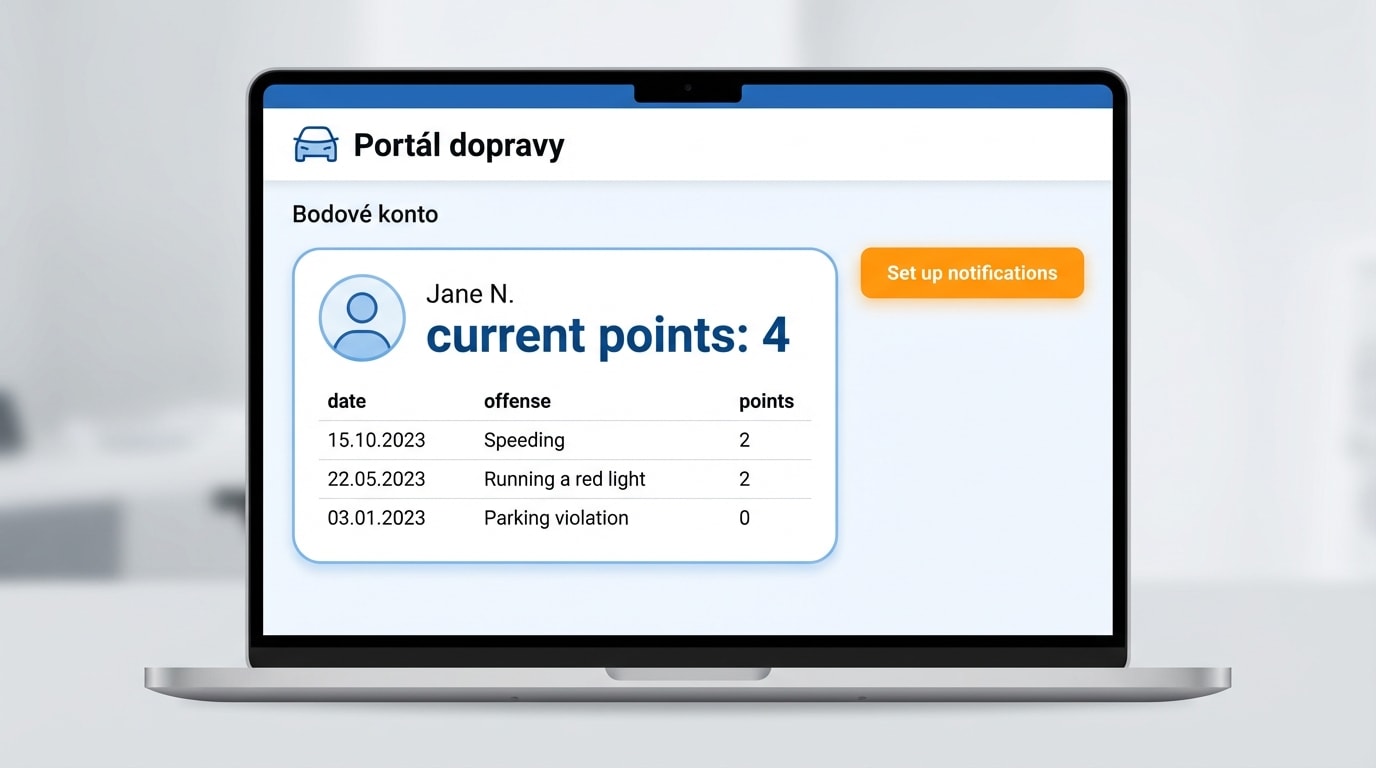
Do you know how many points you have? Most drivers don't, until a letter arrives. Police officers are not required to inform you about points assigned for an offense — so if you don't check your status yourself, you might be unpleasantly surprised.
On the Transport Portal (portaldopravy.cz) or via the Citizen's Portal (portal.gov.cz), you can check your point balance for free at any time. Log in using bank identity, a data mailbox, or NIA. And even better — you can set up automatic notifications (SMS or email) about every change. We recommend doing it right now. It takes two minutes and gives you peace of mind.
Good news: if you go 12 months without any point-penalized offense, 4 points are automatically deducted (Section 123d of Act No. 361/2000 Coll.). And if you have a maximum of 10 points and no 6-point offense, completing a safe driving course at an accredited center will get you another 4 points deducted. A full overview of the point system is in the chapter Points & Offenses or in our guide Point System.
Hit the Track — Even for Free
Driving school taught you to drive in regular traffic. It didn't teach you to brake on a wet road from 100 km/h, it didn't teach you to react to a skid, and it didn't teach you to swerve around an obstacle at full speed. For that, you need a track.
The Start Driving program, organized by BESIP in cooperation with the driving school association, offers free eight-hour courses for drivers aged 18 to 24. Four hours of theory — defensive driving, psychology, high-risk situations — and four hours of practice on a track: skid control, emergency braking, evasive maneuvers. Courses take place at tracks across the country.
If you can't get a free slot or want more, paid skid schools (Polygon Brno, Autodrom Most, Polygon Hradec Králové) offer intensive courses for CZK 3,000 to 6,000. It's an investment that pays for itself many times over — because in a crisis situation, you'll react instinctively and correctly, instead of freezing behind the wheel.
Defensive Driving — One Concept That Changes Everything
All the previous tips can be summed up in one concept: defensive driving. It's not about driving slowly. It's about driving smart. Anticipating what others will do. Keeping an escape route. Not assuming the other driver follows the rules.
Eight principles of defensive driving: Anticipate — watch the situation two to three steps ahead. Keep your distance — the two-second rule, four in the rain. Check your mirrors — every five to eight seconds. Don't drive fast where you can't see — slow down in curves and blind spots. Signal your intentions early — turn signals and brake lights in advance. Yield even when you have the right of way — being alive matters more than being right. Plan with a time buffer — rushing means speeding means points or a crash. And keep your car in good shape.
Defensive driving isn't cowardice. It's the exact opposite — it requires more attention, more thinking, and more discipline than an aggressive style. And it works. BESIP data for 2024 shows a decline in offenses by young drivers across all categories: unbuckled seatbelts down 44%, phone use down 20%, alcohol down 10%, speeding down 10%. Something is working — and a defensive approach is a big part of that "something." More on the mistakes new drivers make most often in the chapter Common Mistakes by New Drivers.
Defensive vs. aggressive approach
Situation: the car ahead brakes without brake lights. Aggressive driver: honk, overtake, gesture from the window. Defensive driver: slow down with a buffer, check mirrors, prepare to stop. Result after a year: aggressive driver has 8 points and one crash. Defensive driver has 0 points and peace of mind.
When Something Happens — A Quick Guide
Even with the best preparation, an accident can happen. In that moment, seconds and a clear head matter. Remember this — or take a photo and keep it in your car.
Turn off the engine and switch on hazard lights. Put on a reflective vest — it's in your mandatory equipment. Place a warning triangle: 50 meters in town, 100 meters on the highway. If someone is injured, call 112 or use the Záchranka app, which automatically sends your location. Document everything: photos of damage, vehicle positions, license plates. Fill out an Accident Report Form. Both parties report the accident to the at-fault driver's insurance.
Call the police if someone is injured, the damage exceeds CZK 100,000, the road is damaged, there's no agreement between the parties, or you suspect alcohol from the other driver. An overview of probationary period rules and what exactly applies to you is in the chapter Rules.
Záchranka app
Download it right now — one tap calls an ambulance with automatic location sharing. It also includes a first aid guide. Free on iOS and Android.
Summary
- 99.25% of new drivers pass their probationary period without issues — just avoid a few basic mistakes
- Phone in hand while driving = 4 points + a fine. Turn on "Do Not Disturb While Driving"
- The 2-second following distance rule (4 in the rain) is the simplest crash prevention
- Don't drink — alcohol accounts for 68% of probationary period violations
- Check your points at portaldopravy.cz and set up notifications
- Try the free Start Driving track course — you'll learn to handle crisis situations
- Defensive driving = driving smart, not slow. Anticipate, keep your distance, have a plan B
Key Terms
| Term | Explanation |
|---|---|
| Defensive driving | A driving style focused on anticipating danger and prevention. It's not about driving slowly — it's about driving smart. |
| Two-second rule | The minimum time gap behind the vehicle in front of you in good conditions. Double it in rain or at night. |
| Point-penalized offense | A traffic offense that adds penalty points to the driver's register (2, 4, or 6 points). |
| Mandatory preventive program | Psychological consultation (4 h) + driving school training (5 h). Triggered by a 6-point offense during probation. |
| Start Driving | A free BESIP course for drivers aged 18–24 — theory + practice on a track (skid control, emergency braking). |
| Transport Portal | A website (portaldopravy.cz) where you can check your point balance for free. |
| Zero alcohol tolerance | In the Czech Republic, no driver may drive under the influence of alcohol. Above 0.3‰ = offense, above 1.0‰ = criminal act. |
| Accident Report Form | A form for documenting a traffic accident. Not legally required, but significantly simplifies insurance claims. |