
How to Get Your License Back After Health Issues
Step by step: what documents you need, how much it costs, and what to expect at the office. Getting your license back after medical suspension.
You got a letter from the authorities saying your driving license has been revoked on medical grounds. You handed in your license and now you have no idea what comes next. Whether you'll ever get it back, how much it'll cost, and how long it'll take.
Good news: most health-related restrictions are temporary. And the law clearly defines how to get back behind the wheel.
Having your license revoked for health reasons isn't a punishment — it's a protective measure. Your doctor determined that at that moment, you couldn't drive safely, and the authorities made a decision based on that. But as soon as your health improves or stabilizes, you have every legal right to apply for reinstatement.
The entire process is governed by Section 100 of Act No. 361/2000 Coll. and follows clear steps. Here you'll learn everything you need — from the first call to your doctor to the moment you get your license back in your hands.
Quick summary:
- Getting your license back is a legally defined process — you apply at the municipal authority with a current medical certificate
- The application itself is free — you only pay for the medical certificate (CZK 200–600) and any specialist examinations
- If more than 3 years have passed since revocation, you must also pass a re-examination at a driving school (~CZK 9,000)
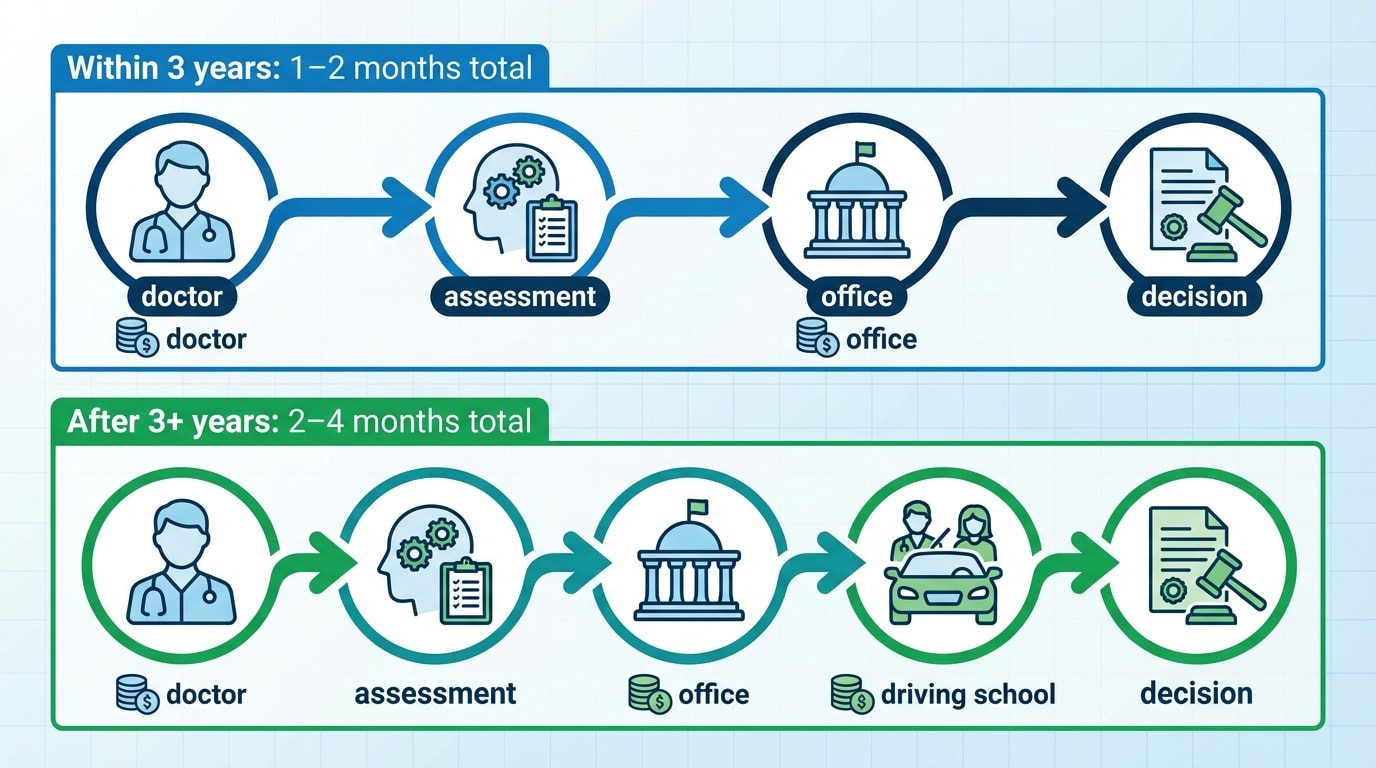
- The entire process takes 1–4 months depending on whether re-examination is needed
Why the authorities revoked your license — and what it means
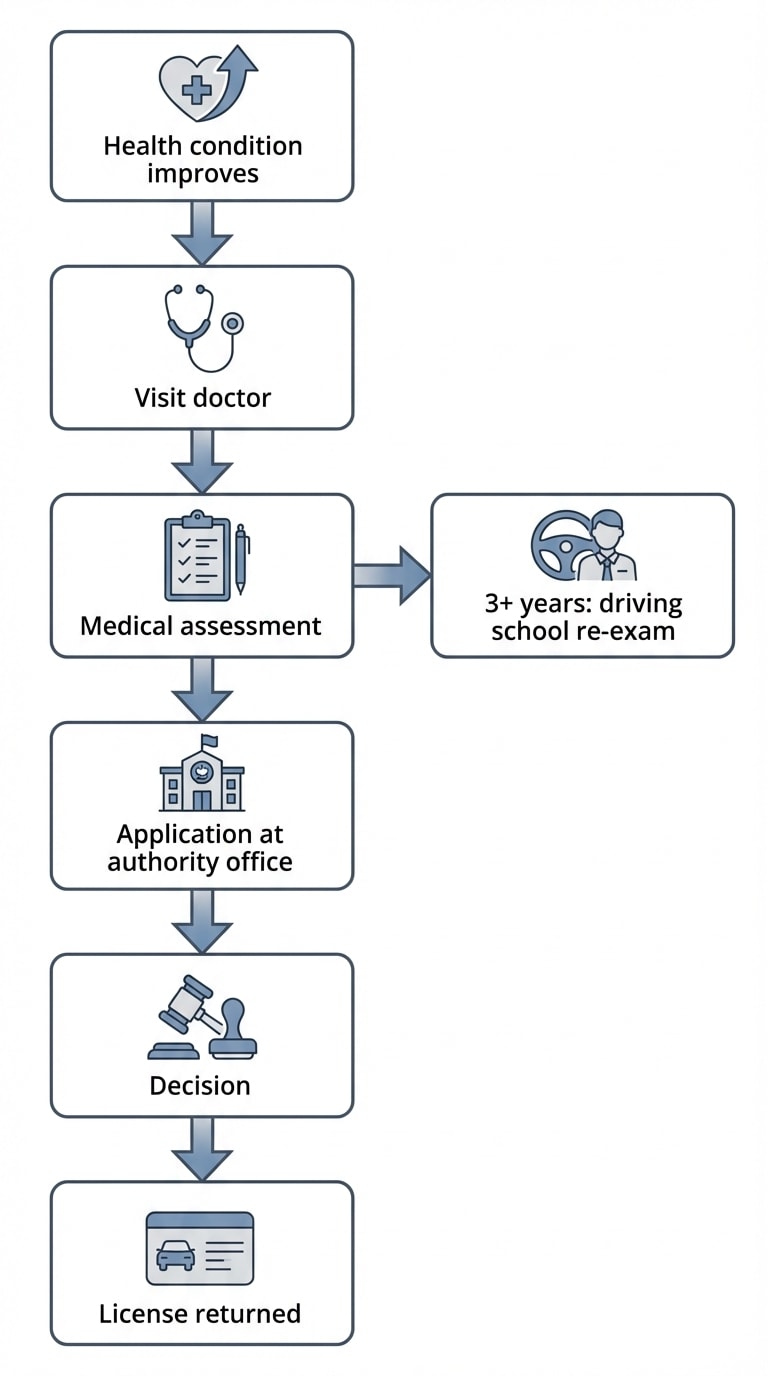
Here's how the mechanism works. Your doctor — whether a GP, neurologist, cardiologist, or ophthalmologist — determines that your health condition affects your ability to drive. By law (Section 86 of Act 361/2000 Coll.), they must immediately report this to the municipal authority with extended powers (ORP) based on your residence. Note: they don't report it to your local municipality, but to the ORP authority — the one that issues driving licenses.
The authority then initiates administrative proceedings. You'll receive a letter inviting you to respond. If the medical findings clearly indicate you're medically unfit, the authority will revoke your driving authorization. After the decision takes legal effect, you must surrender your driving license. The entire proceeding is governed by the Administrative Procedure Code (Act No. 500/2004 Coll.), so you have the right to respond, present your own evidence, and appeal the decision.
And here's the key thing many people overlook: the decision doesn't mean you've lost your license forever. As soon as the reasons for revocation no longer apply — the illness is cured, the condition stabilizes, or the waiting period expires — you have a legal right to apply for reinstatement. And the authority must return it if you meet the conditions.
Your doctor can't confiscate your license
A doctor has no authority to take your driving license. They are legally required to report your health status to the authorities — and the authorities decide through administrative proceedings. You have the right to defend yourself, respond, and appeal.
Three possible outcomes
Not every change in health means the end of driving. The law (Section 85) distinguishes three categories, and what happens to you depends on which one applies.
Medically fit — no change, you keep driving. This is the best scenario — the doctor assessed your condition and concluded it doesn't affect driving. For example, mild hypertension controlled with medication.
Medically fit with conditions — you can drive, but only under specific conditions. Your license will include a harmonized code. For instance, 01.01 means you must drive with glasses. Code 01.06 means glasses or contact lenses. Code 05.01 restricts driving to daytime hours.
This isn't revocation — it's an adjustment. You just need to request a license replacement with the recorded condition. More about vision requirements in the chapter Vision Requirements for Drivers.
Medically unfit — license revocation. You surrender your license and stop driving. But as we've discussed — in most cases, temporarily. And the rest of this article is about the reinstatement process.
Penalty for violating conditions
If your license has code 01.01 (glasses) and the police catch you driving without them, you face a fine of up to CZK 2,500 on the spot. Take the conditions seriously — they protect you and everyone else.
When you can apply for reinstatement — waiting periods by diagnosis
Each diagnosis has its own waiting period before fitness can be reassessed. It's not like someone will call you — once the required time has passed and your condition is stable, the initiative is on you. Here are the most common scenarios.
After an epileptic seizure, you must be at least 12 months seizure-free (for group 1). Confirmation comes from a neurologist. For group 2 (professional drivers), it's stricter — 5 years seizure-free without medication, which in practice permanently disqualifies most professionals.
After an uncomplicated heart attack, you can drive again after 4–6 weeks if a cardiologist confirms a stable condition. After pacemaker implantation, it's usually 1–2 weeks. For an ICD (implantable cardioverter-defibrillator), expect 6 months without a shock — and for group 2, it's a permanent ban.
After cataract surgery, you'll typically return to driving within 1–4 weeks with confirmation from an ophthalmologist. More about vision requirements in the chapter Vision Requirements for Drivers.
With unstable diabetes, the assessment is individual. The key is stable blood glucose without hypoglycemic episodes. Your diabetologist will assess whether your condition is under control.
After a stroke, the waiting period is around 3–6 months — depending on the course and neurological findings.
Waiting periods for common diagnoses
| Diagnosis | Waiting period (group 1) | Condition for reinstatement |
|---|---|---|
| Epilepsy | 12 months seizure-free | Neurologist confirmation |
| Heart attack (uncomplicated) | 4–6 weeks | Cardiology examination |
| ICD implantation | 6 months without shock | Cardiology report |
| Cataract surgery | 1–4 weeks | Ophthalmologist confirmation |
| Diabetes (unstable) | Individual | Stable blood glucose, diabetologist |
| Stroke | 3–6 months | Neurological examination |
Step by step: how to get your license back
Now for the most important part — the concrete process, step by step. The entire procedure is governed by Section 100 of Act 361/2000 Coll. and is intentionally straightforward. But watch out for one thing: the medical fitness certificate must not be older than 30 days from the date of application. So you need to coordinate the doctor visit and the application correctly.
1. Get examined by an assessing doctor
The first step is visiting a doctor who will issue a new medical fitness certificate. Who can that be? Your registered GP, occupational health physician (if you're a professional driver), or any GP if you don't have one of your own.
The doctor will perform an examination and will most likely refer you to a specialist — a cardiologist, neurologist, or ophthalmologist depending on the reason for revocation. These specialist examinations are paid out of pocket and not covered by health insurance.
Budget CZK 500–3,000 per specialist examination. The certificate from the GP itself costs CZK 200–600. More details on what the examination involves in the chapter Medical Exam for Driving License.
Time it right
The certificate must not be older than 30 days when you submit the application. First, schedule your doctor appointment — and as soon as you have the certificate, go to the office. Don't visit the doctor 'in advance' — in a month, the certificate expires.
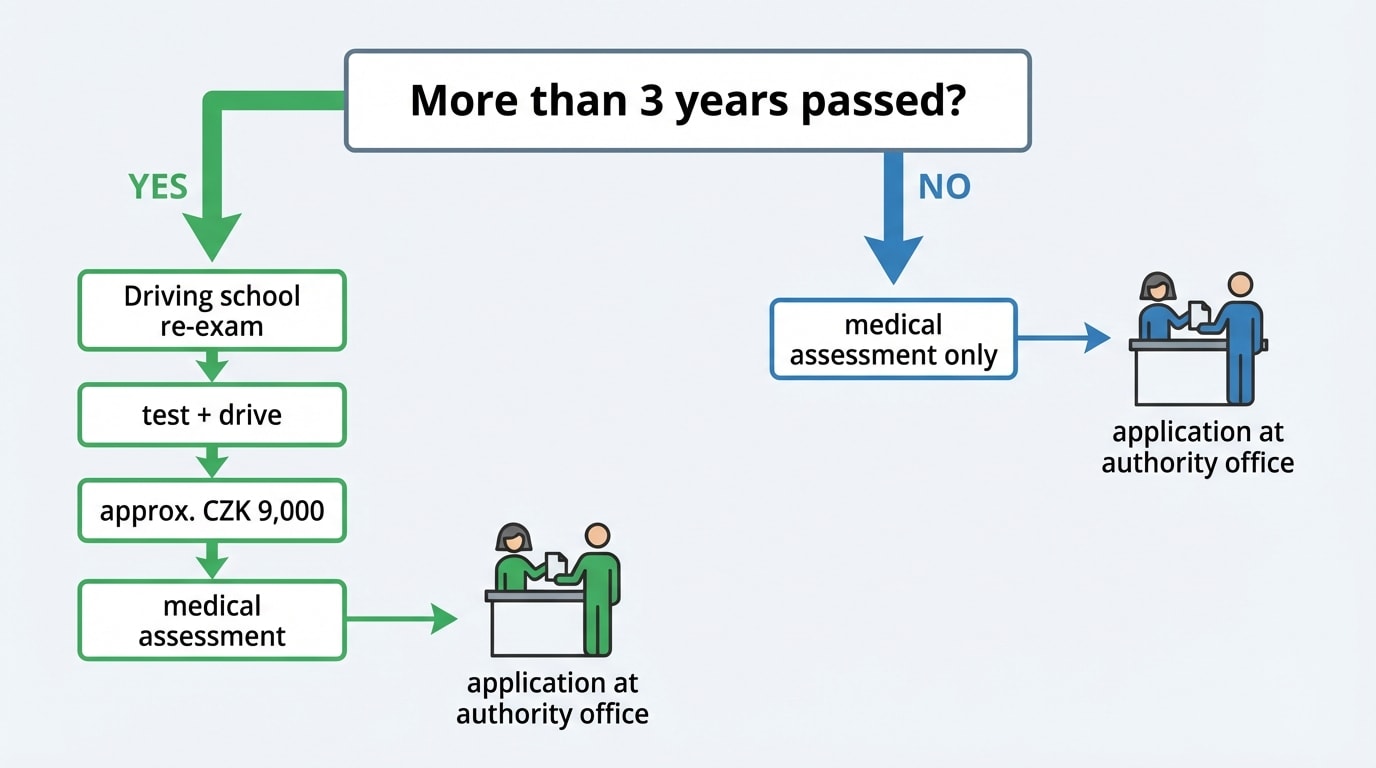
2. Re-examination at a driving school (only if 3+ years have passed)
This is the critical threshold. If more than 3 years have passed since the legal effect of the revocation decision, you must prove your professional competence before applying. In practice, this means a re-examination at a driving school — similar to the final exam.
The re-examination consists of two parts. First, a computer-based test — questions on traffic rules and first aid. Then a practical driving test with an examiner. For categories C, CE, D, and DE, there's an additional practical test on vehicle handling and maintenance.
Practice drives before the re-examination aren't formally required, but driving schools recommend at least one or two preparatory lessons — especially if you haven't driven for three years. The entire re-examination costs approximately CZK 9,000 for category B (the price is contractual and depends on the school). You get a maximum of 3 attempts (first attempt + 2 retakes) with at least 5 working days between them. All parts must be completed within 12 months of the first attempt — otherwise, you need to go through a complete new training course.
Just like the medical certificate, the professional competence document must not be older than 30 days at the date of application. So plan accordingly: re-examination first, then doctor, then office — all within a month.
3. Submit the application at the ORP municipal authority
You submit the application at the municipal authority with extended powers based on your permanent residence — the same office that revoked your license. You can submit it in person, by mail (with an officially verified signature), via data box, or by email with a qualified electronic signature.
The written application must, per Section 100(4), include your name, address, date and place of birth, national identification number, the date the revocation decision took legal effect, and the vehicle category you're applying for. Attach a valid ID document, the medical fitness certificate (no older than 30 days), and if 3+ years have passed — the professional competence document (no older than 30 days).
And here's the best news: the application for license reinstatement is free of charge. No administrative fee. You only pay for medical certificates and any re-examination.
4. Wait for the decision
The authority has 30 days to decide from the date of application (exceptionally 60 days in complex cases). If everything checks out — the certificate confirms fitness and the documents are complete — the authority will decide to reinstate your driving authorization.
It's possible that the authority returns your authorization with conditions — for instance, with a harmonized code for glasses or daytime-only driving. In that case, you'll receive a new driving license with the recorded condition.
How much does the whole thing cost
Let's do the math specifically. Because knowing the process is one thing, and knowing how much money to prepare is another.
If fewer than 3 years have passed since revocation (no re-examination), budget around CZK 700–3,600. That includes the GP certificate (CZK 200–600) plus any specialist examinations (CZK 500–3,000 each). The application at the office is free.
If more than 3 years have passed (with re-examination), add the driving school re-examination — approximately CZK 9,000 for category B. Total costs will be around CZK 9,700–12,600.
For professional drivers (categories C, D), costs may be higher due to stricter specialist examinations and more expensive re-examinations. If a traffic psychology evaluation is also required (common for professionals), add another CZK 1,500–4,000.
Traffic psychology evaluation
When getting your license back for health reasons, psychological tests aren't standard. They're mandatory when getting your license back after reaching 12 penalty points or after a court-imposed driving ban. And for professional drivers in categories C and D.
Group 1 versus Group 2 — why it matters
The law divides drivers into two groups, and the differences in conditions are substantial. Group 1 includes non-professional drivers — categories AM, A1, A2, A, B1, B, and B+E. Group 2 covers professional drivers — C, C+E, D, D+E, professional drivers, driving instructors, and drivers with priority driving rights.
Group 2 faces significantly stricter rules. Some diagnoses that mean only a temporary waiting period for group 1 result in a permanent ban for group 2. A typical example: ICD implantation. A car driver (group 1) can drive again after 6 months without a shock. A truck driver (group 2) cannot — ever. Similarly with epilepsy: group 1 requires 12 months seizure-free, group 2 requires 5 years seizure-free without medication.
The amendment to Decree 445/2024 Coll., effective from January 1, 2025, further tightened conditions for group 2 — new conditions were added to Annex 3 (Brugada syndrome, malignant hypertension, arrhythmogenic cardiomyopathy), and specialist examinations are not covered by insurance. If you're a professional driver, expect higher costs and longer waiting periods.
What if you disagree with the decision
You have the right to fight back. You can appeal the decision to revoke your driving authorization — or the rejection of your reinstatement application. The deadline is 15 days from delivery of the decision (Sections 81–82 of the Administrative Procedure Code, Act 500/2004 Coll.).
You file the appeal with the same authority that issued the decision. They forward it to the appellate body — the regional authority. In your appeal, state why you disagree with the decision and attach evidence. If you have a specialist's report that contradicts the report on which the authority based its decision, that's a strong argument.
The appeal has a suspensive effect — the decision doesn't take legal effect until the regional authority decides. If the appeal also fails, you can file an administrative lawsuit with the court. But that's a last resort — most cases are resolved in administrative proceedings.
Practical tips to make it easier
Over the years that people have dealt with this process, a few tips have emerged that can save you time and stress.
Act quickly. The sooner you apply after the health reasons cease, the better. Not just because you want to drive — but mainly because if you cross the 3-year threshold since revocation, you'll need to pass the re-examination. That's an extra CZK 9,000 and several weeks added to the process.
Coordinate doctor and office. The certificate is valid for just 30 days. First, schedule the doctor's appointment, and as soon as you have the certificate — ideally the same or next day — go to the office to submit the application. If you also need re-examination, plan it so both 30-day deadlines (certificate and professional competence document) are valid at the same time.
Prepare documents in advance. Before going to the doctor, find out what specialist examinations they'll need. If your license was revoked due to a heart condition, book the cardiologist appointment before visiting the GP — so the specialist's report is available.
Account for specialist waiting times. You might wait several weeks for a neurologist or cardiologist. Start booking appointments well in advance as your waiting period nears its end.
If your license was revoked due to medications affecting driving — typically for substance dependence — the waiting period for reinstatement is at least 6 months of proven abstinence. This is a different pathway than for somatic conditions, but the reinstatement principle is the same.
A data box speeds things up
An application submitted via data box is delivered instantly and doesn't require a verified signature. If you don't have one, since 2023 every individual with a Czech ID can have one — just activate it at gov.cz.
What happens if you drive without a license
This is important to mention, because the temptation is real — especially if you live in a village and can't get anywhere without a car. But you're risking a lot. Driving after your license has been revoked is a criminal offense — obstruction of an official decision under Section 337 of the Criminal Code. You face up to 2 years of imprisonment. And if you cause an accident while doing so, the penalties stack up.
On top of that, your insurance company will refuse to pay from your mandatory liability insurance — if you damage someone else's car, you pay everything out of pocket. And getting your license back becomes even harder, because a legal obstacle is added on top of the health reason.
Summary
- Having your license revoked for health reasons is in most cases temporary — the law (Section 100) clearly defines the reinstatement process
- You apply at the ORP municipal authority based on your residence — it's free
- You need a medical fitness certificate no older than 30 days — cost CZK 200–600 plus specialist examinations
- If more than 3 years have passed, you must complete a re-examination at a driving school (~CZK 9,000 for cat. B)
- The authority decides within 30 days — may return the authorization with conditions (harmonized codes)
- You can appeal within 15 days to the regional authority
- Don't drive without a license — it's a criminal offense with up to 2 years of imprisonment
Key Terms
| Term | Explanation |
|---|---|
| Section 100 of Act 361/2000 Coll. | The key section governing reinstatement of driving authorization revoked for health reasons. Defines conditions, documents, and deadlines. |
| ORP Municipal Authority | Municipal authority with extended powers — the office that issues and revokes driving licenses. You apply for reinstatement based on your permanent residence. |
| Medical fitness certificate | A medical document confirming you're fit to drive. For application purposes, it must not be older than 30 days. Issued by a general practitioner. |
| Professional competence re-examination | A driving school exam (test + practical drive), mandatory if more than 3 years have passed since revocation. Max 3 attempts, all parts within 12 months. |
| Harmonized codes | Numerical codes recorded on the driving license expressing driving conditions (01.01 = glasses, 01.02 = contacts, 05.01 = daytime driving). |
| Group 1 / Group 2 | Group 1 = non-professional drivers (AM–B+E). Group 2 = professional drivers (C–D+E). Group 2 has stricter health conditions. |
| Administrative proceedings | The legal process through which authorities decide on rights and obligations (revocation/reinstatement). Governed by the Administrative Procedure Code (Act 500/2004 Coll.). |
| Section 337 of the Criminal Code | Obstruction of an official decision — criminal offense for driving after license revocation. Punishable by up to 2 years of imprisonment. |
| Amendment 445/2024 Coll. | Amendment to the medical fitness decree effective January 1, 2025. Tightened conditions especially for group 2 and added new diagnostic conditions. |
| Doctor's reporting obligation (Section 86) | Legal duty of a doctor to report to the municipal authority when they find that a driver is medically unfit or fit only with conditions. |