
Criminal Traffic Offenses — Penalties & Sentences
When a traffic offense becomes a crime: alcohol above 1.0‰, involuntary manslaughter, hit and run. Prison sentences and how to defend yourself.
Two shots of plum brandy after dinner, a routine drive home, and a police checkpoint at the roundabout. The breathalyzer reads 1.2‰. You expect a fine — but instead of a payment slip, you get a formal accusation. From this moment on, it's not an office handling your case — it's a court. And the stakes aren't a few thousand crowns, but a criminal record, a years-long driving ban, and in the worst case, prison.
Most drivers don't realize this: there's a thin line between a traffic offense and a criminal act. And crossing it is easier than you think. One extra promille, one moment of inattention, one decision to leave the scene of an accident. This chapter shows you exactly where that line is, what happens when you cross it, and what you can do if it happens to you.
Quick summary:
- Blood alcohol above 1.0‰ = automatically a crime of endangerment under the influence (§274 CC), up to 3 years in prison
- Causing a fatal accident = involuntary manslaughter (§143 CC), 1–10 years depending on severity
- Leaving the scene of an accident with injured people = failure to provide assistance (§151 CC), up to 5 years
- Driving while banned = obstruction of an official decision (§337 CC), up to 2 years
- Every traffic-related criminal conviction means a criminal record — even a suspended sentence
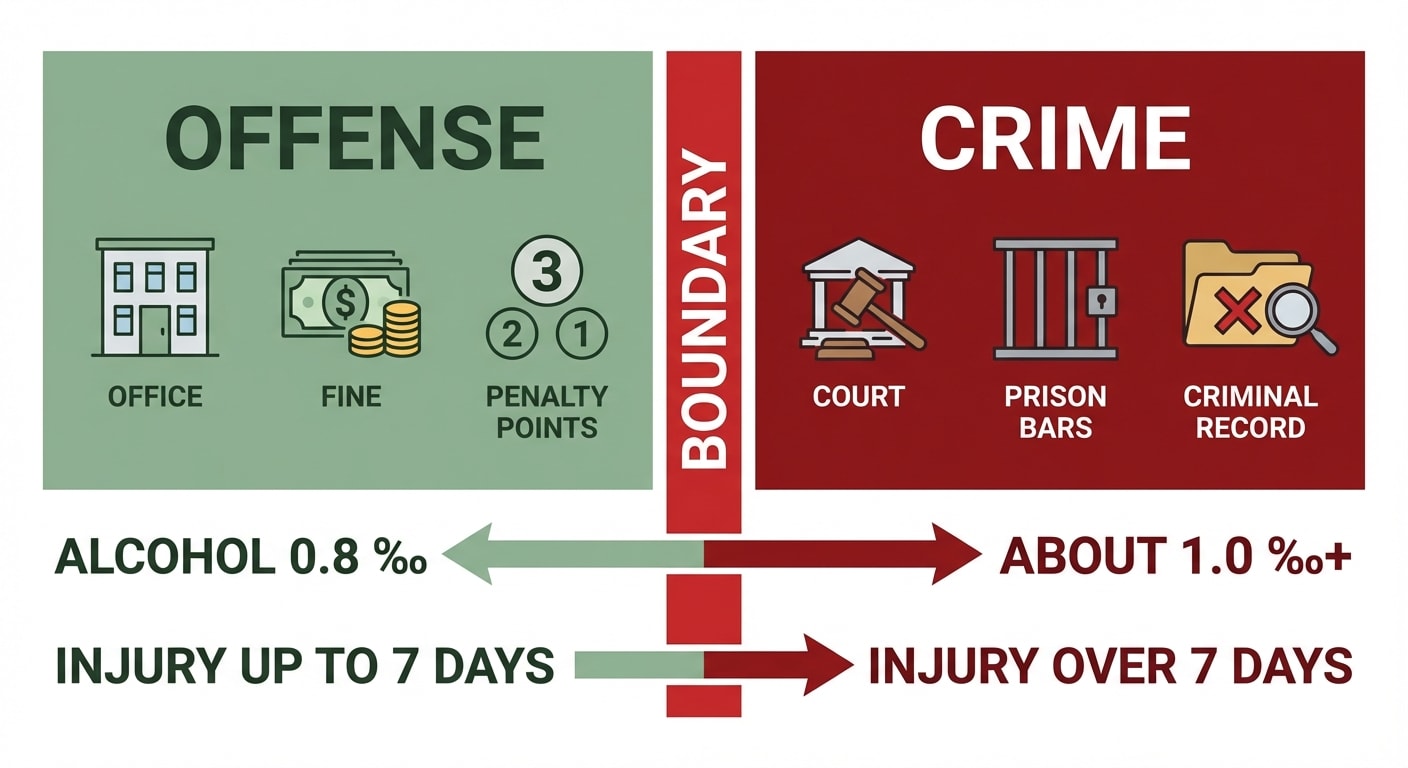
Where Exactly Is the Line Between an Offense and a Crime?
A traffic offense is handled by an administrative authority — you get a fine and penalty points. A criminal offense is handled by a court, and you face imprisonment, a driving ban lasting years, and a criminal record. The difference isn't just paperwork — it's an entirely different world.
The main boundaries can be summed up in five clear rules. First: blood alcohol above 1.0‰ is, according to established case law, automatically considered a "state precluding capability," and it's prosecuted as a crime. Below this threshold it's an offense — unless you cause an accident, because then it can be a crime even with a lower level. We covered alcohol limits and fines in detail in the chapter Alcohol Behind the Wheel.
Second: if you injure someone in an accident and the health impairment lasts more than 7 days, it's a criminal offense of negligent bodily harm. Third: a death on the road is always a crime. Fourth: leaving the scene of an accident where people are injured and you don't provide help is a crime. And fifth: driving a car while under a court-imposed or administrative driving ban is also a crime — no exceptions.
Watch out for drugs behind the wheel
The crime of endangerment under the influence (§274 CC) doesn't apply only to alcohol. It covers all addictive substances — THC, methamphetamine, cocaine, and others. The Supreme Court has set threshold values: THC ≥ 10 ng/ml, methamphetamine ≥ 150 ng/ml, cocaine ≥ 75 ng/ml in blood serum. Above these values, you're automatically in a state precluding capability.
Endangerment Under the Influence — the Most Common Traffic Crime
Section 274 of the Criminal Code is the provision that catches drivers most often. All it takes is getting behind the wheel with more than 1.0‰ blood alcohol — even if you drive perfectly normally, don't endanger anyone, and don't crash anywhere. The mere fact that you're driving in a state precluding capability is a criminal offense.
The basic sentence (§274 para. 1) is up to 1 year of imprisonment, a monetary penalty, or a ban on the activity. In practice, for first-time offenders without an accident, this usually means a suspended sentence or conditional discontinuation of prosecution — if you confess, compensate any damage, and comply with a probationary period of 1–5 years.
Things get worse with the stricter variant (§274 para. 2). If you cause an accident while under the influence, injure someone, cause significant damage, drive a bus or truck, or have been convicted of the same crime in the past 2 years — the sentence jumps to 6 months to 3 years. Plus a driving ban of 1–10 years.
The Criminal Code amendment (270/2025 Coll.) brought one positive change: in less serious cases (§274 para. 1, no accident, first-time offender), courts are increasingly imposing monetary penalties instead of suspended imprisonment. The trend is moving toward the idea that if nothing happened and it's a one-time lapse, you may not necessarily get a suspended sentence — but a criminal record stays with you regardless.
Accidents With Injuries and Death
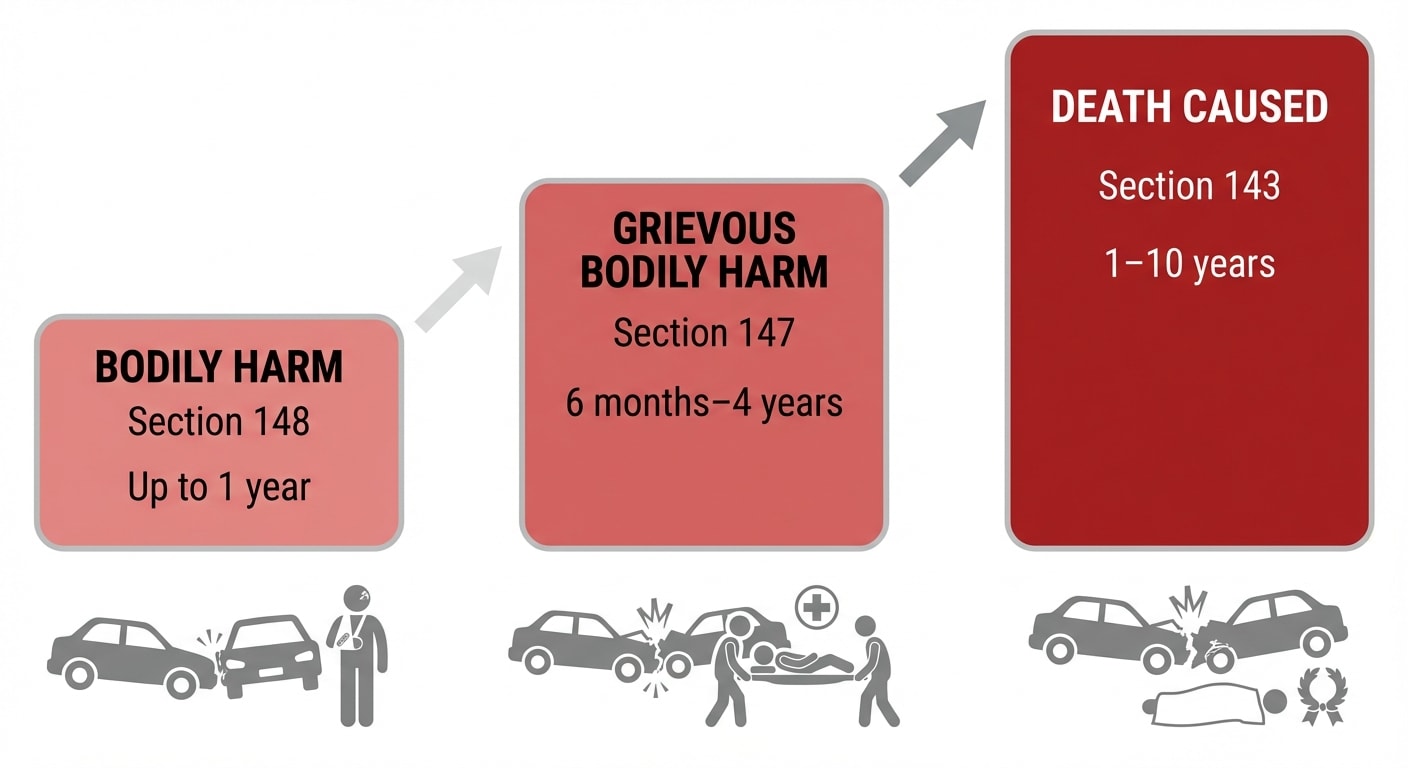
Now we come to the most severe consequences that can happen behind the wheel. The Criminal Code distinguishes three levels of severity.
Negligent bodily harm (§148 CC) applies to situations where you cause an injury lasting more than 7 days in an accident — a fracture, concussion, or extensive lacerations, for example. If it was because you violated an important duty (speeding, failing to yield, using a phone), you face up to 1 year in prison. And if you grossly violated traffic safety laws and injured two or more people, the sentence rises to up to 3 years. In 2024, 438 people died on Czech roads and 1,609 were seriously injured — behind every number is a specific story and a specific driver.
Negligent grievous bodily harm (§147 CC) is the case where the injury has permanent consequences — loss of an organ, paralysis of a limb, permanent health impairment. Here the sentence ranges from 6 months to 4 years, and if you violated traffic safety laws and seriously injured multiple people, up to 8 years.
Involuntary manslaughter (§143 CC) is the most serious. The basic sentence is 1–6 years. If you violated an important duty — such as driving drunk or significantly exceeding the speed limit — the sentence is 2–8 years. And if your gross violation of the rules causes the death of two or more people, it's 3–10 years.
In practice: an expert report from the field of transportation is always a key piece of evidence. The expert assesses speed, braking distance, both drivers' reactions, and reconstructs the entire accident scenario. The result of the report often determines whether the driver violated an "important duty" — and therefore which paragraph of §143 they fall under.
6 penalty points for traffic crimes
For involuntary manslaughter (§143), grievous bodily harm (§147), bodily harm (§148), and endangerment under the influence (§274), you receive 6 penalty points. That's the maximum in a single category — and you're just one more serious offense away from losing your license. You'll find a complete overview of the point system in the chapter Overview of Offenses and Fines.
Hit and Run — Smaller Than You Think, Worse Than You Expect
Many drivers think: "A scratch in the parking lot, nobody saw, I'll drive on." If it really is just bodywork damage and nobody is hurt, it's a traffic offense — a fine of CZK 7,000–25,000 and 4 points (§125c of the Road Traffic Act). Unpleasant, but manageable.
But what if someone was standing near that parking lot and you didn't notice them? Or what if you hit a cyclist at an intersection, stop, see them getting up — and drive away? If it turns out they were injured and you didn't help, you're in §151 territory: failure to provide assistance by a vehicle driver. The sentence? Up to 5 years of imprisonment. Not a fine. Prison.
Section 151 is stricter than the general duty to provide assistance (§150) because it specifically applies to drivers who were involved in the accident. The law assumes that you know best what happened — and therefore you have a duty to stay and help.
Golden rule: always stop after an accident
Even if you think nothing happened, call the police (if damage exceeds CZK 100,000, there are injuries, or third-party property is damaged) and document the situation. Hit and run is proven through camera footage, witnesses, and forensic paint analysis. The difference between a CZK 25,000 offense and a 5-year criminal sentence can come down to whether you stopped or not.
Driving While Banned — §337 and Why People Keep Trying
You'd think that having a court-imposed or administrative driving ban and still getting behind the wheel would be an obvious bad idea. Yet it keeps happening. Obstruction of an official decision (§337 para. 1 letter a CC) means you're performing an activity that was prohibited — in this case, driving even though you have no right to drive.
You face up to 2 years in prison plus an extension of your driving ban. In the point system, this means 4 points. And note: if you're caught repeatedly, the court won't be as lenient — recidivism is an aggravating factor.
A complete overview of all traffic offenses and their corresponding point values can be found in the chapter Overview of Offenses and Fines.
What Awaits You in Criminal Proceedings — Step by Step
Unlike the administrative proceedings we described in the chapter How to Fight a Fine, criminal proceedings are an entirely different world. They're not handled by an office, but by the police and a court. You can't file a simple "objection" and resolve it by letter.
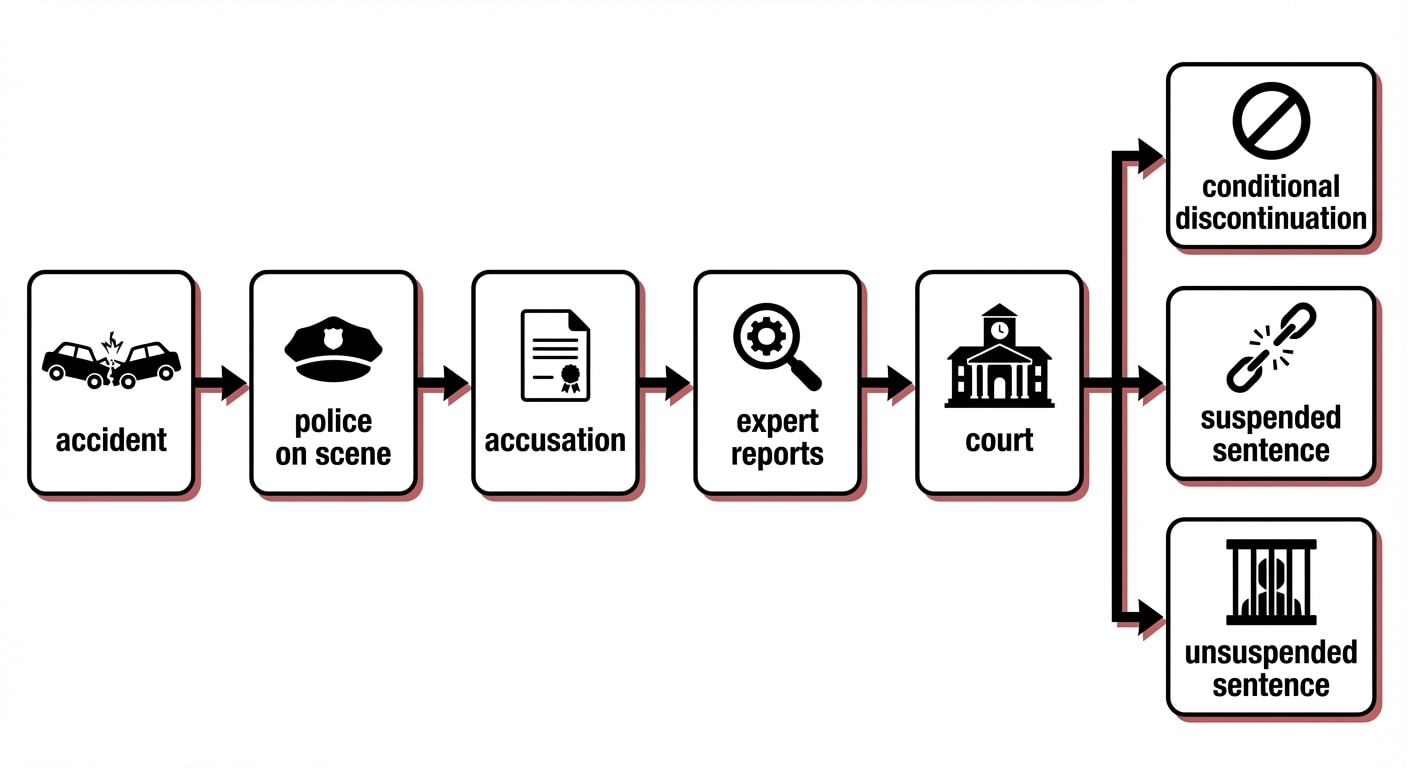
The first step is the on-site investigation. Police secure evidence, conduct a breathalyzer test or blood draw, photograph the scene, and interview witnesses. Then comes the formal accusation — from this point on, you're officially "accused" and have the right to a defense attorney. For criminal offenses with sentences exceeding 5 years (typically §143 para. 2 and 3), a defense attorney is mandatory — if you don't choose one, the court appoints one for you.
Next come expert reports. In traffic accidents, the key report comes from the field of transportation (accident reconstruction), and for injuries, a medical report (severity of injuries). These reports often determine the outcome.
The court can then decide in several ways. In less serious cases (typically §274 para. 1 without an accident), conditional discontinuation of prosecution is an option — you confess, compensate for damage, comply with a probationary period of 1–5 years, and the record is expunged upon successful completion. In moderately serious cases, the court imposes a suspended sentence — you're convicted, but you don't go to prison if you behave during the probationary period. And in the most serious cases, an unsuspended sentence follows — actual prison time.
Consequences of Conviction That Outlast the Sentence
Even a suspended sentence is a conviction. And a conviction for a traffic crime brings consequences that extend far beyond the sentence itself.
Criminal record is the most visible. The entry remains for years after serving the sentence: for sentences up to 1 year, you can apply for expungement after 3 years of good conduct; for sentences of 1–5 years, after 5 years; for sentences over 5 years, after 10 years. For the entire duration of the record, you're not considered "of good repute" — and that can mean problems at work, when applying for a mortgage, or when traveling to countries that require a clean criminal record.
Driving ban for traffic-related crimes is 1–10 years. This isn't a months-long fine like with offenses — it's a real disruption to your life lasting years. And unlike an administrative ban, where retesting is sufficient after the period expires, after a criminal ban you'll also need to undergo psychological and medical examinations.
Employment is another area. Professional drivers — truck drivers, bus drivers, taxi drivers — lose their jobs. But it's not just about them. Positions requiring good repute (public administration, security services, some financial positions) can't be held with a criminal record.
Insurance companies can demand subrogation — meaning they'll want back the money they paid out to victims. If you caused an accident under the influence of alcohol and the insurer compensated the injured, they can recover the entire amount from you. In serious accidents, this can amount to millions.
Suspended ≠ no record
A common misconception: 'I got a suspended sentence, so I don't have a record.' Wrong. A suspended prison sentence IS a conviction and IS in the criminal record. You can request expungement only after the probationary period plus statutory waiting periods have elapsed. Throughout that time, the entry will appear in every criminal record extract.
Endangering the Public — Rare But Brutal
To close, two provisions that rarely appear in practice but are worth mentioning. Intentional public endangerment (§272 CC) covers situations where someone intentionally puts people in danger — such as driving the wrong way on a highway. The sentence is 3–8 years. Negligent public endangerment (§273 CC) can apply to a bus or truck driver who, through negligence, endangers a large number of people. The sentence is up to 2 years, or 6 months to 5 years if an important duty was violated.
The socioeconomic losses from traffic accidents in 2024 reached CZK 149 billion. These aren't abstract numbers — they represent lives, families, and stories. Criminal law exists so that the most serious cases have proportionate consequences — and to deter the behavior that kills on the roads.
Summary
- Alcohol above 1.0‰ = crime of endangerment under the influence (§274 CC), even without an accident
- Causing death = 1–10 years in prison depending on circumstances (§143 CC)
- Grievous bodily harm through negligence = up to 8 years (§147 CC), ordinary injury over 7 days = up to 3 years (§148 CC)
- Leaving the scene of an accident with injured people = up to 5 years (§151 CC)
- Driving while banned = up to 2 years + 4 points (§337 CC)
- Criminal record remains for years after the sentence — affects employment, insurance, and travel
- For first-time offenders without an accident (§274 para. 1), courts often opt for conditional discontinuation or monetary penalties
Key Terms
| Term | Explanation |
|---|---|
| Criminal offense | An unlawful act handled by a court (not an office). Carries the risk of imprisonment and a criminal record. |
| Misdemeanor (přečin) | A less serious criminal offense with a maximum sentence of up to 5 years. Most traffic crimes are misdemeanors. |
| Suspended sentence | A prison sentence whose execution is deferred for a probationary period (1–5 years). If you behave, you don't go to prison. |
| Conditional discontinuation | Criminal prosecution is halted if you confess, compensate damages, and comply with the probationary period. Not a conviction. |
| State precluding capability | A condition where the driver cannot safely operate a vehicle — for alcohol, automatically from 1.0‰; for drugs, above threshold values. |
| Activity ban | A court-imposed driving ban of 1–10 years, imposed as a penalty for traffic-related crimes. |
| Expungement | Erasure of a criminal record entry — possible after a waiting period (3/5/10 years) following completion of the sentence. |
| Subrogation | The insurer's right to recover money paid to victims if the driver caused the accident under the influence. |
| Mandatory defense | A situation where the accused must have a defense attorney — for crimes with sentences exceeding 5 years, the court appoints one. |
| Expert report | A professional analysis of the accident (speed, braking distance, reconstruction) — key evidence in criminal proceedings. |