Traffic Offenses & Fines — Czech Driver Guide 2026
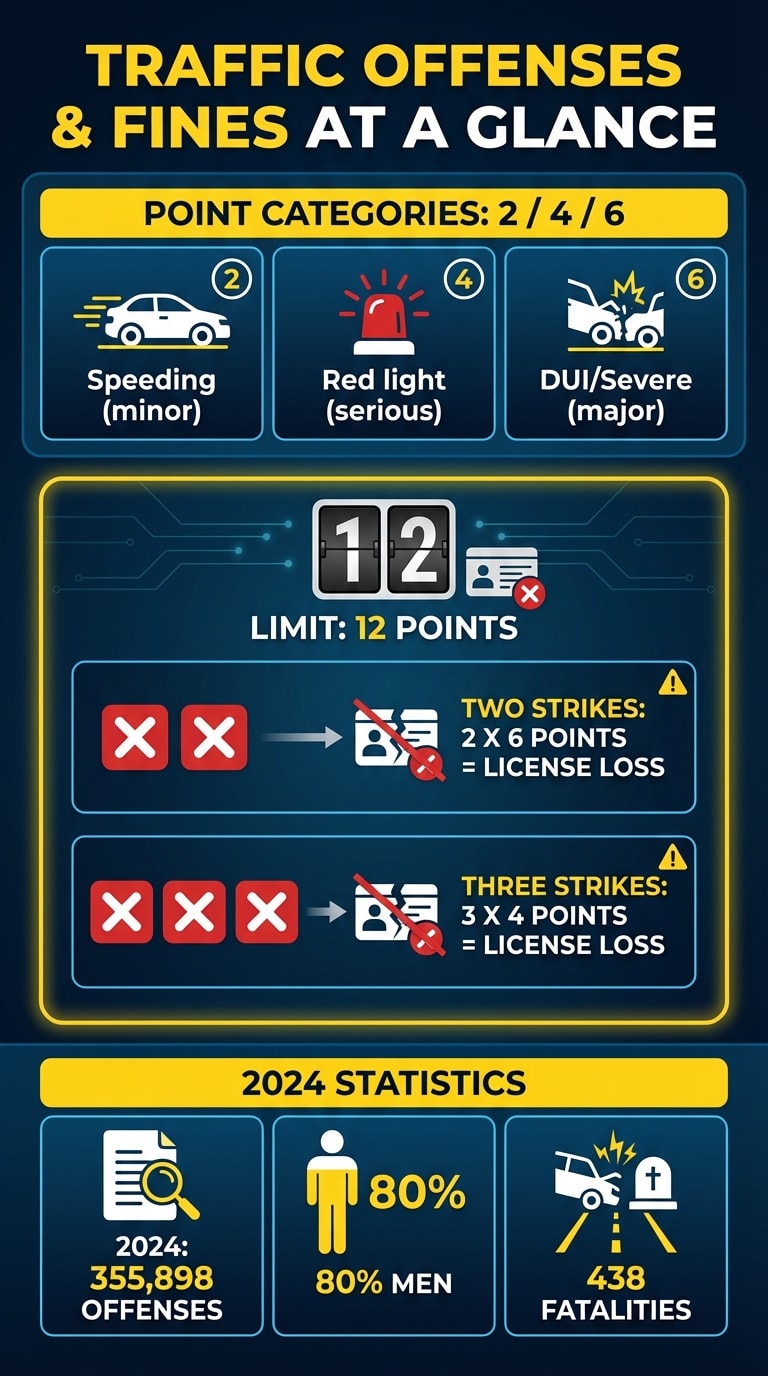
355,898 penalized traffic offenses in a single year. An average of 972 per day. The most common one — slightly exceeding the speed limit in a built-up area — accounts for nearly one in three. And since 2024, the rules have gotten stricter. Fines went up, point categories were simplified, and new "two strikes and you're out" and "three strikes and you're out" rules were introduced. Do you know what holding your phone at a red light costs you today? Or what happens if you refuse a breathalyzer?
This isn't a guide for reckless drivers. Most offenses involve ordinary people — commuters who push it a little in a 50 km/h zone. Or forget their hands-free. Or park where they shouldn't. The system of fines, penalty points, and driving bans in the Czech Republic is fairly complex, and after the 2024 reform, a lot has changed. That's why we put together a guide that shows you — in one place — what each offense costs, how many points you'll get, and what you can do if you disagree.
At Kvalty.cz, we help drivers choose the right driving school — and here, we'll help you understand the system that decides what happens to your license.
Quick summary:
- Since January 2024, there are 3 point categories: 2, 4, and 6 points — simplified from the original five
- The limit for losing your license is 12 points — just two of the most serious offenses
- Fines for using a phone while driving went up 2.5× (from CZK 1,000 to CZK 2,500–3,500)
- Refusing a breathalyzer costs CZK 25,000–75,000 and a driving ban of up to 3 years
Offenses in Numbers
Before you dive into the individual chapters, take a look at the numbers that show how the system works in practice. These aren't abstract statistics — they're data about drivers who use the same roads as you.
In 2024, police and authorities recorded 355,898 penalized traffic offenses. That's an average of 972 per day — and those are only the ones that make it into the records. The real number is far higher. Here's what's interesting about who commits them: 80% of offenders are men, despite making up only 54% of all drivers. By the end of 2024, 449,153 drivers had at least one point on their record — that's 6.42% of all registered drivers.
The good news? The 2024 reform is working. Phone-related offenses dropped by 20%, alcohol-related offenses by 10%, and the number of road fatalities (438) was the lowest ever recorded since 1961. Higher fines and stricter point values are having a measurable effect. And here's an interesting stat: drivers who went through the L17 program — driving from age 17 with a mentor committed only 8.4% of the offenses compared to drivers who started at 18.
Traffic Offenses & Fines — Key Figures 2024
| Figure | Value | Note |
|---|---|---|
| Point categories | 2 / 4 / 6 points | Since Jan 1, 2024 (previously 5 categories) |
| License revocation limit | 12 points | = 2 × most serious offense |
| Penalized offenses (2024) | 355,898 | Average of 972 per day |
| Most common offense | Speeding in town (+10–19 km/h) | 29% of all offenses |
| Male share of offenses | 80% | Despite being only 54% of drivers |
| Road fatalities (2024) | 438 | Lowest number on record |
| Two strikes and you're out | 2 × 6 points = license revoked | Within 3 years |
| Three strikes and you're out | 3 × 4 points = license revoked | Within 3 years |
How the Point System Works
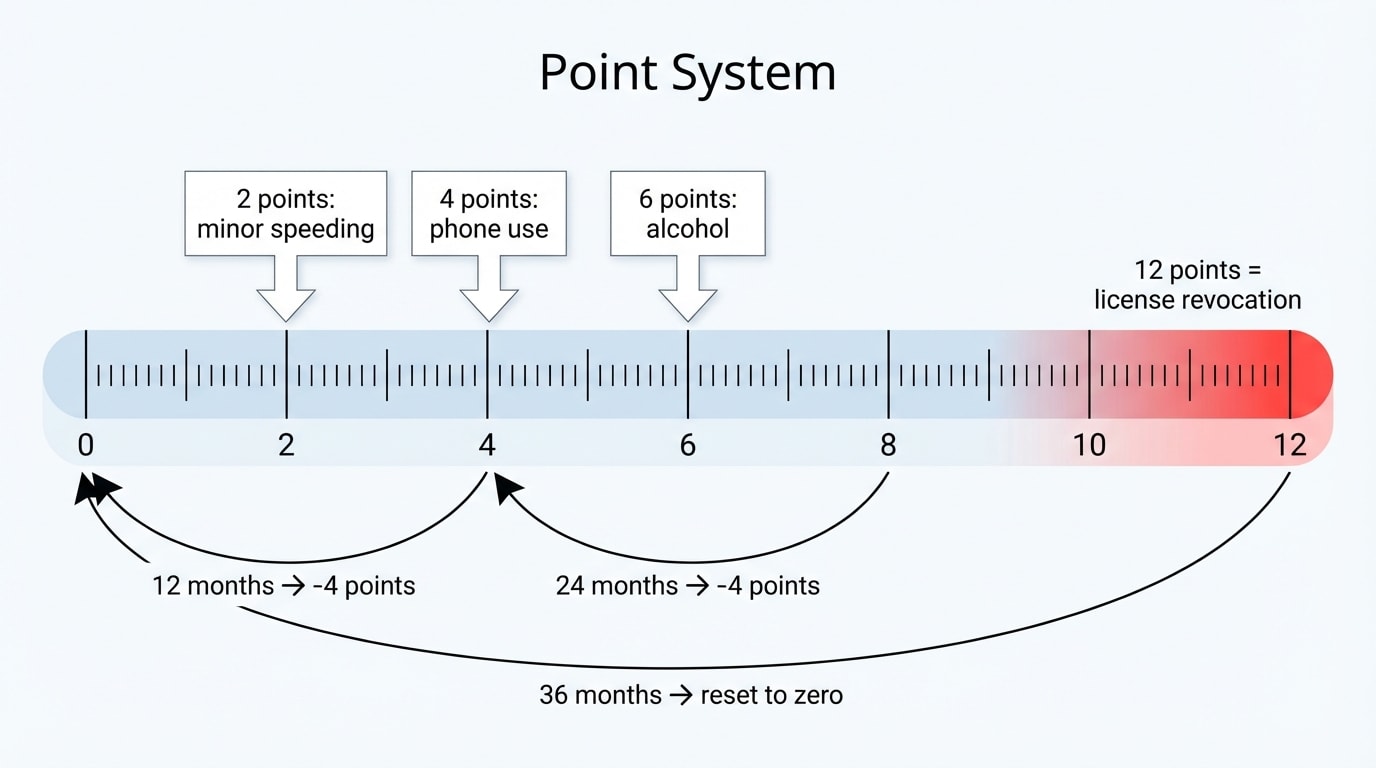
Every driver in the Czech Republic starts at zero. Points are added for offenses — and once you reach 12, you lose your license for at least one year. The point system has been in place in the Czech Republic since 2006. But a reform effective January 1, 2024 (Act No. 271/2023 Coll.) fundamentally changed it.
The original five point categories were simplified to three. Six points are assigned for the most serious offenses — drunk driving, running a red light, excessive speeding (40+ km/h over the limit in town), or driving the wrong way on a highway. Four points are for moderately serious violations like using a phone while driving, speeding by 20–39 km/h in town, or not wearing a seatbelt. And two points for minor speeding or parking in a disabled space.
The reform also introduced two new rules that significantly toughened the consequences of repeat offenses. The "two strikes and you're out" rule means that two six-point offenses within 3 years result in automatic license revocation — even if you haven't reached 12 points. And the "three strikes and you're out" rule does the same for three four-point offenses within 3 years. Three phone-while-driving tickets in three years = license gone.
How do points come off? Twelve months without a penalized offense removes 4 points. Another 12 months removes another 4. And after 36 months without an offense, your record resets to zero. You can check your status online at the transport portal (portaldopravy.cz) or in person at a Czech POINT office. A detailed overview of all offenses and points can be found in the chapter Traffic Offenses & Fines Table. And if you want to understand how points accumulate, expire, and what happens when you max out, check out the Point System guide.
Check your points
At the transport portal (portaldopravy.cz) you can check your point balance for free. Log in using your bank identity or mobile key. You can also set up automatic notifications — an SMS or email will let you know when your balance changes.
Most Common Offenses — What Gets You Points
You might think traffic offenses are for irresponsible drivers. The data says otherwise. The top 3 offenses in 2024 make up more than half of all cases — and all three are things that can happen to practically anyone.
In first place is speeding in a built-up area by 10 to 19 km/h. Doing 60 in a 50 zone — 29% of all offenses. Two points and CZK 1,500–2,000 on the spot. Seems minor, but it's the beginning of the road to losing your license.
In second place is using a phone while driving — 14% of all offenses. Since the 2024 reform, the on-the-spot fine more than doubled: from CZK 1,000 to CZK 2,500–3,500 and from 2 points to 4. That's a major change many drivers still don't know about. And note — holding your phone at a red light while waiting for green is also an offense. More details in the chapter Phone While Driving.
In third place is speeding in a built-up area by 20 to 39 km/h — 11% of offenses, 4 points, and CZK 2,500–3,500 on the spot. This is where it gets serious. With the "three strikes" rule, three such offenses within three years and you lose your license.
Watch out for offense combinations
Three phone-while-driving tickets in 3 years = 3 × 4 points = license revoked. The 'three strikes' rule counts all four-point offenses together — it can be phone + speeding + seatbelt.
What to Do When Police Pull You Over
It happens to everyone — an officer waves you down and you're pulling over. For a lot of drivers, it's a stressful situation, but the process is straightforward.
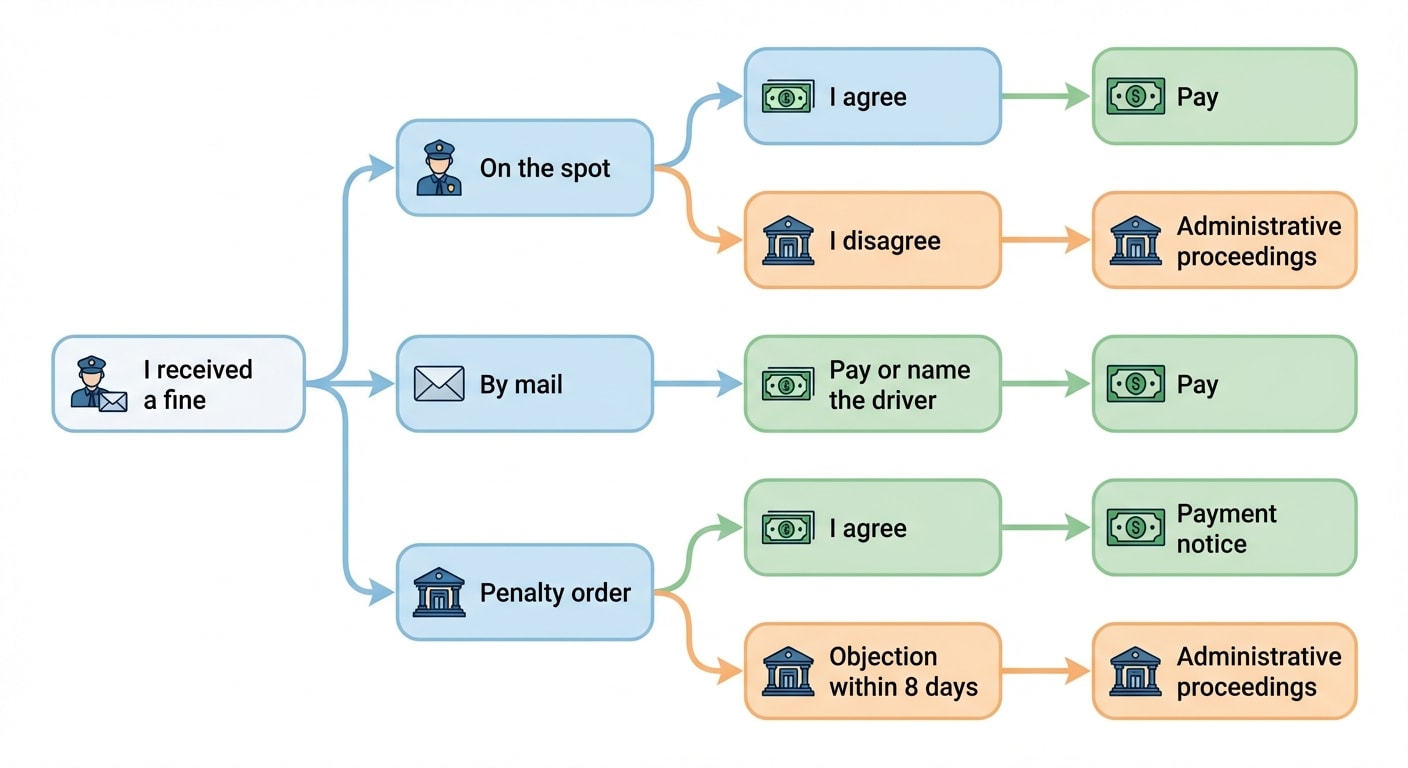
Pull over safely, turn off the engine, and roll down the window. You don't need to get out unless the officer asks you to. Show your documents when asked — since January 2024, you don't need to carry your physical driver's license in the Czech Republic; proving your identity (ID card or passport) is enough. The officer will tell you what you've done wrong and offer to resolve it with an on-the-spot order (formerly a "block fine").
You have two options. You can agree and pay the lower fine on the spot — by card or bank transfer; cash has been mostly phased out since 2024. Or you can disagree — in which case the offense goes to administrative proceedings, where the fine is usually higher and you'll also face proceedings costs of CZK 2,500. When it pays to refuse and when it doesn't is covered in the chapter How to Fight a Fine.
On-the-spot orders are final
If you agree to a fine on the spot and pay, the decision is legally binding. You cannot appeal it. Think carefully before saying yes — especially for higher fines and offenses that carry points.
Frequently Asked Questions
It depends on where and by how much. In town, 10–19 km/h over costs CZK 1,500–2,000 on the spot + 2 points. 20–39 km/h over is CZK 2,500–3,500 + 4 points. 40+ km/h over goes to administrative proceedings — CZK 7,000–25,000 + 6 points + a driving ban of 6–18 months. Outside town, the thresholds are higher. → More in the chapter Speeding
The Czech Republic has zero tolerance. If you're above 0.3‰, you face a fine of CZK 7,000–25,000, 6 points, and a driving ban of 6–18 months. Refusing a breathalyzer is even worse — CZK 25,000–75,000 and a driving ban of 18–36 months. Above 1.0‰, it's a criminal offense. → More in the chapter Drunk Driving
4 points + a fine of CZK 2,500–3,500 on the spot (since the 2024 reform — previously just 2 points and CZK 1,000). Holding your phone at a red light is also an offense. Three times in 3 years = license revoked. → More in the chapter Phone While Driving
The reform simplified the point system to 3 categories (2, 4, 6 points) and significantly increased fines for serious offenses. Alcohol: max up from CZK 20,000 to 25,000. Refusing a test: max up from CZK 50,000 to 75,000. Phone: from CZK 1,000 to 2,500–3,500. New "two strikes" and "three strikes" rules. → More in the chapter Traffic Offenses & Fines Table
Yes. On the spot, you can refuse — the offense goes to administrative proceedings. Against a mailed order, you file an objection within 8 days. Against a decision, you appeal within 15 days. But note: in administrative proceedings, fines are usually higher and you'll face proceedings costs of CZK 2,500. → More in the chapter How to Fight a Fine
Three main situations: alcohol above 1.0‰ (criminal endangerment under the influence), causing an accident with serious injury or death (negligent bodily harm/manslaughter), and fleeing the scene with injured people (failure to render aid). Penalties include suspended sentences and actual prison time. → More in the chapter Criminal Traffic Offenses
If a speed camera captures your vehicle and the authorities can't identify the driver, they send a payment notice to the registered owner. You have 30 days to pay — then the matter is closed without points and without a record. Or you can disclose who was driving. If you do neither, administrative proceedings follow with a higher fine. → More in the chapter How to Fight a Fine
Summary
- Since Jan 1, 2024, there are 3 point categories (2, 4, 6 points) — stricter fines and new rules
- The license revocation limit is 12 points — but 2 × 6 points or 3 × 4 points within 3 years also triggers it
- The most common offense is slightly exceeding the speed limit in town (29% of all cases)
- Phone while driving costs CZK 2,500–3,500 on the spot and 4 points — 2.5× more than before the reform
- Refusing a breathalyzer costs more than a positive result — CZK 25,000–75,000
- You can check your point balance for free at the transport portal (portaldopravy.cz)
Key Terms
| Term | Explanation |
|---|---|
| On-the-spot order | A fine issued directly by police (formerly "block fine") — lower rate, acceptance is final |
| Order proceedings | A fine delivered by mail — you have 8 days to file an objection, otherwise it becomes legally binding |
| Administrative proceedings | Formal proceedings at the municipal office — higher fines, but you have the right to defend yourself and appeal |
| Point balance | Record of penalty points — starts at 0, limit is 12, points are deducted after 12 months without an offense |
| Two strikes and you're out | 2 six-point offenses within 3 years = automatic license revocation |
| Three strikes and you're out | 3 four-point offenses within 3 years = automatic license revocation |
| Operator liability | The registered owner is liable for the offense even if they weren't driving — resolved via a payment notice |
| Driving ban | Administrative penalty for serious offenses — temporary ban on driving motor vehicles (months to years) |
Need to retake your driving test after losing your license?
If you lost your license due to accumulated points, you can apply to get it back after 1 year — but you'll need to pass a re-examination at a driving school, undergo a medical exam, and complete a traffic psychology evaluation. At Kvalty.cz, you can find driving schools in your city that offer re-examination courses. Learn more about the full process in the All About Driving School guide.