
How the Czech Point System Works — 2024 Rules
Three point tiers (2/4/6), who records them, how they're assigned and removed. The simplified system since January 2024 explained clearly.
The police don't give you points. An officer handles the offense and issues the fine — but points are recorded in the registry by the municipal office. And only after the decision becomes legally binding. This surprises most drivers. And that's exactly why it's worth understanding how the whole mechanism works from the start.
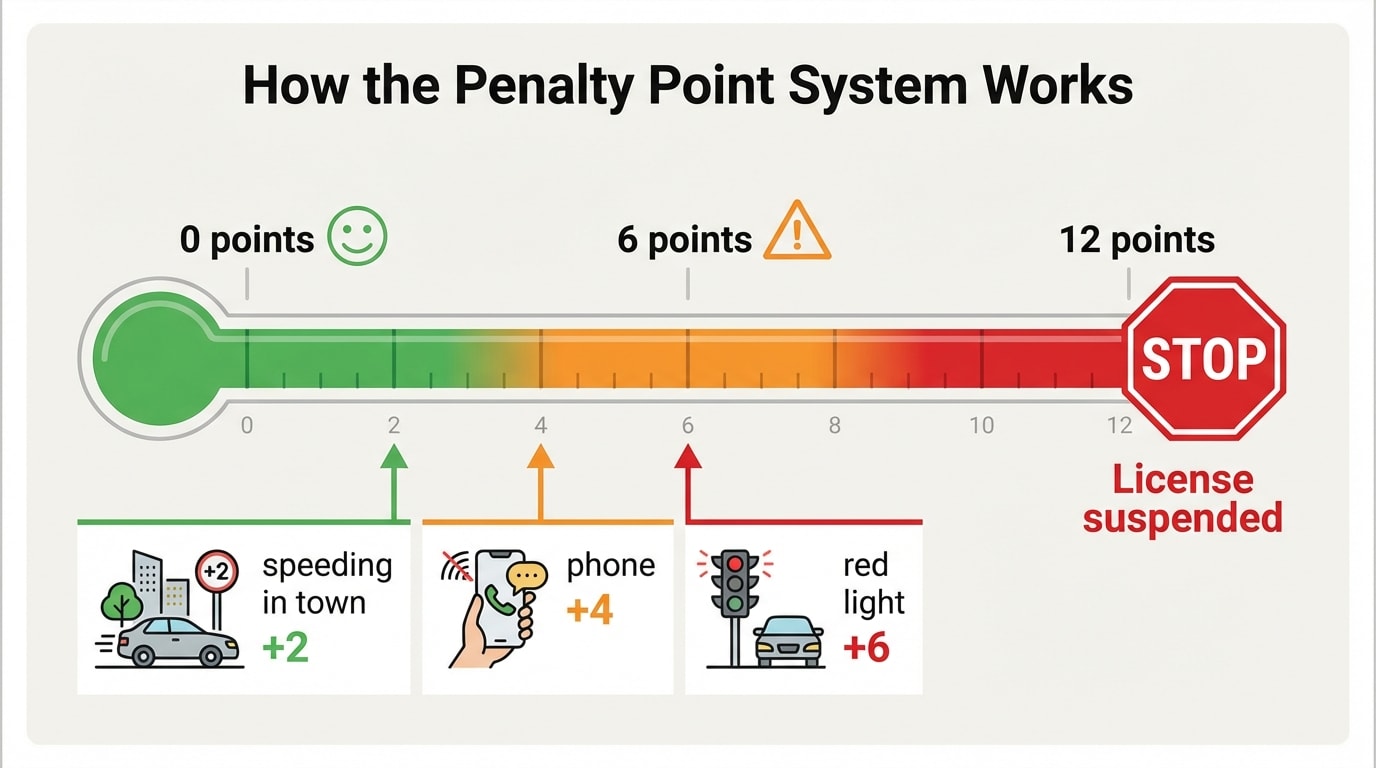
The Czech penalty point system is a simple principle with serious consequences. You start at zero, points are added for each offense, and at 12 points you lose your license for a year. Since January 2024, there are only three point tiers — 2, 4, and 6 points. Two of the most serious offenses get you to 12. Three mid-level offenses and the result is the same.
Quick summary:
- Points are added from zero — the more you have, the worse (unlike school grades)
- Since 2024 there are 3 tiers: 2, 4, and 6 points per offense
- Points are recorded by the municipal office, not the police
- At 12 points your license is suspended for at least 1 year
- Points can be reduced — automatically and through safe driving training
Why the Point System Exists
The Czech Republic introduced its penalty point system on July 1, 2006. The reason was simple — drivers could repeatedly violate traffic rules, pay fines, and keep driving without any cumulative consequences. You paid, you forgot. The point system changed that. Offenses add up, and at a certain threshold you lose the right to drive.
The system works as prevention. When you know that a third phone-behind-the-wheel offense will cost you your license, you'll think twice about picking up that call. And it works — after the system was introduced in 2006, there was a significant drop in fatal road accidents in the Czech Republic.
As of December 31, 2024, a total of 449,153 drivers in the Czech Republic had at least one point on their record — that's 6.4% of all drivers. Another 39,407 had reached the full 12 points. Roughly 5,000 drivers max out each year. That's 400 people per month who lost their license due to offenses.
Three Point Categories
Until the end of 2023, there were five point tiers (2, 3, 4, 5, and 7 points). It was confusing and most drivers had no idea how many points each offense carried. The January 2024 reform (Act No. 271/2023 Coll.) simplified it to three categories. Now it's straightforward.
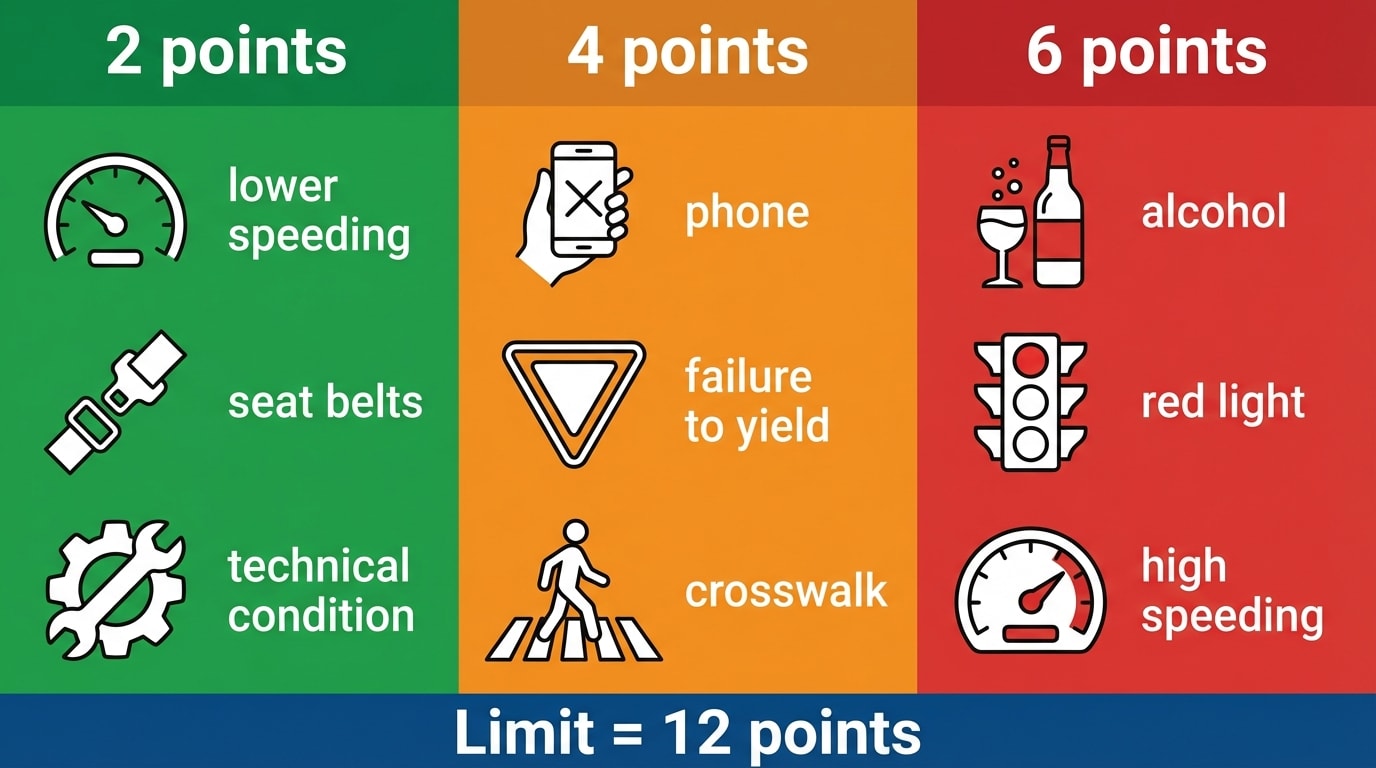
6 points are for the most serious offenses — those where lives are at stake. Driving under the influence of alcohol (above 0.3‰), running a red light, driving the wrong way on a motorway, or exceeding the speed limit by 40+ km/h in a built-up area. Fines for these offenses range from CZK 7,000 to 25,000, and in some cases even higher. Two such offenses within three years and you're at 12 points — the "two strikes and you're out" rule.
4 points cover moderately serious offenses. Exceeding the speed limit by 20–39 km/h in a built-up area, using a phone while driving, not wearing a seatbelt, failing to yield, or leaving the scene of an accident. Fines range from CZK 1,500 to 25,000 depending on the specific offense. Three 4-point offenses in three years = 12 points — "three strikes and you're out."
2 points are for less serious offenses. Exceeding the speed limit by 10–19 km/h, not stopping at a pedestrian crossing, or parking in a spot reserved for disabled drivers. Two points seem harmless, but watch out — they combine with everything else. A few minor offenses plus one phone call behind the wheel and suddenly you're at ten points.
You'll find the complete overview of all offenses with points and fines in the traffic offenses and points table.
Two strikes and you're out
Two offenses carrying 6 points = 12 points = a year without your license. Run two red lights, refuse two breath tests, exceed the speed limit by 40+ km/h twice — and you're walking.
How Points Are Assigned — Step by Step
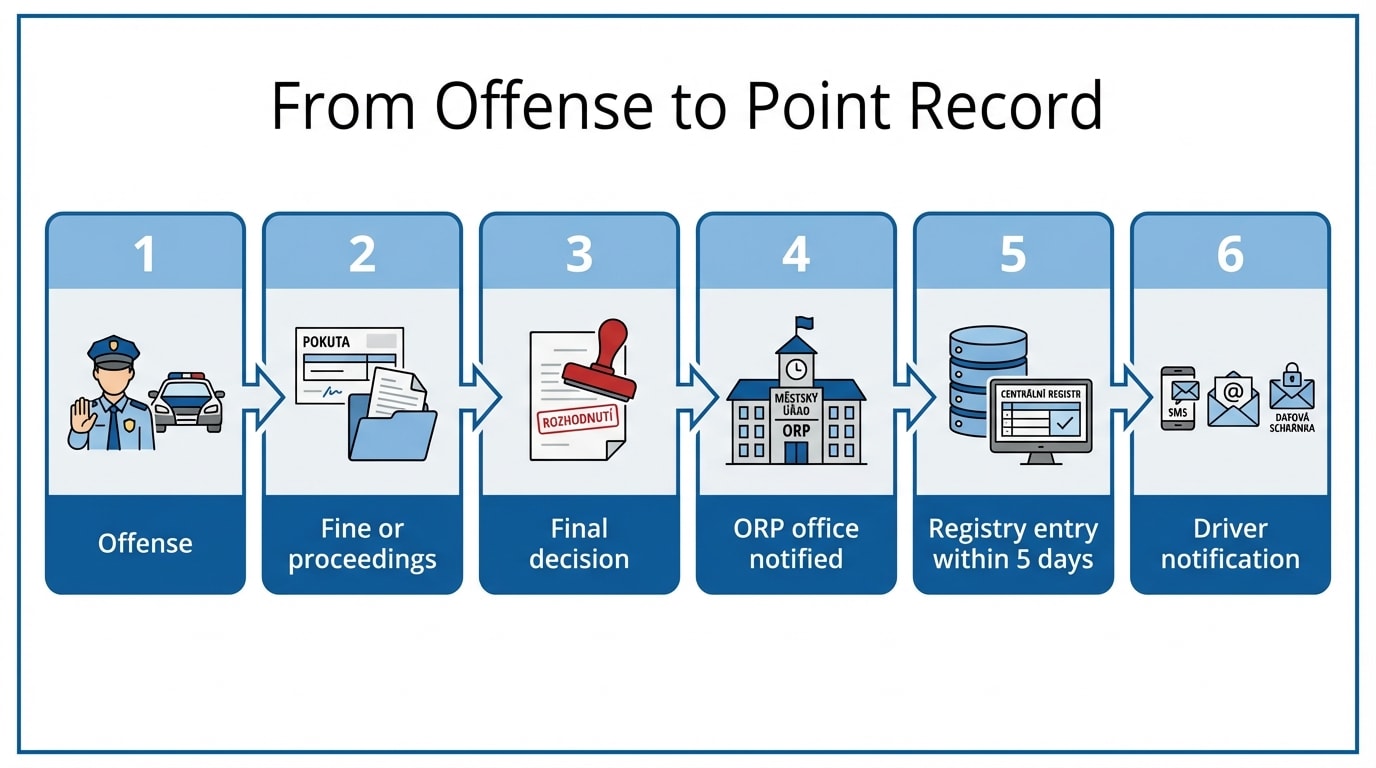
Here's the key detail most drivers don't know: the police officer doesn't give you points on the spot. The whole process has several steps and takes days to weeks.
It starts with an offense. The police or municipal police pull you over, or a speed camera records the violation. If you settle the offense on the spot with a fine (a so-called on-the-spot order), the decision becomes legally binding immediately. If you refuse the on-the-spot fine or it's a more serious offense, the matter is referred to administrative proceedings — where it can take weeks or months before a binding decision is reached.
Once the decision is legally binding, the authority that handled the offense sends a notification to the municipal office with extended powers (ORP) based on your permanent residence. The office then has 5 business days to record the points in the central driver registry. The registry is managed by the Ministry of Transport.
Since 2024, the system automatically notifies you of any change to your point balance. If you have a data mailbox, the notification goes there. Otherwise, you can enable SMS or email notifications on the Transport Portal. Find out how many points you have — a detailed guide is in the How to Check Your Points chapter.
Records stay forever
Points are eventually deducted over time, but the offense record in the registry stays permanently. Even when your balance is zero, the history of your offenses remains in the system.
Who Keeps Track of Points
The central driver registry is managed by the Ministry of Transport. Individual records, however, are maintained by municipal offices with extended powers — the office in the municipality of your permanent residence. That's where you go to file objections, request a point statement, or apply for a point deduction after training.
The police neither assign nor erase points. An officer handles the offense and issues the fine. The recording of points is done by the office based on the notification it receives. This is why you might not see points on your record until days or weeks after the offense — it depends on how quickly the administrative process runs and how fast the notification reaches the office.
How Points Are Removed
The system isn't a one-way street. Points can be reduced in two ways.
The first is automatic deduction. If you go 12 months without committing any offense, the office deducts 4 points. After another 12 months with a clean record, another 4 points. And after a total of 36 months without an offense, all remaining points are wiped to zero.
The second way is safe driving training. A one-day course at a driving polygon, after which 4 points are deducted. Since 2024, that's one more point than before. The training costs CZK 4,000 to 6,890 and you can take it once per calendar year at most. Details — where the training takes place, what the conditions are, and how the whole process works — are in the How to Remove Points chapter.
And what happens if you don't bother with deductions and reach 12 points? The office orders you to surrender your license within 5 business days. Your license is suspended for at least one year. To get it back, you must pass a re-examination at a driving school, a medical check-up, and a traffic psychology evaluation — totaling approximately CZK 16,000. The detailed process is in the What Happens at 12 Points chapter.
What the 2024 Reform Changed
You already know the tiers were narrowed from five to three. But the January 2024 reform (Act No. 271/2023 Coll.) brought more than just simpler scoring.
Fewer categories mean clearer rules — but also a faster path to 12 points. Previously, a driver could accumulate five 2-point offenses and still have "only" 10. Today, two 6-point offenses are enough.
The reform also introduced the probationary license for all new drivers. Anyone who's had their license for less than two years falls under stricter rules. One 6-point offense or an offense with a driving ban means mandatory beginner driver training costing CZK 8,500 to 15,000.
Fines for the most serious offenses increased, safe driving training now deducts 4 points instead of 3, and an automatic notification system informs drivers about every change to their point balance.
Watch out for outdated information
Many articles online still use the old rules (5 point tiers, 3-point deduction for training). Always check whether the source uses the rules valid since January 2024.
How Other Countries Do It
The Czech Republic isn't alone with a penalty point system. But the comparison of how different countries handle it is interesting.
Germany has a limit of just 8 points — stricter than the Czech Republic. France works the opposite way: drivers start with 12 points and points are deducted for offenses. When you drop to zero, you lose your license. Poland is at the other end of the spectrum — the limit is 24 points, but a single offense can cost up to 10. Slovakia doesn't have a point system in the traditional sense, but uses a "three strikes and you're out" principle — three serious offenses in a year and you lose your license.
The Czech 2/4/6 system with a 12-point limit is moderately strict by European standards. But the simplification to three tiers has made it one of the most understandable systems in Europe.
Summary
- Points are added from zero — at 12 points your license is suspended for one year
- Since 2024 there are 3 tiers: 2, 4, and 6 points per offense
- Points are recorded by the municipal ORP office (not police) within 5 business days
- 2 × 6 points = license suspension ("two strikes and you're out")
- Points are reduced automatically (−4 after 12 months) and through training (−4 points)
- Records in the registry are permanent — even after points are deducted
Key Terms
| Term | Explanation |
|---|---|
| Point balance | A driver's record at the municipal office where points for offenses are tallied (starts at 0) |
| Central driver registry | A database managed by the Ministry of Transport with records of all drivers in the Czech Republic |
| ORP (municipality with extended powers) | A type of municipal office that maintains the driver registry and records points based on the driver's residence |
| Point tier | The number of points for a specific offense — since 2024 there are three categories: 2, 4, 6 points |
| On-the-spot order | A fine issued by a police officer directly at the scene — becomes legally binding immediately |
| Administrative proceedings | Formal proceedings about an offense at a government office — can take weeks; points are recorded only after the binding decision |
| Legally binding decision | A decision that can no longer be appealed — only then are points recorded in the registry |
| Two strikes and you're out | Principle: two 6-point offenses = 12 points = license suspension |
| Automatic deduction | Deduction of 4 points after 12 months without an offense — no application needed, happens automatically |
| Safe driving training | A one-day course at a driving polygon — removes 4 points from your balance (CZK 4,000–6,890, max once per year) |