
Common Mistakes by New Drivers — Stats & Facts
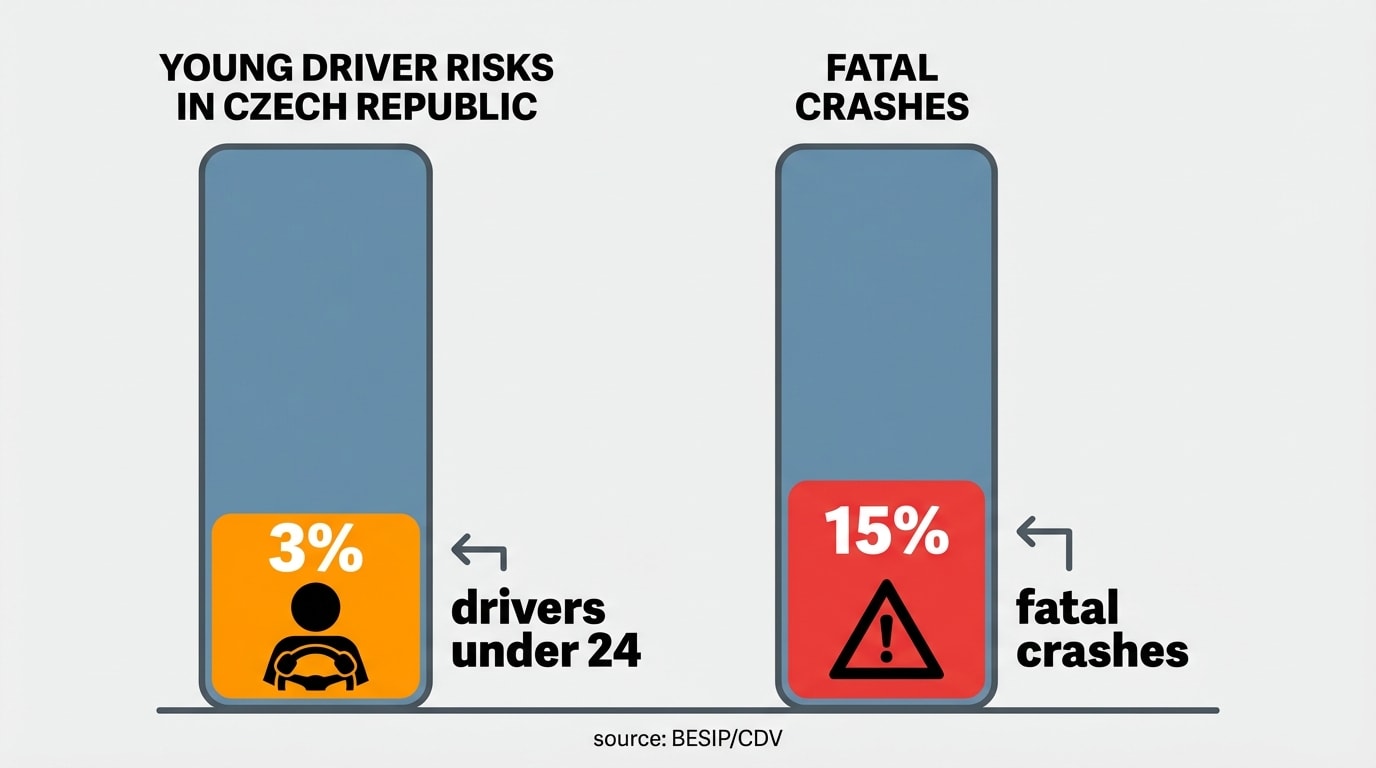
3% of drivers cause 15% of fatal crashes. Speed, alcohol, and old cars — data, causes, and how to avoid the most common beginner mistakes.
Three percent of drivers on Czech roads cause fifteen percent of fatal crashes. They're not drunk drivers getting behind the wheel with a bottle. They're not highway racers. They're new drivers under 24 — often holding a license that's just a few months old, genuinely believing they're driving well. And that feeling — that you've got this — is the most dangerous thing you can have behind the wheel.
This chapter isn't a lecture. We're not going to tell you to drive slowly and be good. We'll show you data — hard numbers from Czech roads over the past five years — and let you draw your own conclusions. Because once you understand why new drivers crash, you can consciously avoid those mistakes. And that's the whole point of the probationary period.
Quick summary:
- Young drivers (under 24) make up 3% of drivers but cause 11% of crashes and 15% of fatal crashes
- Main causes: excessive speed (36%), alcohol (68% of probation violations), and older cars without modern safety systems
- The riskiest group is drivers with exactly one year of experience — not complete beginners
- 41% of victims in young driver crashes are passengers — you're not just crashing yourself
Numbers That Speak for Themselves
Drivers under 24 cause around 10,000 traffic accidents per year in the Czech Republic. In 2022, 52 people died and 250 were seriously injured in these crashes. In 2024, eighteen-year-old drivers alone caused 1,106 accidents — 6 people died, 31 were seriously and 457 lightly injured (BESIP). And we're talking about a group that makes up just three percent of all drivers on the road.
The consequences of their crashes are significantly more severe than average. According to BESIP and the Transport Research Centre (CDV) data, young driver crashes have twice the severity compared to the average of all crashes. In other words — when you crash at eighteen, a serious injury or death is much more likely.
And there's another number that should stop anyone who thinks "it won't happen to me." A full 41% of victims in young driver crashes aren't the drivers themselves — they're passengers. In 2019, crashes caused by young drivers killed 35 drivers but also 33 passengers. When you push the accelerator harder than you should, you're not just risking your own life. You're risking the lives of friends who trust you.
Drivers with 1 year of experience are the most dangerous
CDV data shows that the most fatalities and serious injuries aren't caused by complete beginners, but by drivers with exactly one year of experience. In 2019, they killed 24 people and seriously injured 83. Why? Because after a year behind the wheel, you've lost your initial caution but still lack real experience with crisis situations.
Speed, Alcohol, and Old Cars — The Three Main Killers
Speed
Excessive speed is behind 36% of young driver crashes. For drivers over 25, it's just 19%. The difference is enormous and has a simple explanation — new drivers can't judge what their car and the road can handle. They don't know the vehicle's limits in a curve, they have no reflexes for aquaplaning, and they've never braked from 130 km/h on a wet road.
CDV data reveals an even more disturbing detail. In their first year of driving, about 34% of young drivers exceed 160 km/h on the motorway. By their third year, it's 56%. Paradoxically — the longer you drive, the more you risk. You gain confidence faster than actual skill. And excessive speed is the most tragic cause of crashes overall: for every 1,000 such accidents, there are 4 deaths and 8 serious injuries (CDV).
Alcohol
Remember this number: 68%. That's the percentage of probation violations related to driving under the influence of alcohol or drugs. Of the 3,260 drivers who violated their probationary license conditions in the program's first two years, 2,227 were driving under the influence (ČT24).
Alcohol doesn't just slow down young drivers' reactions. It removes inhibitions about speed — 45% of crashes under the influence are caused by excessive speed (iROZHLAS). So the two worst causes combine. During the probationary period, zero alcohol tolerance applies to all drivers in the Czech Republic (§5(2)(b) of Act No. 361/2000 Coll.). Exceeding 0.3‰ gets you a 6-point offense that triggers mandatory training costing CZK 8,000–16,000. Details on what exactly 6 points mean for a new driver are in the chapter Points and Offenses.
One beer = 6 points
The law doesn't distinguish between 'a little drunk' and 'very drunk' — above 0.3‰, it's a 6-point offense. One beer (0.5 l) will exceed this limit for most people. Above 1.0‰, it becomes a criminal offense (§274 of the Criminal Code). Details in the chapter [Probation Rules](/probationary-period/rules/).
Old Cars Without Modern Systems
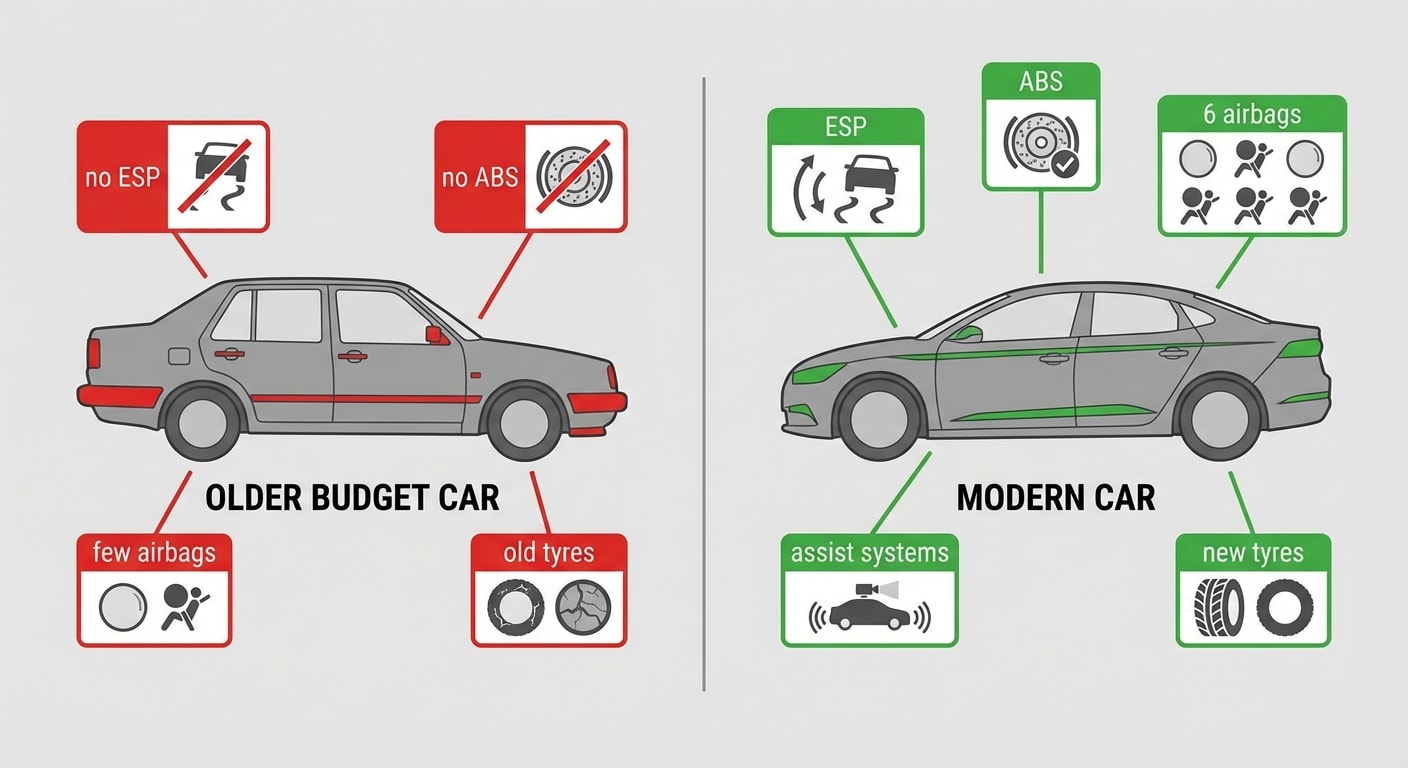
The average age of a vehicle in which a young driver crashes is over 11 years. Between 2022 and 2023, this number increased from 12.4 to nearly 15 years (TipCars). That means cars from around 2010 — often without electronic stability control (ESP), without emergency brake assist, sometimes even without ABS.
It makes sense. As a new driver, you buy what you can afford — typically a car for CZK 30,000–60,000. Older, more worn, less equipped. And it's exactly with such a car that you end up in a situation where modern technology could have saved your life, but you don't have it. Bad tyres, worn brake pads, and the absence of any driver assistance system — all of this increases the risk that a minor mistake behind the wheel becomes a serious accident. If you drive such a car, you should have proper insurance — more in the guide New Driver Insurance.
Your Head Matters More Than Your Engine
Behind most young driver crashes isn't poor driving technique. It's psychology. The Transport Research Centre identified several key factors explaining why the 18–24 age group crashes so much.
Overestimating your own abilities is factor number one. After a few months behind the wheel, you feel like you're driving well — but you've never dealt with a skid on ice, aquaplaning in the rain, or a deer on the road. You have no experience with crisis situations because you haven't been in one yet. And it's precisely this false sense of security that leads to faster driving and less attention.
Underestimating risks is related to age. The feeling of invulnerability is completely natural at eighteen — your brain literally convinces you that it can't happen to you. It's not stupidity. It's biology. But on the road, that biology can cost you your life.
Peer pressure is another factor that doesn't get discussed enough. Friends in the car, the desire to show you "can handle it," loud music, and a party atmosphere — all of this increases the willingness to take risks. The data confirms it: crashes with passengers make up a large portion of the statistics. It's predominantly young men — according to CDV, men are behind the vast majority of fatal crashes in the under-24 driver category.
10 Mistakes Nearly Every Beginner Makes
Besides the big killers — speed, alcohol, and old cars — there's a whole range of "small" mistakes that don't look dangerous on their own but combined increase the risk of a crash. Here are the ten most common.
Driving with one hand on the wheel looks cool, but in a crisis you need both hands in the "three and nine" position to react quickly. A poorly adjusted seat — too close, too far — reduces visibility and slows your pedal response. Distraction from your phone, loud music, or chatting with passengers is a classic — 14% of fatal young driver crashes are caused by not paying attention to the road.
Unnecessary panic in heavy traffic or after stalling at a junction leads to rushed decisions. Conversely, overly defensive driving — constantly yielding to everyone, indecisiveness when turning — makes you unpredictable. Other drivers don't expect you to stop in the middle of a junction because you're unsure.
Neglecting vehicle maintenance is a silent killer. Low tyre pressure, worn brake pads, or insufficient washer fluid — these are things you deal with only when it's too late. "Autopilot" on familiar routes is another trap. You drive to school or work every day, you stop concentrating — and one day at the same junction you've been through a hundred times, you miss a cyclist.
Then there are emotions behind the wheel — lecturing other drivers, honking, gesticulating. Road rage is surprisingly common among beginners and leads to bad decisions. Incorrect zipper merging — whether you're forcing your way in or letting three cars go ahead — irritates surrounding drivers and creates collision risks. And unnecessary fog lights in clear weather? You're blinding oncoming drivers, and that alone can cause a crash.
Practical tips to avoid mistakes
For all ten mistakes, there are simple solutions — from properly adjusting your seat to checking tyres before winter. Specific tips on how to get through the two-year probationary period without points and without crashes are in the chapter [Tips for a Safe Probationary Period](/probationary-period/safety-tips/).
When and Where Is the Greatest Danger
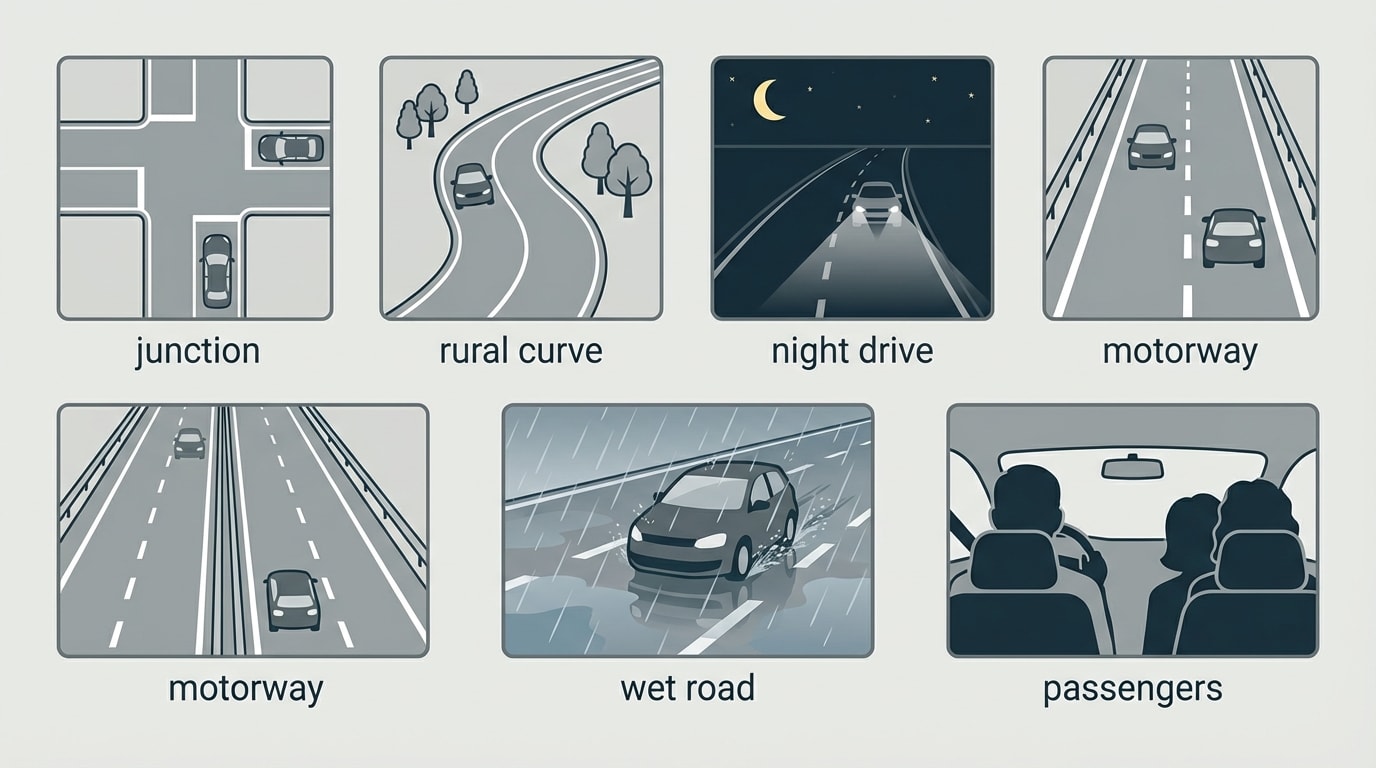
Some situations are more dangerous for new drivers than others. Junctions are where new drivers make mistakes most often — you misjudge the speed of an approaching car and pull into the junction when you shouldn't. Curves on rural roads are another trap. The only correct response to a skid in a curve is to ease off the throttle and not slam the brakes — but that's only taught theoretically in driving school.
Night driving reduces visibility and adds fatigue. Motorways require maintaining a safe following distance that you're not used to from city driving. Wet or icy roads change the car's behaviour in ways you don't expect — aquaplaning on a rainy road starts at just 80 km/h and the car simply stops responding to the steering wheel.
And then there's the social dimension. Driving with a group of friends sounds like fun, but the data is clear — passengers increase crash risk for young drivers. Showing off, noise, distraction — all of it reduces concentration. Remember that 41% of victims in young driver crashes are those very passengers.
L17 — Proof That It Can Be Different
In all of this, there's one piece of good news. Drivers who obtained their license through the L17 programme (driving from age 17 with a mentor) crash dramatically less. In 2024, seventeen-year-old L17 drivers caused just 6 accidents — with 4 light injuries and zero deaths. In the same year, eighteen-year-old drivers caused 1,106 accidents and 6 fatalities.
Why such an enormous difference? Because L17 drivers have at least a year of driving with an adult mentor behind them. They've accumulated thousands of kilometres in real traffic — in rain, at night, on the motorway — before they started driving alone. That extra year of experience is exactly what other new drivers are missing. More about the L17 programme in the guide L17 — Driving from Age 17.
The L17 programme was used by 20% of new drivers, and its graduates committed only 8.4% of offenses compared to eighteen-year-olds and older (BESIP 2024). This is the strongest argument that the problem with new drivers isn't that they're young — it's that they don't have enough practice.
Summary
- Young drivers (under 24) make up 3% of drivers but cause 11% of crashes and 15% of fatal crashes
- Three main causes: excessive speed (36% of crashes), alcohol (68% of probation violations), and old cars without modern safety systems
- The riskiest group is drivers with 1 year of experience — false confidence is more dangerous than inexperience
- 41% of victims in young driver crashes are passengers
- Drivers from the L17 programme crash dramatically less — 6 accidents vs. 1,106 for eighteen-year-olds in 2024
- Most mistakes can be avoided — practical tips in the chapter Tips for a Safe Probationary Period
Key Terms
| Term | Explanation |
|---|---|
| Excessive speed | Speed not appropriate for road conditions — the most common cause of fatal young driver crashes (36%) |
| Probationary period | Two-year trial period from obtaining your first license — a 6-point offense triggers mandatory training |
| Zero alcohol tolerance | Applies to all drivers in the Czech Republic — above 0.3‰ it's a 6-point offense |
| L17 programme | Driving from age 17 with a mentor — graduates have demonstrably fewer accidents and offenses |
| Defensive driving | A driving style that anticipates risks and actively avoids them — the foundation of safe driving |
| Aquaplaning | Loss of tyre contact with the road surface on wet roads — the car stops responding to steering |
| ESP (electronic stability control) | A system that automatically corrects skids — older cars often lack it |
| Peer pressure | Influence of surroundings — the effect of passengers on risky behaviour of young drivers behind the wheel |
| False confidence | A state where the driver overestimates their abilities — typical after 1–3 years of experience |
| CDV | Transport Research Centre — the main Czech institution for analysing transport safety |