Parking Fines in Czechia 2026 — Towing & Clamps
Where you can't park, how much you'll pay, and what to do if your car is towed or clamped. Fines CZK 500–10,000, payment notices, and how to appeal.
A yellow slip under your wiper. A clamp on your wheel. Your car gone — and you have no idea where they took it. Parking violations are by far the most common traffic offense in the Czech Republic. Prague alone dealt with nearly 900,000 traffic violations in the first half of the year, and the vast majority were parking related. A few meters in the wrong spot and a minor mistake turns into a bill worth thousands of crowns.
Since January 2024, fines for repeat parking offenders have tightened so much that habitually parking without paying is no longer worth it. Joint proceedings for multiple violations can reach up to CZK 25,000 — previously the maximum was just CZK 2,500. Here you'll learn exactly where you can't stop, how much you'll pay for different violations, how wheel clamps and towing work, what to do with that official letter from the authorities, and when it makes sense to fight back.
Quick summary:
- Standard parking fine: CZK 500–1,500 on the spot, up to CZK 5,000 in administrative proceedings
- Parking in disabled spots: CZK 2,500–10,000 + 2 penalty points
- Towing costs CZK 1,500–3,500 depending on the city + daily storage fees
- You have 30 days to pay a payment notice from the authorities — no points, no record
- Parking on public green space: fines up to CZK 50,000 (outside traffic law)
Where you can't stop or park
The Road Traffic Act (§27) lists every place where stopping and parking is prohibited. It's not a short list — but you can figure out most of it with common sense. If your car could endanger someone, block a sightline, or obstruct traffic, you probably can't park there.
Here are the spots where drivers mess up most often. At a pedestrian crossing and within 5 meters before it, you can't stop even for a minute. At an intersection, keep a 5-meter gap before and after the boundary — the only exception is parking in a built-up area on the opposite side of a T-junction. At a bus stop, maintain a distance of 30 meters before the stop sign and 5 meters after it; for a bus bay, it's a bit more lenient — 15 meters before and 5 after.
At a railroad crossing, in a tunnel, and in an underpass, the ban is absolute — including within 15 meters before and after them. On tram tracks, in a reserved lane, or in a cycle lane, you can never park. And if your car would block a traffic sign or signal from view, that's a violation too.
Parking on the sidewalk is a special category. You can park on a sidewalk only if a traffic sign explicitly permits it (IP 11 or IP 12). Your car must fit entirely on the sidewalk without protruding onto the road, and this only applies to vehicles under 3,500 kg. Without a sign, you have no business on the sidewalk — even if "everyone parks there."
The 3-minute stopping rule
At a reserved parking area (like those at businesses or hospitals), you can stop for up to 3 minutes without penalty — as long as you don't obstruct others. But watch out: at spots reserved for disabled drivers, this rule DOES NOT APPLY. Not even for 10 seconds.
Outside of built-up areas, the rules get even stricter. On Class I roads, you can only stop and park at designated parking areas. On Class II and III roads, the same applies during reduced visibility (fog, darkness, rain). Motorways and expressways are clear — parking only at designated rest areas.
How much you'll pay — overview of parking fines
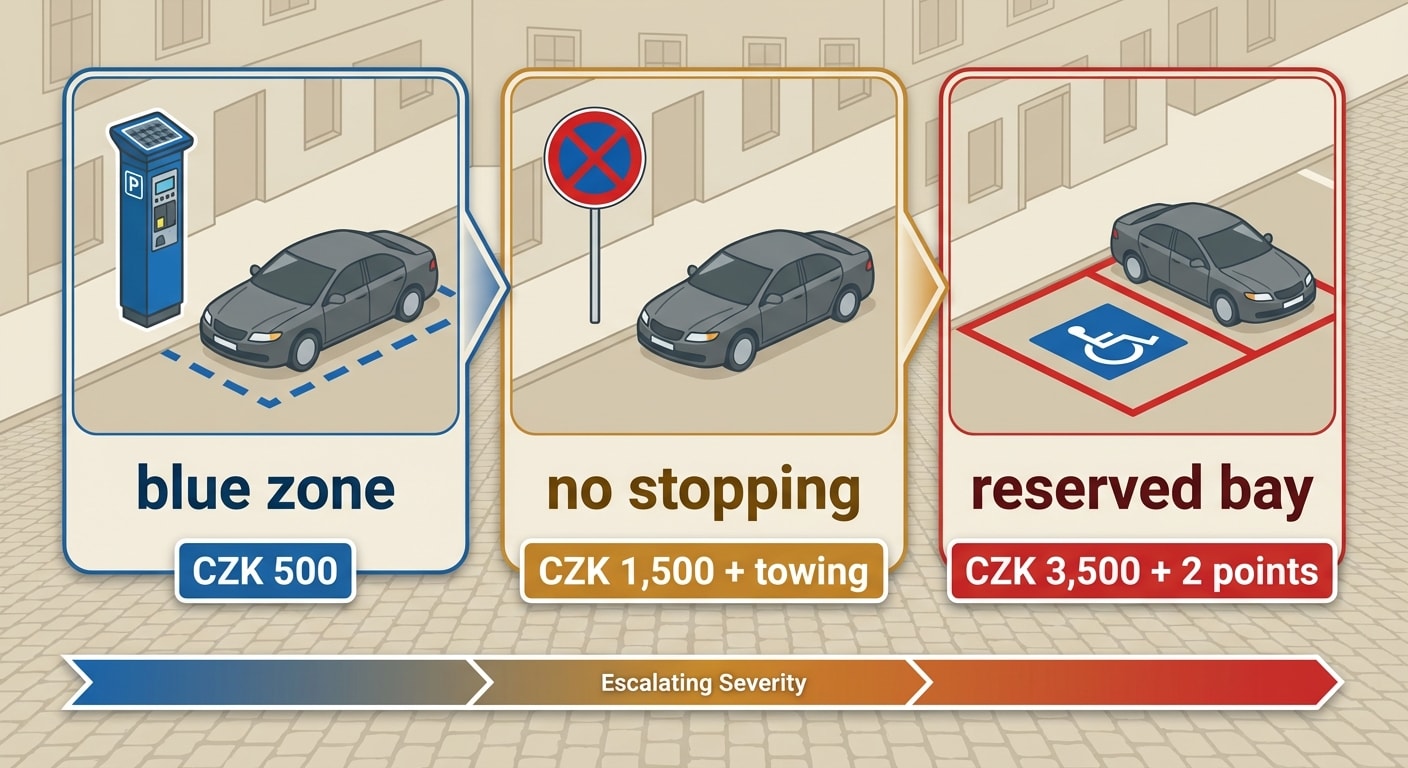
The amount of your fine depends on exactly what you violated. Unpaid parking in a blue zone costs a few hundred crowns. But parking in a disabled spot can mean a fine of up to CZK 10,000 and 2 penalty points on your license.
Parking fines — current rates 2024+
| Type of offense | On-the-spot fine | Administrative proceedings | Points |
|---|---|---|---|
| Unpaid parking / blue zone | up to CZK 1,500 (usually CZK 500) | CZK 2,000–5,000 | 0 |
| Stopping/parking ban violation (§27) | up to CZK 1,500 | CZK 2,000–5,000 | 0 |
| Parking on sidewalk without sign | up to CZK 2,000 | CZK 2,000–5,000 | 0 |
| Parking on/within 5 m of a crosswalk | up to CZK 1,500 | CZK 2,000–5,000 | 0 |
| Parking in disabled spot / misuse of permit | CZK 2,500–3,500 | CZK 4,000–10,000 | 2 |
| Creating a traffic obstruction | CZK 2,500–3,500 | CZK 4,000–10,000 | 4 |
| Parking on public green space | — | up to CZK 50,000 | 0 |
Most standard parking violations don't cost you points. The exceptions are parking in disabled spots (2 points) and situations where your car creates a traffic obstruction — like blocking an exit or an entire street. In that case, you're looking at 4 points and a fine of CZK 4,000 to 10,000. For a complete overview of all offenses and point values, check the chapter Traffic offenses and fines overview.
Repeat offenses cost significantly more
Since 2024, authorities can conduct joint proceedings for multiple parking violations with a fine of up to CZK 25,000. Previously the maximum was CZK 2,500 — habitually parking without paying used to be worthwhile. Not anymore.
Wheel clamps — when your car isn't going anywhere
Officially called a "technical device to prevent vehicle departure." In practice, it's a yellow metal clamp on your wheel and the promise of a very unpleasant afternoon. Only a municipal police officer can attach a wheel clamp — never a private person, parking company, or property manager.
An officer applies it in three situations: your car is parked where stopping or parking is prohibited; you haven't paid parking fees; or your vehicle is illegally occupying public space. An additional condition is that the driver isn't present — if you're at the car, the officer will approach you directly and offer to resolve the offense on the spot.
What should you do if you find a clamp on your car? Leave the car where it is — never try to remove the clamp yourself, as you'd damage it and that's another offense. Call 156 (municipal police) and wait for an officer. They'll settle the offense with you via an on-the-spot fine — you pay and the clamp comes off. The law states it must be removed "without unnecessary delay," so you shouldn't have to wait more than a matter of minutes.
If you don't show up for an extended period — roughly more than 30 days — municipal police can order the car towed.

Towing — where they took your car and how much it costs
Towing is a last resort, but it's far from uncommon. Around 20,000 cars are towed in Prague every year. The towing decision is made by a police officer or municipal police officer under §45 of the Roads Act — your illegally parked car is considered an obstruction of traffic.
Towing costs vary by city and are added to the fine for the parking violation itself. In Prague, you'll pay CZK 1,900 for towing; in Brno CZK 3,500; in Plzeň CZK 1,550. On top of that comes daily storage at the towing lot — CZK 250 to 400 per day in Prague, CZK 120 in Brno. The total bill including the fine, towing, and storage typically runs between CZK 3,000 and 7,000.
Towing costs by city
| City | Towing fee | Daily storage |
|---|---|---|
| Prague | CZK 1,900 | CZK 250–400/day |
| Brno | CZK 3,500 | CZK 120/day |
| Plzeň | CZK 1,550 | CZK 80–100/day |
| Ostrava | ~CZK 1,500 | ~CZK 100/day |
What should you do if you come back and your car is gone? Call municipal police at 156 or Czech Police at 158 — they'll verify whether your car was towed and tell you where it was taken. At the impound lot, present your ID and vehicle documents, pay the towing and storage fees, and they'll release your car. The fine for the actual parking offense comes separately — either by mail or resolved on the spot.
Before you call a tow truck
If your car 'disappeared' in a big city, first verify it wasn't towed — call 156. Only then report a theft to police at 158. Most car 'disappearances' in city centers are tow-aways.
The letter from the authorities — what is a payment notice
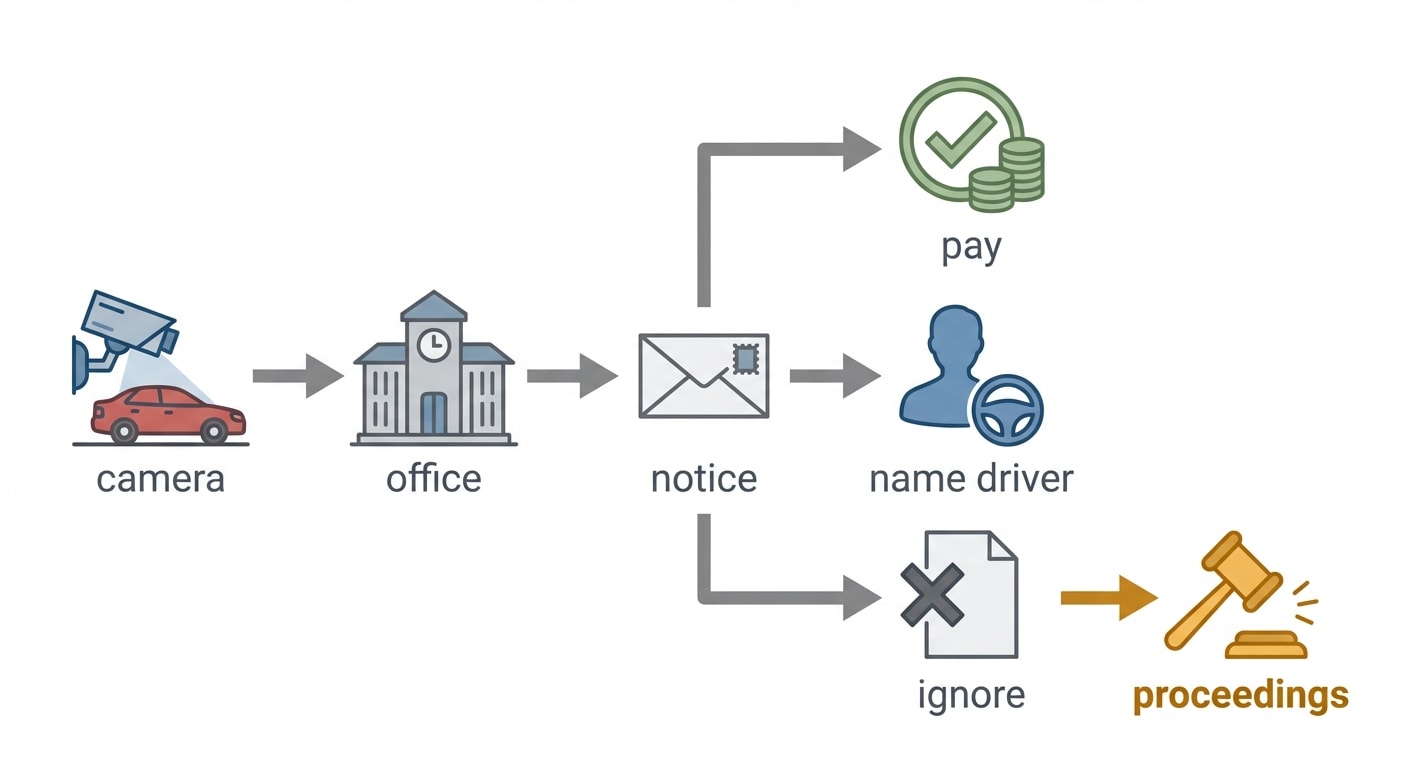
You receive an envelope from the city hall or municipal authority. Inside is a "notice to pay a specified amount." This doesn't automatically mean you have to pay a massive fine — but you absolutely cannot ignore it.
Here's how it works: a camera system recorded your car in a place it shouldn't have been — like in a blue zone without valid parking authorization. No officer was present, the driver wasn't identified. So the authorities contact the vehicle operator — the person registered as the owner in the vehicle registry.
You have three options. First, pay within 30 days. The amount corresponds to the lower end of the fine for the given offense — for unpaid parking, typically around CZK 500. If you pay, the matter is closed. No points, no record in your driving file, no administrative proceedings. Second, tell the authorities who was driving the car at the time. The offense then goes to that specific driver. And third — don't pay and don't identify anyone. But that's the most expensive option: the authorities open administrative proceedings where the fine will be higher, plus CZK 2,500 in proceedings costs is added (since July 1, 2024).
For a detailed guide on fighting fines, filing objections, and appealing, check the chapter How to fight a fine.
Parking in disabled spots — the most expensive mistake in the lot
Parking in spots reserved for people with disabilities is in a different category from regular parking violations. It's not just about the fine — it's 2 penalty points on your license. And the rules are stricter than most drivers realize.
The law in §67(8) is clear: stopping and parking is prohibited at reserved parking spaces for vehicles with a ZTP (severely disabled) parking permit unless your vehicle has this designation. And note — the 3-minute stopping rule that applies at other reserved parking spots does not apply here. You can't argue "I just ran into the pharmacy." Not even for 30 seconds.
The on-the-spot fine is CZK 2,500 to 3,500; in administrative proceedings CZK 4,000 to 10,000. Plus 2 points on your license. If a disabled parking space lacks both a vertical and horizontal sign, you have an argument for defense — but such cases are rare because cities usually keep their signage in order.
Since 2022, parking in disabled spots has counted among point-carrying offenses. It used to be point-free — now those 2 points bring you closer to the 12-point limit for license revocation. For a full overview of the point system, check the hub Penalty point system.
Paid parking zones — colors, rules, payment
Major Czech cities have paid parking zone systems that differ from city to city. Prague is the most complex — three colors, dozens of city districts, varying prices. Brno has three zones (A, B, C). Plzeň, Ostrava, and other cities have their own variants.
In Prague, you'll encounter blue, purple, and orange zones. Blue is primarily for residents — visitors can park for 1 to 3 hours (just one hour in the center) at CZK 40 to 80 per hour via a mobile app. Purple is mixed — residents and visitors, with longer maximum parking times. Orange is for short-term visitor parking, typically 2 to 3 hours.
If you park in a zone and don't pay, the typical on-the-spot fine is around CZK 500. That sounds trivial — but watch out for repeat offenses. Since the 2024 reform, authorities can conduct joint proceedings for multiple violations at once and impose a fine of up to CZK 25,000. Before the reform, the maximum was CZK 2,500, so repeated non-payment literally paid for itself. One case from Prague 1: a car rental company committed 74 violations in 14 days and under the old law paid a total of CZK 2,500. Today they'd pay tens of thousands.
Parking payments are gradually shifting to mobile apps — ParkSimply, MPLA, Sejf, and others. Traditional parking meters still exist, but cities are phasing them out. Always check what system applies in a given zone — a ticket under the wiper may no longer be enough.
Parking on green space — a surprisingly expensive offense
Parking on the grass in front of your building or at the edge of a park might seem harmless. But watch out — parking on public green space doesn't fall under traffic law. It's governed by Act No. 128/2000 Coll. on Municipalities, and the fine can reach up to CZK 50,000. That's many times more than most "standard" parking fines.
Why such a steep penalty? Public green space falls under municipal management, and damaging it counts as violating a local ordinance. Cities keep a close eye on their parks and lawns — especially in Prague and Brno, where municipal officers actively enforce this. The fine amount depends on the extent of damage and the approach of the given municipality, but it's certainly not something anyone would overlook.
When to fight and when to pay
Not every parking fine is worth fighting. But there are situations where it definitely pays to push back. If the traffic signage wasn't visible or was damaged, you have a strong argument. The same applies if the horizontal markings (lines on the road) were faded or illegible. The parking meter wasn't working? That's also grounds for dispute — but you need proof (a photo of the meter, a screenshot from the app).
Practical tip: always photograph where you park. The parking sign, the ticket behind the wiper, or the screen confirming your payment. It takes 10 seconds and could save you thousands. If you receive a payment notice for a spot where you actually paid, that photo is your best evidence.
On the other hand, if the violation is clear-cut and documented — say you're parked in a no-stopping zone and the officer photographed it — there's little point going to administrative proceedings. The fine there tends to be higher (CZK 2,000–5,000 instead of CZK 1,500) and CZK 2,500 in proceedings costs gets added. For a detailed guide on defense, deadlines, and appeals, see the chapter How to fight a fine.
Always photograph where you park
Snap the sign, the ticket behind your wiper, and the app payment screen. 10 seconds of effort = your best defense against an unwarranted fine. If you paid via an app, screenshots are saved automatically.
Summary
- Parking is the most common traffic offense in the Czech Republic — handled mainly by municipal police and camera systems
- Standard fines range from CZK 500 to 5,000, but parking in disabled spots costs up to CZK 10,000 + 2 points
- Towing adds another CZK 1,500–3,500 to the fine + daily storage fees at the impound lot
- Only a municipal police officer can attach a wheel clamp — leave your car and call 156
- Pay a payment notice within 30 days — the matter closes with no points and no record in your driving file
- Since the 2024 reform, joint proceedings for repeat offenses can reach CZK 25,000
- Always photograph where you park — the photo could be your best evidence in a dispute
Key terms
| Term | Explanation |
|---|---|
| On-the-spot fine (příkaz na místě) | A fine issued by an officer directly at the scene (formerly "bloková pokuta"). Lower rate, but consent is irrevocable. |
| Administrative proceedings | Formal proceedings at the authority's office — higher fines, but you have the right to defense and appeal. |
| Payment notice (výzva k úhradě) | A letter from the authority to the vehicle operator. Pay within 30 days and the matter ends with no points. |
| Objective liability | The vehicle operator (owner) is responsible for the offense even if they weren't driving — unless they identify the driver. |
| Wheel clamp (botička) | A technical device to prevent vehicle departure. Attached by municipal police to the car's wheel. |
| Towing (odtah) | Forced relocation of a vehicle to an impound lot — ordered by an officer, costs paid by the operator. |
| ZPS (zóna placeného stání) | Paid parking zone — a designated area where parking requires payment or a resident permit. |
| Joint proceedings (společné řízení) | Proceedings for multiple offenses at once — since 2024 the maximum fine is CZK 25,000. |
| ZTP parking permit | A permit authorizing parking in spots reserved for people with severe disabilities. |
| Traffic obstruction | A vehicle blocking traffic — grounds for towing and a higher fine (CZK 4,000–10,000 + 4 points). |