
Epilepsy and Driving: When Can You Drive Again?
You can drive with epilepsy — but you need to meet specific conditions. 12 months seizure-free, neurologist clearance, and a clear step-by-step process.
An epilepsy diagnosis changes your life in many ways. One of the first blows people mention, but few expect, is losing their driving license. Your neurologist tells you that you can't drive — and suddenly you're figuring out how to get to work, to the store, to pick up the kids from kindergarten. That feeling of helplessness is real and justified. But here's the good news: most people with epilepsy can drive. Not immediately, not without conditions, but they can.
In Czechia, approximately 100,000 people live with epilepsy. Of these, 65% are so-called compensated — thanks to treatment, they have no seizures and live a completely normal life, including driving a car. This article explains the conditions for getting your license back, exactly what you need to meet, what exceptions exist, and how the entire process works step by step.
Quick summary:
- With epilepsy, you can drive after 12 months seizure-free (Group 1 — personal drivers)
- After an isolated seizure without treatment, 6 months is enough
- Exceptions exist: sleep-only seizures, seizure during medication change (only 3 months wait)
- Professional drivers (Group 2) face stricter rules — 10 years after stopping medication
- Your doctor is required to report epilepsy to the authorities — it's the municipal office that revokes the license, not the doctor
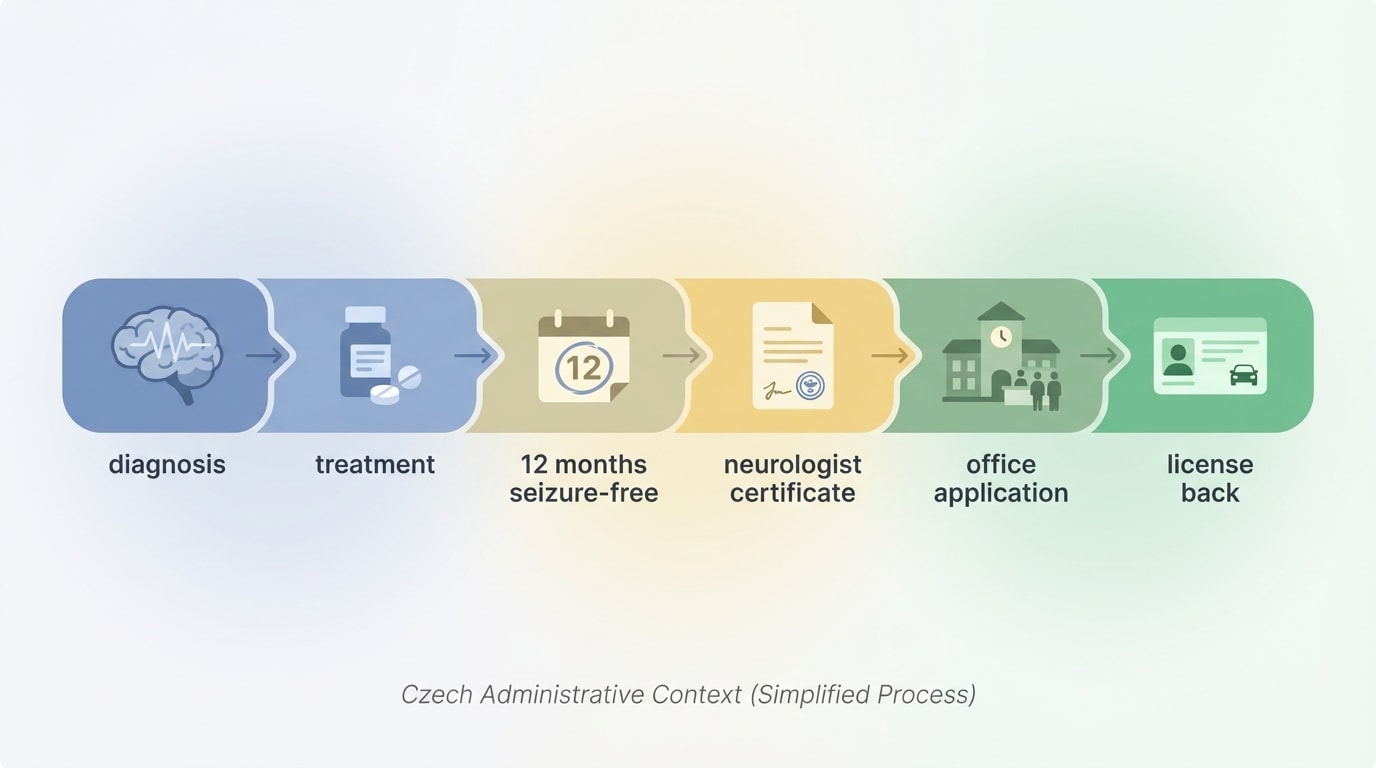
What Epilepsy Means for Your Driving License
For the purposes of Decree 277/2004, epilepsy is defined as at least two epileptic seizures within five years. The type of seizure doesn't matter — whether it's a major tonic-clonic seizure with falling and convulsions, or a minor focal seizure without loss of consciousness. Two seizures in five years = epilepsy in the legal sense.
A single isolated seizure is not considered epilepsy. This is an important distinction because the rules are then more lenient — the waiting period is shorter and the process simpler. If you've had one seizure in your life and treatment wasn't started, 6 months without another seizure is sufficient.
The logic behind it all is simple: a seizure behind the wheel can cost lives — yours and others on the road. The rules exist to make a seizure behind the wheel as unlikely as possible. And statistics show they work. After 12 months seizure-free, the accident risk for a driver with epilepsy is only 22% higher than for an average driver. That's comparable to other common risk factors like fatigue or using a phone while driving.
What the numbers say
About 100,000 people in Czechia live with epilepsy (1% of the population). Around 5,000 new cases are diagnosed each year. Of all accidents caused by drivers with epilepsy, only 11% were a direct result of a seizure — the rest were caused by ordinary driving errors, just like anyone else.
Group 1 vs. Group 2 — What's the Difference
The law splits driving licenses into two groups — each with different rules.
Group 1 includes categories AM, A1, A2, A, B1, B, and B+E. These are motorcycles, personal cars, and their trailers — essentially everything you drive for personal use. The rules here are more lenient because you drive for yourself and for shorter periods.
Group 2 includes categories C1, C, D, T, and their combinations with trailers. These are trucks, buses, and tractors — professional driving. This also includes professional drivers, driving school instructors, and drivers of emergency vehicles. The rules are significantly stricter because you spend all day behind the wheel and often carry other people or cargo.
The difference is enormous. While a personal car driver with epilepsy needs 12 months seizure-free, a professional driver must have 10 years after completely stopping anti-epileptic medication while remaining seizure-free. For many people, this effectively means the end of a professional career behind the wheel.
Seizure-Free Period — How Long You Must Wait
This is the core of the entire topic. The seizure-free period is the time during which you must not have any epileptic seizure before your neurologist can clear you to drive.
Diagnosed Epilepsy — Group 1
If you've been diagnosed with epilepsy and are taking anti-epileptic drugs, you must be a minimum of 12 months without any seizure. The type of seizure doesn't matter — every one counts. You must take your medication regularly and work with your neurologist.
After the 12 months pass, your neurologist examines you. They evaluate your clinical condition, perform an EEG (electroencephalography), and assess the impact of medication on your thinking and reactions. In Czechia — unlike most other EU countries — the neurologist also considers MRI and EEG results. This is a Czech specificity that makes the assessment more precise, but also more thorough.
Isolated Seizure Without Treatment — Group 1
If you've had one seizure and the doctor didn't start treatment (because one seizure doesn't necessarily mean epilepsy), 6 months without another seizure is sufficient. The condition is a normal neurological finding.
Professional Drivers — Group 2
Here the rules are much tougher. After an isolated seizure without treatment, you must wait 5 years and have a normal neurological finding. If you have diagnosed epilepsy, returning to professional driving is only possible 10 years after completely stopping anti-epileptic medication — and only if you remain seizure-free the entire time.
Ten years is a long time. In practice, this means a truck or bus driver diagnosed with epilepsy at 35 will probably return to professional driving at 45 at the earliest — if at all. This is a hard reality you're better off knowing now. If you're a professional driver and receive an epilepsy diagnosis, consider alternatives: bicycle courier services, administration in a transport company, logistics work.
Seizure-free period by situation
| Situation | Group 1 (personal) | Group 2 (professional) |
|---|---|---|
| Diagnosed epilepsy with treatment | 12 months seizure-free | 10 years after stopping medication |
| Isolated seizure without treatment | 6 months seizure-free | 5 years seizure-free |
| Seizure during medication change | 3 months without driving | Individual assessment |
| Seizures only during sleep | After 12-month pattern | Cannot drive |
| Provoked seizure (legal sense) | Individual assessment | Individual assessment |
Exceptions — When You Don't Have to Wait 12 Months
Not every seizure means a year without driving. The law and decree recognize several situations where the waiting period is shorter or where you can drive despite occasional seizures.
Seizures exclusively during sleep. If your seizures only occur during sleep — never while awake — and this pattern has lasted at least 12 months, you can drive. You don't need to be completely seizure-free; it's enough that they only happen at night. For many epilepsy patients, this is a crucial exception.
Seizures that don't affect driving. Simple focal seizures without impaired consciousness — for instance, twitches in the hand without losing contact with your surroundings — can be assessed as not limiting driving if they've been recurring consistently in the same way for at least 12 months.
Seizure during medication change. If a seizure occurred because your doctor adjusted the dosage or type of anti-epileptic medication, only 3 months without driving is required, not the full 12. The condition is that the change was managed by a doctor (you didn't reduce the dose yourself) and seizures stopped after returning to the original or a new stable dose.
Provoked seizure. A seizure triggered by a clearly identifiable cause that's unlikely to recur while driving — typically acute illness (meningitis, encephalitis), high fever, or alcohol withdrawal. But watch out for what is not considered a provoked seizure: sleep deprivation, flashing lights, or psychological stress. These situations can also occur while driving, which is why the law doesn't recognize them as exceptions.
Watch out for 'provoked' seizures
A seizure after a sleepless night or during stress is not considered provoked in the legal sense — because these situations can also occur while driving. A provoked seizure must have a cause that cannot recur while driving (fever, meningitis, withdrawal).
What Happens When You're Diagnosed with Epilepsy
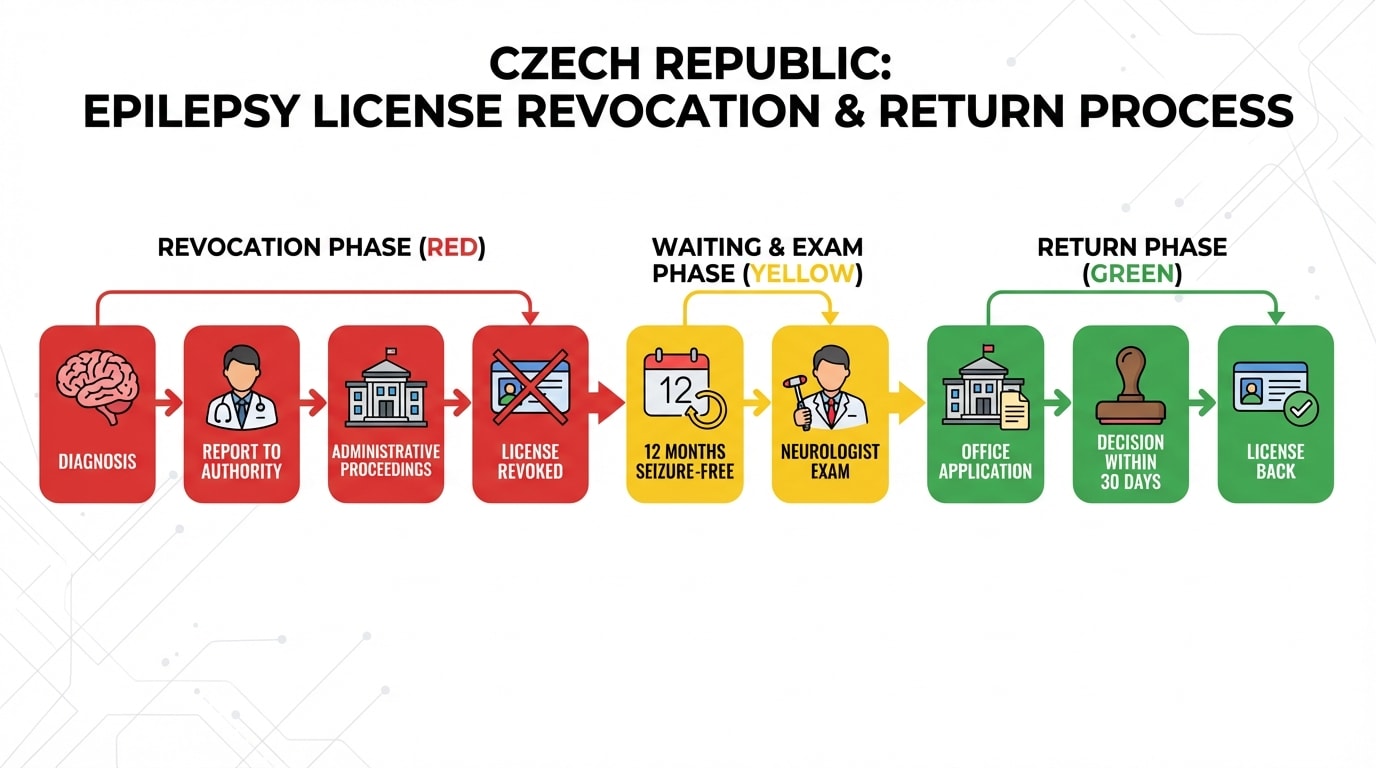
This process is often a shock for people, so let's walk through it step by step.
Step 1: Neurologist makes the diagnosis. Based on examination — medical history, EEG, possibly MRI — your neurologist confirms epilepsy or an epileptic seizure.
Step 2: Doctor reports to the authorities. Since 2012, doctors have a legal obligation (§86 of Act 361/2000) to notify the municipal authority (ORP) that their patient has epilepsy. The doctor doesn't revoke your license personally — they send an assessment to the authority. This obligation applies without exception, and failure to comply can have serious professional and legal consequences for the doctor.
Step 3: The authority initiates administrative proceedings. The municipal authority sends you a decision to revoke your license — typically temporary, usually for 12 months. The decision arrives in an envelope with a red stripe or via data mailbox. You must surrender your driving license.
Step 4: Seizure-free period. Now the waiting begins. You take your medication, attend check-ups with your neurologist, and most importantly — you don't have seizures. This period is essential and cannot be shortened.
Step 5: Neurologist's assessment. After the seizure-free period has passed, your neurologist performs a comprehensive examination. They conduct an EEG, assess your clinical condition, and evaluate the effect of anti-epileptic drugs on cognitive functions (some medications can slow reactions or cause drowsiness). They may also request MRI, psychological or psychiatric assessment.
Step 6: Application at the office. With the neurologist's assessment (no older than 30 days), you submit an application to get your license back at the municipal authority. You also attach a personal declaration about your health condition. The application itself is free of charge.
Step 7: Authority's decision. The authority decides within 30 days. If everything is in order, you get your license back.
If more than 3 years have passed since revocation, you must also pass a re-examination at a driving school. Professionals additionally complete a 35-hour professional competency course. Details about the entire reinstatement process can be found in the chapter How to Get Your License Back.
The Neurologist's Role — What Exactly They Assess
The neurologist is the key figure in the entire process. You can't proceed without their positive assessment. What exactly do they evaluate?
They start with medical history — asking about the course of your epilepsy, types of seizures, their frequency, treatment to date, and its results. They want to know whether the medication is working, whether seizures have improved, worsened, or stopped.
EEG examination is mandatory. Electroencephalography measures the brain's electrical activity and shows whether epileptic discharges are present even when a seizure isn't occurring. The EEG result alone doesn't decide — epileptiform activity on EEG doesn't automatically mean unfitness — but it's an important piece of the overall picture.
The neurologist also assesses the effect of anti-epileptic drugs on cognition. Medications like valproate, carbamazepine, or phenytoin can slow reactions, reduce attention, or cause drowsiness. If your medication significantly affects your ability to concentrate and react, the neurologist must take this into account. You can read more about the effects of medications on driving in a separate chapter.
If needed, the neurologist may request additional examinations: brain MRI, video-EEG (long-term monitoring), psychological assessment, or psychiatric evaluation. They may also recommend a traffic psychology assessment, which costs approximately 3,000 CZK. Based on its results, restrictions may be imposed — so-called signal codes: daytime driving only, maximum distance from home, or speed limits.
Czechia is specific in this regard. Along with the Netherlands, it's one of the few EU countries where MRI and EEG results are considered when assessing driving fitness for epilepsy — most other countries rely primarily on clinical history.
Insurance and Epilepsy — What to Watch Out For
This area is full of pitfalls, and most people with epilepsy don't know about them.
Mandatory liability insurance (statutory insurance) works normally if you have a valid driving license — meaning your neurologist confirmed your fitness and you're driving legally. But if you drive without valid authorization (for example, during the waiting period) and cause an accident, the insurer pays the injured parties but will seek reimbursement from you. This is called recourse, and for a serious accident, it can amount to millions.
Comprehensive and accident insurance is more problematic. Most insurers have an exclusion clause in their terms that reads something like: "The insurer does not pay if the insured event resulted from an epileptic seizure." So if you have a valid license, take your medication, and still have a seizure behind the wheel — comprehensive insurance probably won't pay for damage to your car. Mandatory liability for damage to others will, though.
Travel insurance is available for people with epilepsy, but usually with a condition: the disease must be compensated, stable, and without a doctor visit in the last 12 months. Having written confirmation from your neurologist is a good idea.
Comprehensive insurance and seizures
Most insurers exclude epileptic seizures from comprehensive insurance coverage. If you have a seizure behind the wheel and damage your car, the insurer probably won't pay for repairs. Mandatory liability for damage to others does apply, though, if you have a valid license.
Criminal Liability — When Not to Worry and When to
Imagine the worst-case scenario: a seizure behind the wheel, an accident, injuries. What does the law say?
If you couldn't have predicted the seizure — say it's the first seizure in your life, or you have compensated epilepsy and take your medication — criminal proceedings are typically discontinued. There's a precedent from Czechia: a 63-year-old driver with epilepsy had a seizure behind the wheel and caused an accident. The police themselves proposed discontinuing criminal proceedings because the seizure was unpredictable.
But if you know about the diagnosis and still drive without valid authorization — for example, during the waiting period or after the authority revoked your license — it's an entirely different situation. You can face charges of general endangerment (§272 or §273 of the Criminal Code). And that's not a misdemeanor, but a criminal offense.
The message is clear: follow the rules, wait for the assessment, don't take shortcuts. Twelve months is long, but it's the price of driving legally and safely.
Statistics — How Risky Are Drivers with Epilepsy
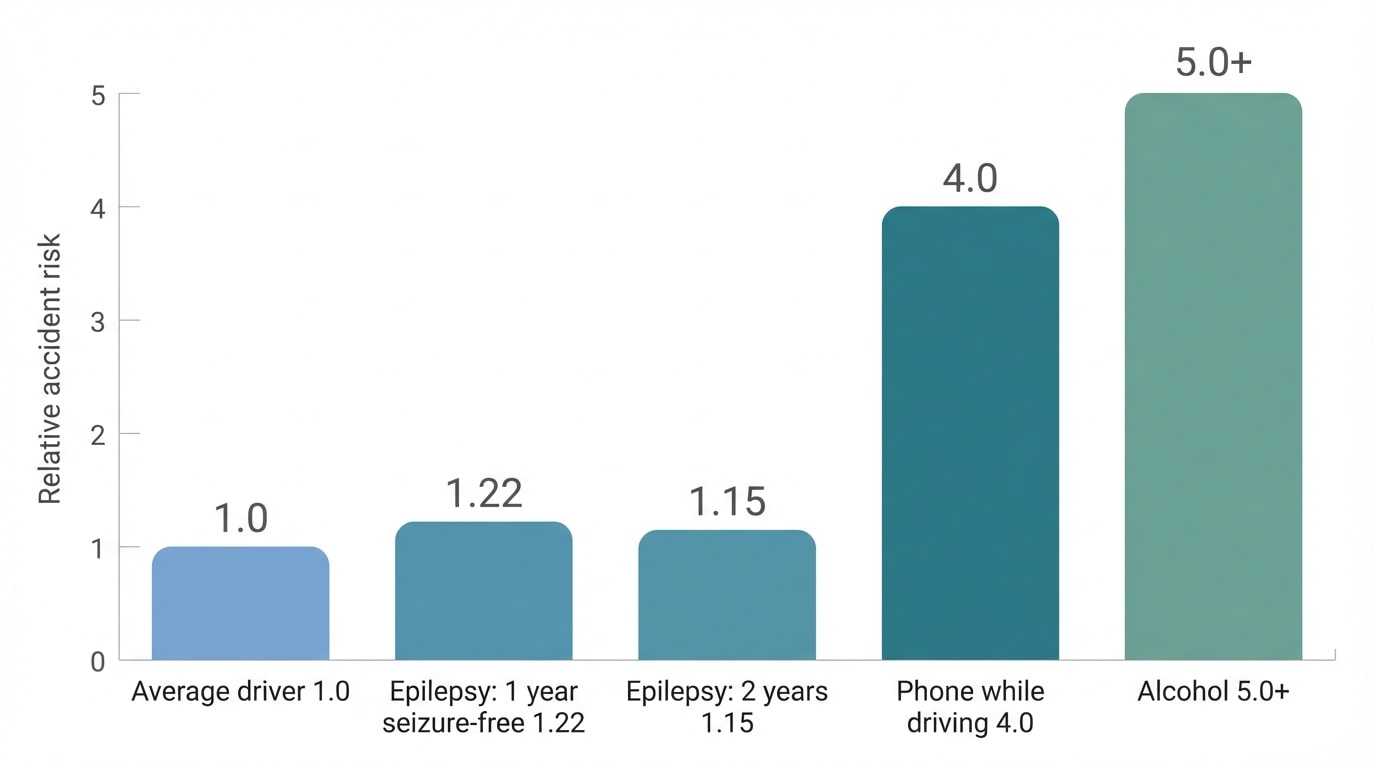
The numbers speak clearly — and they're on your side. People with epilepsy have a 1.2 to 1.8 times higher relative risk of a traffic accident compared to the general population. That sounds like a lot, but context matters.
After one year seizure-free, the relative risk drops to 1.22 — just 22% higher than an average driver. After two years seizure-free, it's 1.15, essentially comparable. For context: a driver using their phone while driving increases their accident risk fourfold. A driver with epilepsy after one year seizure-free is significantly safer.
And one more important figure: only 11% of accidents caused by drivers with epilepsy are a direct result of a seizure. The remaining 89% are caused by ordinary driving errors — just like anyone else. Epilepsy doesn't make you a bad driver.
How the EU Sees It and Where Czechia Stands
The rules for epilepsy and driving stem from EU Directive 2009/113/EC, which Czechia implemented into Decree 277/2004. The basic framework is therefore the same across the EU: 12 months seizure-free for Group 1, stricter rules for Group 2.
But Czechia is among the stricter countries. It considers MRI and EEG results, which most EU countries don't. On the other hand, this is also an advantage — the assessment is more precise and can protect you if you have a normal EEG finding, even when the doctor is hesitant.
Some EU countries, like Belgium or Italy, have shorter waiting periods for Group 2. In Czechia, a reduction from the current 10 years to 5 years is being discussed, but no change has been implemented yet.
What's New — Latest Changes
Decree amendment 445/2024 (effective January 1, 2025) revised cardiovascular criteria and added new categories, but neurological and epilepsy criteria remained essentially unchanged. The rules for epilepsy are therefore not changing.
However, the shift of the mandatory exam age from 65 to 70 (effective January 1, 2026) is relevant. If you have epilepsy and are over 65, you don't need regular exams until you turn 70 — unless your neurologist says otherwise. Details can be found in the chapter Medical Exam for a Driving License.
Summary
- You can drive with epilepsy — 65% of patients are compensated and return behind the wheel
- Group 1 (personal drivers): 12 months seizure-free, 6 months after an isolated seizure without treatment
- Group 2 (professionals): 10 years after stopping medication — for many, the end of a driving career
- Exceptions exist: sleep-only seizures, seizure during medication change (only 3 months)
- Doctors are required to report epilepsy to the authorities (§86) — the license is revoked by the office, not the doctor
- After 12 months seizure-free, accident risk is only 22% higher than for an average driver
- Comprehensive insurance typically doesn't cover seizure-related damage — but mandatory liability does
Key Terms
| Term | Explanation |
|---|---|
| Seizure-free period | The time during which you must not have any seizure before your neurologist can approve you to drive. For Group 1, this is 12 months. |
| Epileptic seizure | A temporary brain function disorder caused by abnormal electrical activity. For decree purposes: 2+ seizures in 5 years = epilepsy. |
| EEG (electroencephalography) | An examination of the brain's electrical activity. A mandatory part of fitness assessment for epilepsy. In Czechia, it carries more weight than in most EU countries. |
| Signal code | A restriction recorded on the driving license — for example, daytime driving only or a maximum distance from home. |
| Provoked seizure | A seizure triggered by a clear cause that won't recur while driving (fever, meningitis). Sleep deprivation or stress don't count. |
| Group 1 | Non-professional drivers (AM, A, B) — more lenient epilepsy criteria (12 months seizure-free). |
| Group 2 | Professional drivers (C, D) — stricter criteria (10 years after stopping medication). |
| §86 of Act 361/2000 | Doctor's reporting obligation — must immediately report a driver's unfitness to the municipal authority. |
| Traffic psychology assessment | A specialized examination (~3,000 CZK) that may be required for license reinstatement. Evaluates safe driving ability. |
| Harmonized code | A numeric code on the driving license indicating a condition — valid across the EU. |