
L17 vs. Waiting Until 18 — Which Is Better?
Comparing L17 with the standard license: safety, costs, insurance, and real experience. Who benefits from L17 and who should wait.
Six accidents. Versus one thousand one hundred and six. That's the scorecard from the first year of the Czech L17 program — six accidents caused by seventeen-year-old drivers with a mentor beside them, and one thousand one hundred and six accidents by eighteen-year-old novices who got behind the wheel alone for the first time. Zero deaths versus six. Those numbers don't need interpretation. They speak for themselves.
And yet many people hesitate. "Is it worth it? Does it cost more? Isn't it a pointless year with a parent sitting next to you?" This chapter gives you answers. We'll walk through hard safety data, a financial comparison, real advantages and disadvantages, and help you decide whether L17 makes sense for your situation. If you're not sure what L17 is or how it works, start with the chapter What Is L17 and How It Works.
Quick summary:
- L17 drivers caused 6 accidents with 0 deaths in 2024 — eighteen-year-old novices caused 1,106 accidents with 6 deaths
- Driving school costs the same — you don't pay a single crown extra for L17
- Main disadvantage: until 18 you can only drive with a mentor and only in Czechia
- L17 makes sense for anyone with a reliable mentor who wants a safer start
Numbers That Speak for Themselves
In 2024, a total of 24,048 people obtained their driving license through the L17 program. That's roughly one third of all new category B license holders in Czechia — the program is no niche experiment but a massive shift in how Czech teenagers learn to drive.
And the safety data? Seventeen-year-old drivers with mentors caused just 6 traffic accidents over the entire year. Four people sustained minor injuries. Nobody was seriously hurt. Nobody died. Meanwhile, eighteen-year-old novices — those who sat behind the wheel without any supervision for the first time — caused 1,106 accidents. Six people lost their lives. Thirty-one were seriously injured. Four hundred and fifty-seven suffered minor injuries.
The story continues with traffic violations. L17 drivers accumulated 71 point-carrying violations over the year. Eighteen-year-olds without mentors: 772. L17 drivers accounted for just 8.4% of all monitored young driver violations — despite representing roughly a third of new drivers.
There's no point pretending this comparison is perfectly fair. L17 drivers ride with a mentor — someone who watches and corrects them. Eighteen-year-olds are on their own. But that's precisely the point of the program — giving fresh drivers a safety net during the most dangerous period. And the data show that net works.
Why are the numbers so dramatic?
The most dangerous period for any driver is the first few months behind the wheel. Your reactions aren't yet automatic, you misjudge distances and speeds, and stressful situations throw you off more easily. A mentor compensates for these weaknesses — they see what you don't yet see and alert you in time.
International Experience Confirms It
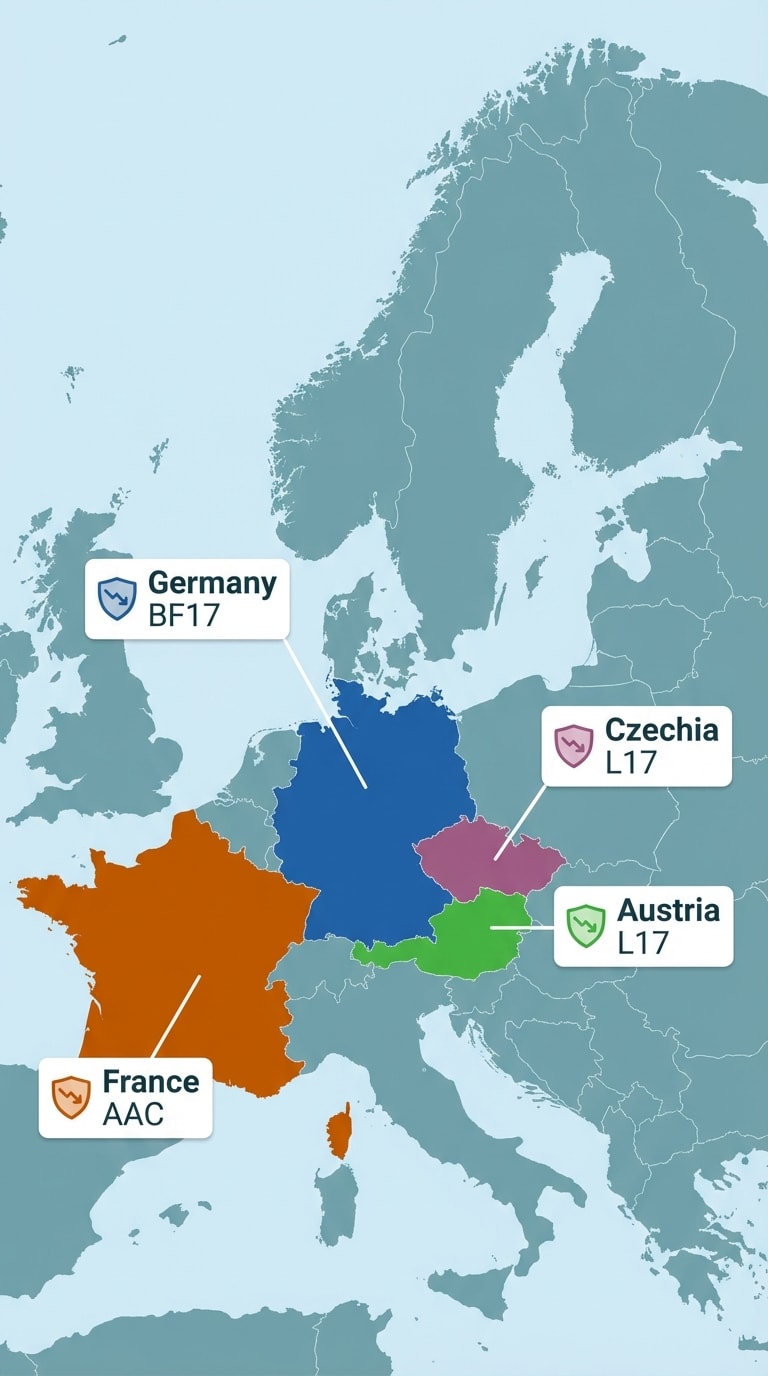
Czechia isn't the first country to introduce a system like this. Germany launched its BF17 program (Begleitetes Fahren mit 17) back in 2004, and after twenty years has a vast body of data to show for it. A study by Justus Liebig Universität Gießen found that BF17 participants had 28.5% fewer accidents and 22.7% fewer violations than those who started at eighteen without a companion. Those who drove with a mentor for longer than six months had an even more striking 57% fewer accidents.
Austria has had its own L17 program since 1999 — over a quarter century of data. A third of all category B license applicants in Austria now choose L17. The share of accidents involving novice drivers has dropped from 12% to 9% during that time. And 98% of participants rate the program positively.
A Swedish study added another perspective: lowering the learning age to 16 led to a 40% decrease in accident rates among those who started earlier. Those who didn't take advantage of the option saw no benefit. Proof that the gain comes from a longer period of supervised practice — not from some magical effect of starting young.
An important note: in 2025 the European Union approved a directive establishing a pan-European framework for accompanied driving from age 17. Member states have until 2028 to transpose it. Czechia is thus "ahead of the curve" — the Czech L17 complies with the EU's future requirements. More on the history and international context in the chapter What Is L17 and How It Works.
How Much Does It Cost — Financial Comparison
One of the most common questions: "Does L17 cost more?" Short answer: no. A category B driving course costs exactly the same whether you enroll at fifteen and a half or at eighteen. There is no L17 surcharge.
Aktuální ceny autoškol skupiny B podle krajů — živá data z Kvalty.cz
| statsTable.columns.location | statsTable.columns.avgPrice | statsTable.columns.minPrice | statsTable.columns.maxPrice | statsTable.columns.schoolCount |
|---|---|---|---|---|
| region Prague | 29,975 Kč | 12,990 Kč | 64,500 Kč | 111 |
| South Bohemian Region | 29,111 Kč | 15,000 Kč | 59,000 Kč | 70 |
| Central Bohemian Region | 26,617 Kč | 15,000 Kč | 55,000 Kč | 159 |
| Ústí nad Labem Region | 26,324 Kč | 15,000 Kč | 44,500 Kč | 73 |
| Pardubice Region | 26,238 Kč | 15,000 Kč | 50,000 Kč | 50 |
| Vysočina Region | 25,998 Kč | 15,100 Kč | 57,000 Kč | 53 |
| Hradec Králové Region | 25,813 Kč | 16,000 Kč | 50,000 Kč | 58 |
| Olomouc Region | 25,242 Kč | – | 58,000 Kč | 65 |
| South Moravian Region | 25,086 Kč | 15,000 Kč | 40,000 Kč | 117 |
| Karlovy Vary Region | 25,071 Kč | 17,800 Kč | 38,000 Kč | 17 |
| Plzeň Region | 25,018 Kč | 15,000 Kč | 39,000 Kč | 48 |
| Zlín Region | 24,985 Kč | 15,200 Kč | 38,900 Kč | 76 |
| Liberec Region | 24,169 Kč | 16,500 Kč | 36,999 Kč | 49 |
| Moravian-Silesian Region | 21,924 Kč | 15,000 Kč | 39,500 Kč | 120 |
Total 1066 schools
The only extra cost of L17 is mentor registration. If you register your mentor at the same time as your license application, it's free. If you add a mentor later, it costs CZK 100 at the office or CZK 80 online via the Transport Portal. With four mentors (the maximum), that's 0 to CZK 400 extra. A full breakdown of fees is in the chapter Requirements.
Where L17 starts saving you money is insurance. Mandatory liability insurance for young drivers under 25 is significantly more expensive — insurers put them in the highest risk category. L17 gives you two advantages here. First, you start driving sooner, which means you start building a no-claims bonus sooner. Each year without an at-fault accident earns you roughly a 5% premium discount. After ten years, that's a 50% discount. Second, Generali Česká pojišťovna offers a 30% discount specifically for L17 graduates who can prove they drove with a mentor before turning 18. We have an entire chapter on this topic: L17 Insurance.
Save on insurance from the start
Register the car under a parent and be listed as an authorized driver. Kilometers driven without an accident will help when you first take out your own liability insurance. And ask your insurer straight away about discounts for L17 graduates — Generali offers 30%, others may have their own deals.
The bottom line is straightforward: L17 is financially neutral or slightly better. Driving school costs the same. Administrative costs are negligible. And you can save on insurance in the long run.
What L17 Gives You Extra — A Year of Practice
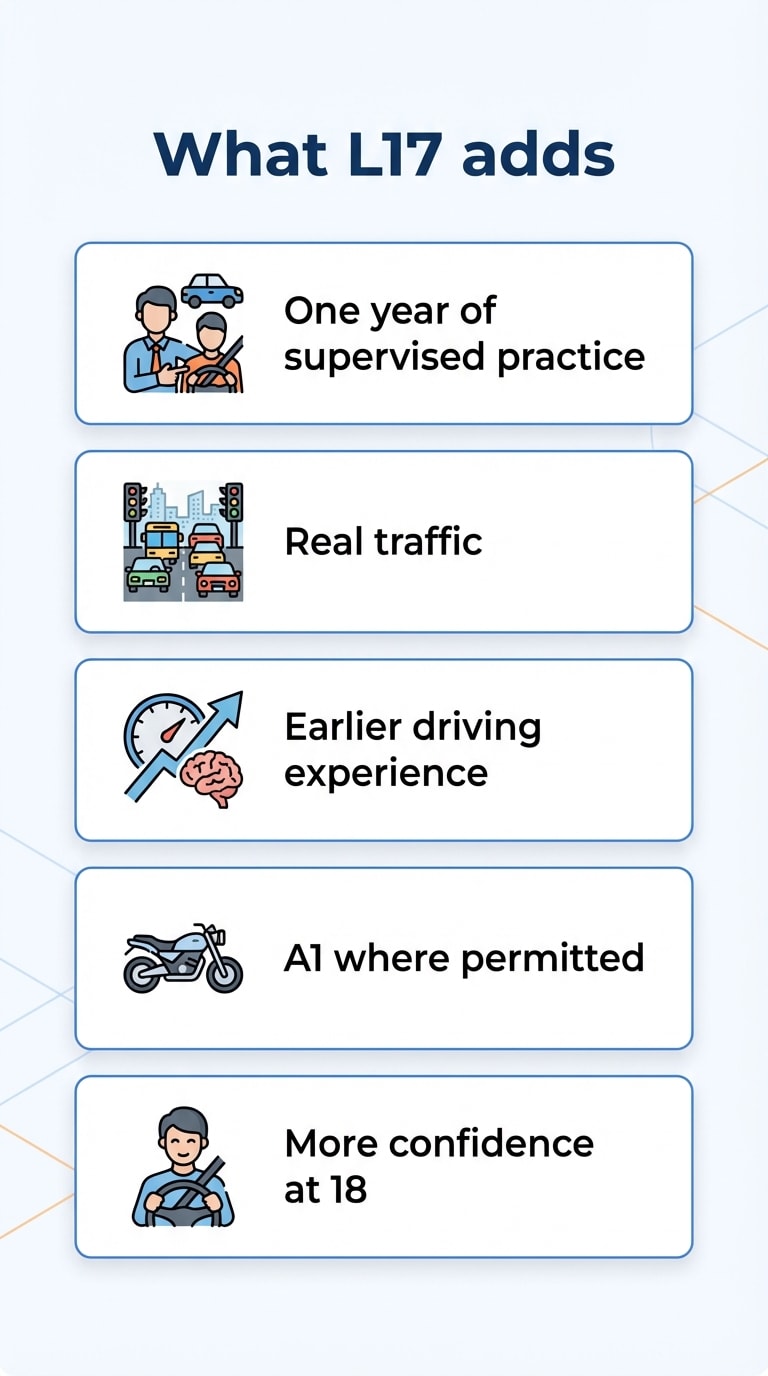
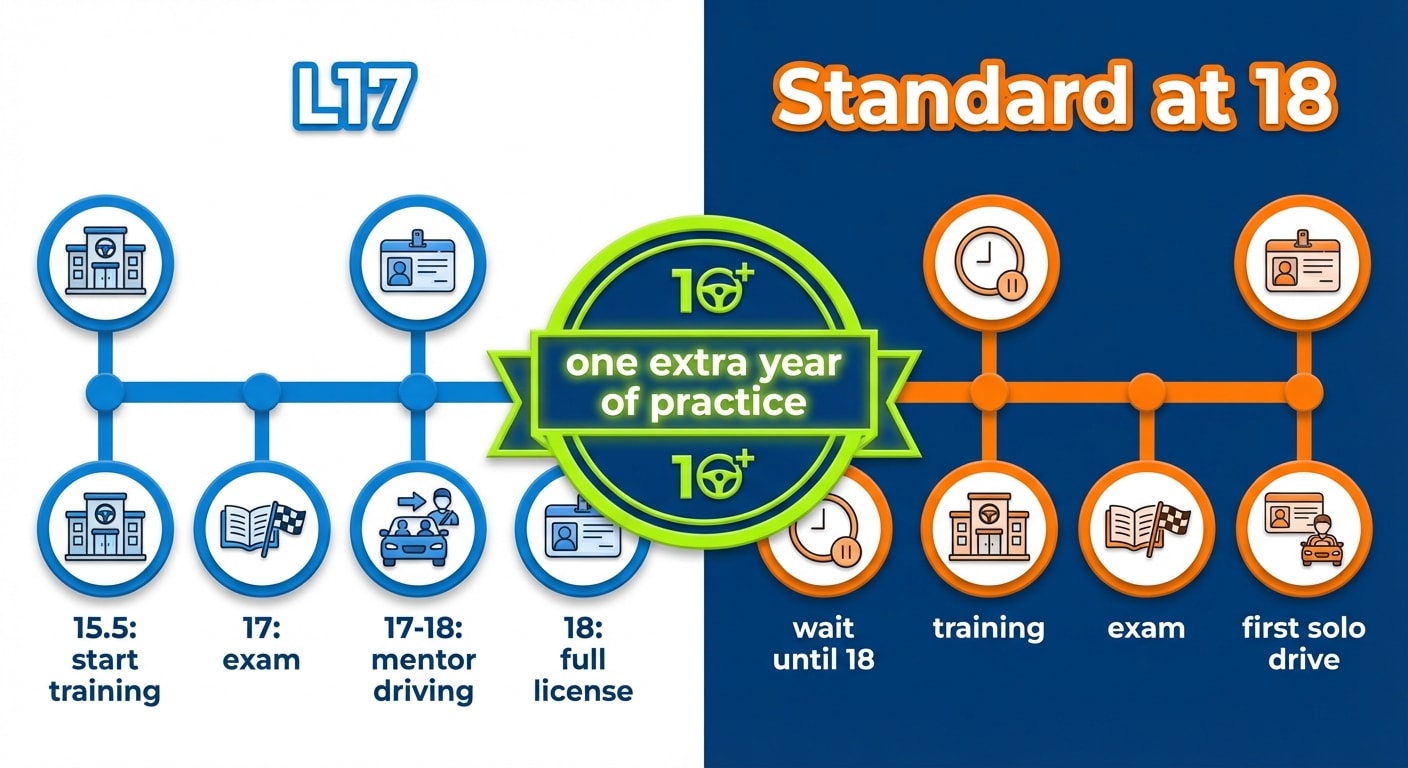
The biggest advantage of L17 isn't in insurance numbers — it's in what happens between your seventeenth and eighteenth birthdays. You've finished driving school and passed your exam. Instead of putting your license in a drawer and waiting a year, you get in the car and start driving.
A year with a mentor means hundreds, maybe thousands of kilometers in real traffic. You drive to school during rush hour. You drive at night and in the rain. You learn to park in tight spots, react to aggressive drivers, handle highway on-ramps. All of this happens with someone experienced beside you who catches your mistakes before they become accidents.
When you turn eighteen and sit behind the wheel alone for the first time, you won't be a nervous beginner. You'll have a year of practice behind you that your peers are only just starting. And that shows — German statistics clearly demonstrate that the advantage of accompanied driving persists for years after the mentoring period ends.
Add another bonus: L17 graduates automatically receive a category A1 license — small motorcycles up to 125cc with automatic transmission. And you can ride those on your own, without a mentor, from age 17. A motorcycle for summer, commuting to school, visiting friends — that's real independence even before you turn eighteen.
What L17 Doesn't Give You — Disadvantages, Honestly
Every decision has two sides, and L17 is no exception. You need to know these disadvantages upfront, not discover them behind the wheel.
A mentor, always and everywhere. Until eighteen, you can't drive alone. Not even to the shop around the corner. Not with friends on a road trip. Every time, your registered mentor must be in the passenger seat. If you only have one mentor and they can't make it, you're not going. That's why it's smart to register multiple mentors — the law allows up to four. How to choose and register a mentor is covered in the chapter Choosing and the Role of a Mentor.
Czechia only. The law (§83a) explicitly states that a license issued under L17 is valid exclusively within the Czech Republic. Until 18, you can't drive in Slovakia, Germany, or anywhere else. Family road trip to Croatia? Your parent drives. Ski trip to Austria? Same. This restriction automatically lifts on your 18th birthday — more on that in the chapter Transition to a Full License.
Full liability as the driver. Many people don't realize this: you, as the driver, bear full legal responsibility for a traffic accident — not the mentor. The mentor is only liable for violating their own duties, typically alcohol, inattention, or failure to supervise. But for violations, damages, and insurance claims, it's on you. If you cause an accident, it goes on your record, your premiums go up, and the consequences are identical to those for an adult driver.
Finding a mentor can be a problem. The mentor needs a category B license held for more than 10 years, the last 5 years continuously, zero penalty points, and no driving bans. Not every family has such a person. Grandparents often don't meet medical fitness requirements. Friends or relatives may not want to take on the responsibility. And any point-carrying violation disqualifies a mentor during the year.
The probationary license starts at 17. The law amendment (Act 271/2023) established a two-year probationary period for all first-time drivers from January 1, 2024 — but for L17, it starts on the day you receive your license at 17. A serious violation (6 or more points) means a mandatory traffic psychology session and practical training at your own expense. You have three months, otherwise you lose your license. The good news: the first year of probation runs under your mentor's supervision, so the risk of a serious violation is minimal.
Driving without a mentor = serious trouble
If you're stopped by police as a 17-year-old driver without a mentor in the passenger seat, you face a fine of CZK 2,500–5,000 and a driving ban of 6 to 12 months. That means you won't be driving at all until 18 — not with a mentor, not without one.
Who L17 Is For — and Who It Isn't
Whether to go the L17 route depends on your specific situation. There's no universal answer. But after a year of the program and tens of thousands of graduates, it's fairly clear who benefits most.
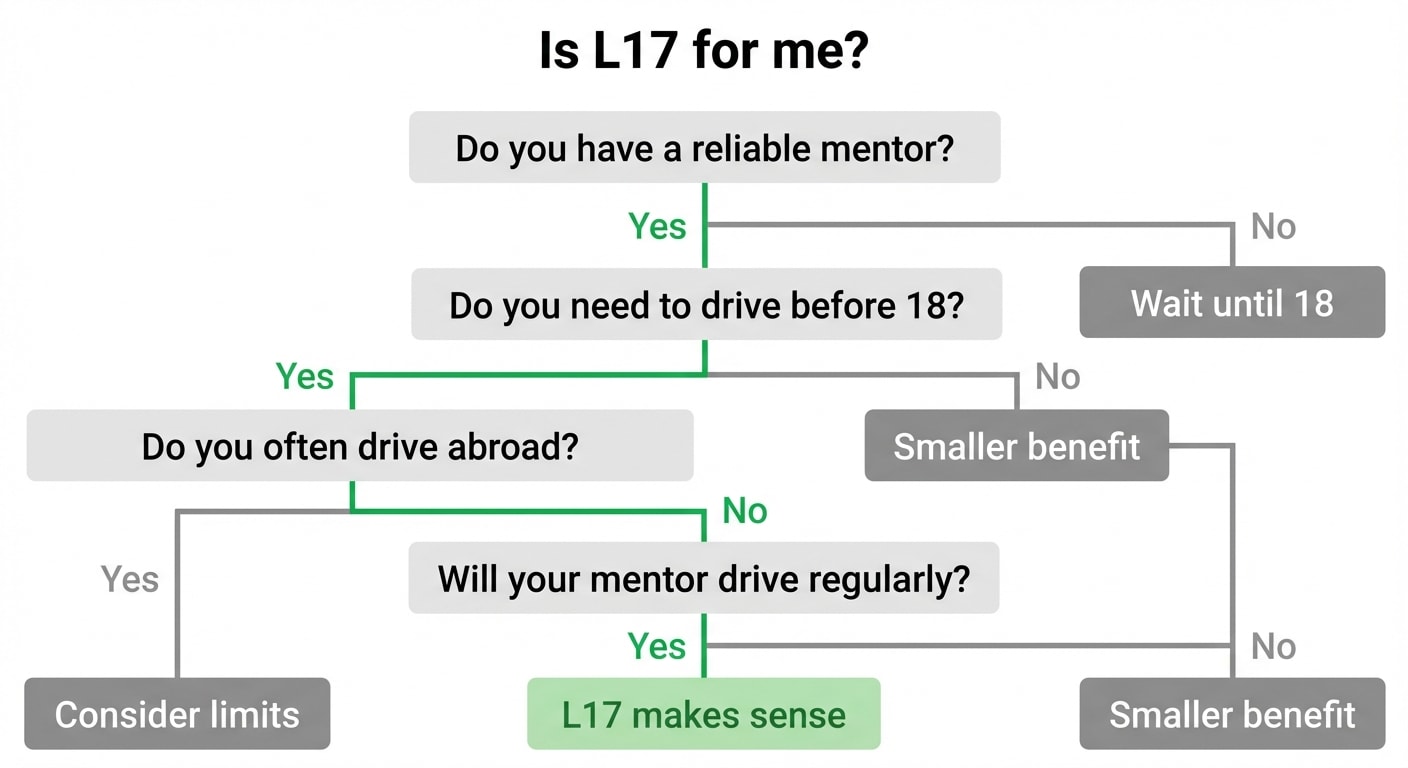
L17 makes sense if you commute to school — especially in rural areas where buses run twice a day and the nearest station is 15 kilometers away. With a mentor beside you, you get to school on time and back home without depending on unreliable connections. It makes sense if you're active in sports, music, or other activities and need mobility for training, competitions, and concerts. It makes sense if your family has a reliable mentor who's willing to drive regularly — ideally a parent who drives you around anyway.
And it makes sense above all because the data clearly show a safety benefit. A year of supervised practice dramatically reduces accident risk. Not because seventeen-year-olds are better drivers than eighteen-year-olds — but because they have someone beside them who catches mistakes before they become disasters.
L17 doesn't make sense if you don't have a suitable mentor. You can't drive without one, and finding a qualified person outside the family is difficult. It doesn't make sense if your family frequently travels abroad by car and you wanted to be behind the wheel. Until 18, you're limited to Czechia. And it doesn't make sense if you're looking for total independence — with a mentor in the passenger seat, you're simply not "the one driving alone." That comes at eighteen.
One last factor is regularity. If your mentor couldn't drive with you at least a few times a week, the benefit of L17 drops significantly. A few rides a month won't give you anywhere near the practice you need. At that point, it may be better to wait until 18 and invest your time in more intensive training. How the entire training process works is covered in the chapter Training and Progress.
A Family Bonus Nobody Talks About
One aspect of L17 that rarely gets mentioned: mentoring improves the mentor's driving too. Surveys among mentors show satisfaction scores of 6.6 out of 7. But more than the number, it's the comments that tell the story — parents describe how they started driving more responsibly because they knew their child was watching and learning from them. They stopped using their phones while driving. They started following speed limits more consistently. They thought about their habits.
The mentoring year also often strengthens communication between parent and teenager. Shared hours in the car create space for conversations that wouldn't otherwise happen. It's not just about driving — it's about the relationship.
Summary
- L17 drivers have dramatically lower accident rates — 6 accidents vs. 1,106 for eighteen-year-old novices (2024 data)
- Driving school costs the same — you pay nothing extra for L17. Administration costs a maximum of CZK 400
- Main advantage: a year of supervised practice before you start driving alone
- Main disadvantage: you drive only with a mentor and only in Czechia until 18
- L17 pays off for those who have a reliable mentor and need mobility or a safer start
- International data from Germany (20 years) and Austria (25 years) confirm the long-term positive effect of accompanied driving
Key Terms
| Term | Explanation |
|---|---|
| L17 | A program allowing you to obtain a category B driving license from age 17 with mandatory mentor accompaniment until 18 |
| BF17 (Begleitetes Fahren mit 17) | The German accompanied driving program from age 17 — the inspiration for Czech L17 |
| Mentor | An experienced driver (10+ years of practice, 0 penalty points) who accompanies the L17 driver in the passenger seat |
| Probationary license | A two-year trial period for all first-time drivers from January 1, 2024 — a serious violation triggers mandatory training |
| No-claims bonus | Period without an at-fault insurance claim — each year reduces your premium by ~5% |
| Category A1 license | A bonus for L17 graduates — riding motorcycles up to 125cc with automatic transmission, without a mentor, from age 17 |
| Traffic psychology session | A mandatory 4-hour session after a serious violation during the probationary period — costs ~CZK 2,500 |
| Probationary period | 2 years from obtaining your license, during which a serious violation triggers mandatory training and a psychology session |