How to Get a Motorcycle License — Step by Step
Complete guide to getting a motorcycle license: medical exam, driving school enrollment, training, final exam, and obtaining your driving permit.
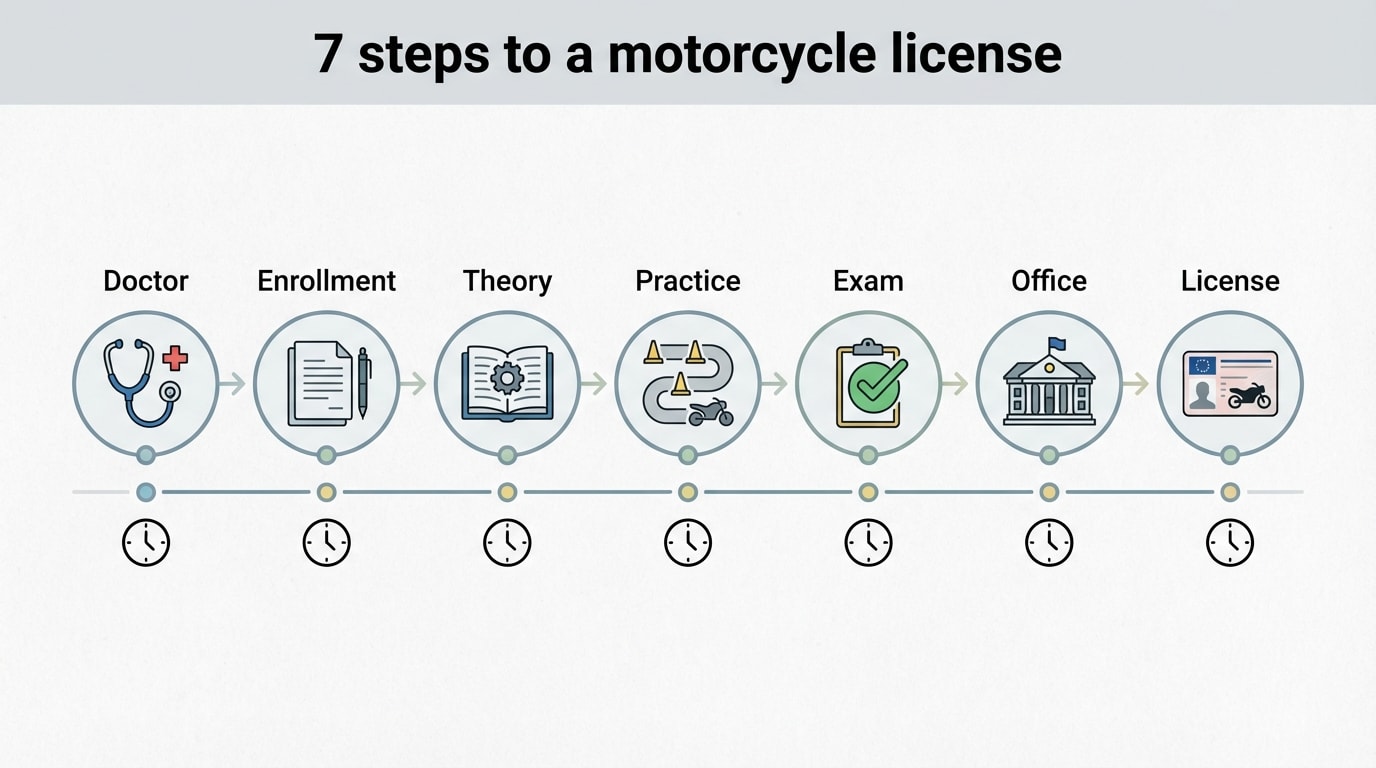
Every third person who shows up for the practical motorcycle exam walks away empty-handed. They don't fail because they can't ride — they fail because they underestimated the preparation, picked the wrong driving school, or didn't know what to expect. The entire process from first thought to license in hand takes 2 to 4 months and costs CZK 15,000–27,000. When you know what's coming at every step, you save yourself stress, time, and money.
This guide walks you through the entire process from start to finish: from the doctor's office through choosing a driving school, theory and practical training, all the way to the exam and picking up your license. It doesn't matter whether this is your first license or you're adding a motorcycle category to your car license — the process is always the same. Only the details differ, and we'll explain those too.
Quick summary:
- The entire process has 7 steps: doctor → enrollment → theory → practice → exam → office → license
- The legal minimum is 13 hours of practical riding, but most people need 15–20 hours
- Since 2024 you get 3 attempts at the exam and 12 months to pass all parts
- Since 2026 you can ride immediately after passing — no need to wait for the physical card
Step 1: Medical examination
Before you even set foot in a driving school, you need a doctor's confirmation that you're medically fit to operate a motor vehicle. No driving school will accept you without this document — Act No. 247/2000 Coll. requires it.
The examination is performed by your registered general practitioner — the GP you're signed up with. You can't go to any random doctor. Bring your ID, glasses or hearing aids (if you use them), and a urine sample. The doctor will check your vision, hearing, color perception, balance, and perform a basic neurological exam. The whole thing takes about half an hour.
The medical certificate costs CZK 400–700 — health insurance doesn't cover it. The certificate is valid for 3 months from the date of issue, so don't get it done too far in advance. If you have cardiac issues, since 2025 you'll also need a specialist cardiology exam (§87a of Act No. 361/2000 Coll.).
Watch the certificate expiry
The medical certificate is valid for only 3 months. If you let it sit and enroll in driving school later, you'll have to go back to the doctor. Schedule your exam so you can submit your application within 2–3 weeks.
Step 2: Enrollment in a driving school
With the certificate in hand, head to a driving school. And here comes the first important decision — not every driving school offers motorcycle courses. You need to find a moto-school — a driving school specializing in motorcycle training. On Kvalty.cz you can compare driving schools in your area and filter by offered categories.
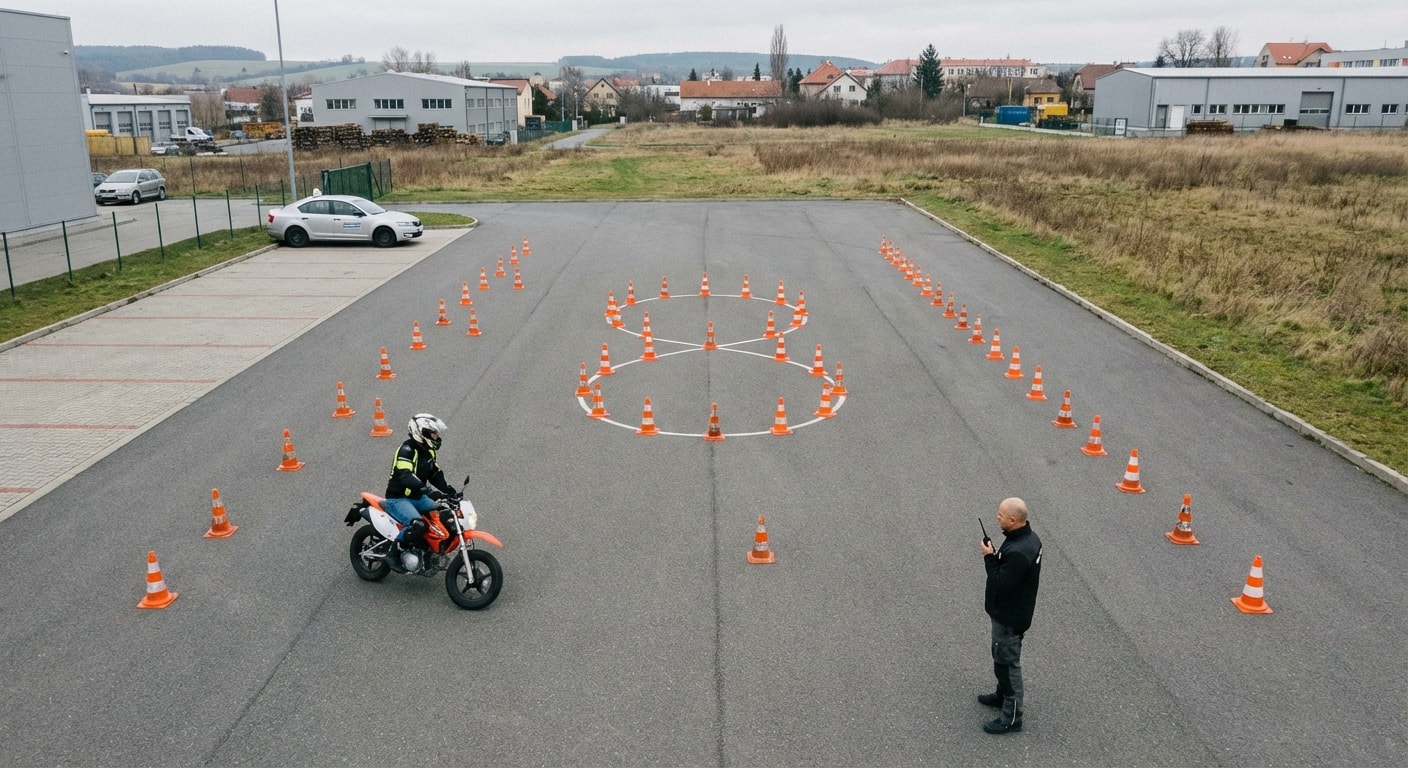
What to look for when choosing? First: quality of the training ground. A good moto-school has its own practice area with cones, markings, and enough space to practice maneuvers. A supermarket parking lot is not a training ground. Second: condition of the motorcycles. The training bike should match the category you're applying for. Third: intercoms. Communication between you and the instructor during motorcycle riding is crucial — make sure the school has working wireless communication.
For enrollment, you'll need:
- A valid national ID card (or passport + proof of residence)
- Medical fitness certificate (no more than 3 months old)
- A passport-size photograph
- Notarized parental consent if you're under 18 (applies to AM and A1)
Most driving schools require a deposit, typically 50% of the course price. For a detailed price overview by category and region, see the chapter Motorcycle license cost.
How to spot a good moto-school
Ask about practical hours above the legal minimum (13), training ground quality, age of training motorcycles, and whether they have intercoms. Reviews on Kvalty.cz tell you what graduates say.
Step 3: Theory
Theory is the first part of the training and for many students the least popular one. But you can't afford to underestimate it — the theoretical exam eliminates more people than you'd expect.
For categories A1, A2, and A, the law requires 26 hours of theoretical instruction. For AM, it's 9 hours. One lesson hour is 45 minutes (§27 of Act No. 247/2000 Coll.). The curriculum covers traffic regulations (14 hours), driving theory and safe riding principles (6 hours), vehicle operation and maintenance (1 hour), first aid training (2 hours), and revision with testing (3 hours).
If you already have a category B license, you have a huge advantage. You know the traffic rules from your car theory — and those make up the majority of questions. The rest is motorcycle-specific, but the logic stays the same. Some driving schools offer an individual study plan where you focus mainly on motorcycle specifics.
You can practice tests online at etesty2.mdcr.cz — the official testing platform of the Ministry of Transport, where you'll find the same questions as in the actual exam. There are 856 questions in total, and you'll get 25 at the exam. More about the exam itself in the chapter Motorcycle driving test.
Step 4: Practical training
This is the part you signed up for. Practical motorcycle training is simultaneously the most demanding and the most enjoyable part of the entire process. And it's fundamentally different from car training.
Why motorcycle training is different from car training
In a car, the instructor sits next to you and can intervene at any moment — hit the brake, grab the wheel. On a motorcycle, you're on your own from hour one. The instructor rides a separate motorcycle or follows in a car behind you, communicating via intercom. They can't help you. Either you handle it, or the bike goes down. This is the reality you need to mentally prepare for.
More specifics: training depends on weather. In heavy rain, icy conditions, or extreme heat, lessons get cancelled — wet pavement on a practice course is dangerous for beginners. Most motorcycle courses therefore run from March to October. And finally — riding a motorcycle is physically demanding. You need to be able to lift a fallen bike (weighing 150–200 kg), maneuver it at low speed, and maintain balance.
Three phases of practical training
The law requires a minimum of 13 hours of practical riding (§26 and Annex 3 of Decree No. 167/2002 Coll.). One hour is 45 minutes, and you can complete a maximum of 2 hours of practical motorcycle riding per day. Training is divided into three phases.
The first phase takes place on the practice course. You learn the basics: starting the engine, pulling away, stopping, shifting gears, maintaining balance. Then low-speed maneuvers are added — slow riding, slalom through cones, figure-eight. This takes about 3–5 hours and it's critical. If you can't handle slow riding on the course, there's no point heading out on the road.
The second phase is accompanied rides in traffic. You head out on less busy roads, learning to read traffic, turn, shift gears in a real environment. The instructor rides behind you and provides guidance and feedback through the intercom. Another 3–5 hours.
The third phase is practicing exam maneuvers. The driving school prepares you for the 10 prescribed maneuvers you'll perform at the practical exam — high-speed slalom, emergency braking, obstacle avoidance. This is the most intensive part and takes 5–8 hours. A detailed description of all 10 maneuvers is in the chapter Motorcycle driving test.
How many hours do you really need
The legally required 13 hours is a minimum, not a recommendation. Most driving schools recommend 15–20 hours of practical riding, and it's not because they want to charge you more. Thirteen hours of 45 minutes each is actually less than 10 hours of actual riding. That's painfully little to master 10 exam maneuvers, ride in traffic, and feel safe on a motorcycle.
If you have zero prior experience with two-wheeled vehicles — no scooter, no moped, nothing — count on needing closer to 20 hours. There's no shame in that. It's a smart approach that increases your chances of passing the exam and, more importantly, of riding safely once you have your license.
13 hours isn't enough
The legal minimum of 13 hours is insufficient for most people. Driving schools recommend 15–20 hours. The extra investment (typically CZK 1,000–1,500 per hour) pays for itself — you save on retake fees and, more importantly, you'll be safer on the road.
Step 5: The final exam
After completing the training, the big day arrives. The motorcycle license exam consists of two parts: theoretical and practical.
The theoretical exam is taken on a computer. You get 25 questions with varying point values, have 30 minutes, and need at least 43 out of 50 points (86%). Questions are drawn from a pool of 856. If you've already passed the car exam, you know what to expect — the format is identical.
The practical exam is what sets the motorcycle test apart from all others. It has two parts. In the first, you perform 10 prescribed maneuvers on the practice course: removing the bike from the stand, slow riding, U-turn, slalom, figure-eight, starts and stops, high-speed slalom (min. 40 km/h), obstacle avoidance (min. 50 km/h), precision braking, and emergency braking. If you fail the first part, you don't proceed to the second. The second part is riding in traffic — at least 30 minutes on the road, with the examiner following in an escort vehicle.
Since 2024 (Act No. 271/2023 Coll.), you get 3 attempts at each part — one regular and two retakes. All exams must be completed within 12 months of the first attempt. If you fail even on the third try, you'll need supplementary training followed by 3 more attempts.
The administrative fee for the first exam is CZK 700. A theory retake costs CZK 100, a practical retake CZK 400. A complete exam guide including tips on how to pass is in the chapter Motorcycle driving test.
Step 6: Applying for your driving permit
Congratulations — the exam is behind you. Now you need to actually get the permit in your hands. You have 6 months from the exam to submit an application for your driving permit.
You submit the application at the municipal office of a municipality with extended powers in your place of permanent residence. Since 2026, you can also do this online via the Transport Portal. Bring your valid ID, proof of passing the exam, medical certificate, and a statutory declaration (confirming no driving bans or penalty points).
Standard processing takes 20 days and costs CZK 200 (in person) or CZK 160 (online). If you're in a hurry, express processing in 5 business days costs CZK 700 (in person) or CZK 560 (online). A pickup location surcharge is CZK 100.
And here's great news: since January 1, 2026, you can drive immediately after passing the exam and being entered in the driver registry — without waiting for the physical permit. You have 30 days before the plastic card arrives.
New in 2026: Ride right away
After passing the exam and being entered in the central driver registry, you can drive immediately — up to 30 days without a physical permit. No need to wait 20 days for the plastic card.
Step 7: You've got it — what now?
With the license in hand (or at least in the registry), a new world opens up. But before you head out on your first motorcycle, take a moment to think. The training taught you the basics, but real learning starts now — in real traffic, on your own bike, without an instructor in your earpiece.
If you don't have a motorcycle yet, check out our guide Choosing your first motorcycle, where you'll find model recommendations for beginners, comparisons of new and used bikes, and an explanation of power limits for A2. And don't forget about safety gear — the helmet and gloves you had during training are just the beginning.
Special case: Upgrading from A2 to A (or A1 to A2)
If you already hold a lower motorcycle category and want to move up, things are significantly simpler. To upgrade from A1 to A2 or from A2 to A, you need to meet one condition: at least 2 years of holding your current category (§19 of Act No. 247/2000 Coll.).
Mandatory training at a driving school is not required — you can go straight to the exam. The exam includes only the practical part: maneuvers on the practice course and riding in traffic. No theory, no written tests. The cost ranges from CZK 5,000 to 10,800 including fees.
But beware — just because training isn't mandatory doesn't mean you don't need it. Moving from A2 to A means a significantly more powerful machine. Maneuvers on the practice course that you managed on a 35 kW bike are completely different on a 100 kW machine. Most driving schools recommend at least 3–5 hours of preparatory rides. For a few thousand extra, you significantly increase your chance of passing the exam on the first attempt.
Harmonization code 79 — upgrade trap
If you hold an A1 with harmonization code 79 (restriction to ≤ 150 cc), you cannot upgrade to A2 via a supplementary exam. You must complete full training. Check the entry in your license before enrolling.
Upgrading from B — myths and reality
Many people think: "I have a car license, I'll handle the motorcycle just fine." This belief is dangerous. A category B license gives you zero training reductions for a motorcycle. You must complete the full course for your chosen motorcycle category — the same number of theory hours, the same number of practice hours.
You have exactly one advantage: you know the traffic rules. Motorcycle theory will go faster because you've already dealt with most of the questions during your car exam. But practical training starts from absolute zero. Riding a two-wheeled vehicle has nothing in common with driving a car. No steering wheel, no foot brake pedal, no center of gravity you're used to.
Common mistake: "The course maneuvers will be easy, it's just slalom." No. Slalom on a motorcycle at 40 km/h between cones, emergency braking from 50 km/h, or a figure-eight in a tight space — these are maneuvers that require dozens of hours of practice. Don't underestimate it.
One small exception: with a B license, you can ride a small motorcycle up to 125 cc and 11 kW, but only with automatic transmission and only within the Czech Republic. Details are in the chapter Motorcycle license categories.
Training gear — what you need to get
The driving school provides the motorcycle. Helmet, gloves, boots, and clothing are usually your responsibility. Some moto-schools lend basic gear, but don't count on it — check in advance.
For training and the exam, you need: a certified motorcycle helmet that fits properly. Leather motorcycle gloves that also protect your wrists. Sturdy boots or motorcycle boots protecting your ankles, with sensitivity for gear shifting. A motorcycle jacket (leather or textile). Sturdy trousers — ideally motorcycle pants, at minimum tough jeans. Sweatpants are not acceptable.
A complete overview of required and recommended gear is in the chapter Safety and gear. Budget CZK 5,000–15,000 for gear — depending on whether you buy new or find something second-hand.
Total cost overview
How much does the entire process cost from doctor to license in hand? Here's a rough overview. Exact course prices vary by category and region — a detailed comparison is in the chapter Motorcycle license cost.
Estimated costs for a motorcycle license
| Item | Cost |
|---|---|
| Medical certificate | CZK 400–700 |
| Driving school course (by category) | CZK 10,000–27,000 |
| Administrative exam fee | CZK 700 |
| Driving permit issuance (standard / express) | CZK 200 / 700 |
| Basic protective gear | CZK 5,000–15,000 |
| Total estimate | CZK 16,300–43,400 |
When to enroll — timing your plan
Motorcycle training is a seasonal affair. Practical motorcycle rides require dry conditions and reasonable temperatures. Most driving schools offer motorcycle courses from March to October, with peak season in May through September.
The ideal strategy: enroll in February or March. Start theory in March, hit the practice course in April, take the exam in May or June. You have the whole summer ahead of you for riding. Anyone who enrolls in September risks not finishing the training before the winter break — and having to continue in the spring of the following year.
Intensive courses (2–4 weeks) are possible, but expect a surcharge of CZK 4,000–9,000 and the need to be available almost every day.
Summary
- The complete motorcycle license process takes 2–4 months and has 7 clear steps
- Start with a medical exam (CZK 400–700), then enroll in a moto-school
- Training includes 26 hours of theory and a minimum of 13 hours of practice (15–20 recommended)
- Since 2024: 3 exam attempts, 12-month deadline, you only retake the part you failed
- Since 2026: you can ride immediately after the exam — no waiting for the physical permit
- Upgrading A1→A2 or A2→A after 2 years: practical exam only, costs CZK 5,000–10,800
- Enroll in February–March to have the whole summer for riding
Key terms
| Term | Explanation |
|---|---|
| Moto-school (*motoškola*) | A driving school specializing in motorcycle training |
| Lesson hour | 45 minutes (not 60) — the legal duration of one training hour |
| Practice course | An enclosed area for maneuver practice — the first phase of training |
| Intercom | Wireless communication between the student on the motorcycle and the instructor |
| Escort motorcycle | The instructor's bike, riding behind you during road rides |
| Supplementary exam | The exam when upgrading A1→A2 or A2→A — practical part only |
| Harmonization code 79 | A restriction in the license (e.g., ≤ 150 cc) — may affect eligibility for supplementary exams |
| Administrative fee | The fee for the exam (CZK 700) and for license issuance (CZK 200–700) |
| Driver registry | The central database — since 2026, registration alone is enough to start driving |
| L17 | Driving from age 17 with a mentor — applies only to category B, not motorcycles |