
Probation Rules for New Drivers — Facts vs Myths
Zero alcohol tolerance, point limits, and 8 common myths debunked. What you can and can't do in your first 2 years with a Czech driving license.
Reduced point limit. No motorway access. Mandatory sticker on your car. Three things almost everyone says about the probationary period — and none of them are true. So many myths circulate around the provisional license that most new drivers have no idea what actually applies to them.
The reality is simple. The rules of the probationary period fit on a few lines — and most of them don't restrict you at all. This article shows you what the law actually says, what's just urban legend, and why drunk driving is the only thing you should genuinely worry about.
Quick summary:
- The point limit is 12 points — same as for all drivers
- There are no speed, motorway, night driving, or passenger restrictions for new drivers in Czechia
- Zero alcohol tolerance applies to all drivers — not just you
- A single 6-point offense triggers mandatory training (psychologist + driving school, CZK 8,000–16,000)
What actually applies to you
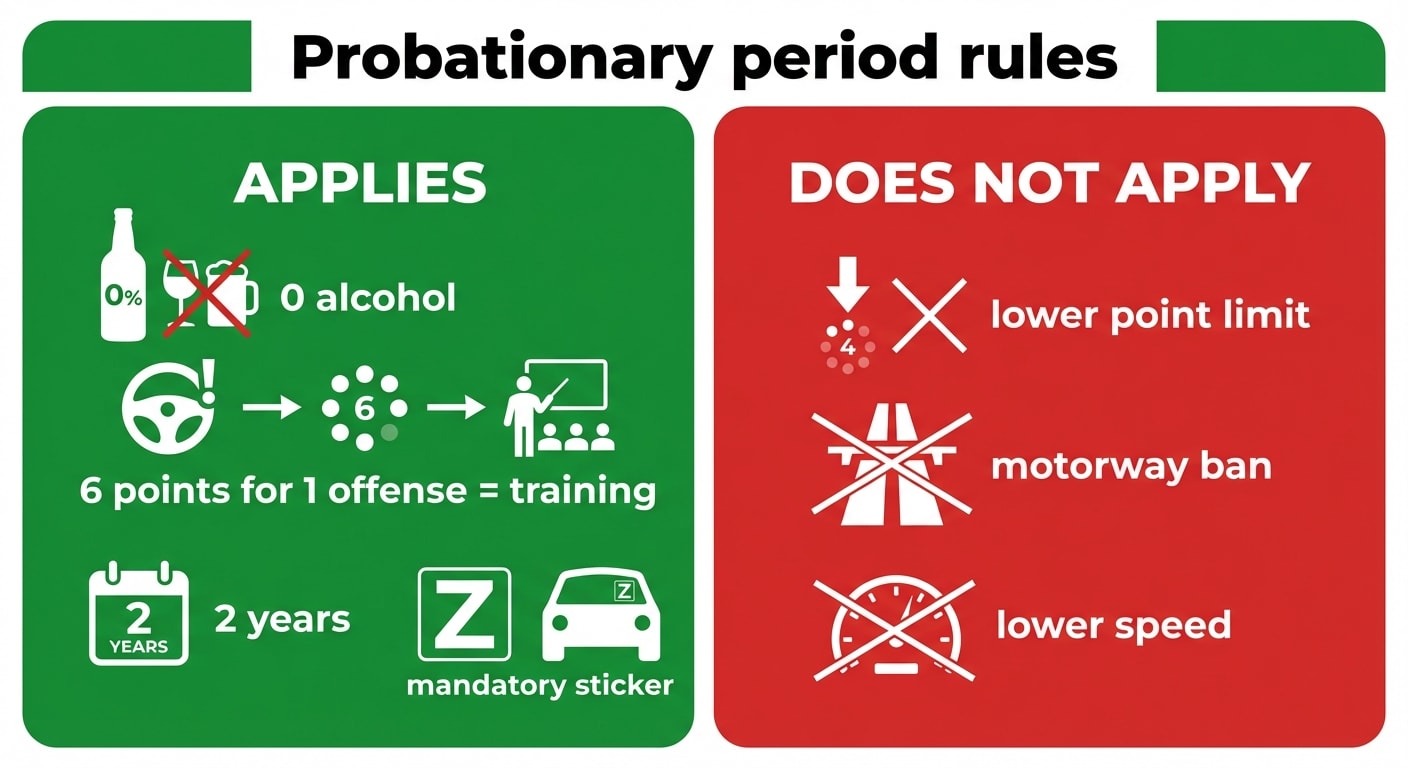
The probationary period lasts 2 years from the date your driving license is first issued. It was introduced by amendment No. 271/2023 Coll. effective January 1, 2024, and applies to everyone who first obtained a license from January 2022 onwards. Your age doesn't matter — whether you're 18 or 45, the same rules apply.
During those two years, exactly one extra rule applies to you compared to other drivers. If you commit an offense rated at 6 points — the most serious category — you must complete a mandatory prevention program. This consists of a traffic psychology consultation (4 hours) and beginner driver training at a driving school (5 hours). The total cost ranges from CZK 8,000 to 16,000. We cover it in detail in the chapter Mandatory Training for New Drivers.
Here's the critical detail many people miss. The program is only triggered when you receive 6 points from a single offense. Accumulating smaller offenses — say 2 points for speeding and 4 points for using your phone — adds up to 6 points on your record, but does not trigger the training requirement. The law (Section 102f(2) of Act No. 361/2000 Coll.) is unambiguous on this.
Beyond that, the exact same rules apply to you as to a driver with twenty years of experience. Same speed limits. Same motorway access. Same night driving conditions. No passenger limits. No mandatory car markings.
When does the probationary period end?
After 2 years without a qualifying offense, your license automatically stops being 'provisional.' Nobody notifies you — the period simply ends quietly. From that moment on, you're a regular driver.
8 myths that circulate — and none of them are true
A staggering amount of misinformation surrounds the probationary period. The Ministry of Transport even issued a special statement to debunk these myths (Ministry of Transport, 2024). Here are the most common ones — and why you shouldn't believe them.
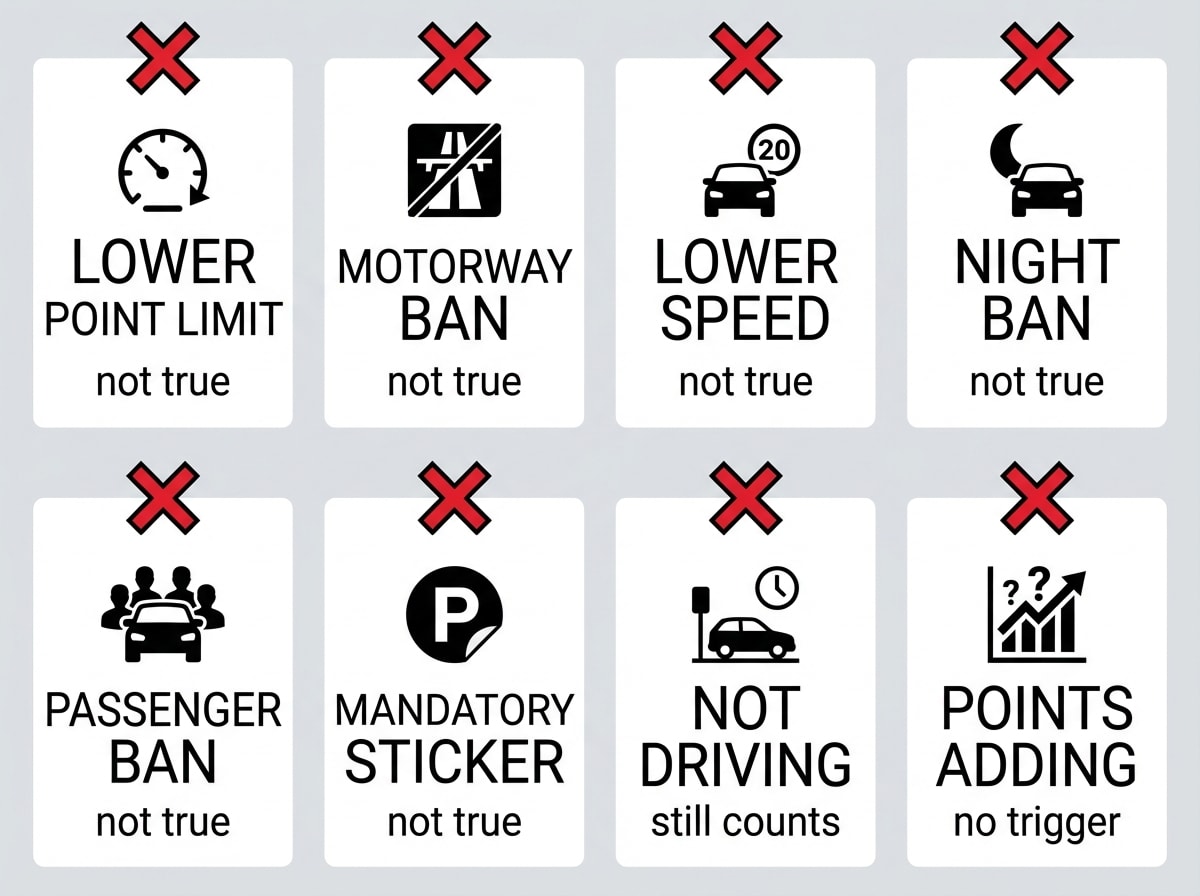
Myth 1: "I have a reduced point limit — 6 points instead of 12." False. The point limit is 12 for all drivers in Czechia. The number 6 refers to a different rule — a 6-point offense triggers mandatory training. But you still have 12 points before license revocation, same as everyone else.
Myth 2: "I'm not allowed on the motorway." False. There are no motorway restrictions for new drivers in Czechia. From the moment you get your license, you can drive on the motorway under the same conditions as everyone else.
Myth 3: "I have a reduced speed limit." False. Speed limits are the same — 50 km/h in town, 90 km/h outside town, 130 km/h on motorways. Some European countries have lower limits for beginners. Czechia doesn't.
Myth 4: "I can't drive at night." False. Night driving is not restricted in any way. You can drive any time, 24 hours a day.
Myth 5: "I can't carry passengers." False. You can carry whoever you want. Some countries (e.g., Germany for L17 drivers) have restrictions. Czechia doesn't.
Myth 6: "I need a 'Z' or 'L' sticker on my car." False. There is no mandatory marking for new drivers in Czechia. The "L" sign is only required on driving school training vehicles.
Myth 7: "If I don't drive for 2 years, the probation expires." False. The two-year period runs from the date on your license, not from when you first sit behind the wheel. Not driving doesn't help.
Myth 8: "If I accumulate 2+4 points, I have to do the training." False. The training requirement is triggered by 6 points from a single offense. Adding up smaller offenses does not trigger this obligation.
Zero alcohol tolerance
This isn't a rule specific to the probationary period — it applies to all drivers in the Czech Republic. But as a new driver, it's especially important to understand why.
The law (Section 5(2)(b) of Act No. 361/2000 Coll.) is clear: a driver must not drive immediately after consuming alcohol or at a time when they could still be under its influence. In practice, there's a so-called protective threshold of up to 0.24‰ — the natural alcohol level the body can produce on its own. Above 0.3‰, however, you're committing an offense.
Now the key number. An alcohol offense (above 0.3‰) costs you 6 points, a fine of CZK 7,000–25,000, and a driving ban of 6–18 months. As a new driver, this automatically triggers the mandatory prevention program — an additional CZK 8,000–16,000 on top. One beer can end up costing over CZK 30,000, several months without a license, and 9 hours of mandatory training.
Refuse the breathalyzer? Even worse — a fine of CZK 25,000–75,000 and a driving ban of 18–36 months. Above 1.0‰, it's no longer an offense but a criminal act under Section 274 of the Criminal Code. That carries up to 3 years of imprisonment.
68% of violations = alcohol
Of the 3,260 new drivers who violated probation conditions in the first 2 years of the program, 2,227 (68%) were driving under the influence of alcohol or drugs (ČT24, 2026). Alcohol is the number one cause by a huge margin. Don't drink and you're practically safe.
What triggers obligations — and what doesn't
Let's go through this one more time with specifics. During your two-year probationary period, there are three situations that require you to complete the prevention program.
First: you commit an offense rated at 6 points. This is the most common trigger. Six-point offenses include driving under the influence of alcohol, running a red light, exceeding the speed limit by 40+ km/h in town (or 50+ km/h outside town), endangering a pedestrian at a crosswalk, dangerous overtaking, or driving the wrong way on a motorway. A complete overview of offenses with points and fines is in the chapter Points and Offenses.
Second: you commit a traffic-related criminal offense that results in a court-imposed driving ban.
Third: you commit an offense that results in an administrative driving ban — even if it doesn't carry the full 6 points.
What does not trigger obligations: minor offenses worth 2 or 4 points. Exceed the speed limit by 15 km/h? Two points and a fine, but no training. Use your phone while driving? Four points and a fine, but no training. The points accumulate on your record, but the accumulation of smaller offenses does not trigger the mandatory program.
That doesn't mean you can take minor offenses lightly. Points add up, and at 12 points you lose your license — same as anyone else. More on how to monitor and reduce your points in the chapter Points and Offenses.
Consequences — what happens if you don't comply
If you commit a qualifying offense, the municipal authority sends you a formal notice requiring you to complete the prevention program. From the delivery date, you have 3 months. That sounds comfortable, but spots with psychologists and driving schools can fill up — don't start looking in the last week.
While completing the program, you can continue driving (unless you've been issued a driving ban). You don't need to surrender your license.
Missed the deadline? The day after the 3-month period expires, you automatically lose your driving privilege (Section 102g of Act No. 361/2000 Coll.). No letter needs to arrive — it happens by operation of law. You must surrender your license, and to get it back, you need to document completion of both courses. If more than a year passes since losing your license, you'll also need to prove professional, medical, and psychological fitness — essentially meaning retaking your exams. A detailed guide on completing the program is in the chapter Mandatory Training for New Drivers.
3 months go fast
If you receive a notice, start looking for a psychologist and driving school immediately. The Ministry of Transport maintains a list of accredited psychologists. Most larger driving schools offer the training — it doesn't have to be the one where you got your license.
Czechia vs. Europe — how strict are we?
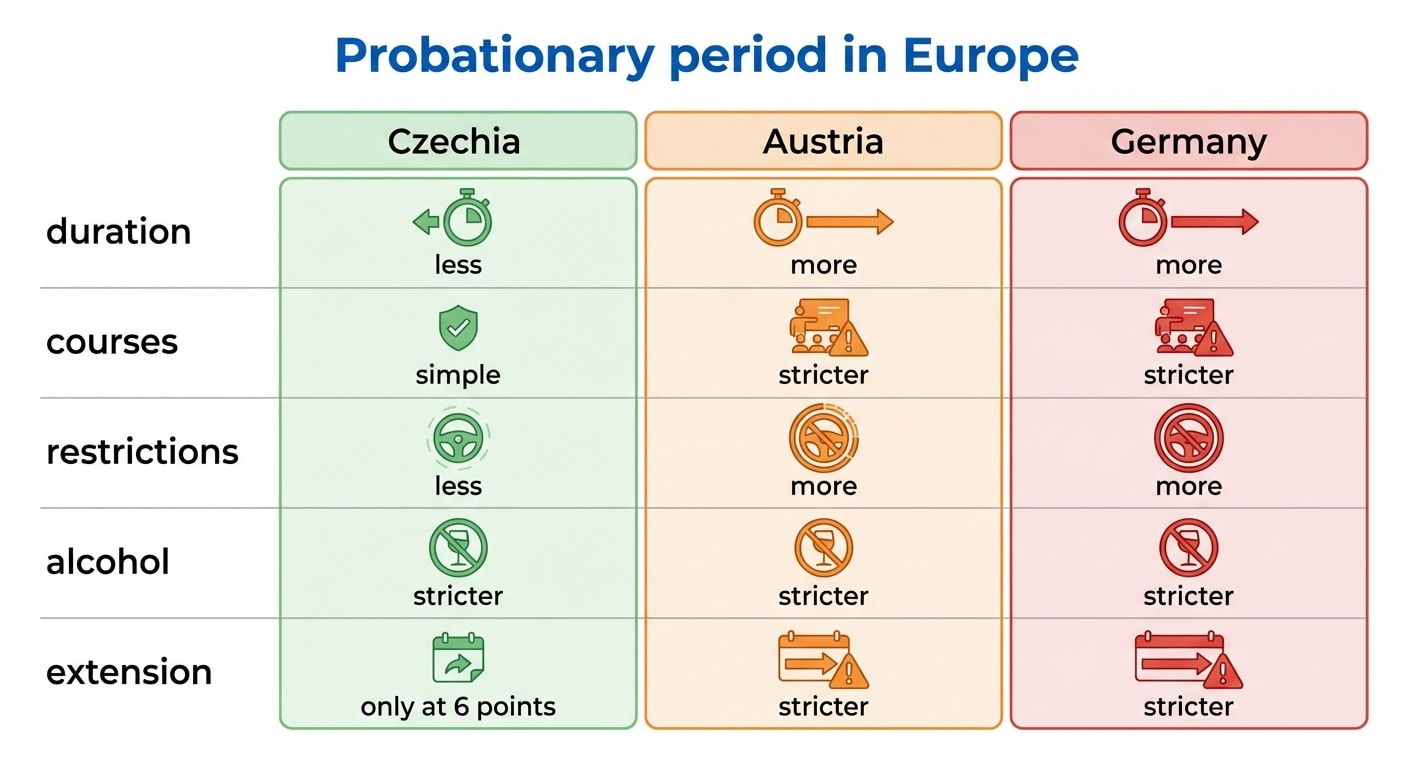
The Czech probation model is relatively mild compared to other European countries. No speed restrictions, no mandatory courses for everyone — just a reactive system that intervenes when something goes wrong.
Austria introduced its probationary period back in 1999 and takes a completely different approach. Every new driver must complete mandatory educational courses — including a crisis situation simulator and a supervised drive with feedback from a psychologist. Not after an offense, but as a compulsory part of the first years of driving. This proactive "Alpine model" is significantly stricter than the Czech system.
Germany also has a 2-year probationary period, but with one key difference: an offense extends the probation by an additional 2 years (up to 4 years total). In Czechia, it's always a fixed 2 years. Germany also explicitly introduced zero alcohol tolerance for drivers under 21 and those in the probationary period — in Czechia, zero tolerance applies to everyone regardless.
Some countries have restrictions that are only rumored about in Czechia: lower speed limits for beginners, night driving bans, passenger limits. None of this applies in Czechia. Driving from age 17 with a mentor (L17) has been available in Czechia since 2024 — and drivers who completed this program have demonstrably fewer accidents and offenses.
Summary
- The probationary period lasts 2 years and applies to all drivers with a first license from January 2022
- The point limit is 12 points — the same as for all drivers, not 6
- There are no restrictions on speed, motorways, night driving, passengers, or mandatory markings in Czechia
- A single 6-point offense triggers mandatory training — CZK 8,000–16,000
- Alcohol is the cause of 68% of violations — don't drink and you'll be fine
- You have 3 months to complete your obligations — miss it and you lose your license
- The Czech system is mild compared to Austria or Germany — no mandatory courses for everyone
Key Terms
| Term | Explanation |
|---|---|
| Probationary period | Two-year period from first license issuance (from January 1, 2024) with stricter consequences for serious offenses |
| Provisional driving license | Official name for the probationary period under Act No. 361/2000 Coll. (Section 102f) |
| Six-point offense | Most serious offense category (alcohol, red light, extreme speeding) — triggers the mandatory prevention program |
| Prevention program | Psychological consultation (4 h) + driving school training (5 h), mandatory after a 6-point offense during probation |
| Zero alcohol tolerance | Ban on driving under the influence of alcohol applicable to all drivers in Czechia — above 0.3‰ = offense (6 points) |
| Protective threshold | Blood alcohol level up to 0.24‰, considered a physiological minimum and not penalized |
| Loss of driving privilege | Automatic license revocation for failure to meet obligations within the 3-month deadline (Section 102g) |
| Point account | Record of penalty points — starts at 0, license revoked at 12 points |
Want to know more?
Check out the complete overview of offenses with points and fines in the chapter [Points and Offenses](/probationary-period/points-and-offenses/), or learn about what awaits you in the prevention program in the chapter [Mandatory Training](/probationary-period/mandatory-training/). And if you want practical advice on how to get through two years without problems — see [Tips for a Safe Probationary Period](/probationary-period/safety-tips/).