
Medical Fitness to Drive in Czechia 2026
Poor eyesight, heart medication, or diabetes — and you still want to drive? You can. But you need to know the conditions. Medical fitness to drive applies to everyone — from driving school students to professional truck drivers to seniors who received a letter saying they need a check-up. And since 2026, the rules have changed: mandatory exams only from age 70 and digital health certificates.
At Kvalty.cz, we help you choose the right driving school — and here we'll help you make sense of medical fitness to drive. The system looks complicated at first glance but actually follows clear rules. We draw on current legislation (Act 361/2000, Decree 277/2004 as amended by Decree 445/2024) and data from the Ministry of Transport.
Quick summary:
- Since 2026, mandatory medical exams start at 70 (previously 65) — then every 2 years
- The medical certificate for driving school costs CZK 400–1,000 and must be less than 3 months old
- New certificates from 2026 are recorded digitally — you don't need to carry a paper copy
- Most chronic conditions don't mean the end of driving — just specific conditions to meet
Who Does Medical Fitness Apply To
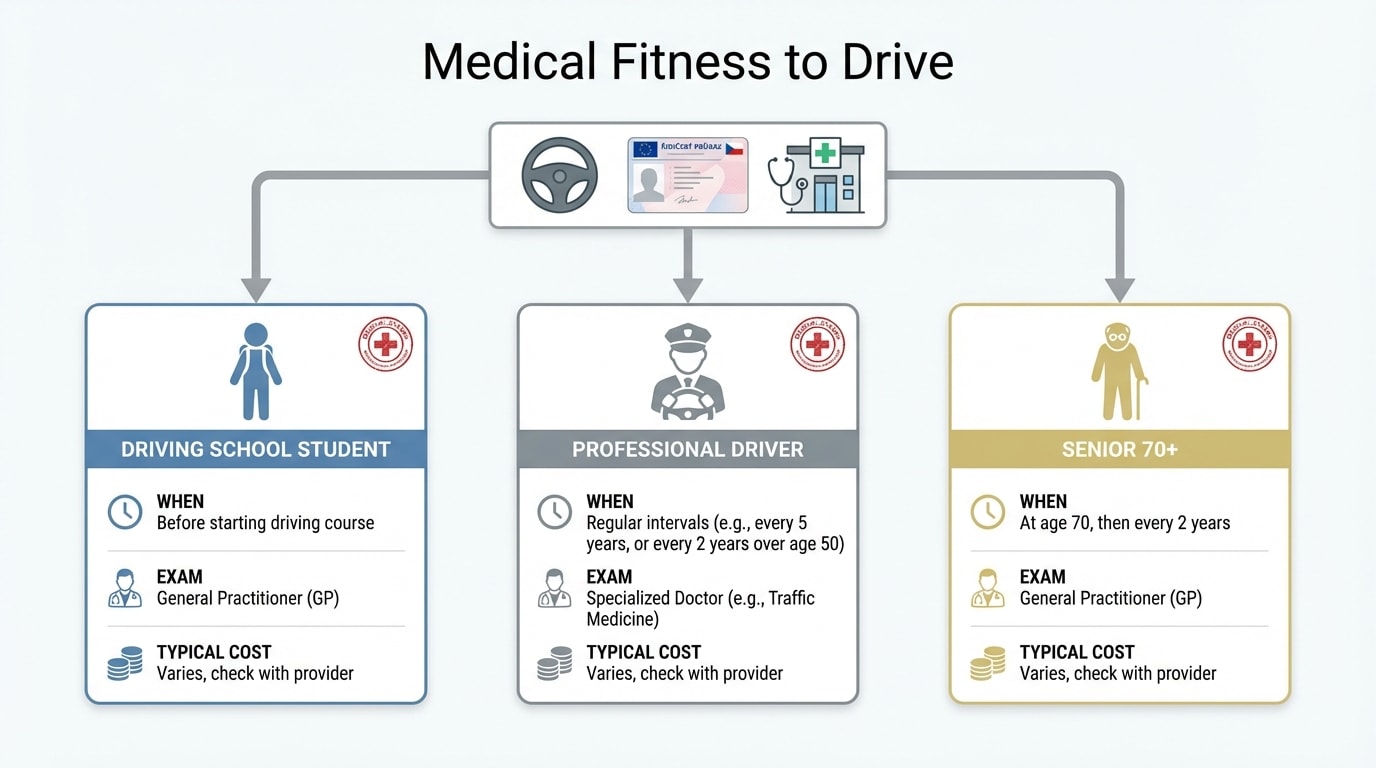
Let's be straight: if you're under 70 and not a professional driver, you don't need regular check-ups. But there's an important "but" — everyone has to go through it at least once.
Everyone who enrolls in driving school needs a medical fitness certificate. Without it, they won't accept you. You go to your general practitioner, who examines you, tests your vision and hearing, and issues the certificate. The whole thing takes about 30 minutes and costs CZK 400–1,000 — usually around 500 crowns. Health insurance doesn't cover it.
The certificate must be less than 3 months old, so schedule your exam so it doesn't expire before you start at the driving school (§85 of Act 361/2000).
Professional drivers — those with category C or D licenses, employed drivers, driving school instructors, and emergency vehicle drivers — have regular check-ups. Every two years until 50, every year after that. For employees, the employer covers the cost (§87).
And then there are seniors. That's where things changed significantly since 2026.
What Changed in 2026
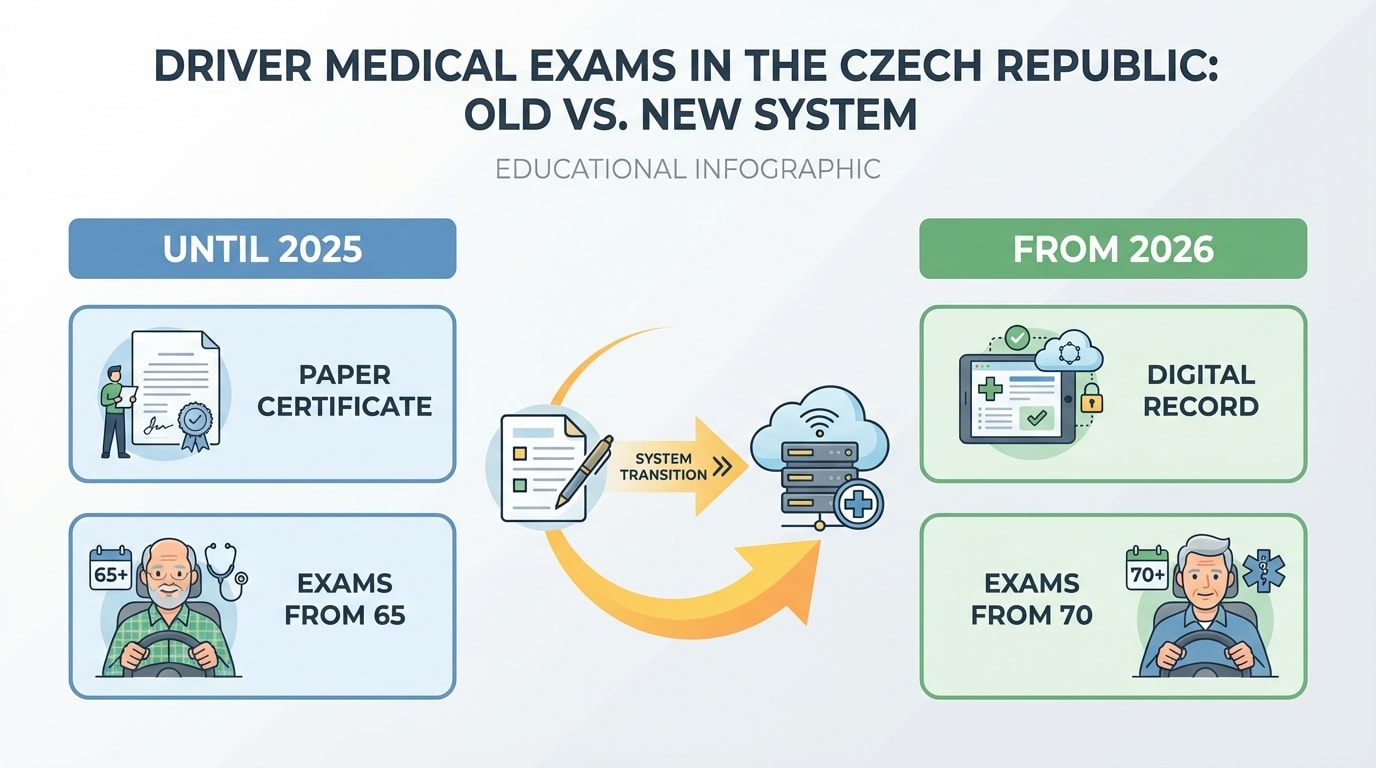
Two big updates. First: mandatory exams moved from age 65 to 70. If you're 66 or 68, you can breathe easy — you don't need an exam until you turn seventy. From 70 onwards, you go every 2 years.
Second: digital health certificates. Doctors now record the certificate directly in the system. The data is automatically synced with the driver registry. You don't need to carry any paper — police verify your fitness directly in the information system.
You can also find your certificate in the EZKarta app or on the eHealth Portal. But careful: this only applies to certificates issued from January 1, 2026. Older certificates must still be carried physically.
Three Possible Exam Outcomes
After the examination, the doctor places you in one of three categories. Most people fall into the first — fit without restrictions. The second category, "fit with conditions," is far more common than you'd think. And the third, unfit, is less common than you fear.
Fit — you can drive without any restrictions. Your certificate is valid.
Fit with conditions — you may drive, but you must meet a specific condition. Most commonly, it's glasses or contact lenses (harmonized code 01.06 on your license). It could also be a hearing aid, vehicle modification, or daytime driving only. The condition is recorded on your driving license. Driving without meeting the condition is an offence with a fine of CZK 1,500–2,500.
Unfit — the doctor decides you cannot drive at this time. They are legally required to report it to the municipal office (§86). The office initiates administrative proceedings and you must surrender your license. But note — in most cases, this is a temporary state. After recovery or stabilization, you can apply to get it back. The detailed process is in the chapter How to Get Your Fitness Back.
Fitness with conditions is no big deal
Millions of drivers in Czechia drive with glasses or contacts and have a condition recorded on their license. It doesn't mean any practical limitation — you just put on your glasses before turning the key.
Health Conditions and Driving — What the Law Says
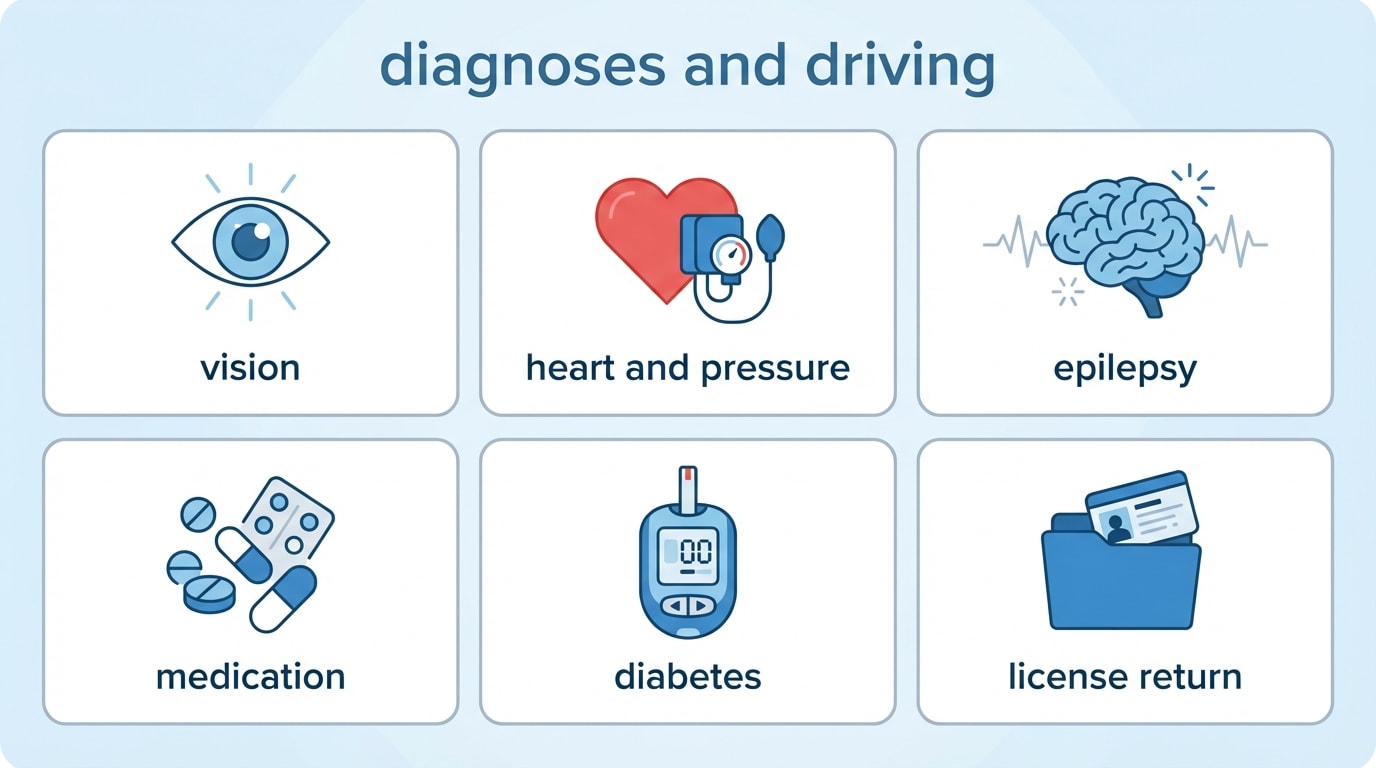
Annex 3 of Decree 277/2004 contains a complete list of diseases and conditions that affect fitness to drive. We're not here to scare you with a list of diagnoses — the key message is simple: most chronic conditions don't automatically mean the end of driving. They mean specific conditions you need to meet.
In Czechia, there are over 900,000 diabetics, around 100,000 people with epilepsy, and approximately 3 million Czechs with cardiovascular disease. The vast majority of them can drive. The system distinguishes two groups — Group 1 (cars, motorcycles — less strict criteria) and Group 2 (trucks, buses, professionals — stricter criteria). For each diagnosis, there are clear conditions.
We've prepared seven chapters, each covering one area. You can read them in order or jump straight to the topic that concerns you.
What Happens If You Don't Follow the Rules
The law takes this seriously — and if you drive without valid medical fitness, the fines are steep. It's not just about money. It's about the safety of you and everyone else on the road.
Penalties for violating medical fitness rules
| Situation | Fine | Additional consequences |
|---|---|---|
| Don't have your certificate on you (but it exists) | Up to CZK 2,000 on the spot | — |
| Driving without valid medical fitness | CZK 5,000–10,000 | Driving ban for 6–12 months |
| Driving after license revocation | Criminal offence (§337 Criminal Code) | Up to 2 years imprisonment |
Watch out for older certificates
Digital certificates (from 2026) can be verified by police in the system. But if your certificate was issued before 2026, you still need to carry it physically. Otherwise, you risk a fine of up to CZK 2,000.
Summary
- Medical fitness must be proven by every driving license applicant, professional drivers, and since 2026 all drivers from age 70
- The exam costs CZK 400–1,000 and is performed by a general practitioner
- From 2026, certificates are digital — you don't need to carry a paper copy
- Most chronic conditions (diabetes, epilepsy, heart problems, vision disorders) don't mean the end of driving — just specific conditions to meet
- Driving without valid fitness is an offence with a fine of CZK 5,000–10,000 and a driving ban
Key Terms
| Term | Explanation |
|---|---|
| Medical fitness to drive | Physical and mental ability to operate a motor vehicle — assessed by a general practitioner |
| Medical fitness certificate | A medical document confirming you may drive — digital from 2026 |
| Group 1 | Non-professional drivers (AM, A, B) — less strict health criteria |
| Group 2 | Professional drivers (C, D) — stricter health criteria |
| Harmonized code | Number on your license indicating a condition (01.06 = glasses or contacts) |
| Fit with conditions | You may drive, but must meet a specific condition (glasses, hearing aid, vehicle modification) |
| Doctor's reporting obligation | Doctor must report unfitness to the municipal office (§86 of Act 361/2000) |
| ELP | Electronic medical certificate — the new digital system from 2026 |
| Decree 277/2004 | Implementing regulation for Act 361/2000 — list of conditions affecting driving |