
Motorcycle Driving Test — What to Expect
Motorcycle driving test explained: written test, 10 course maneuvers (slalom, emergency braking, figure-eight), and road test. Tips to pass first try.
Roughly one in three applicants fails the motorcycle driving test on their first attempt. On the skills course, where you must perform ten precisely defined maneuvers, a single drop of the bike sends you home. On the road, the examiner watches every movement of your head. And nerves — they can undermine even people who breezed through training without a single problem. The good news? When you know exactly what's coming, it becomes much easier.
This article walks you through the entire exam step by step: from the written test through all ten course maneuvers to the road ride. You'll learn what the examiner evaluates, what causes an automatic fail, and how to prepare so you walk away with your license in hand.
Quick summary:
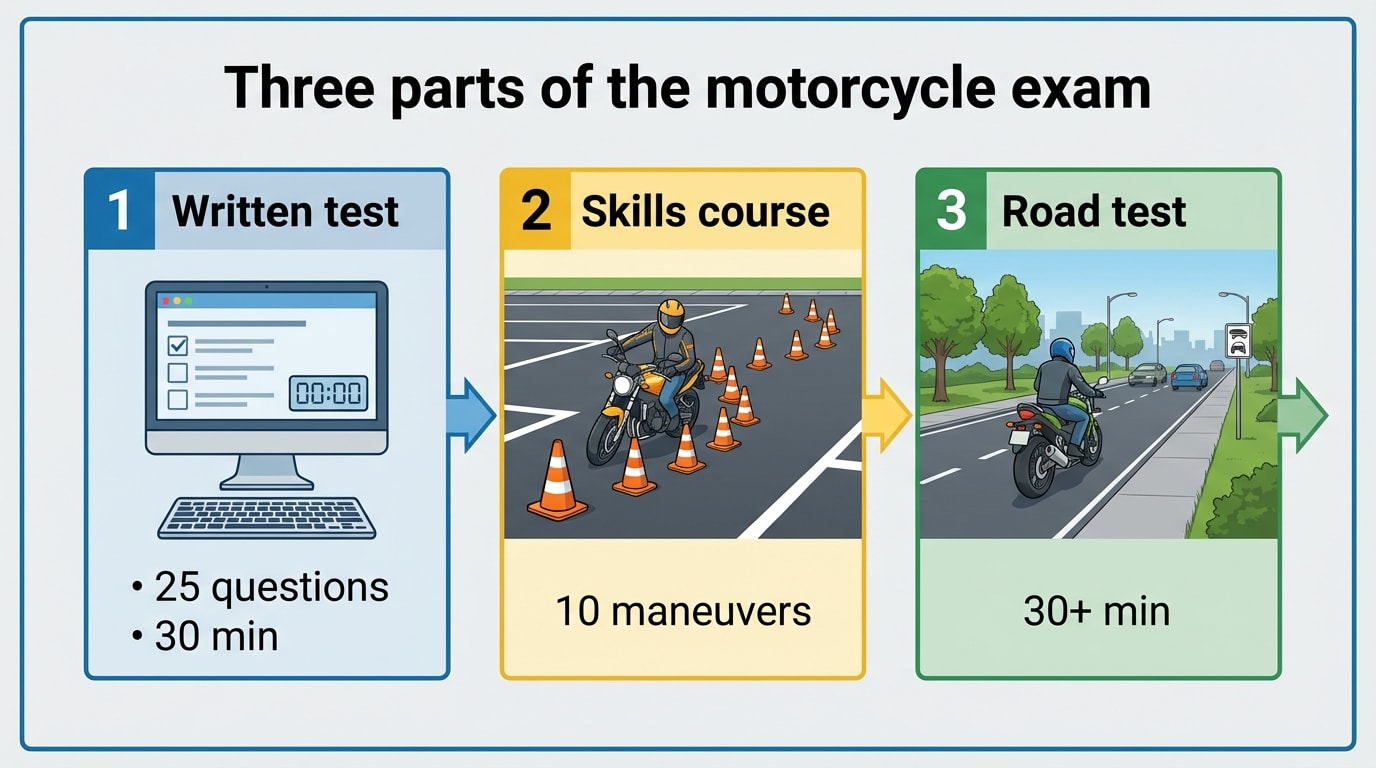
- The exam has 3 parts: written test (25 questions), 10 maneuvers on a closed course, and a road ride (min. 30 minutes)
- Dropping the bike on the course = immediate end of the exam
- You get 3 attempts per part (1 regular + 2 retakes), all within 12 months
- The administrative fee for the first exam is CZK 700
What exam day looks like
The whole day starts at a municipal office with extended authority — that's where the examiner is based. You arrive at the scheduled time, pay the CZK 700 fee, and your first stop is the computer.
The written test lasts a maximum of 30 minutes. The screen displays 25 randomly selected questions from a database of approximately 856 questions — traffic rules, road signs, safe driving, traffic situations, regulations, and first aid. You need to score at least 43 out of 50 points, which is 86%. You get the result immediately. If you don't pass, your exam day is over — you won't see the course.
The highest-weighted questions in the test are traffic situations (4 points per question). These are images of intersections where you decide about right of way or correct lane positioning. Ten questions on traffic rules (2 points each) form the foundation, but it's the traffic situations that make or break your result. If you already have a category B license, theory is familiar territory — the questions are shared across all categories. If you want to practice the questions beforehand, you can use the Ministry of Transport's official testing platform (eTesty).
After passing the test, you move to the skills course. But first, the examiner checks your protective gear. Under Decree No. 167/2002 Coll., you must have full protective equipment for the practical exam — a helmet, motorcycle gloves, ankle boots, and appropriate clothing (jacket and trousers that protect against abrasion). The examiner also does a random check of the motorcycle: tires, brakes, lights, turn signals.
Full gear is mandatory at the exam
Helmet, gloves, boots, and jacket — without them, the examiner won't let you take the practical test. In normal traffic, only a helmet is required by law, but stricter rules apply at the exam (Decree No. 167/2002 Coll., §19).
The skills course: 10 maneuvers that matter
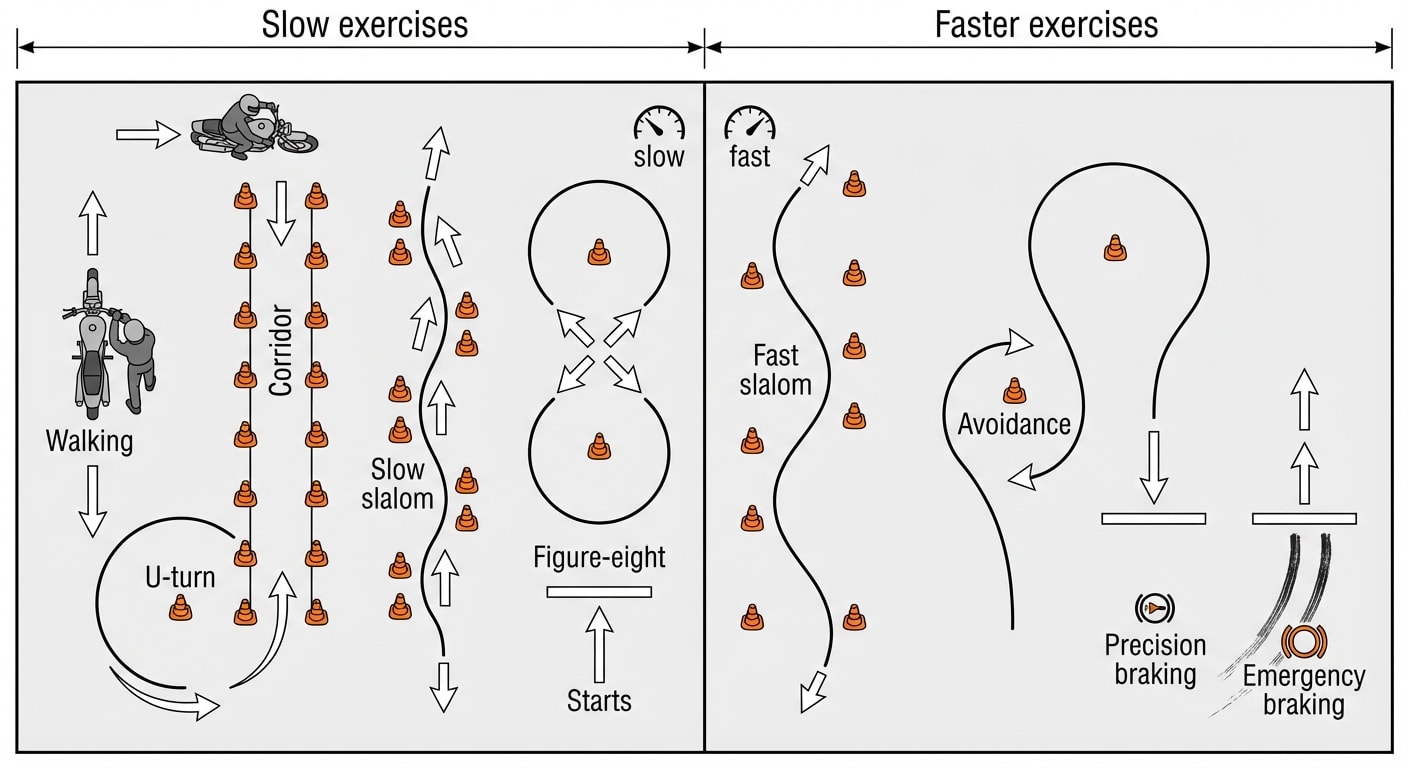
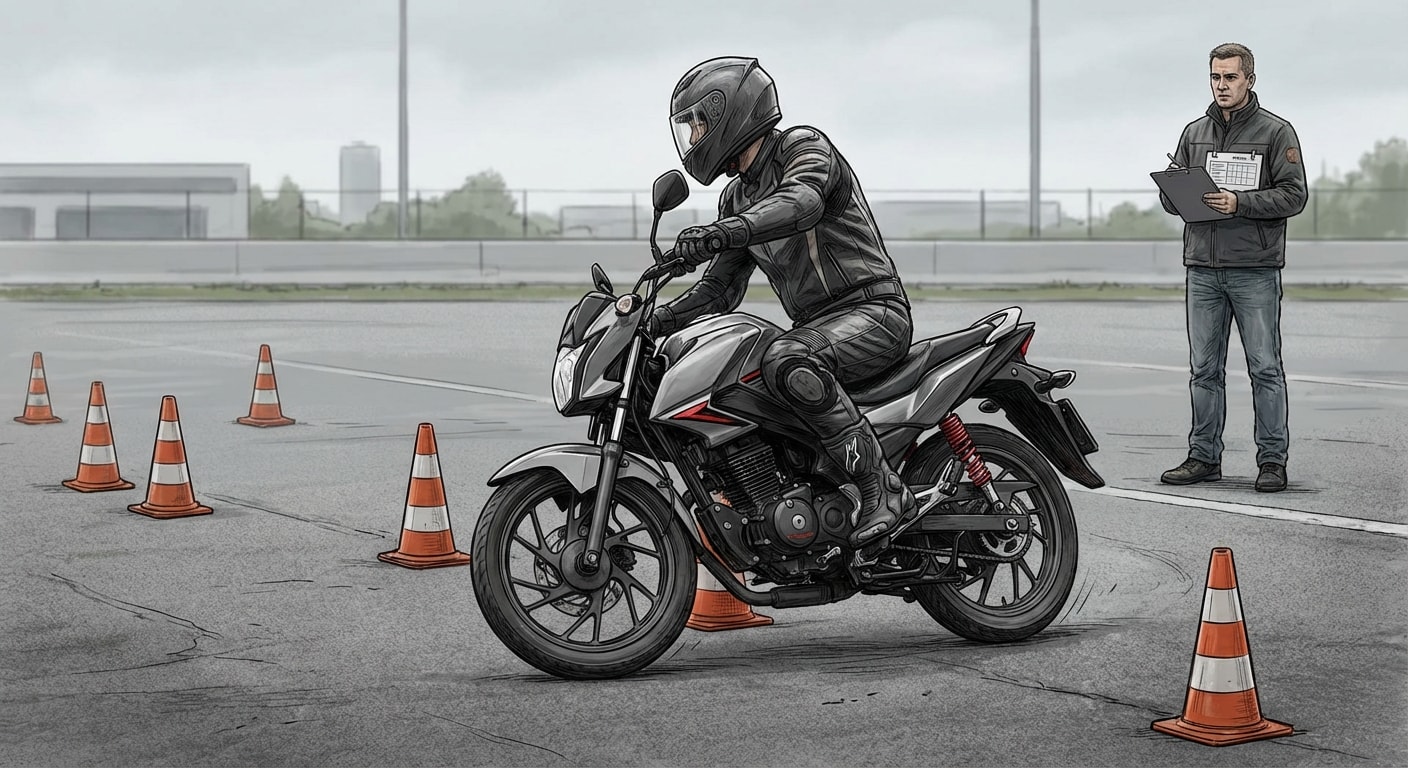
The skills course is a closed area — typically a parking lot or driving school facility — with cones and marked paths. Ten precisely defined exercises await you, split into slow (walking pace around 4 km/h) and fast (40–50 km/h). Dropping the motorcycle means an immediate end to the exam, regardless of how many exercises you've already completed.
Slow exercises — balance and patience
The first six exercises are ridden slowly. Sounds easy, but riding a motorcycle slowly is paradoxically harder than riding fast — you don't have the gyroscopic effect of the wheels that stabilizes you at speed.
You start with walking the motorcycle without the engine. Taking it off the center stand, pushing it forward with a left turn, reversing into a marked rectangle, parking on the stand. It's not about strength but technique — with a heavy machine, you need to know where to place your weight.
Next comes riding in a corridor behind the examiner. Picture a narrow lane 40 to 50 centimeters wide, 12 meters long. You ride at walking pace and must not put your foot down or leave the corridor. The key is clutch and rear brake work — smooth alternation of throttle and braking keeps the bike upright.
Then there's a 180-degree turn (U-turn) in a circle with a maximum radius of 4 meters, a slalom between five cones spaced 3.5 meters apart, a figure-eight through six cones (three complete passes), and repeated starts with one foot on the peg. For all slow exercises, the rule is: foot on the ground or knocking over a cone is a fault — you get three attempts per exercise, but a third unsuccessful attempt means you're done.
The secret to slow exercises
Don't rush during slow maneuvers. Clutch at the engagement point, gentle throttle, and cover the rear brake — that keeps the motorcycle stable. Most importantly, look where you want to go, not at the front wheel.
Fast exercises — courage and precision
The remaining four exercises are performed at 40 to 50 km/h. Here you need the courage to open the throttle, because failing to reach the required speed is an automatic fail.
High-speed slalom — five cones spaced 9 meters apart, constant 40 km/h. Unlike the slow slalom, here you work with full-body lean, not just the handlebars.
Obstacle avoidance is a maneuver that tests your instincts. You accelerate to at least 50 km/h (45 km/h for category AM) and 7 meters before the obstacle, you must swerve into the adjacent lane and return. You must not brake during the maneuver — any braking is an automatic fail. The technique that saves you here is called countersteering: you push the handlebars in the direction opposite to where you want to turn, which leans the motorcycle in the desired direction. It sounds counterintuitive, but that's how it works at higher speeds, and you'll practice it during training.
Precision braking — stopping from 50 km/h so that the front wheel stops precisely between two lines just 30 centimeters apart. The braking distance must not exceed 17 meters. You must use both brakes and stop in a straight line.
Emergency braking — stopping from 50 km/h within a maximum of 12 meters. This is about braking as hard as possible but safely. A brief wheel lock-up is tolerated by the examiner, but lifting the rear wheel (a stoppie) means failure.
Road test — 30 minutes under the microscope
You've passed the course? Next comes the second part of the practical exam — at least 30 minutes in real traffic. You ride alone on the motorcycle, while the examiner follows in an escort vehicle with the driving instructor (or rides on a second motorcycle). Route instructions come through a communication device — an earpiece in your helmet.
The examiner evaluates everything you do: starting off, riding on straight roads, cornering, behavior at intersections, turning, overtaking, passing, response to traffic lights, roundabouts, railway crossings, public transport stops, and riding alongside pedestrians. They assess smoothness, anticipation, and overall compliance with traffic rules.
One piece of advice is worth its weight in gold: exaggerate your head turns when checking surroundings. The examiner must physically see the movement of your head — just glancing with your eyes isn't enough. When approaching an intersection, turn your head clearly left and right, even if it's empty. It might look excessive, but that's exactly what the examiner is watching for.
A common reason for failing the road test is poor lane positioning. On a motorcycle, it's natural to ride more toward the center, but the examiner wants to see you riding to the right when the situation allows. Other typical mistakes include late reactions to pedestrians, incorrect positioning when turning left, and not adjusting speed. Even experienced drivers with a category B license sometimes struggle here — riding a motorcycle in traffic is a completely different experience from driving a car. Different perspective, different dynamics, different habits. The full process from enrollment to license gives you context for where the exam fits in the overall journey.
From experience: a seasoned driver at his first motorcycle test
A journalist from Aktuálně.cz with 13 years behind the wheel described his motorcycle exam: he breezed through the cones on the course, but on the road he had to unlearn habits — he automatically rode in the center of the lane, forgot to make exaggerated head turns, and underestimated the pace at intersections. On a motorcycle, everything happens faster.
When things don't work out — retakes
Failing the exam isn't the end of the world. The law (§42 of Act No. 247/2000 Coll.) gives you a total of 3 attempts per part — one regular and two retakes. You only repeat the part you failed. If you pass the course but don't manage the road test, you won't have to go back to the course.
At least 5 working days must pass between retake attempts. That gives you time to work on your mistakes. And all exams must be completed within 12 months of your first attempt (§42, paragraph 4). If you miss that deadline, you start the entire training over.
As for costs — a retake of the written test costs CZK 100, the vehicle handling test CZK 200, and the practical ride CZK 400. After a third failure in any part, you must complete supplementary training (theoretical or practical), and then you get additional attempts. Details on all fees can be found in the chapter Motorcycle license cost.
Exam fees
| Exam type | Fee |
|---|---|
| First examination (all parts) | CZK 700 |
| Retake — written test (rules) | CZK 100 |
| Retake — vehicle handling | CZK 200 |
| Retake — practical ride | CZK 400 |
Tips for passing on the first try
Most people who fail on the course don't fail because they can't do it. They fail because of nerves. The body can handle it — you've practiced for dozens of hours. But the mind freezes at the critical moment. What can you do about it?
First, practice the course as much as possible. Ask your driving instructor for extra course sessions before the exam — every additional hour reduces anxiety. Second, for fast exercises, err on the side of more throttle. Failing to reach the minimum speed of 40 or 50 km/h is an automatic fail, while going slightly faster doesn't hurt. Third, for slow exercises, look where you want to go — not at the front wheel, not at the cones. Your body follows your gaze.
On the road, behave like a textbook-perfect rider. Follow everything you learned: checking surroundings, signaling, correct positioning. When the examiner gives you a direction, acknowledge it — a calm "yes, turning left" shows you're receiving the communication. And if you make a minor mistake, don't panic. One small error doesn't mean failure — the examiner evaluates the overall impression.
One more thing: differences between categories affect the course too. For category AM, fast exercises are performed at 45 km/h instead of 50 km/h. It's a small but important detail.
Summary
- The motorcycle exam has three parts: written test (43/50 points), 10 maneuvers on a closed course, and a road ride (min. 30 minutes)
- The course includes slow exercises (corridor, slalom, figure-eight, U-turn) and fast exercises (slalom at 40 km/h, obstacle avoidance, braking, emergency braking)
- Dropping the bike on the course = immediate end of the exam
- You get 3 attempts per part, all within 12 months of the first exam
- First examination costs CZK 700, retakes CZK 100–400
- The most common cause of failure is nerves, not lack of skill
Key terms
| Term | Explanation |
|---|---|
| Skills course (cvičiště) | A closed area (parking lot, facility) where the 10 prescribed maneuvers of the first part of the practical exam are performed |
| Countersteering | A steering technique at higher speeds — you push the handlebars in the opposite direction of where you want to turn, leaning the motorcycle into the curve |
| Examiner (zkušební komisař) | An official at the municipal office with extended authority who conducts and evaluates the exam |
| eTesty | The electronic written test — 25 questions on a computer with instant results |
| Emergency braking | Stopping from 50 km/h within a maximum of 12 meters using both brakes |
| Retake exam (opravná zkouška) | Repeating a failed part of the exam — max. 2 retakes, min. 5 working days apart |
| Obstacle avoidance (úhybný manévr) | Swerving around an obstacle at 50 km/h without braking — a key technique for real-world riding |
| Protective gear (ochranná výstroj) | Helmet, gloves, boots, and jacket — all four mandatory at the exam, only helmet required in traffic |