
Driving School Training — From Enrollment to License
How driving school training works step by step: enrollment, medical check, theory, driving lessons, exam. Legal minimums and real timelines.
A lot of people think driving school takes half a year. Others believe they'll be done in a month. The reality is somewhere in between — and it depends mostly on you. A standard category B course takes 2 to 4 months, but that timeframe can be shortened or stretched. This article walks you through the entire journey from the moment you decide to get your license to the moment you're holding it. Step by step, no vagueness, with specific numbers and deadlines.
Quick summary:
- The entire training from enrollment to license realistically takes 3–4 months (standard course) or 4–6 weeks (intensive).
- The legal minimum is 70 teaching hours: 36 hours of theory and 34 hours of practical training (including 28 driving lessons).
- Before enrollment, you need a medical certificate from your GP — it costs around CZK 500 and must be no older than 3 months.
- Since 2024, you can start training from age 15.5 and drive from age 17 with a mentor (L17 program).
What You Need Before You Even Start
Before you call a driving school, you need to take care of one thing: a medical certificate confirming your fitness to drive. Without it, no driving school can accept you — Act No. 247/2000 Coll. (§13) requires it.
Book an appointment with your general practitioner. Nothing dramatic awaits you — it's a routine check-up, not a sports physical. The doctor will check your vision (visual acuity, color perception, visual field), hearing, balance, and overall health. They'll go through your medical history — whether you take any medications, whether you've been treated for anything serious. The whole thing takes about twenty minutes.
The result will be one of three: "fit," "fit with conditions," or "unfit." If you wear glasses, don't worry — you'll get a certificate with the condition "with corrective lenses" and your license will have code 01 noted on it. That's completely normal and doesn't limit you in any way. "Unfit" applies to serious conditions like untreated epilepsy, severe vision disorders, or substance dependency — the vast majority of people pass without issues.
The certificate costs CZK 400 to 1,000 (not covered by health insurance, typically around CZK 500) and must be no older than three months on the date you enroll in driving school. So don't get it too far in advance.
Tip for the medical check-up
Book your doctor's appointment about 2–3 weeks before your planned enrollment. That gives you enough time for any additional examinations, while ensuring the certificate won't 'expire' (it's valid for 3 months).
Enrollment — What to Bring and What You'll Sign
Got the certificate in hand? Great. Now pick a driving school — and if you're not sure how, check out the chapter How to Choose a Driving School, where you'll find 12 questions you should ask before signing up anywhere.
You need four things for enrollment: the medical certificate, your national ID card (or passport), one passport-size photo, and a completed application form (the driving school will provide it, or you can download it from the Ministry of Transport website). If you're under 18 and going for the L17 program, add written consent from your legal guardian.
At enrollment, you'll sign a contract with the driving school and pay — either the full amount at once or a deposit. How much it'll cost depends on the region and the specific school. A detailed budget breakdown is in the chapter How Much Does Driving School Cost.
The driving school will issue you a student card. It's your "diary" for the entire training — completed theory hours and driving lessons are recorded in it. Bring it to every session. Since 2024, some driving schools keep it electronically (amendment 271/2023 Coll.), but the paper version is still common.
Theory — 36 Hours That Don't Have to Hurt
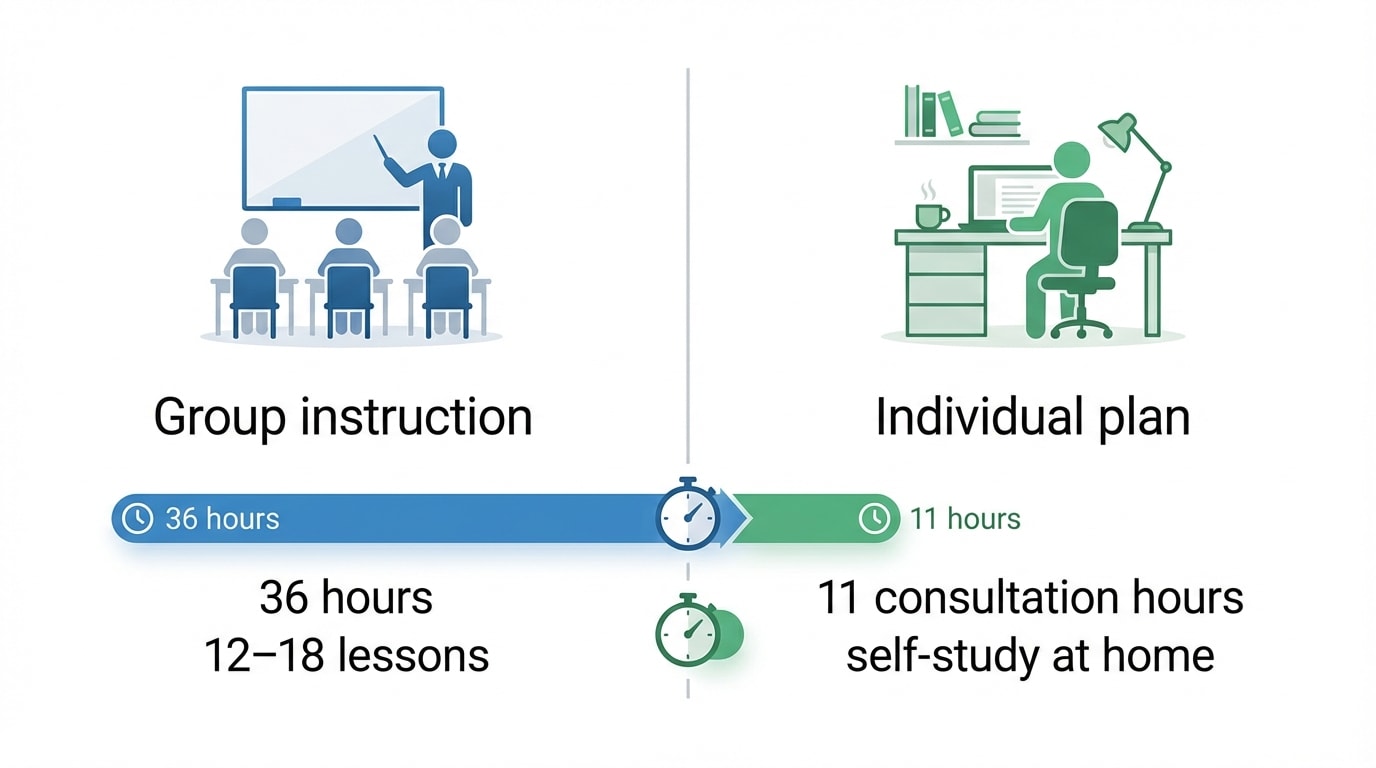
Theoretical instruction is the first pillar of training. The law requires a minimum of 36 teaching hours (à 45 minutes) for group instruction, or 11 hours under an individual study plan. Yes, you read that right — the difference is huge and most people don't know about it.
Group instruction means lectures in a classroom with other students. They typically take place once or twice a week for two to three hours, totaling 12 to 18 sessions. You learn traffic rules, vehicle operation and maintenance, driving theory, safe driving principles, and first-aid preparation.
Individual study plan is the more flexible option. You study at home from a textbook or e-learning platform and attend consultations — at least one hour of consultation for every four hours of self-study, in groups of no more than five students (§18 of Act No. 247/2000 Coll.). Most driving schools today offer this option because it's faster and suits people who work or study.
Here's the thing — theory and driving can run in parallel. You don't have to finish all the theory before you sit behind the wheel for the first time. Driving schools routinely combine them — from the second or third week, you're driving while still attending theory. The only requirement is that theory must be completed before the final exam.
How to prepare for theory effectively? That's a topic for a whole chapter — and it exists: Theory — How to Study.
Practical Training — 28 Lessons, Three Stages, One Goal
Practical training is the core of the entire driving school experience. The law requires a minimum of 28 teaching hours of driving (à 45 minutes — note, not 60 minutes, as some might assume). Add 2 hours of vehicle maintenance practice and 4 hours of first-aid training — 34 hours of practical work in total.
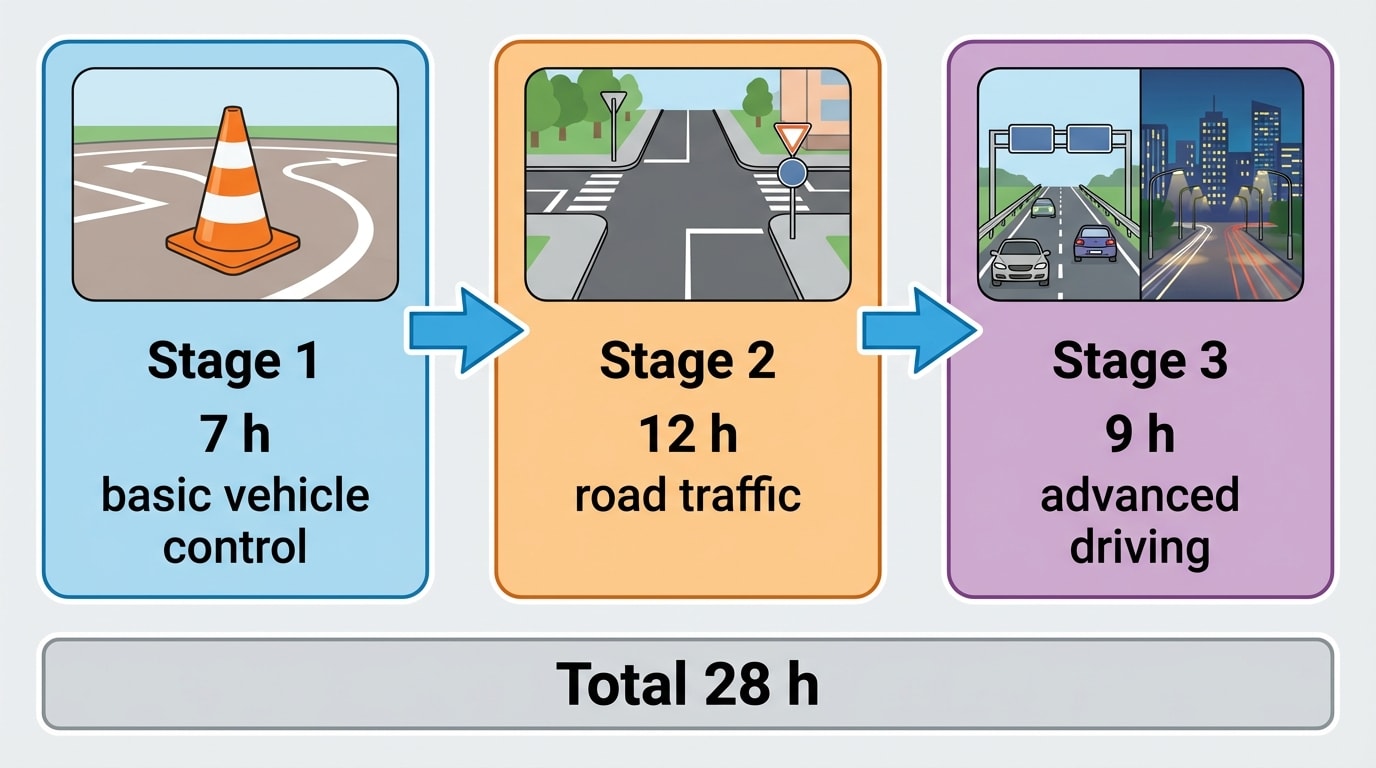
Those 28 driving lessons are divided into three stages that build on each other. You can't skip a stage or swap their order. The instructor assesses whether you've mastered the current stage before moving you to the next one.
Stage 1 — Basics (7 hours)
This is the tutorial. You learn to operate the car in a safe environment: starting, stopping, shifting gears, turning, weaving between cones, reversing. Some driving schools start on a simulator (a computer driving simulator) or a practice ground (an enclosed polygon). Most, however, go straight to quiet streets on the edge of town with minimal traffic.
Don't worry if it doesn't click right away. Nobody can shift smoothly and check mirrors at the same time after their first hour. The instructor has their own brake and clutch — dual controls are mandatory by law. The vehicle is clearly marked with a "DRIVING SCHOOL" sign, so other drivers know to be patient.
Stage 2 — Road Traffic (12 hours)
This is where things get real. You head into normal traffic: intersections, right-of-way, turning, following traffic flow, pedestrian crossings. You learn to read traffic situations and react to them. Twelve hours may sound like a lot, but every lesson is different — different routes, different conditions, different scenarios.
Most students drive two to three lessons per week. In an intensive course, it can be every day. The maximum is two lessons per day, meaning 90 minutes of actual driving — the law doesn't allow more (in stage 3, the driving school may exceptionally permit up to 4 hours).
Stage 3 — Advanced Driving (9 hours)
The final stage prepares you for independent driving. You drive in heavy city traffic, on multi-lane roads, on highways. If possible, you'll also try driving at night or in the rain. At least one hour must be dedicated to practicing reactions to hazardous situations (§28 of Act No. 247/2000 Coll.) — the instructor simulates a dangerous scenario and you respond.
After the third stage, you should feel ready for the exam. If not, that's no shame — many students buy 5 to 10 extra lessons. Data shows the average student drives 32 to 35 hours, not the legal 28. Each extra hour costs CZK 400 to 700, but it's worth the investment if it helps you pass the exam on the first try. More about what to expect during lessons is in the chapter Practical Driving Lessons.
45 minutes ≠ 60 minutes
One teaching hour in driving school is 45 minutes, not 60. Some schools sell 'hours' as 60-minute blocks, but the legal hour is shorter. Ask upfront so you know what you're paying for.
How It All Looks on a Calendar — A Realistic Timeline
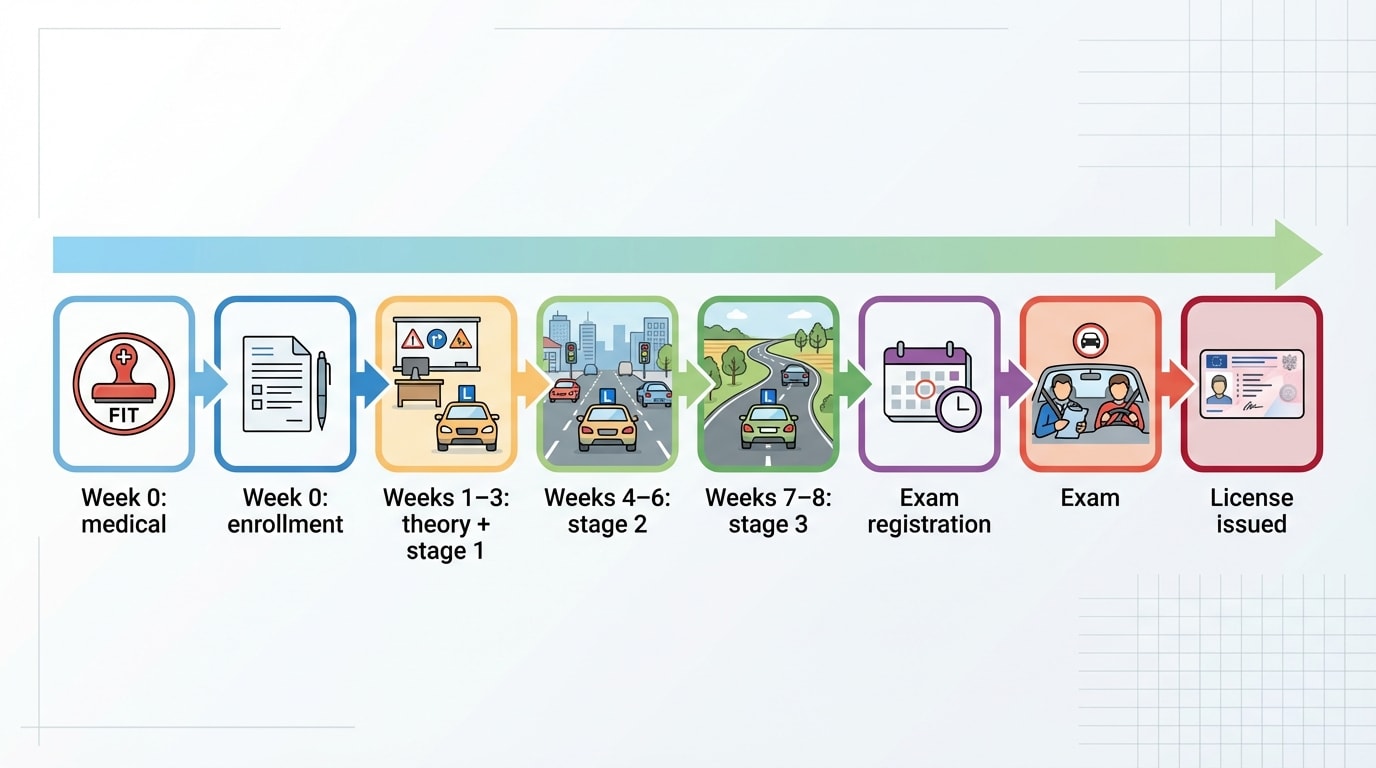
Let's map the entire training onto specific weeks. This is a realistic scenario for a standard category B course where you drive two to three lessons per week.
Before enrollment, you get the medical certificate — that takes a few days to two weeks (mostly waiting for a doctor's appointment). On enrollment day, you handle the paperwork, pay, and receive your student card. The first week, you start theory — either lectures or self-study with consultations.
Around the second to third week, the first driving lessons begin. Seven hours of Stage 1 take about two to three weeks. Then come twelve hours of Stage 2, which take roughly four to six weeks. Stage 3 with its nine hours lasts three to four weeks. In parallel, you finish theory, maintenance, and first-aid training.
Around week ten to twelve, you've completed all hours. The driving school registers you for the exam — by law within 15 days of completing training (§32 of Act No. 247/2000 Coll.). The examining authority has another 15 days to schedule the test. In reality, 2 to 4 weeks pass between the end of training and the exam — use that time for intensive online test practice.
After passing the exam, you submit an application for your license at the municipal or regional office. The card is produced within 20 business days. Since 2026, however, you can legally drive during the waiting period — for up to one month after your license is granted.
Total? From enrollment to license in hand, count on 3 to 4 months for a standard course. With an intensive course, you can do it in 4 to 6 weeks, but you'll need to drive almost every day.
Dead time between training and exam
You'll wait 2–4 weeks between finishing training and your exam date. Don't let that time go to waste — practice test questions on eTesty2.cz or similar portals. You'll breeze through the theory exam.
The L17 Program — License at 17 with a Mentor
Since January 1, 2024, the Czech Republic has the L17 program, which allows getting a category B driving license at age 17. It was introduced by amendment 271/2023 Coll. and worth understanding.
The driving school training is exactly the same as the standard course — the same number of theory hours, the same 28 driving lessons, the same three stages. The only difference is when you can start and what applies after the exam. You can begin training from age 15.5 and take the exam at 17.
After passing the exam, however, you don't drive alone. Until you turn 18, you must have a mentor beside you — a person who meets strict requirements: category B license for at least 10 years, zero penalty points, and no driving ban in the last 5 years. You can have up to 4 mentors registered in the driver registry. Registering the first mentor when applying for your license is free; additional ones cost CZK 100.
The mentor sits in the passenger seat, monitors traffic, and can advise you. Zero alcohol tolerance applies to both of you. And an important restriction: the L17 program is valid only within the Czech Republic. You can drive abroad only from age 18.
Mentor requirements (L17)
Category B license for at least 10 years, 0 penalty points, no driving ban in the last 5 years. Maximum 4 mentors. Zero alcohol tolerance for both mentor and driver. Valid only in the Czech Republic.
What Happens When Things Don't Go as Planned
Training doesn't always run smoothly. There are situations that can extend it — and it's only fair to know about them upfront.
The most common reason is needing extra lessons. The legal 28 hours is the minimum — and it really is just the minimum. If you don't feel ready for the exam, buy a few extra lessons. There's nothing wrong with that — your instructor will tell you whether you're prepared, and if not, there's no point rushing to the exam and risking failure, which will cost you more.
Long gaps between lessons are another problem. If you skip more than two weeks (illness, work, vacation), you'll lose some of the skills you've built and need a refresher lesson. The ideal is to maintain a regular rhythm — at least two lessons per week.
In spring and summer, driving schools tend to be busy (students before graduation exams, new graduates). Lesson slots are harder to find and the wait for the exam can stretch out. If you have the option to start in autumn or winter, it'll be calmer — and as a bonus, you'll practice driving in the dark and on wet roads.
And what if you fail the exam? You get three attempts at each part. After the third failure, supplementary training is required, followed by another three attempts. If you still don't pass, you must complete the entire training from scratch. All exam parts must be passed within 12 months of your first attempt. Details are in the chapter Exams.
Your Right to Transfer
If your driving school isn't working out — bad instructor, inconvenient schedule, whatever the reason — you have a legal right to transfer to a different one (§19 of Act No. 247/2000 Coll.). The original school must hand over your student card with records of completed hours. The new school will recognize what you've already done and you continue from there.
In practice, it costs an administrative fee of around CZK 2,000, and getting money back for unused lessons may take some negotiating. But if you feel you're wasting time or money at your current school, transferring is worth it. More about spotting a bad driving school is in the chapter How to Choose a Driving School.
What Comes After Training
Once you've completed all your hours and the driving school registers you for the exam, the final steps remain. The theory test on a computer — 25 questions, 30 minutes, you need at least 43 out of 50 points. The practical road test with an examiner — at least 30 minutes in real traffic. Both are covered in detail in the chapter Exams.
After passing the exam, you submit your license application and receive it within 20 business days. What comes next — the point system, insurance, mandatory equipment — is all in the chapter After Getting Your License.
Summary
- The entire training from enrollment to license realistically takes 3–4 months (standard) or 4–6 weeks (intensive course).
- The legal minimum is 70 hours: 36 hours of theory + 28 hours of driving + 6 hours of other subjects.
- Practical training has three stages: basics (7 h), road traffic (12 h), advanced driving (9 h).
- Theory and driving can run in parallel — you don't have to wait until theory is finished to start driving.
- The medical certificate from your GP costs ~CZK 500 and must be no older than 3 months.
- The L17 program allows driving from age 17 with a mentor — but the training is the same.
Key Terms
| Term | Explanation |
|---|---|
| Student card | Document recording completed theory and driving hours. Can be electronic since 2024. |
| Teaching hour | 45 minutes — not 60. The legal unit for both instruction and driving in driving school. |
| Individual study plan | A more flexible theory format — study at home, attend consultations (11 h instead of 36 h). |
| Training stage | One of three phases of practical training (basics → traffic → advanced driving). |
| Simulator | A computer driving simulator. Can replace some Stage 1 hours, but not all schools have one. |
| Practice ground | An enclosed area (parking lot, polygon) for practicing basic maneuvers without traffic. |
| L17 program | License from age 17 with a mentor. Training from age 15.5, accompanied driving until 18. |
| Mentor (L17) | A person with category B license for 10+ years and 0 points who accompanies the L17 driver. Max 4 mentors. |
| Supplementary training | Required after the third failed exam attempt — only then do you get another 3 tries. |
| Dual controls | The training vehicle has a second brake and clutch for the instructor — a safety feature required by law. |