
L17 Training — How It Works and What's Different
How L17 driver training works: driving school, mentor rides, three-stage progress system, and the path to your exam. A practical guide.
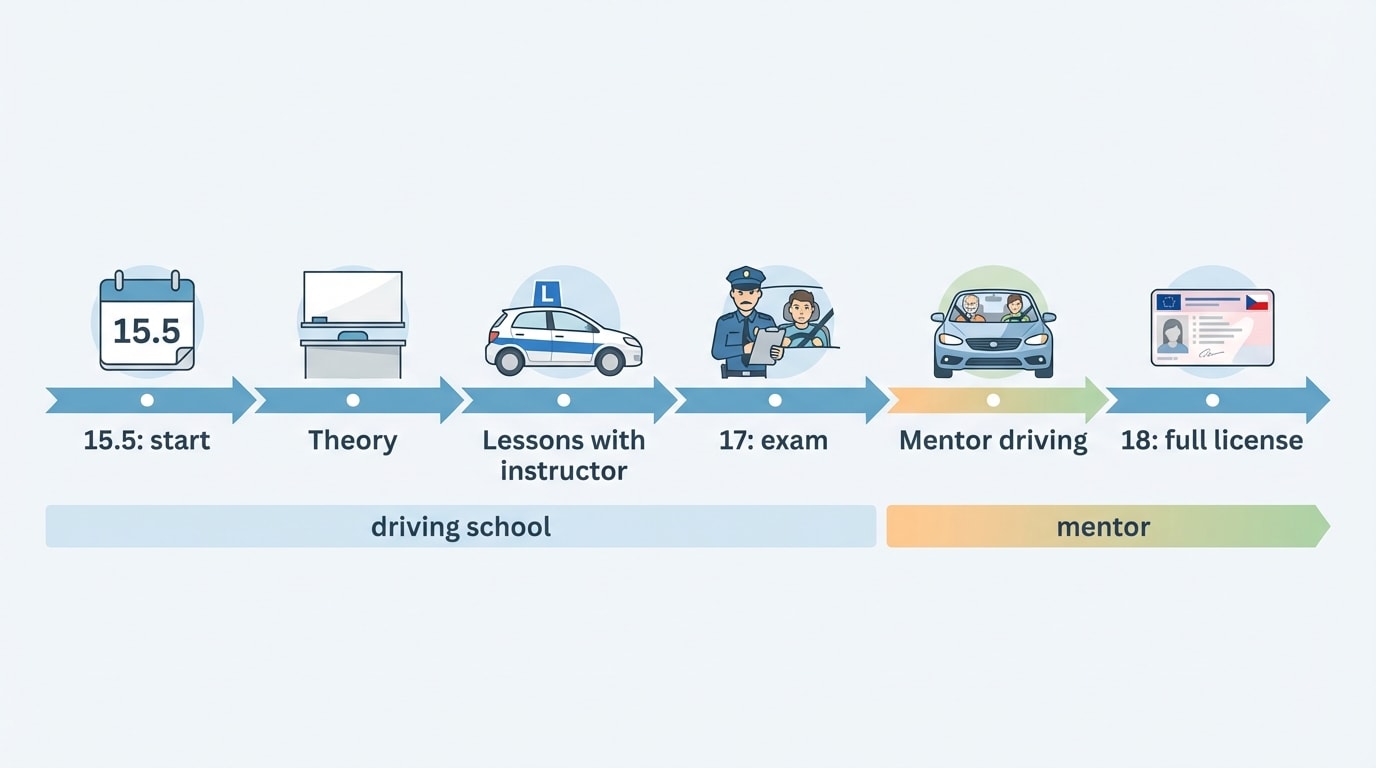
The driving school training for L17 is exactly the same as for anyone getting their license at eighteen. Same number of hours. Same theory. Same driving lessons. Same exam. No special regime, no extra hours, no surcharge. What's different comes only after passing your exams — and that's precisely what makes L17 such a unique program.
This chapter walks you through the entire process from your first lesson at driving school to the day you turn eighteen and no longer need a mentor beside you. If you're not sure what L17 actually is or how to enroll, start with the chapter What Is L17 and How It Works or go through requirements and conditions.
Quick summary:
- Driving school training is identical to the standard category B course — 36 hours of theory + 28 hours of practice
- After passing exams, you drive with a mentor until you turn 18 — that's the key difference
- Recommended goal: 60 drives, 60 hours, and 2,000 km with a mentor before your eighteenth birthday
- The exam is the same: theory test (43 out of 50 points) + practical driving test
What Awaits You at Driving School
Think of driving school as two big parts: theory and practice. They run partly in parallel — you don't sit through every lecture before touching the steering wheel. But your driving instructor won't let you drive until you've mastered the basics of traffic rules. The law requires it (§26 of Act No. 247/2000 Coll.), and it makes sense — you need to know what signs mean and how intersections work before you find yourself in one.
Theory takes at least 36 teaching hours. One teaching hour at driving school is 45 minutes, so don't confuse it with a school period — it's a bit shorter. Of those 36 hours, 18 cover traffic rules, 10 cover driving theory and safe driving principles, 2 cover vehicle operation and maintenance, and 2 cover first aid. The remaining 4 hours are revision and testing. Some driving schools offer an individual study plan with fewer hours (the legal minimum is 11), but the Association of Driving Schools recommends the full course. And honestly — you'll be grateful for those 36 hours when exam day comes.
Practical driving lessons total at least 28 teaching hours. Add 2 hours of practical vehicle maintenance (changing a wheel, checking fluids) and 4 hours of practical first aid training. In total, you'll go through approximately 70 teaching hours combining theory and practice. The law also says you can do a maximum of 2 hours of practical driving training per day (§27), so nobody will make you drive for four hours straight.
How long does the whole thing take?
A typical category B course takes 2 to 3 months. It depends on how often you schedule driving lessons and how quickly you master the theory. The law allows a maximum of 18 months from the start of training — after that, you'd have to start over. If you want to take the exam exactly on your 17th birthday, start training at around 16.5 years old.
Three Phases of Practical Training
The 28 practical hours behind the wheel are divided into three phases. Each demands different skills and simulates different traffic conditions.
Phase one — light traffic (7 hours). You start on a practice ground or in a simulator. You get used to the car's dimensions, learn to shift gears, operate pedals, and steer. Then you move to roads with minimal traffic — quiet streets where you meet one car per minute. The goal is simple: make driving stop feeling like juggling four things at once and start feeling automatic.
Phase two — road traffic (12 hours). This is where it gets real. Intersections with traffic lights, overtaking, perpendicular and parallel parking, driving in the city with heavier traffic. Your instructor gradually puts you in more complex situations. It takes 12 hours because this is where you learn to react to other drivers — and that takes time and repetition.
Phase three — advanced traffic (9 hours). Parallel parking between cars, complex intersections, highway driving. And at least 1 mandatory hour of crisis situation training — emergency braking, obstacle avoidance, skid response (§28). This is the part drivers remember years after driving school. It's intense, but afterward you know you can handle an unpleasant surprise.
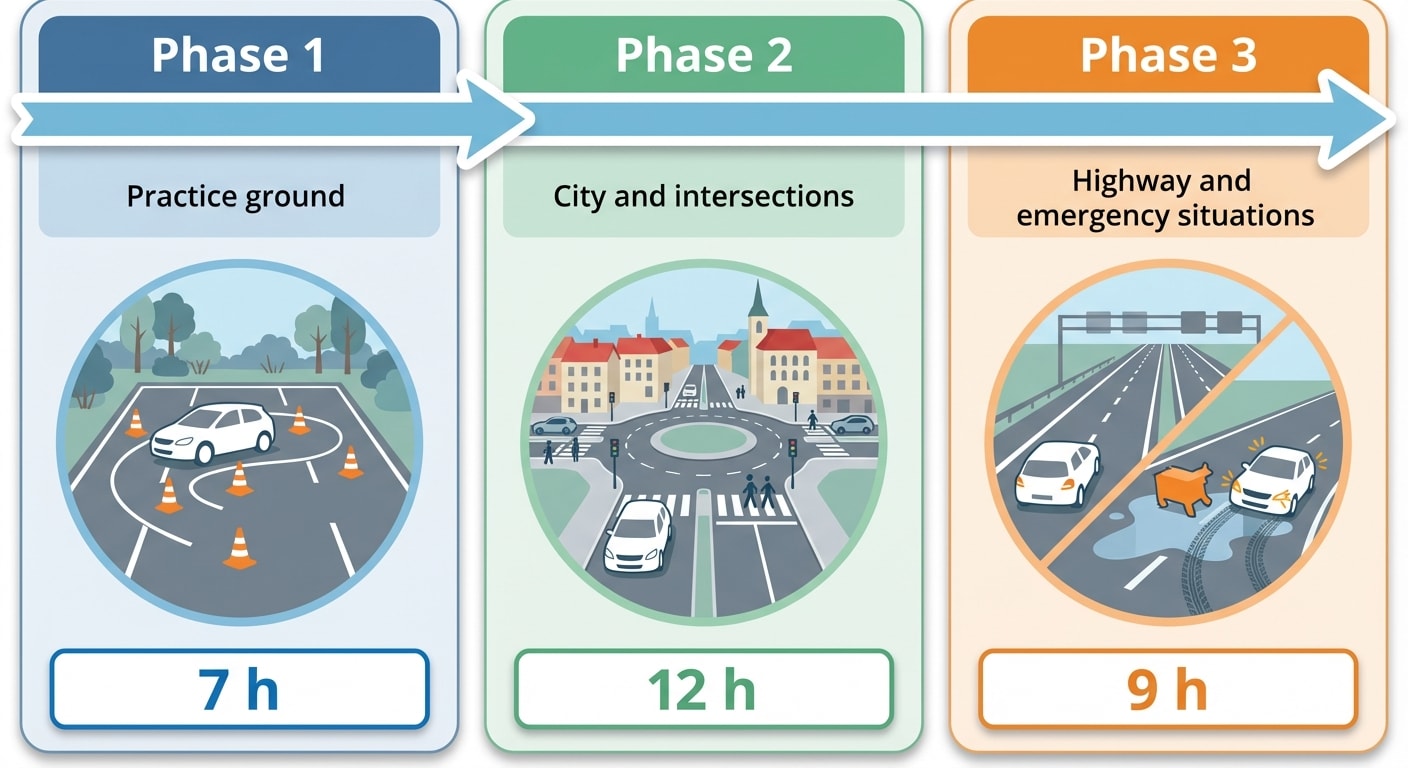
This entire training is completely identical for L17 and for the standard course. Your driving instructor covers exactly the same material regardless of whether you're 16 or 18. Same number of hours, same maneuvers, same standards. The only difference is what comes after the exam.
The Exam — What to Expect
When your instructor decides you're ready, they'll register you for the exam. It has two parts: a theory test and a practical driving test.
The theory test is electronic — you sit at a computer and answer questions. You can score a maximum of 50 points, and you need at least 43 to pass. That means you can afford a maximum of 7 error points. Sounds like plenty — but some questions carry 2 or 3 points, so 3–4 wrong answers can knock you out. Practice for a perfect score.
The practical exam is a drive on real roads with an examiner. It typically lasts 30–45 minutes and tests whether you've mastered what you learned across the three training phases. The examiner evaluates smoothness, safety, compliance with regulations, and overall handling of situations.
Three attempts — that's it
You get a maximum of 3 attempts for each part of the exam. A theory retake costs CZK 100, a practical retake CZK 400. If you don't pass on the third try, you have to go through the entire training again. Sounds harsh, but with solid preparation you'll pass on the first attempt — most students do.
The exam fee is CZK 700. A crucial detail for L17: you must be at least 17 years old on the day of the exam. Not when you submit the application, not when you start training — on the actual day you take the exam. If you're still 16 and sign up for an exam next week, they won't let you in. For practical information about everything you need to arrange before enrolling in driving school, see the chapter Requirements and Conditions.
What Happens After the Exam — And Here's Where the Key Difference Begins
You passed the exam. You have your category B driving license. And now your path diverges from those who waited until eighteen.
If you'd gotten your license the standard way at 18, you'd now be sitting behind the wheel completely alone for the first time in your life. No instructor beside you. No dual pedals. Just you, the car, and traffic. And statistics show that this exact period is the most dangerous — data from L17's first year tells a clear story.
But you have an advantage. At 17, you drive with a mentor — someone who sits beside you, watches the traffic, and advises you. They're not an instructor. They don't have dual controls. They can't physically intervene in your driving. But they're an experienced driver with at least 10 years of experience and a clean penalty point record who helps you gain real-world experience in a safe environment. Everything about choosing a mentor and what they must meet can be found in the chapter Choosing and the Role of a Mentor.
This is the part that makes L17 such a unique program. At driving school, you learn to drive — that's school. With a mentor, you learn to drive for real — that's real-world practice. And you have an entire year for it.
The Three-Stage Progress System — How to Structure Mentor Drives
After passing the exam, the period of driving with a mentor begins. The law doesn't prescribe how much you need to drive — no mandatory kilometers, no minimum hours. But there's a recommended system that helps you make the most of that year.
The three-stage progress system was developed by experts within the L17 program and is supported by the Ministry of Transport and the Czech Police. It's not mandatory — it's a proven framework that helps you gradually increase the difficulty of your drives.
Stage 1 — Beginner. Goal: 20 drives, 20 hours behind the wheel, 300 km. Drive 1–2 times a week in light traffic, on routes you know. No night driving, no highways, no complicated traffic junctions. In this phase, you're getting used to having a mentor beside you instead of an instructor — and to the fact that the car has no dual controls. Typical mistakes at this stage: delayed reactions, forgotten turn signals, poor estimation of lateral clearance.
Stage 2 — Intermediate. Goal: another 20 drives, 20 hours, 700 km. Increase your frequency and add city traffic, heavier roads, more complex maneuvers. Start driving on routes you don't know. Watch out for overconfidence — at this stage, drivers often think they've mastered everything, and that's exactly when they make unnecessary mistakes.
Stage 3 — Experienced. Goal: another 20 drives, 20 hours, 1,000 km. Switch between mentors and vehicles — every car handles differently and every mentor has a different style. Practice highway driving, night driving, and driving in poor conditions (rain, snow, fog). By the end of this stage, you should be ready for independent driving.
In total, the three-stage system recommends 60 drives, 60 hours of active driving, and 2,000 km driven with a mentor. Sounds like a lot, but break it down: if you drive twice a week, you'll manage it in 7–8 months. And every drive gives you more experience than sitting at home waiting for your eighteenth birthday.
Naturally, not artificially
The best mentor drives aren't special training circuits — they're ordinary family trips. Going shopping? Get behind the wheel. Visiting grandma? You drive. Heading to practice? Your ride. The more you integrate driving into everyday life, the faster you'll improve — and the less it will feel like an obligation.
Mentor Drives vs. Driving School Lessons — What's Different
At first glance, it looks similar: you're behind the wheel, a more experienced person sits beside you. But the differences are fundamental.
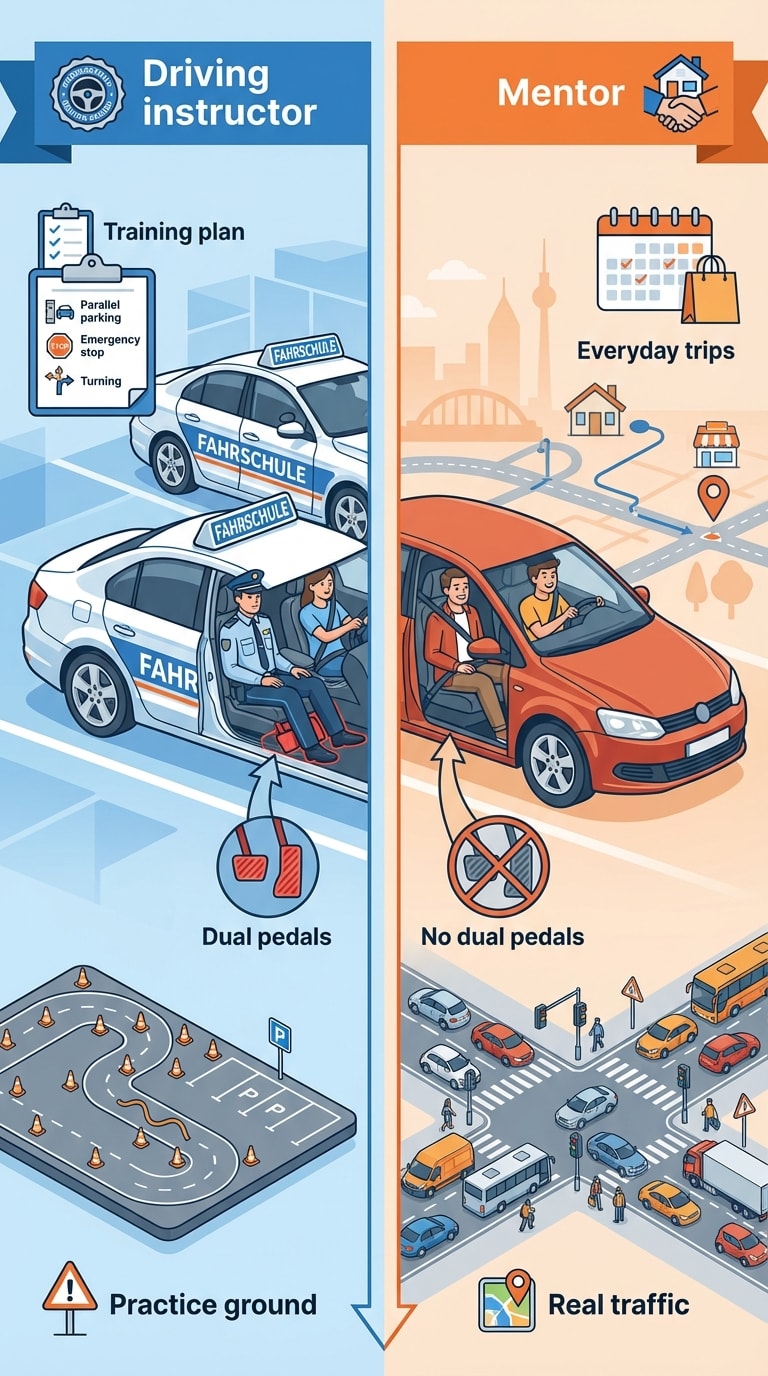
At driving school, you drive a training vehicle with dual controls — the instructor has their own brake pedal and can intervene in your driving at any time. With a mentor, you drive a regular car without any modifications. The mentor can advise you, alert you, tell you to "brake" — but they physically can't step on the brake for you. That's why solid training at driving school is so important.
At driving school, you have a structured curriculum: a precise number of hours, legally defined phases, specific maneuvers to practice. With a mentor, no formal plan exists — the recommended three-stage system is just a guideline. You choose where you drive, when you drive, and for how long.
And there's one more fundamental difference: responsibility. At driving school, the instructor bears responsibility for safety (instructional liability). When driving with a mentor, you bear responsibility as the driver. If you cause an accident, you're liable — not the mentor. The mentor is only responsible for fulfilling their legal obligations (sitting beside you, watching traffic, not being under the influence). More about mentor responsibilities and duties can be found in the chapter Choosing and the Role of a Mentor.
Practical Tips for Your First Mentor Drives
You passed the exam, you have your license, the mentor is registered. What now?
Before your first drive, download the L17 app. It's free for iOS and Android, developed by the Association of Driving Schools in cooperation with the Ministry of Transport, Czech Police, and ŠKODA Auto. It tracks driven kilometers, hours behind the wheel, number of drives, and offers the three-stage progress system. It's not mandatory — but it's a handy way to see your progress.
Agree on rules with all your mentors beforehand. If you have two or three mentors, each will have a slightly different style — and that's fine, because you'll learn to adapt. But the basic rules should be the same: how to communicate during a drive, what to do in a crisis, who gives the signal to stop.
Plan your first drives during calm times. Weekend mornings, warm summer evenings, empty roads outside the city. No rush hour, no city centers, no confusing intersections. Gradually add difficulty — and after every drive, talk with your mentor about what went well and what to improve. That five-minute debrief is more valuable than you think.
Optionally, you can place a magnetic L17 or O3 (novice driver) sign on the car. It's not mandatory — unlike Austria, where you must — but other drivers will know there's a beginner behind the wheel and give you more space.
What a typical month looks like for an L17 driver
Monday: ride home from school (15 km, light traffic). Wednesday: shopping with mom (8 km, city, parking). Saturday: trip to grandma's with dad (45 km, road outside city). Sunday: sports practice — there and back (20 km). Total: 4 drives, about 90 km, 3 hours behind the wheel. Per month: 16 drives, 360 km. That's a solid pace.
What Happens If You Break the Rules
We'll mention this briefly because it's important to know what's at stake. If police stop you and find that at 17 you're driving without a mentor — meaning alone — you'll face a fine of CZK 2,500 to 5,000 and a driving ban for 6 to 12 months. That means you might not get back behind the wheel until after your eighteenth birthday. And you'll miss out on the experience you were supposed to be gathering with your mentor.
The mentor has obligations too. They must sit in the seat beside you. They must watch the traffic. They must not be under the influence of alcohol or other substances (§83a of Act No. 361/2000 Coll.). If they violate these obligations, they face a fine of CZK 4,000 to 10,000 in administrative proceedings or up to CZK 2,500 on the spot. But they don't get penalty points — traffic violations are always your responsibility as the driver. Details about mentor obligations can be found in the chapter Choosing and the Role of a Mentor.
From Exam to Eighteenth Birthday — At a Glance
You can break the entire journey into clear steps:
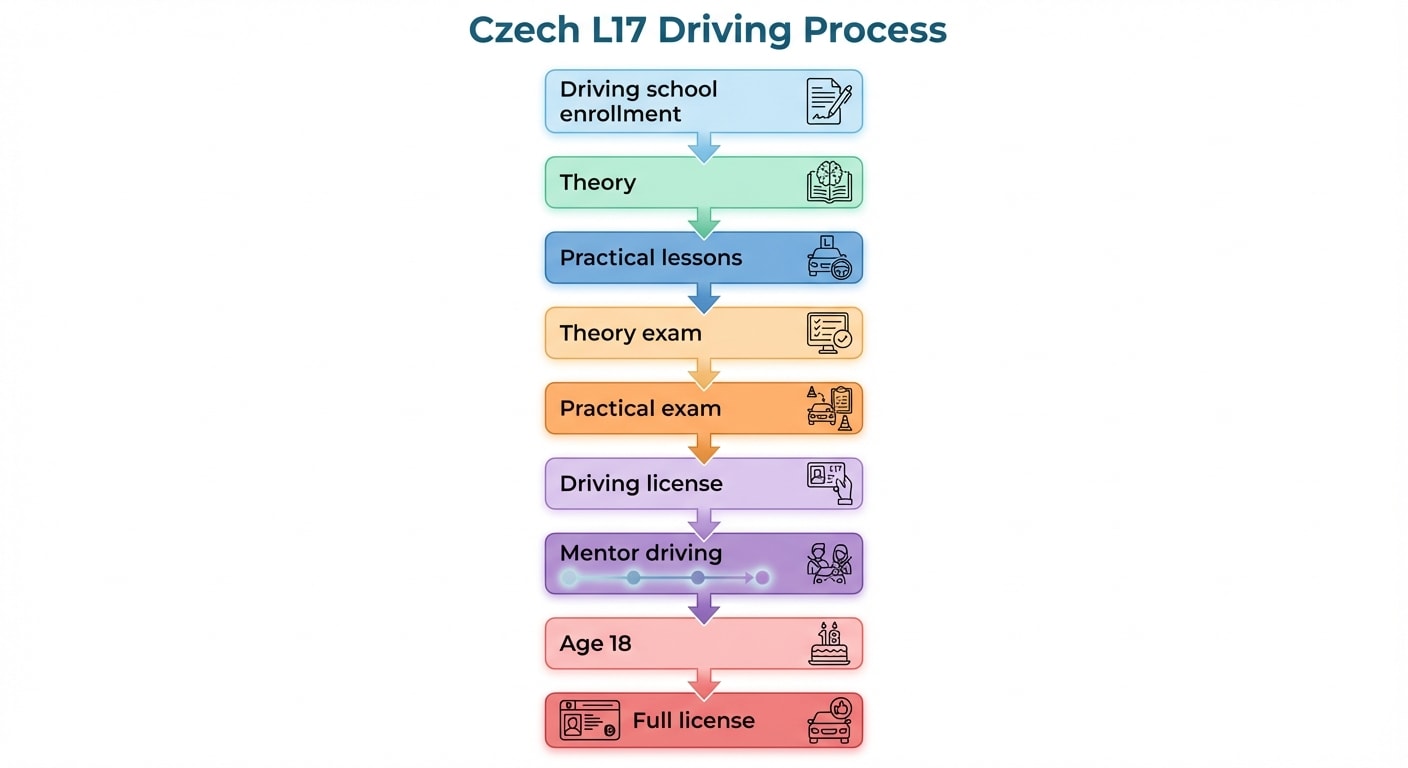
- Driving school training (2–3 months) — 36 hours of theory, 28 hours of practice, identical for L17 and standard courses
- Exam — theory test (43/50) + practical driving test, fee CZK 700
- Driving with a mentor (approx. 12 months) — recommended 60 drives, 60 hours, 2,000 km
- 18th birthday — automatic transition to a full license, no more mentor required
Wondering what exactly happens on your eighteenth birthday and how the probationary period works? That's the topic of the chapter Transition to a Full License. And if you're still looking for a driving school to complete L17, check out the chapter Driving Schools with L17 Program — or go straight to compare driving schools on Kvalty.cz.
Summary
- Driving school training is identical for L17 and the standard course — 36 hours of theory + 28 hours of practice + 6 hours maintenance and first aid
- After the exam, you drive with a mentor until age 18 — in a regular car, no dual pedals, on real roads
- The three-stage system recommends driving 60 times, 60 hours, and 2,000 km — it's a guideline, not a requirement
- The L17 app (free) helps you track your progress
- The exam costs CZK 700, and you must be at least 17 on exam day
- Never drive without a mentor — the fine is CZK 2,500–5,000 and a driving ban of 6–12 months
Key Terms
| Term | Explanation |
|---|---|
| Teaching hour | 45 minutes — the standard length of one lesson at driving school |
| Practice ground | A closed area for practicing basic maneuvers without real traffic |
| Simulator | A driving simulator — some driving schools use it in the first phase of training |
| Dual controls | Brake pedal and steering on the instructor's side — training vehicles have them, regular cars don't |
| Three-stage system | A recommended framework for structuring mentor drives: Beginner → Intermediate → Experienced |
| L17 app | A free mobile app for tracking L17 driver progress — number of drives, km, hours |
| Crisis situation | Emergency braking, obstacle avoidance, skid response — a mandatory part of training (min. 1 hour) |
| Probationary period | A trial driving license — 2 years from the date your license is granted, applies to all first-time drivers |