
Speeding Fines in Czech Republic 2026 — Full Guide
How much you'll pay for speeding in and outside of town. Fine tables, radar tolerances, section speed cameras, and the 2-strikes / 3-strikes rules.
You're driving through town at 70 km/h. The speedometer says "just 20 over," so it seems harmless. But the radar measures 67 km/h — after the tolerance deduction, that's 64 km/h. Exceeding the limit by 14 km/h in a built-up area. Two penalty points and a fine of CZK 1,500–2,000. If that speedometer had shown a little more — say 74 — you'd be in the 20+ km/h bracket: 4 points and a fine of CZK 2,500–10,000. Ten more kilometres per hour, double the consequences.
Speeding is the most common traffic offense in the Czech Republic. It accounts for more than half of all point-carrying offenses, and in 2023 it caused over 12,000 accidents that killed 138 people. This isn't a scare statistic — it's the reason speeding fines are so high. In this chapter, you'll find the exact fine amounts in and outside of town, how radar tolerances work, where section speed cameras are waiting, and what happens if you get caught a second time.
Quick summary:
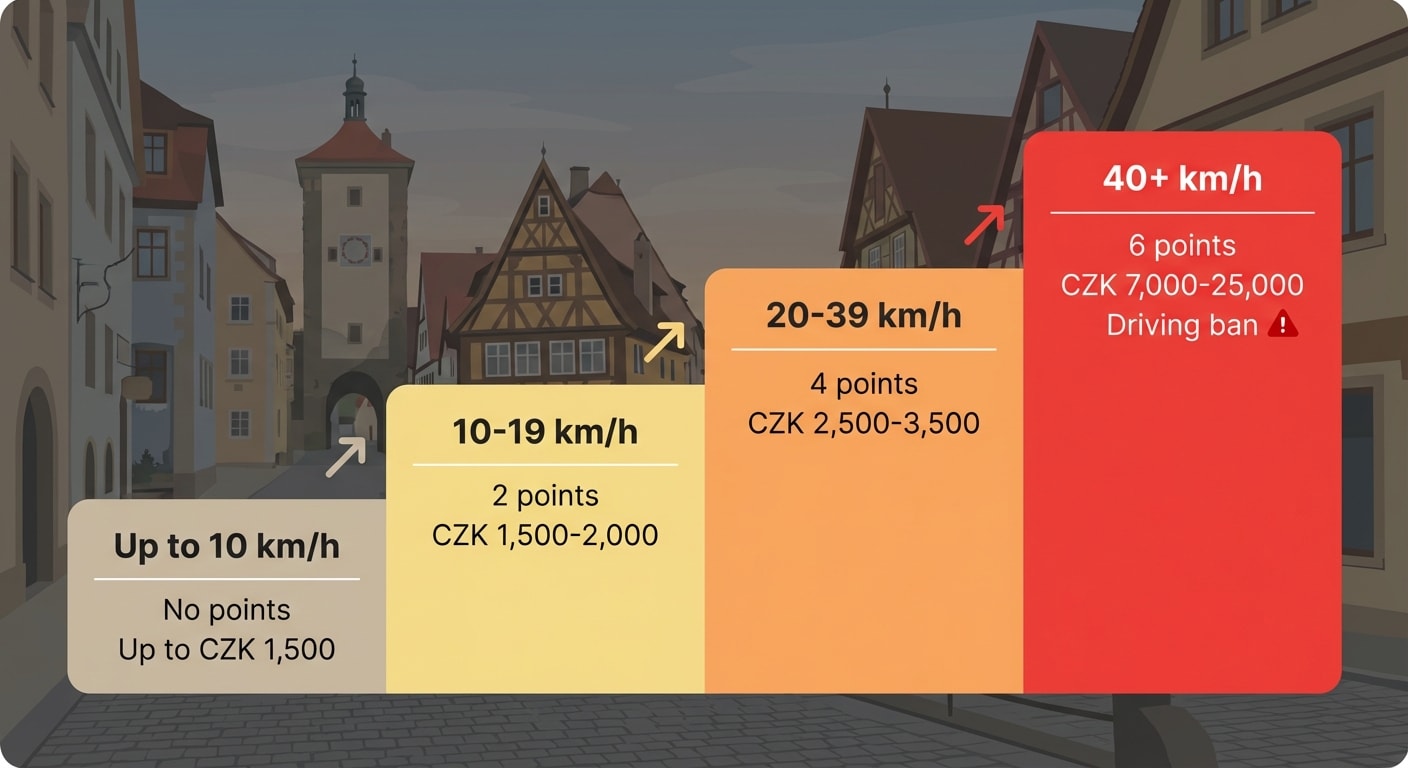
- In town, exceeding the limit by 10–19 km/h costs CZK 1,500–2,000 + 2 points; 40+ km/h over means CZK 7,000–25,000 + 6 points + a driving ban
- Outside of town, the brackets are more lenient — 2 points from 10 km/h over, but 6 points only from 50+ km/h over
- Radar tolerance is ± 3 km/h below 100 km/h and ± 3% above 100 km/h — the same for all types of measurement
- Two 6-point speeding offenses within 3 years = automatic license revocation ("two strikes and you're out")
Speed limits in the Czech Republic
Before we get to fines, you need to know the limits. In the Czech Republic, it's straightforward — the type of road determines the maximum speed (§18 of Act No. 361/2000 Coll.). In built-up areas 50 km/h, on roads outside town 90 km/h, on expressways 110 km/h, and on motorways 130 km/h. Since October 2025, a pilot section with a 150 km/h limit has been running on the D3 motorway between Planá nad Lužnicí and Úsilné.
But watch out — these are maximum values. Municipalities can lower the limit with local signage (for example, 30 km/h near a school or in a residential zone) or raise it up to 80 km/h on selected through-roads. A road sign always overrides the default limit. And if you miss a sign and claim "I didn't see it" — that's not a defence any authority will accept.
A separate category is inappropriate speed. Even if you're under the limit but road conditions are poor — fog, ice, heavy traffic — and you cause an accident, you're responsible. The law states that a driver must travel at a speed that allows them to stop within their line of sight. This is a principle that judges take seriously.
How much you'll pay in town
In built-up areas, the brackets are stricter because towns have pedestrians, children, and intersections. The difference between "20 over" in town and "20 over" on the motorway is enormous — one costs 4 points, the other just 2.
Speeding fines — in built-up areas
| Excess | On-the-spot fine | Administrative proceedings | Points | Driving ban |
|---|---|---|---|---|
| up to 10 km/h | up to CZK 1,500 | CZK 2,000–5,000 | 0 | — |
| 10–19 km/h | CZK 1,500–2,000 | CZK 2,000–5,000 | 2 | — |
| 20–39 km/h | CZK 2,500–3,500 | CZK 4,000–10,000 | 4 | — |
| 40+ km/h | not available on-the-spot | CZK 7,000–25,000 | 6 | 6–18 months |
Notice the jump between the third and fourth bracket. Up to 39 km/h over, the offense can be resolved on the spot with a police officer for a lower fine. Once you exceed by 40 km/h or more — meaning you're doing 90 in a 50 zone — it can't be handled as an on-the-spot fine. You're facing administrative proceedings, a fine of CZK 7,000–25,000, 6 penalty points, and a driving ban of 6 to 18 months. This is the category where a single offense changes your life for six months to a year and a half.
Two strikes and you're out
Exceeding the limit by 40+ km/h in a built-up area is a 6-point offense. Two such offenses within 3 years mean automatic license revocation — even if your points balance is otherwise clean. The same applies to any combination with another 6-point offense (alcohol, running a red light).
How much you'll pay outside of town
Outside built-up areas — on roads, expressways, and motorways — the brackets are set more leniently. While in town you get 4 points from exceeding by 20 km/h, outside of town it's only from 30 km/h over. The logic is clear: at 130 km/h on a motorway, 20 extra km/h is relatively less risky than 20 extra km/h in a 50 zone near a school.
Speeding fines — outside built-up areas
| Excess | On-the-spot fine | Administrative proceedings | Points | Driving ban |
|---|---|---|---|---|
| up to 10 km/h | up to CZK 1,500 | CZK 2,000–5,000 | 0 | — |
| 10–29 km/h | CZK 1,500–2,000 | CZK 2,000–5,000 | 2 | — |
| 30–49 km/h | CZK 2,500–3,500 | CZK 4,000–10,000 | 4 | — |
| 50+ km/h | not available on-the-spot | CZK 7,000–25,000 | 6 | 6–18 months |
The most common offense outside of town is exceeding by 10–29 km/h — the situation where you're doing 100 on a road with a 90 limit or going 155 on the motorway at 130. Still "only" 2 points, but a fine of CZK 1,500–2,000 on the spot. Repeating the offense within 12 months raises the stakes — if you commit another 4-point speeding offense within a year, you face a driving ban of 1 to 6 months even without reaching 12 points.
For the complete table of all offenses, not just speeding, see the chapter Traffic Offenses & Fines Overview.
How radar tolerance works
There are plenty of myths around measurement tolerance. The most widespread is that "10 km/h over is fine." It isn't. An offense is committed from 1 km/h over the limit after the tolerance deduction — and that deduction is smaller than most drivers think.
The rule is simple: below 100 km/h, 3 km/h is deducted; above 100 km/h, 3% is deducted. This applies uniformly to all types of measurement — stationary radars, mobile police radars, and section speed cameras. No difference. No "bigger tolerance on the motorway" exists.
In practice, this means that in a 50 km/h zone, an offense occurs from a measured speed of 54 km/h (deduct 3, you get 51 — exceeding by 1 km/h). On the motorway at 130 km/h, it's from a measured 135 km/h (deduct 3%, i.e. 4 km/h, you get 131). In the new pilot section with a 150 km/h limit, the threshold is 155 km/h.
Radar tolerances — overview
| Zone | Limit | Offense from (measured) | Actual speed |
|---|---|---|---|
| Residential zone | 20 km/h | 24 km/h | 21 km/h |
| School / 30 zone | 30 km/h | 34 km/h | 31 km/h |
| Built-up area | 50 km/h | 54 km/h | 51 km/h |
| Road outside town | 90 km/h | 94 km/h | 91 km/h |
| Expressway | 110 km/h | 114 km/h | 111 km/h |
| Motorway | 130 km/h | 135 km/h | 131 km/h |
| Motorway (pilot section) | 150 km/h | 155 km/h | 151 km/h |
And what about the car's speedometer? It always shows more than your actual speed — manufacturers deliberately set it optimistically so you can't blame the instrument for being inaccurate. The difference is typically 3–10%. So when the speedometer shows 55 in a 50 zone, you're probably actually doing 50–52. But you can't use the speedometer in your defence — the only thing that counts is what a calibrated radar measures after the tolerance deduction.
GPS is more accurate than the speedometer
Navigation apps (Google Maps, Waze, Mapy.cz) display speed via GPS, which is more accurate than the speedometer — the deviation is typically within 1–2 km/h. They also warn you about speed limits and approaching radars. Using a navigation app with radar alerts is legal in the Czech Republic.
Where and how speed is measured in the Czech Republic
The method of measurement affects how the fine is handled. If a police patrol stops you, you deal with it on the spot. If a stationary radar catches you, a letter arrives. And with section speed cameras, there's no chance to "hit the brakes" at just the right moment.
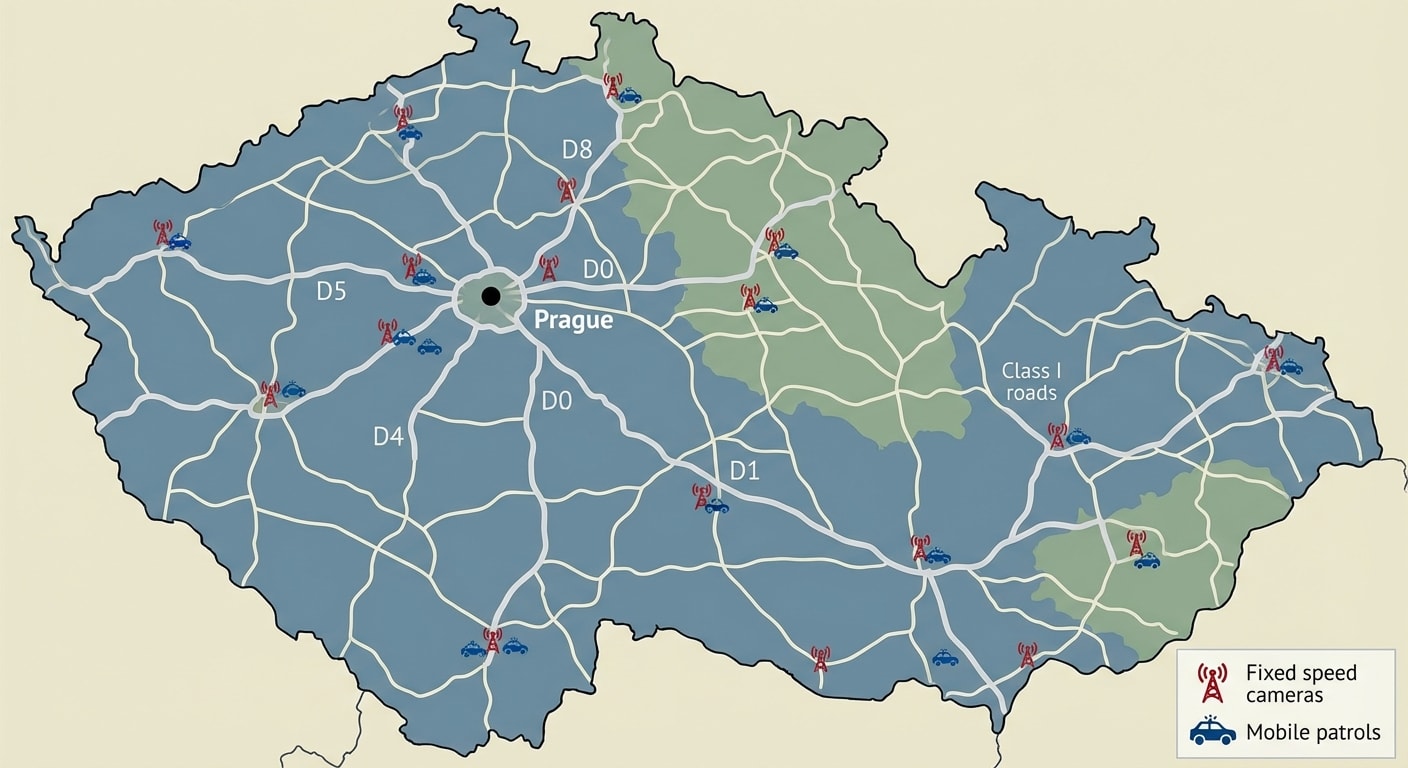
Stationary radars are the most visible — orange or grey boxes on poles by the road. They automatically photograph licence plates and measure speed. The Czech Republic has the most of them in Prague (98 measurement points, of which 60 are section speed camera segments), but you'll find them in smaller towns too. They're operated by municipalities, not the police — and the fine revenue goes to the municipal budget.
Section speed cameras are a newer and fairer system. Two cameras at the beginning and end of a section (typically 1–5 km) measure your average speed. You can't slow down before the radar and speed up after — either you drive the whole section within the limit, or you don't. Section speed cameras are expanding rapidly: on motorways D0, D1, D4, D5, and D8 they're in tunnel sections and new stretches. Cities like Brno are planning to introduce urban section speed cameras.
Mobile radars are police patrols with portable measurement devices. They can measure anywhere. Every year, the Czech Police organises the pan-European Speed Marathon — in 2025, speed was measured at 984 locations across the country in a single day.
Municipal police are allowed to measure speed, but only at locations pre-approved by the national Police. They can't just set up wherever they want.
What happens when you get caught
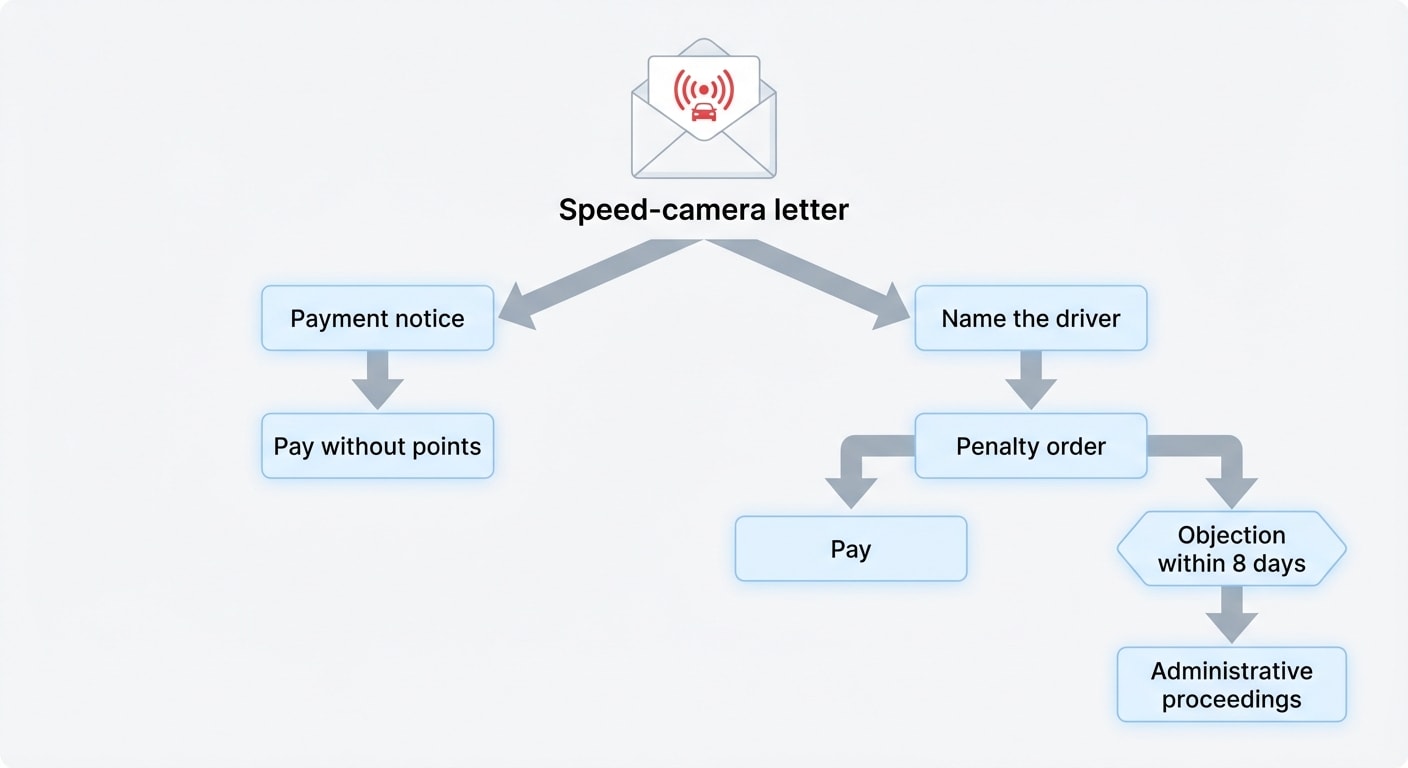
It depends on how you're caught. If a police patrol stops you, they'll offer you an on-the-spot fine — you pay a lower amount (by card or bank transfer) and it's done. Once you agree, the offense is settled and you can't appeal. You can refuse — but then the case goes to administrative proceedings, where fines tend to be higher and you'll also pay CZK 2,500 in proceedings costs.
If a radar or camera catches you, here's what typically happens: a few weeks later, a letter arrives from the municipal authority with a photo of your car. It's either a payment notice addressed to you as the vehicle operator (under §125f), or a penalty order in offense proceedings.
The payment notice is the simpler option. The authority couldn't determine who was driving and is contacting you as the vehicle owner. The fine is a maximum of CZK 10,000, with no points and no record. You have two choices: pay (and the case is closed), or tell them who was driving (then it's dealt with that driver — points, higher fine, possibly a driving ban).
The penalty order is more direct — the authority knows who you are and is sending you a decision. You can file an objection against the order within 8 days of delivery. If you do, the order is annulled and administrative proceedings begin. If you don't, it becomes legally binding. For details on when it's worth fighting and when it's better to just pay, see the chapter How to Fight a Fine.
What happens if you repeat the offense
One speeding fine is an inconvenience. Repeating it is a problem. Since 2024, the law targets drivers who speed repeatedly — and the penalties escalate quickly.
If you commit a 4-point speeding offense (exceeding by 20–39 km/h in town or 30–49 km/h outside of town) and the same thing happens within 12 months, you face a driving ban of 1 to 6 months — even if your points balance is nowhere near 12.
And then there are two rules introduced by the 2024 reform. The "two strikes and you're out" rule says that two 6-point offenses within 3 years mean automatic license revocation. Exceeding by 40+ km/h in town (or 50+ outside of town) is a 6-point offense. Two of those within 3 years are enough — or a combination with any other 6-point offense, such as drunk driving or running a red light.
The "three strikes and you're out" rule works similarly for 4-point offenses. Three of those within 3 years = license revocation. They don't all have to be for speeding — it could be speeding + phone + not wearing a seatbelt. But speeding and using a phone while driving are the two most common 4-point offenses, so the combination is very realistic.
And in extreme cases, where excessive speed causes a serious accident with injury or death, the offense becomes a criminal matter. That's an entirely different league — court, criminal record, possibly a suspended or actual prison sentence. You can read more in the chapter Criminal Traffic Offenses.
150 km/h on the motorway — what you need to know
Since October 2025, a pilot section on the D3 motorway (between exits 84 Planá nad Lužnicí and 131 Úsilné) has a raised speed limit of 150 km/h. It's the first place in the Czech Republic where you're allowed to drive that fast — and the Ministry of Transport is considering expanding it to other sections depending on the pilot results.
What does this mean for fines? The principle is the same. Radar tolerance at 150 km/h is ± 3%, meaning an offense occurs from a measured 155 km/h (actual speed 151 km/h). Exceeding by 10–29 km/h (i.e. 160–179 km/h measured) is 2 points and CZK 1,500–2,000. Exceeding by 50+ km/h (200+ km/h measured) is 6 points, a fine of CZK 7,000–25,000, and a driving ban.
There's an important detail: the higher limit only applies where it's indicated by signs. Once you leave the marked section, the standard 130 km/h applies. And 150 km/h is not allowed for anyone in a vehicle under 3.5 tonnes with a trailer or in a bus. You also can't do 150 in wet conditions, fog, or other poor visibility — that falls under the principle of inappropriate speed.
150 km/h pilot section
D3 motorway, exits 84 (Planá nad Lužnicí) – 131 (Úsilné). Permitted since October 2025. The Ministry of Transport is evaluating safety and planning potential expansion to other motorways.
Why speeding is punished so severely
The numbers speak clearly. In 2023, inappropriate speed caused over 12,400 accidents in the Czech Republic. 138 people died and 393 were seriously injured. The Transport Research Centre calculated that for every 1,000 accidents caused by speed, there are 4 deaths and 8 serious injuries. That's drastically worse than for other types of offenses.
Overall, inappropriate speed is behind approximately 40% of all fatal traffic accidents. And a survey by the Transport Research Centre showed that 86% of drivers regularly exceed speed limits. Most of them only slightly — by 5 or 10 km/h. But even 5 extra km/h in a built-up area extends the braking distance by several metres and turns "I braked in time" into "I didn't brake in time."
A positive note to end on: the tougher fines from 2024 are working. In 2024, the number of speeding offenses dropped by 10% compared to the previous year. And the total number of road fatalities reached 438 — the lowest figure in history since 1961. Higher fines aren't just punishment. They change behaviour.
For an overview of all offenses and points in one place, see the chapter Traffic Offenses & Fines Overview. And if you want to understand how points accumulate, decrease, and what happens when you reach the limit, check the guide Penalty Points System.
Summary
- Speeding is the most common offense in the Czech Republic — accounting for more than 50% of all point-carrying offenses
- In town, the brackets are stricter: 4 points from +20 km/h, outside of town from +30 km/h
- Radar tolerance is ± 3 km/h (below 100 km/h) and ± 3% (above 100 km/h) — for all measurement types
- Exceeding by 40+ km/h in town means 6 points, a fine of CZK 7,000–25,000, and a driving ban
- Two 6-point offenses within 3 years = automatic license revocation
- Payment notice from a radar: max. CZK 10,000 without points — or you name the driver
- Disagree with a fine? Read about how to fight it
Key terms
| Term | Explanation |
|---|---|
| Radar tolerance | Legal measurement deviation: ± 3 km/h below 100 km/h, ± 3% above 100 km/h |
| Section speed cameras | Two cameras measure average speed over a 1–5 km section — no way to "hit the brakes" |
| Stationary radar | Permanently installed radar by the road — automatically photographs and measures |
| Objective liability | Vehicle owner is liable for a radar-caught offense if the driver can't be identified (§125f) |
| On-the-spot fine | Fine from a police officer — lower rate, but consent is irrevocable |
| Payment notice | Letter to the vehicle operator — max. CZK 10,000, no points, no record |
| Penalty order proceedings | Order sent by post from the authority — objection within 8 days, otherwise becomes binding |
| Administrative proceedings | Formal proceedings at the authority — higher fines + CZK 2,500 in proceedings costs |
| Two strikes and you're out | 2 × 6-point offense within 3 years = license revocation |
| Three strikes and you're out | 3 × 4-point offense within 3 years = license revocation |
| Inappropriate speed | Driving that doesn't match conditions — an offense even under the limit |
| Speed Marathon | Pan-European police operation — measurement at hundreds of locations in one day |