
Motorcycle Safety — Gear and Accident Statistics
Required and recommended motorcycle gear, accident statistics for riders in Czechia, how to choose a helmet and protectors, and how to reduce road risk.
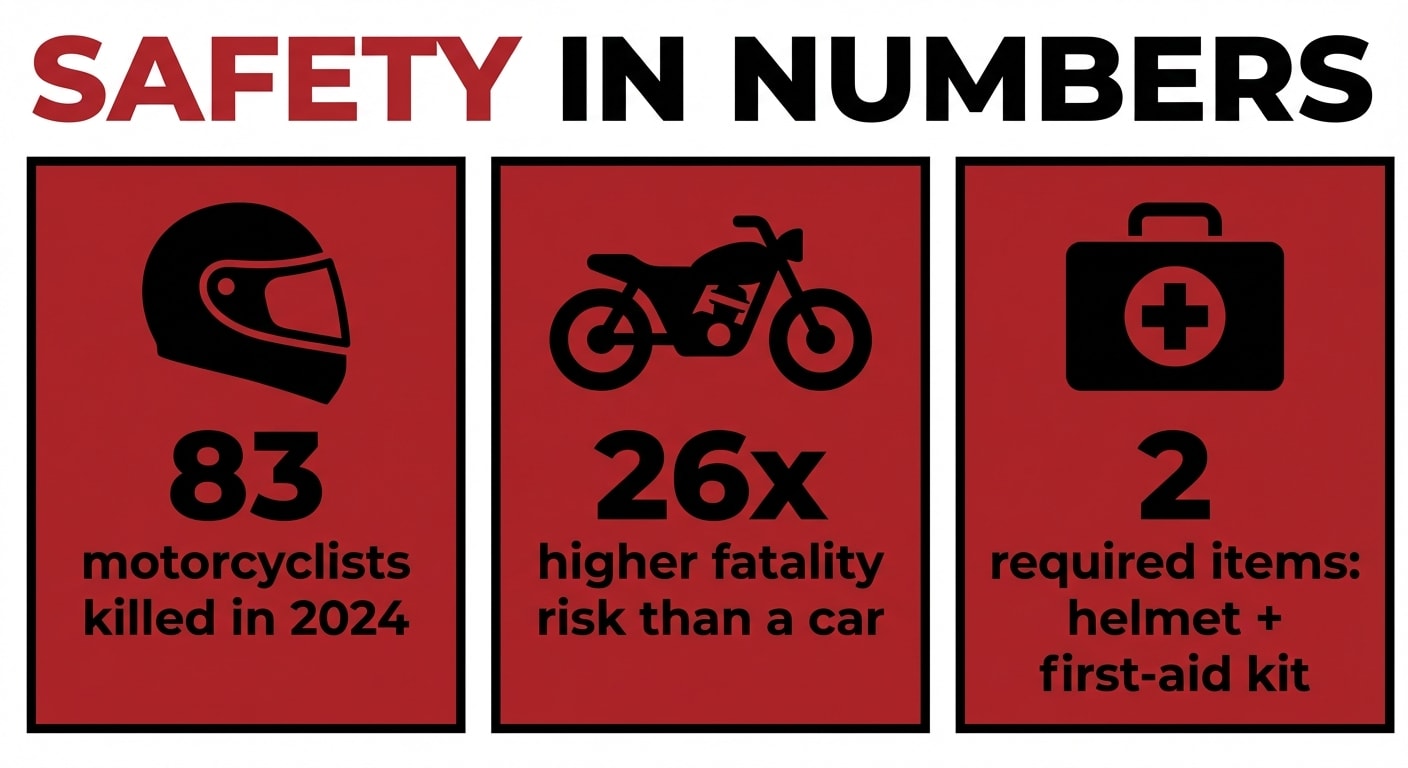
In 2024, 83 motorcyclists died on Czech roads. It's the worst toll since 2018 — and 2025 is shaping up to be even worse. A motorcyclist is 26 times more likely to die in a crash than someone in a car. Yet the law only requires one piece of protective gear: a helmet. The rest is on you. This article shows you what the law demands, what you should have on top of that, and why the right gear can mean the difference between a scrape and months of rehabilitation.
Quick summary:
- The only legally required motorcycle equipment is a helmet and a first-aid kit — nothing else
- Riding without a helmet costs you CZK 1,500–2,000 and 4 penalty points (since January 2024)
- A quality gear setup (helmet, jacket, pants, gloves, boots) starts around CZK 15,000
- 60% of accidents are caused by motorcyclists themselves, but 40% are caused by car drivers who failed to see the bike
What the Law Says — and Why It's Not Enough
Czech legislation is surprisingly lenient toward motorcyclists. The mandatory equipment for a motorcycle (category L) under Decree No. 153/2023 Coll. includes just one item: a first-aid kit. No warning triangle, no reflective vest — the vest is explicitly excluded for motorcyclists (Section 5(1) of Act No. 361/2000 Coll.).
The second legal requirement is a helmet. Under Section 6(1)(h) of Act No. 361/2000 Coll., you must wear a properly fastened protective helmet of an approved type. The same applies to your passenger. You also need to protect your eyes — either with a helmet visor or goggles.
And that's it. No gloves, no jacket, no ankle-high boots. Legally, you can ride on the highway in a t-shirt and shorts as long as you're wearing a helmet. Yet 80% of all motorcycle accidents result in injury. The most common type is "road rash" — skin abrasion from sliding across asphalt, which in a t-shirt looks like a third-degree burn. The law protects you minimally. You have to protect yourself.
Fine for riding without a helmet
Riding without a helmet costs CZK 1,500–2,000 on the spot (CZK 2,000–5,000 in administrative proceedings) plus 4 penalty points. Since January 2024, the point count was increased from 3 to 4 — you're halfway to losing your license.
First-Aid Kit — What Must Be Inside
The contents of the first-aid kit are defined by decree and surprisingly modest. You need a prepared bandage with one pad, a prepared bandage with two pads, adhesive plaster, a rubber tourniquet for stopping arterial bleeding, and a pair of latex or nitrile gloves. Since 2018, you no longer need to carry a triangular bandage or a resuscitation mask.
Good news: since October 2018, the expiration date doesn't matter. As long as the kit is complete and undamaged, it's fine. A missing first-aid kit costs you a fine of up to CZK 2,000. And if you ride a moped under 50cc, you don't need one at all.
The Helmet — Your Most Important Piece of Gear
A helmet is the one thing that reliably saves lives in a crash. In 2022, 4 motorcyclists died on Czech roads without a helmet — out of 62 total. Four lives that a helmet could have saved. A properly chosen helmet can determine whether you walk away from a crash on your own two feet.
Which Helmet to Choose
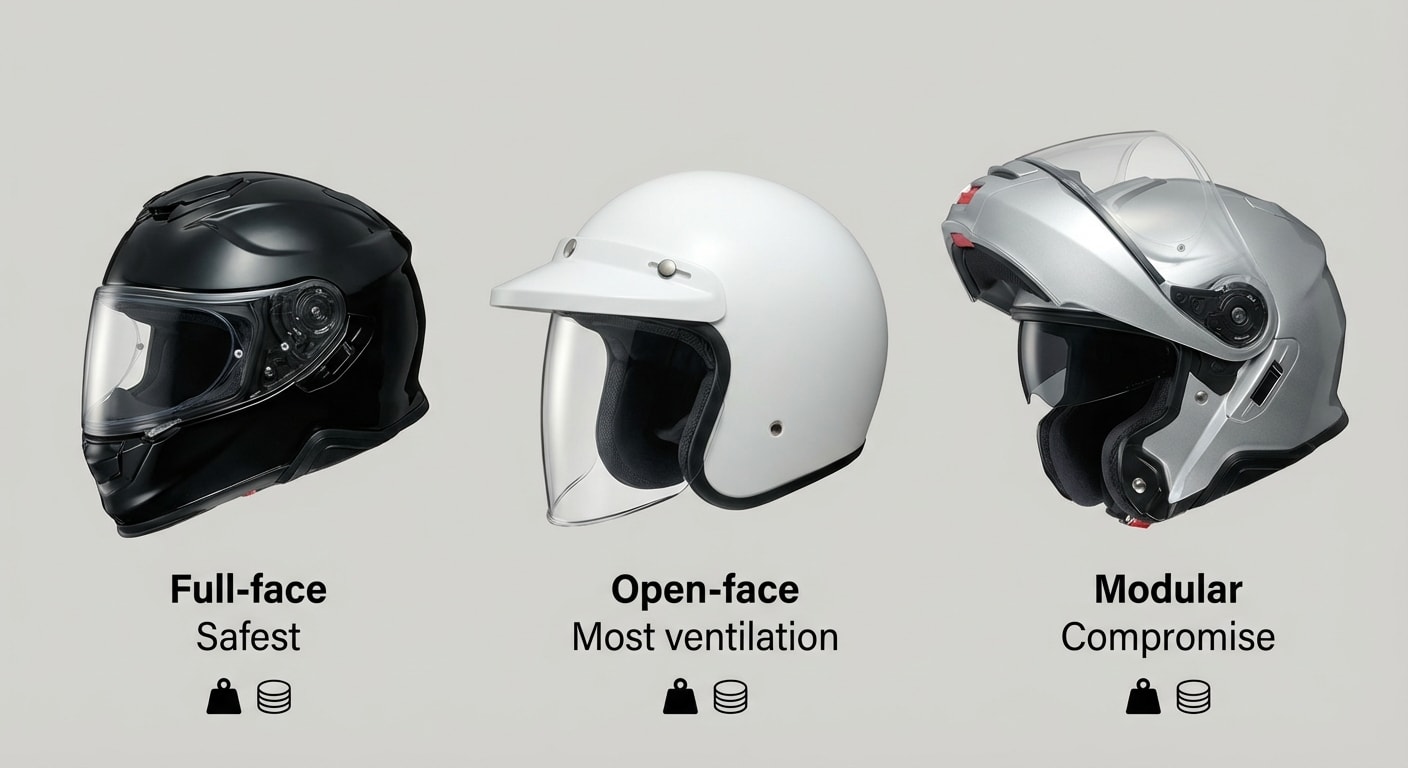
There are three basic types on the market: full-face (protects the entire face), open-face (no chin guard), and modular/flip-up (combines both). For motorcycle riding, a full-face helmet is clearly the safest — statistics show that approximately 35% of impacts hit the chin area, which an open-face helmet doesn't protect.
Every helmet sold in the EU must have European type approval. Two standards are currently valid: ECE 22.05 and the newer ECE 22.06. Since 2024, newly manufactured helmets must meet ECE 22.06, which introduced stricter crash tests — impact from 8.5 meters instead of the previous 7.5, a new rotational impact test, and tougher requirements for flip-up mechanisms. If you own a helmet with ECE 22.05 purchased earlier, it remains legal.
How much to invest in a helmet
A quality full-face helmet with ECE 22.06 starts around CZK 2,500. Mid-range (CZK 5,000–10,000) offers an excellent price-to-protection ratio. Premium helmets from Shoei, Arai, or AGV cost CZK 10,000 and up. Don't buy a helmet under CZK 2,000 — basic open-face helmets for a few hundred are suitable for a slow scooter at best.
How to Choose the Right Fit
When selecting a helmet, the most important thing is proper sizing. The helmet shouldn't pinch, but it also shouldn't move around on your head — try grabbing it by the chin and twisting. If it moves, it's too big. Ideally, wear it in the store for at least 10–15 minutes, because the inner liner breaks in slightly over time. And never buy a used helmet — it may be damaged inside after an impact without any visible signs.
Protective Clothing — Certification That Saves Your Skin
There's no legal requirement to wear protective clothing on a motorcycle in Czechia. You can ride in jeans and a hoodie. But when sliding across asphalt at 50 km/h, cotton wears through in less than a second. Motorcycle clothing with CE certification is designed to protect you during exactly that.
Since April 2018, motorcycle clothing falls under EU Regulation 2016/425 on Personal Protective Equipment (PPE). Manufacturers must pass certification under the EN 17092 standard and label products with the CE mark plus a motorcyclist pictogram. The standard defines five protection classes:
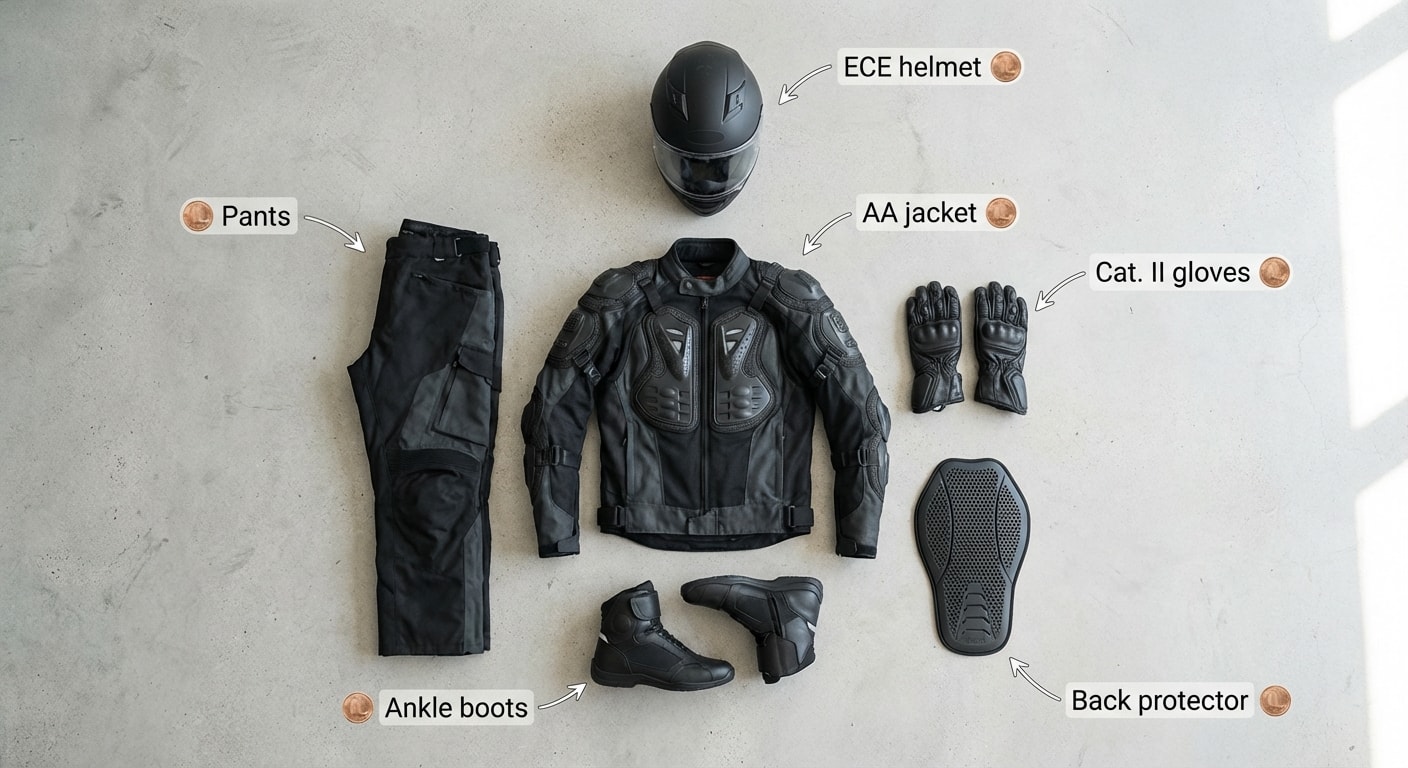
AAA (EN 17092-2) is race-level — maximum resistance to abrasion and cuts. Typically one-piece leather suits. AA (EN 17092-3) is the recommended standard for regular riding — a compromise between protection and comfort, two-piece sets or quality textile jackets with aramid lining. A (EN 17092-4) is the basic level — protects during a slide, but over a shorter distance. B (EN 17092-5) matches class A but without integrated protectors. C (EN 17092-6) covers mesh protector vests for hot days.
How do you spot it in the store? Look for the motorcyclist pictogram and the class letter on the tag. If it's not there, the clothing hasn't passed certification and may look like motorcycle gear but functionally it's just printed shorts.
For a beginner, the best choice is class AA — it offers adequate protection for road use without making you feel like a racer on a circuit. A decent jacket with protectors in class AA costs CZK 3,000–8,000, pants similarly.
Protectors — A Back Protector Is Essential
Protectors are inserts in clothing or standalone pieces that absorb energy on impact and protect joints, bones, and the spine. They're tested under the EN 1621 standard in several categories.
EN 1621-1 covers protectors for shoulders, elbows, knees, and shins. There are two levels — Level 1 (basic protection) and Level 2 (higher protection). The difference lies in how much energy the protector absorbs. Level 2 handles significantly more, and if you have the choice, always go for Level 2.
EN 1621-2 is the standard for back protectors — the so-called "spine protector." Spinal injuries are among the most severe motorcycle injuries, and a quality back protector can literally determine whether you'll walk after a crash. Many jackets only have a foam insert in the back that doesn't meet EN 1621-2. Buy a back protector separately and insert it into your jacket, or wear it as a standalone protector under your clothing. An investment of around CZK 1,500–3,000 for a Level 2 back protector is the smartest thing you can do for yourself.
On protector labels, you may also find markings T+ and T−, indicating the protector was tested at +40°C and −10°C respectively. This matters because some materials stiffen in cold weather and lose their ability to absorb energy.
Protectors at a glance
EN 1621-1 = joints (shoulders, elbows, knees). EN 1621-2 = spine. EN 1621-4 = airbags. Always look for Level 2 — the price difference is small, the protection difference is huge.
Gloves and Boots — Why You Shouldn't Ride in Sneakers
Your hands are the first thing to hit the ground in a motorcycle fall — you instinctively try to catch yourself. Without gloves, you'll scrape the skin off your palms to the bone in a fraction of a second. Motorcycle gloves are tested under the EN 13594 standard in two categories. Category I is basic protection; Category II adds knuckle protectors and higher abrasion resistance. For road riding, go for Category II — they cost CZK 1,000–3,000.
The same principle applies to boots. Ankles and feet are extremely vulnerable in a crash — an ankle can break even in a zero-speed fall while stopping. Motorcycle boots have reinforced ankles, anti-slip soles, and cut-through protection. On the label, look for the motorcyclist pictogram plus IPA (ankle protector) and IPS (shin protector) markings. Decent motorcycle boots start around CZK 2,000.
Sneakers and city shoes have no place on a motorcycle. Not even for a short trip to the store. Most falls happen below 30 km/h, during slow city riding, exactly when most people think "it's just around the corner, I'll be fine."
Airbag Vest — The Future of Protection
Motorcycle airbags are the latest revolution in rider protection. They look like a regular vest or jacket, but inflate during a fall to protect the chest, ribs, cervical spine, back, and lumbar area. They can reduce impact force on the body by 60 to 90% compared to standard protectors — that's an enormous difference.
There are two variants on the market. Mechanical airbags are activated by a lanyard connected to the motorcycle frame. When you separate from the bike, the lanyard pulls a valve and the vest inflates. They don't require charging, are simpler, and cheaper — CZK 3,000–8,000. The downside is that you have to connect the lanyard every time you get on and disconnect it when you get off. And if you don't separate from the motorcycle (e.g., in a side impact), the airbag won't activate.
Electronic airbags have their own sensors (accelerometers and gyroscopes) that detect a fall and inflate the vest in 20 to 80 milliseconds — faster than you can touch the ground. They work independently of the motorcycle, so they activate even in side impacts or when you go over the handlebars. The price is higher: CZK 10,000–30,000 and up. They require charging and a cartridge replacement after activation.
Airbag vests aren't mandatory and most riders don't even know about them yet. But if you ride regularly and want maximum protection, it's the best safety investment after a helmet. They're tested under the EN 1621-4 standard.
Who Actually Crashes — Numbers That Surprise
You might think accidents mainly involve inexperienced riders who overestimate their abilities. But the statistics tell a different story. The highest-risk age group among Czech motorcyclists is 35–44 years old — middle-aged men fulfilling a lifelong dream of owning a motorcycle, or returning to riding after a fifteen-plus-year break. Not beginners, but "comeback" riders who think they've still got it.
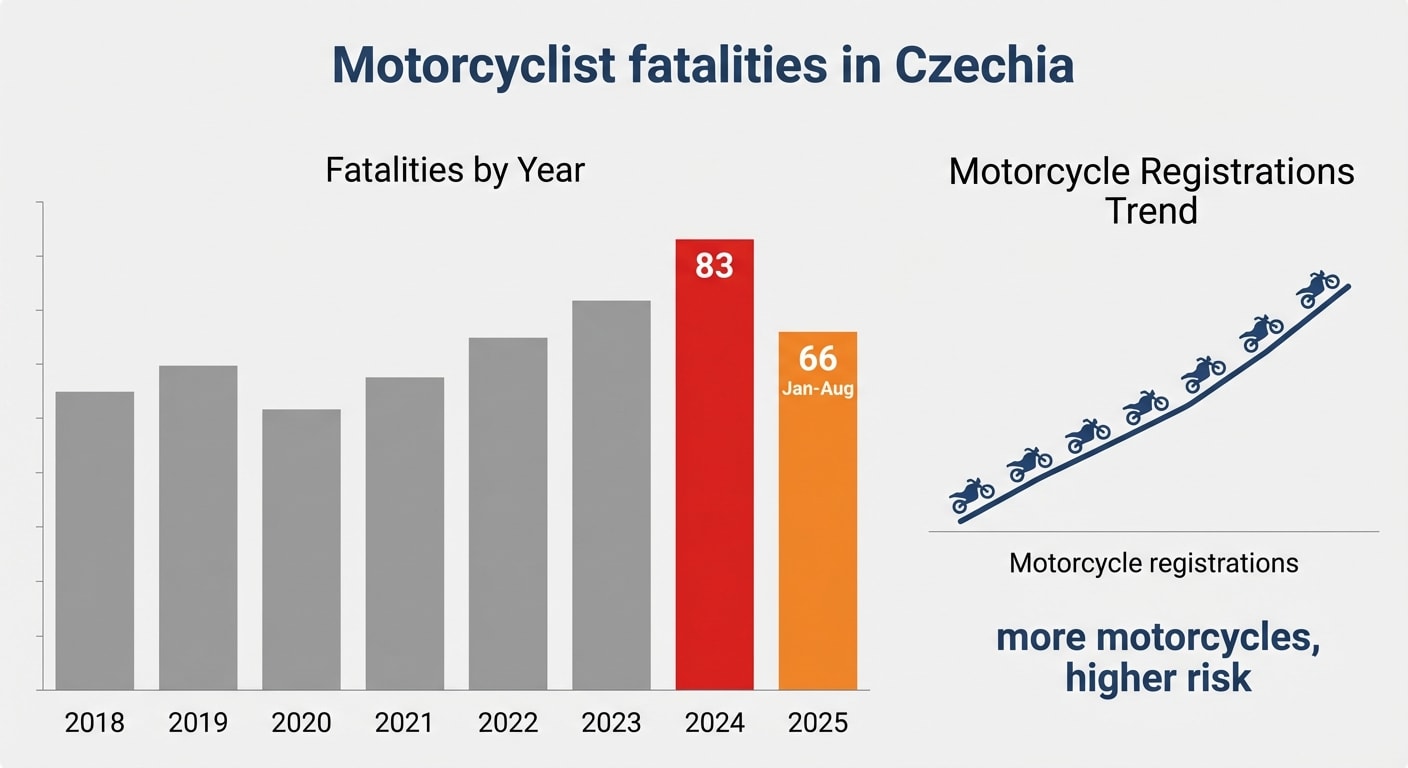
In 2024, over 4,000 accidents involving motorcycles occurred — a 14% increase over 2023. In the first eight months of 2025, 66 motorcyclists died, which is 24% more than the same period the previous year. The trend is alarming and correlates with the sharp rise in motorcycles on the road — in 2024, 30,330 new motorcycles were registered in Czechia, nearly double the 2016 figure.
The causes of accidents split into two major groups. 60% of accidents are caused by the motorcyclists themselves — excessive speed, losing control in a curve and crossing into oncoming traffic, or improper overtaking. Over 40% of fatal accidents happen in curves, and 32% involve excessive speed.
The remaining 40% of accidents are caused by car drivers. Most often because they failed to see the motorcycle. A car driver looks at an intersection, the brain registers "nothing coming" — because it's looking for a car, not the narrow outline of a motorcycle. This is called the SMIDSY effect (Sorry Mate, I Didn't See You). A University of Nottingham study confirms it's a neurological phenomenon called "inattentional blindness" — the brain automatically ignores smaller, faster objects that don't match the expected pattern. That's exactly why BESIP launched the "Hey, Motorcycle!" campaign in 2025, backed by CZK 22.6 million. The goal? Teach car drivers to consciously say "Hey, motorcycle!" out loud whenever they spot one.
In European comparison, Czechia doesn't do well — in motorcyclist fatalities per million inhabitants, the country ranks 7th worst out of 19 tracked nations.
Watch out at the start of the season
After the winter break, accident risk is significantly higher. Both motorcyclists and car drivers need to 'get used to' each other again. Start the season with shorter routes, gradually rebuild your reflexes, and before your first spring ride check brakes, tires, lights, and chain.
Active Safety — How to Reduce Risk
Gear protects you when an accident happens. But it's even better to prevent the accident altogether. Here are a few principles that work.
ABS is non-negotiable. Since 2017, anti-lock braking systems have been mandatory on all new motorcycles in the EU. During emergency braking, ABS prevents wheel lockup, keeping the motorcycle stable and steerable. If you're choosing your first motorcycle, don't just insist on ABS as one of your top priorities — insist on it as your single non-negotiable requirement.
Defensive riding means riding as if nobody can see you — because often they genuinely can't (see the SMIDSY effect above). Keep your distance, assume the car at the intersection won't yield, and stay out of blind spots. During the practical exam, the examiner evaluates your anticipation — and it's a skill that proves useful every single day.
Other active safety features found on modern motorcycles include traction control (TC), which monitors rear wheel spin, combined braking systems (CBS), which distribute braking force between both wheels, and a steering damper, which prevents dangerous handlebar oscillations at higher speeds.
"Learn to Survive" — Free Courses
If you want to take safe riding to the next level, there's a program in Czechia that surprisingly few people know about. The "Learn to Survive" project has been running since 2010, supported by BESIP and the Czech Insurers' Bureau. It offers full-day safe riding courses completely free of charge — in 2025, there were 56 courses at ten training facilities across the country.
At the course, under the guidance of experienced instructors, you'll practice emergency braking, handling a motorcycle in crisis situations, cornering technique, and basic first aid. It's suitable for beginners and experienced riders alike. In 2024, 2,500 motorcyclists participated. Registration runs through the website ucmeseprezit.cz — spots fill up quickly, so don't hesitate.
Investing in training and preparation always pays off. But a safe riding course is an additional investment that could one day save your life.
How Much Does Safety Cost
A complete gear setup isn't cheap, but compared to the cost of a motorcycle course or the bike itself, it's a fraction of the total expense. A rough budget for a beginning rider looks like this: a quality full-face helmet with ECE 22.06 for CZK 3,000–6,000, a class AA jacket with protectors for CZK 4,000–8,000, pants for CZK 3,000–6,000, Category II gloves for CZK 1,500–3,000, boots for CZK 2,000–4,000, and a standalone Level 2 back protector for CZK 1,500–3,000. Total: CZK 15,000–30,000.
Is that a lot? Depends on your perspective. One day in the ICU costs around CZK 50,000. Surgery for a broken ankle runs into hundreds of thousands. And plastic surgery for extensive road rash costs tens of thousands per procedure. Plus, quality gear lasts years — a well-maintained jacket and helmet serve you for 5–7 seasons.
If you have comprehensive insurance, some insurers consider gear quality when settling claims. And most importantly — no insurance policy can give you your health back.
How to save on gear
End-of-season sales (September–October) offer 20–40% discounts on last year's collections. Quality is the same, just the design is a year older. Never buy a used helmet though — it may be internally damaged after an impact without any visible signs.
Summary
- The law only requires a helmet and a first-aid kit — that's not enough. Invest in complete gear.
- A helmet with ECE 22.06 is the baseline. Full-face type offers the best protection.
- A Level 2 back protector (EN 1621-2) is the most important protector after the helmet — many jackets don't include one, buy it separately.
- 60% of accidents are caused by motorcyclists, 40% by car drivers. You can prepare for both.
- The highest-risk group is "comeback" riders aged 35–44, not complete beginners.
- "Learn to Survive" courses are free and could save your life.
Key Terms
| Term | Explanation |
|---|---|
| ECE 22.06 | Current European motorcycle helmet type approval with stricter crash tests (mandatory for newly manufactured helmets since 2024) |
| EN 17092 | Standard for motorcycle protective clothing certification — classes AAA (race-level) through C (mesh vests) |
| EN 1621-1 | Standard for joint protectors (shoulders, elbows, knees) — Level 1 (basic) and Level 2 (higher protection) |
| EN 1621-2 | Standard for back protectors — "spine protector." Level 2 strongly recommended. |
| EN 13594 | Standard for motorcycle gloves — Category I (basic) and II (enhanced protection) |
| CE | European Conformity mark — must appear on motorcycle clothing alongside a motorcyclist pictogram |
| SMIDSY effect | "Sorry Mate, I Didn't See You" — a neurological phenomenon where a car driver overlooks a motorcycle because the brain is looking for cars |
| ABS | Anti-lock Braking System — mandatory on new motorcycles since 2017, prevents wheel lockup during braking |
| Road rash | Extensive skin abrasion from sliding across asphalt — the most common injury type for motorcyclists without protective clothing |
| Defensive riding | A riding style where you assume others can't see you and adjust your behavior accordingly |