Category B+E: Full Trailer License Up to 3.5 Tons
With B+E you can tow trailers up to 3,500 kg — combinations up to 7 tons. Training, exam, cost, and who needs it.
You buy a two-horse trailer with a MAW of 2,500 kg. Hitch it to an SUV with a MAW of 2,300 kg. The combination weighs 4,800 kg — and B96 only covers 4,250. You're standing in the parking lot, trailer loaded, and you can't legally go anywhere. This is what happens when you don't check the weight beforehand. The solution? Category B+E — a full towing license that lets you tow trailers up to 3,500 kg behind a passenger car. Combinations up to 7 tons.
B+E is the "final destination" for private drivers who need maximum flexibility when towing. It's not an extension to your existing license like B96 — it's a standalone category that you earn through a full training course and by passing both a theory and practical exam. It costs more, takes longer, but opens the door to everything a passenger car can tow. This article tells you exactly what B+E covers, how the course works, what to expect at the exam, and what it all costs.
Quick summary:
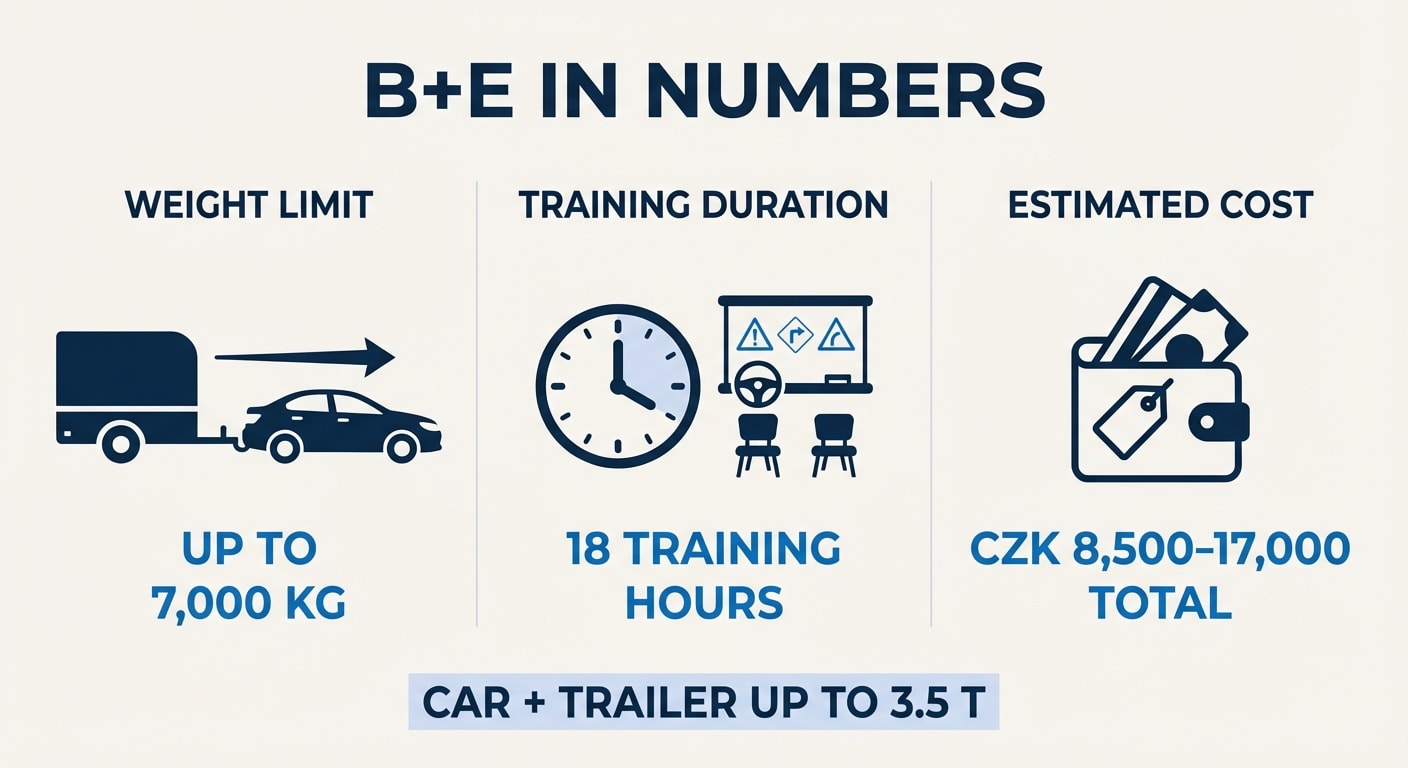
- B+E covers combinations up to 7,000 kg — car (max 3,500 kg) + trailer (max 3,500 kg)
- Requires a full course: 6 hours of theory + 12 hours of practice (8 driving + 2 maintenance + 2 first aid)
- Exam includes a theory test (computer) + practical driving with a combination
- Cost: CZK 7,000–15,000 for the course + CZK 700 administrative fee + approx. CZK 1,000 in other fees
What exactly B+E allows
The Road Traffic Act (Section 80a of Act No. 361/2000 Coll.) defines category B+E as authorization for vehicle combinations consisting of a category B vehicle and a trailer with a MAW not exceeding 3,500 kg. In plain terms: behind any passenger car (MAW up to 3,500 kg), you can hitch any trailer (MAW up to 3,500 kg). The total combination can weigh up to 7,000 kg.
That's a massive jump compared to category B alone (max 3,500 kg with a braked trailer) or B96 (max 4,250 kg). With B+E, you cover virtually everything a passenger car can pull — large caravans, heavy horse trailers, boat trailers, construction trailers with excavators.
One example says it all: a Škoda Kodiaq (MAW 2,340 kg) with a large family caravan Hobby De Luxe (MAW 2,100 kg). The combination weighs 4,440 kg — well beyond the B96 limit. But with B+E, no problem. And you still have over 2,500 kg of headroom in case you buy a heavier trailer someday.
C+E holders already have B+E
If you hold a C+E license (truck + trailer), you automatically have B+E rights. No additional exam needed. Many professional drivers don't know this — and end up paying for a course they don't need.
Who actually needs B+E
B+E isn't for everyone. If your combination is under 4,250 kg, B96 is faster and cheaper. But four groups of drivers can't do without the full license.
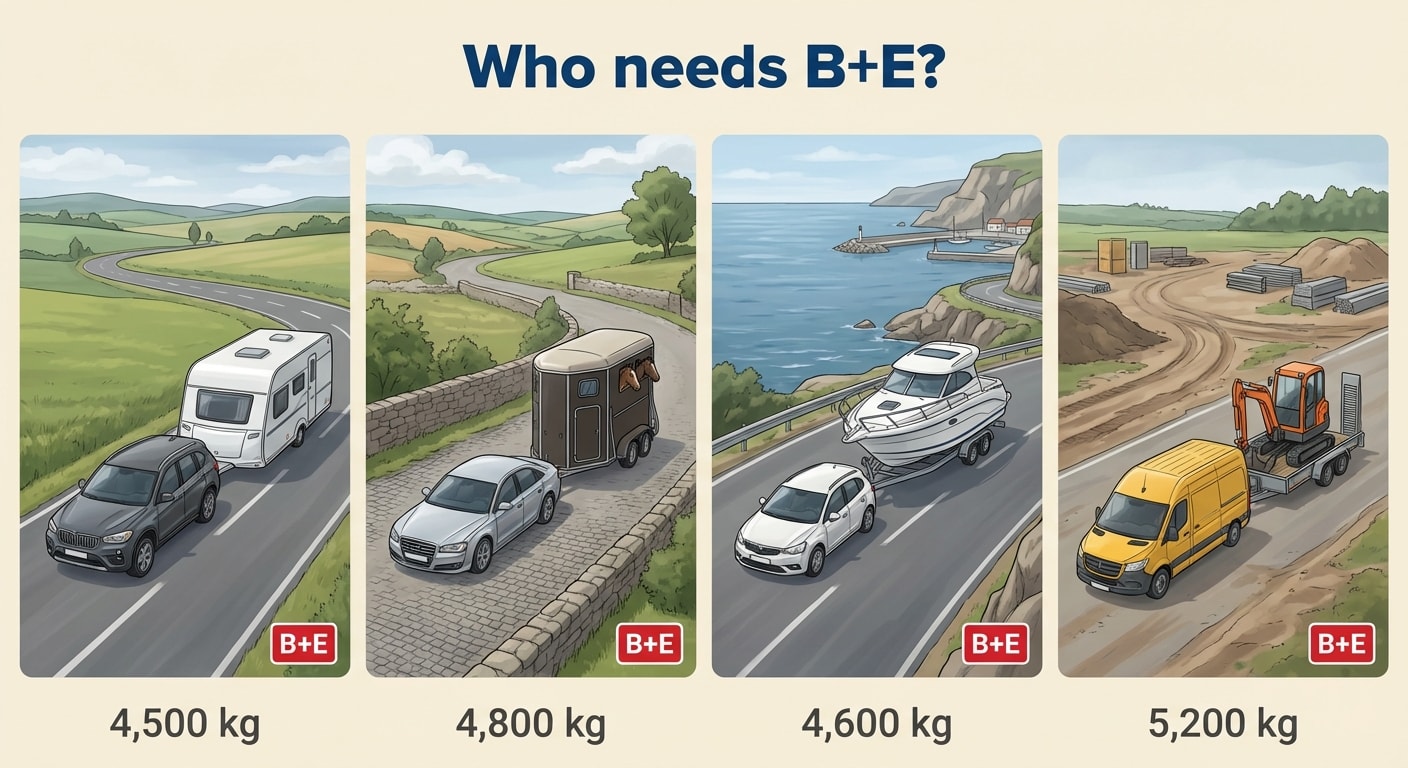
Large caravan owners top the list. Family caravans with a MAW of 1,800–2,200 kg behind an SUV with a MAW of 2,300–2,500 kg create combinations of around 4,500–4,700 kg. That's B+E territory. For a detailed breakdown of which caravan needs which category, see the chapter Caravans and Motorhomes.
Horse transporters make up the second major group. A trailer for two or more horses has a typical MAW of 2,000–3,000 kg. Behind an SUV, that easily exceeds 4,500 kg. And with horses, it's not just about paperwork — with B+E, you complete training that teaches you to drive a combination smoothly. More about horse transport and other live cargo in the chapter Towing Boats, Horses & Motorcycles.
Owners of larger boats need B+E once the boat exceeds 6–7 meters in length. A boat trailer for that size has a MAW of 2,000–2,500 kg. Behind a car with a MAW over 2,000 kg, the combination is well above the B96 limit.
Small business owners with heavy work trailers — transporting machinery, construction materials, agricultural equipment. Whenever the trailer's MAW exceeds 1,800 kg and the towing vehicle has a MAW over 2,500 kg, B96 isn't enough.
How the course works
The B+E course has two parts: theory and practice. A total of 18 training hours (45 minutes each). Act No. 247/2000 Coll. on obtaining professional competence sets the minimum requirements — and driving schools stick to them, because more hours would unnecessarily raise the price.
Theory takes 6 hours. Two sessions cover driving theory and safe driving principles for combinations — combination dynamics, braking, cornering, crosswind effects. One session covers vehicle traffic regulations, one covers vehicle operation and maintenance, one covers medical preparation (first aid), and the final hour is review. Theory takes place in a classroom, usually in two to three blocks over a week.
Practical training has 12 hours, and this is where you actually learn to drive. Eight hours are spent behind the wheel of a combination in real traffic — city, highways, open roads. You'll learn how the combination responds to steering, how braking distances differ, how to navigate an intersection with a long trailer. Two hours are practical maintenance — pre-drive inspection, hitching and unhitching the trailer, checking lights and brakes. The remaining two hours are practical first aid training.
Most driving schools spread the course over 3–4 weeks. Driving sessions typically 1–2 times per week for two hours each, theory in blocks. If you have a more flexible schedule, some schools offer an intensive variant in 2 weeks.
B+E course structure
| Part | Content | Hours (×45 min) |
|---|---|---|
| Driving theory | Combination dynamics, safe driving | 2 |
| Regulations | Vehicle traffic rules | 1 |
| Operation & maintenance | Technical preparation of the combination | 1 |
| Medical preparation (theory) | First aid | 1 |
| Review | Theory assessment | 1 |
| Driving | Combination driving in traffic | 8 |
| Practical maintenance | Hitching/unhitching, inspection | 2 |
| Practical medical preparation | Practical first aid | 2 |
| Total | 18 |
What to expect at the exam
The B+E exam has two parts: a theory test and a practical drive. Unlike B96, where only a driving test is required, here you must demonstrate theoretical knowledge as well.
The theory test is the first hurdle. You take it on a computer at the examination center. Questions cover traffic regulations — signs, right of way, duties of a combination driver. This isn't a test on "everything" like for category B — it focuses specifically on situations relevant to driving with a combination. You get one attempt. If you fail, you wait at least 5 working days for a retake.
The practical drive lasts 30–45 minutes and has four parts. You start with a pre-drive vehicle inspection — the examiner wants to see that you know what to check and why. Then comes what makes B+E unique: hitching and unhitching the trailer. You must disconnect and reconnect the trailer — properly seat the tow coupling, secure the safety cable, connect the electrics, release and engage the handbrake. With B96, this isn't tested in such detail.
Then you drive in traffic. Intersections, turning, overtaking — all with a combination that's significantly longer and heavier than what you're used to. The examiner evaluates whether you check your mirrors (the blind spot with a combination is enormous), maintain safe distances, and maneuver the combination smoothly.
And the final part: reversing with the combination. Parking, maneuvering in tight spaces. A trailer behaves counter-intuitively when reversing — and with a combination weighing 4–5 tons, it demands composure and precision. Driving schools agree that reversing is the most common reason for exam failure.
You have 3 attempts to pass the exam. All must be used within 12 months of the first date. If you fail, a theory retake costs approximately CZK 200 (driving school) + CZK 100 (office), a driving retake CZK 1,200 (driving school) + CZK 400 (office).
Hitching the trailer — a key discipline
At the B+E exam, you must disconnect and correctly reconnect the trailer. Tow coupling, safety cable, electrics, handbrake — the examiner checks every step. Practice this at the driving school as many times as you need. Incorrect hitching = automatic fail.
What it all costs
B+E is more expensive than B96 — but for more money, you get significantly more authorization. Course prices in the Czech Republic range from CZK 7,000 to 15,000. Prague and large cities are traditionally more expensive, smaller schools offer lower prices.
On top of the course fee, add mandatory charges: CZK 700 administrative exam fee, CZK 500–800 medical certificate, and CZK 200 for the license replacement. Total costs range from CZK 8,500 to 17,000.
A lot? Compare it with the alternatives. The fine for driving with a trailer without the proper license is CZK 25,000–50,000, a driving ban of 12–24 months, and 4 penalty points (Section 125c of Act No. 361/2000 Coll.). One roadside check would cost you more than the entire course. And compared to B96 (CZK 5,000–9,500), the price difference is CZK 3,000–7,000 — for that, you get a 7,000 kg ceiling instead of 4,250 kg and better preparation for real-world towing.
Total B+E costs
| Item | Cost |
|---|---|
| Driving school course (18 hours) | CZK 7,000–15,000 |
| Medical certificate | CZK 500–800 |
| Administrative exam fee | CZK 700 |
| License replacement | CZK 200 |
| Total | approx. CZK 8,500–17,000 |
B+E vs. B96 — how to decide
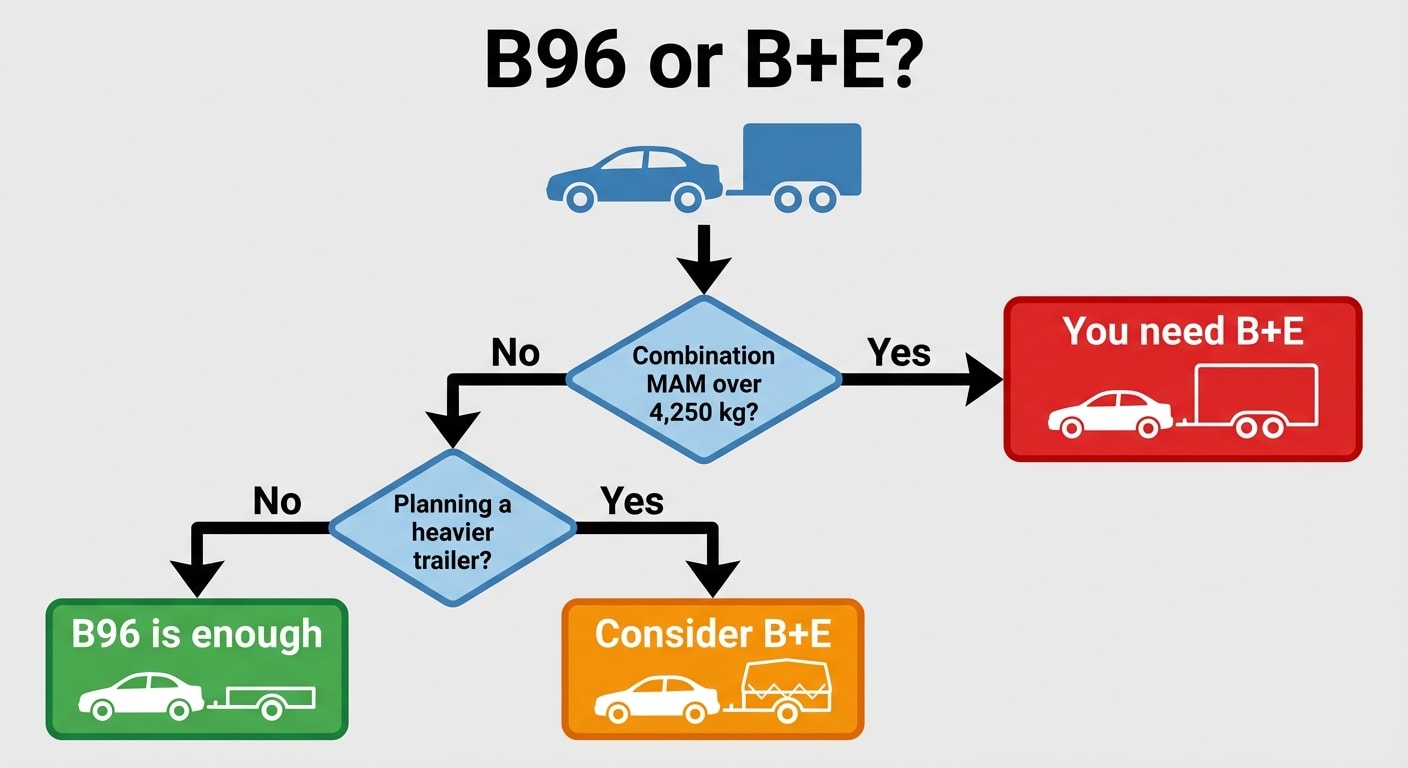
Choosing between B+E and B96 comes down to three questions.
First: how much does your combination weigh? If the total MAW is under 4,250 kg, B96 is enough and it's both cheaper and faster. If it exceeds 4,250 kg, the choice is clear — B+E.
Second: are you planning a heavier trailer in the future? If you're currently hauling a combination at 3,900 kg but plan to upgrade to something bigger in a few years, B96 will stop being enough. In that case, it makes sense to invest in B+E right away and avoid paying twice.
Third: do you mind written tests? B96 requires only a practical exam. B+E includes a theory test as well. For some, that's a reason to choose B96 — especially if their combination weight is right around the 4,250 kg threshold.
But there's also an argument that doesn't get discussed much: quality of preparation. With B+E, you complete 18 hours of training and truly learn to control a combination. With B96, you get 2–4 hours of driving — that's the bare minimum. If you plan to regularly drive with a heavy trailer, the longer B+E training is an investment in your safety. More on how to drive safely with a combination in the chapter Trailer Towing Safety.
Step by step — from registration to your new license
The entire process from the first call to the driving school to a new license card with category B+E typically takes 4–6 weeks. Here's the exact procedure.
Verify the requirements. You need a valid category B license, be at least 18 years old, have permanent residence in the Czech Republic (or work or study here for at least 6 months), and must not have an active driving ban. You'll also need a medical fitness certificate from your GP (CZK 500–800).
Choose a driving school. On Kvalty.cz, you can compare driving schools in your area that offer B+E courses. Ask about the total price (including all hours), the training format (intensive vs. standard), and what vehicle and trailer they use. The driving school will help you fill out the application.
Complete the training. Six hours of theory and twelve hours of practice. Theory takes place in a classroom, practice behind the wheel of a combination in real traffic. Driving schools typically use an SUV or wagon (Škoda Kodiaq, VW Touran) with a braked single-axle trailer (AGADOS or similar).
Pass the exam. Theory test on a computer + practical driving with a combination. The driving school arranges the date.
Pick up your new license. After passing, visit your local municipal office (transport department) with the driving school's confirmation and request a license replacement. The fee is CZK 200, processing typically takes up to 20 days.
Upcoming rule changes
EU Directive 2025/2205 plans to raise the category B limit from 3,500 kg to 4,250 kg for all fuel types. This would mainly impact B96 — its range would overlap with category B itself. But B+E will remain relevant even after this change, because it covers combinations from 4,250 to 7,000 kg.
The directive also introduces a new code 96.03 for motorhomes up to 4,250 kg with a trailer (combination up to 5,000 kg). For heavier combinations, however, B+E will remain the only option. Member states must implement the rules by November 26, 2027 — in the Czech Republic, it's expected to take effect around 2027–2029. Until then, current rules apply unchanged.
B+E stays relevant after the law changes
Unlike B96, which could lose its purpose, B+E will remain necessary for combinations over 4,250 kg. If you're planning a heavy trailer, investing in B+E pays off regardless of future legislative changes.
Summary
- B+E covers combinations up to 7,000 kg — car (max 3,500 kg) + trailer (max 3,500 kg)
- The course is 18 training hours: 6 theory + 8 driving + 2 maintenance + 2 first aid
- The exam has two parts: a theory test on computer + practical driving with a combination
- Total costs: CZK 8,500–17,000 (course + fees + medical certificate)
- From registration to your new license, expect 4–6 weeks
- If your combination is under 4,250 kg, B96 is cheaper and faster
Key Terms
| Term | Explanation |
|---|---|
| B+E (category B+E) | A standalone driving license category for combinations: car (MAW ≤ 3,500 kg) + trailer (MAW ≤ 3,500 kg), total max 7,000 kg. |
| MAW (Maximum Authorized Weight) | The maximum weight of a vehicle or trailer from the registration document — field F.1. For license categories, MAW is always used, not actual weight. |
| Hitching/unhitching | Connecting and disconnecting the trailer — tested in detail at the B+E exam: tow coupling, safety cable, electrics, handbrake. |
| Examiner | A state examiner who evaluates the test — pass / fail. Independent of the driving school. |
| Braked trailer (O2) | A trailer with its own braking system, MAW 750–3,500 kg. Typically used for B+E training and exams. |
| Section 80a of Act No. 361/2000 Coll. | The section of the Road Traffic Act that defines category B+E and its weight limits. |
| Act No. 247/2000 Coll. | The act on obtaining professional driving competence — sets the training scope (18 hours) and exam conditions. |
| Administrative fee | A fee of CZK 700 for the exam, paid to the municipal office. Retake: CZK 100 (theory) or CZK 400 (driving). |