
Choosing Your First Motorcycle — Beginner's Guide
How to choose your first motorcycle: best A2 license models, new vs. used bikes, 35 kW power restrictions, used bike inspection, and running costs.
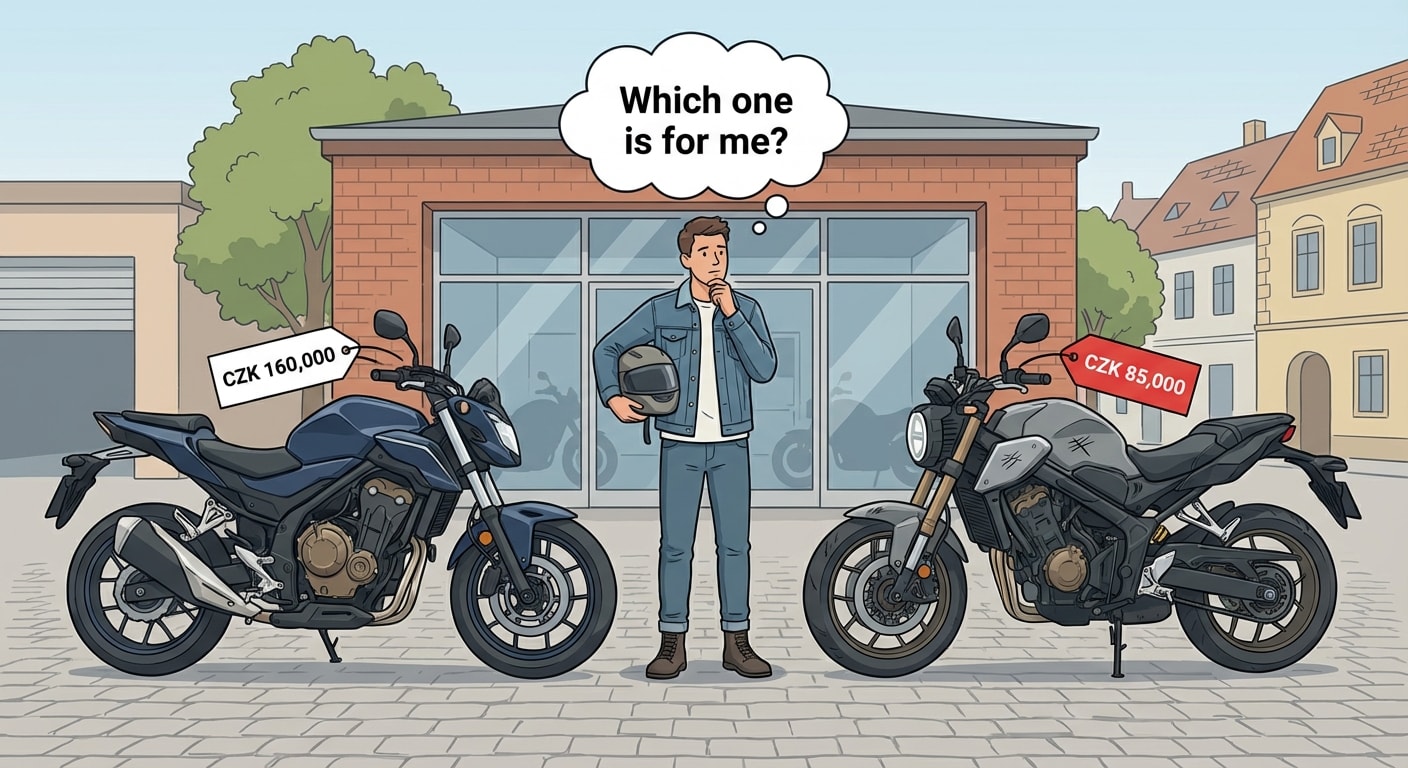
Your first drop is coming. Not maybe — definitely. Ask any motorcyclist. The question is whether that drop will cost you a few hundred crowns for a plastic cover on a used 300cc, or fifteen thousand on the fairings of a brand-new sport bike. Choosing your first machine is one of the most important decisions you'll make as a new rider. A bad pick can waste your money, kill your enthusiasm — or surprise you with power your reflexes aren't ready for.
This article will help you choose a motorcycle that fits your license, your body, your budget, and your experience. We'll walk through the legal limits, motorcycle types, specific models, the new-versus-used dilemma, and a checklist that'll tell you whether someone's selling you a problem.
Quick summary:
- With an A2 license, you can ride motorcycles up to 35 kW with a power-to-weight ratio of max 0.2 kW/kg
- Beginners do best on a naked bike — upright seating, low weight, cheap repairs after a drop
- A used bike that's 3–5 years old is the best compromise between price and modern technology
- Budget for the total: motorcycle + gear (CZK 25,000–35,000) + insurance + registration
What the law allows — the 35 kW rule
Before you start browsing specific models, you need to know what you're allowed to ride. If you hold an A2 license, Act No. 361/2000 Coll. (§80a) sets three conditions at once. The engine must not exceed 35 kW (roughly 47.6 horsepower). The power-to-weight ratio must not exceed 0.2 kW/kg — meaning a motorcycle with a full 35 kW must weigh at least 175 kilograms. And if the bike has been restricted (derestricted from higher power), its original unrestricted power must not exceed 70 kW.
In practice, this means one simple thing: buy a motorcycle designed for A2 from the factory — one that natively produces 35 kW or less. You'll avoid the hassle of restricting, extra costs, and complications with the vehicle registration document. A detailed overview of all categories and upgrade paths is in the Motorcycle license categories chapter.
What is the 'double rule'?
You can only restrict a motorcycle for A2 if its full power doesn't exceed 70 kW (double the 35 kW limit). A Yamaha MT-07 with 54.4 kW? Yes, you can restrict that. A Kawasaki Z900 with 92.2 kW? No — it's over the limit, even if someone restricted it to 35 kW.
Types of motorcycles — which one fits you
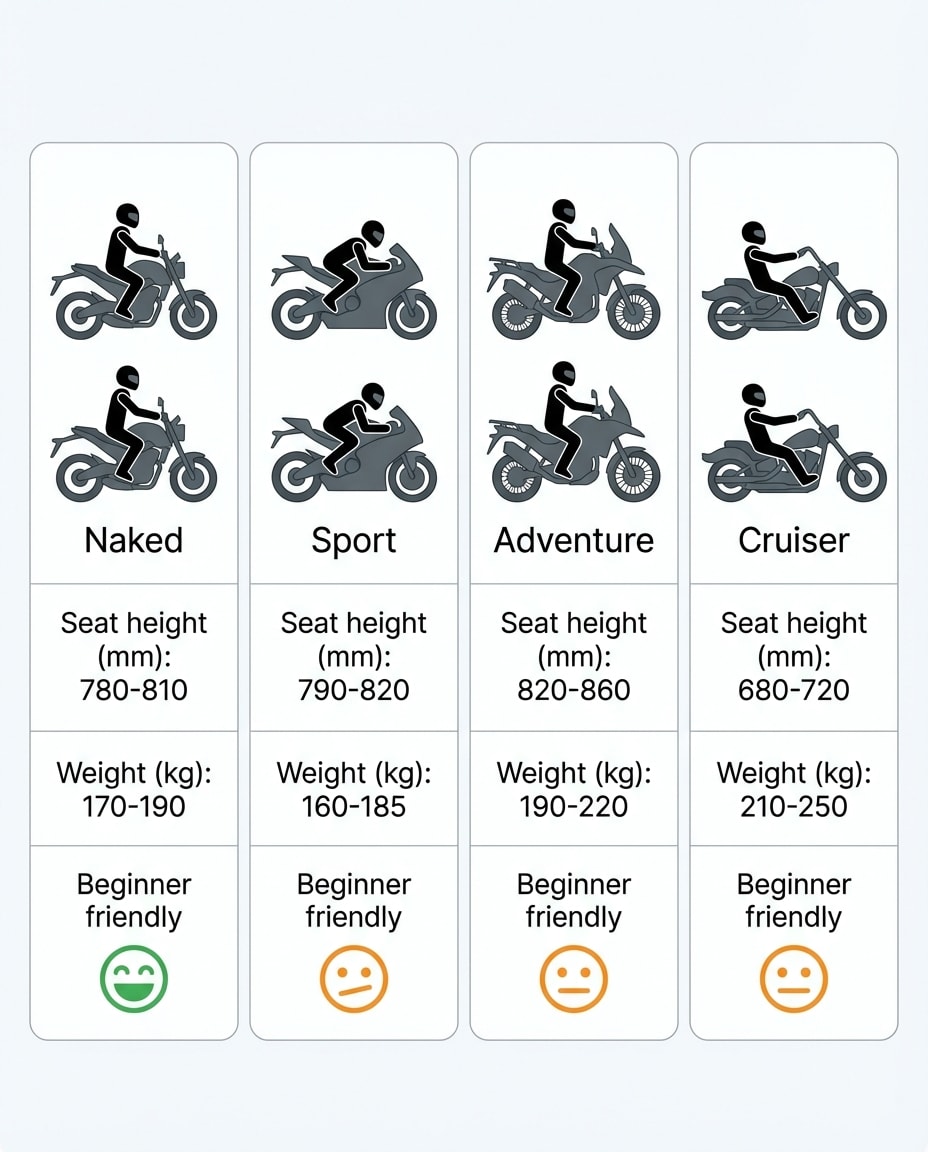
Motorcycles fall into several basic categories, each designed for a different riding style. Before you fall in love with the looks of a specific model, think about where and how you'll ride most often.
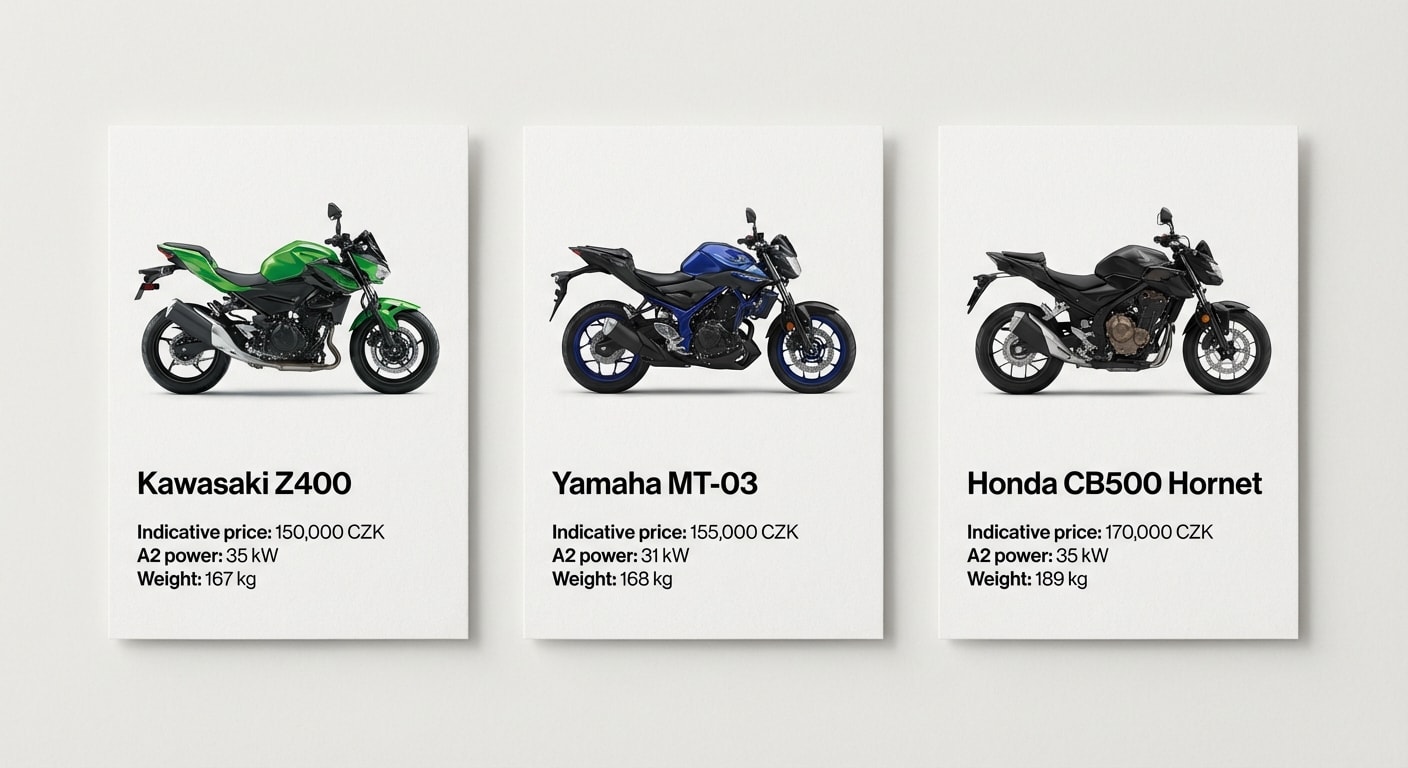
Naked bikes are hands down the best choice for beginners. You sit upright with a good view of traffic, the bike is relatively light, and there's no fairing — so when you make that inevitable slow-speed mistake in a parking lot and the bike tips over, repairs cost a few hundred crowns. Honda CB500 Hornet, Yamaha MT-03, KTM 390 Duke, or Kawasaki Z400 — these are all naked bikes that sell like hot cakes in the A2 segment.
Sport bikes (Yamaha YZF-R3, Kawasaki Ninja 400) tempt you with their looks and sound. But be honest with yourself: the forward-leaning position will tire your back and wrists much sooner than you expect, and sport bikes make it harder to learn riding technique in everyday traffic. Fairings get expensive when you drop them. If you crave a sporty experience, nakeds like the MT-03 or KTM Duke deliver more of it than you'd think — without the downsides.
Adventure and enduro bikes (BMW G310 GS, Honda CB500X, Royal Enfield Himalayan 450) have a higher seating position and big wheels. They're great for longer trips and can handle unpaved roads. But expect higher weight and a taller seat height, which can be a problem for shorter riders.
Cruisers (CFMoto 450CL-C, Jawa 300 CL) offer a low seat, relaxed position, and a style made for weekend rides. The low seat height is an advantage for shorter riders. Maneuverability in the city is worse than a naked, though.
How to choose based on your body
Seat height and motorcycle weight aren't just catalog numbers — they directly affect how safely and confidently you'll ride. The basic rule: you must be able to comfortably reach the ground with at least one foot flat. If you're standing on tiptoes, every stop at a traffic light turns into a stressful experience.
A seat height around 770–800 mm suits most people, including shorter riders. The mid-range of 800–830 mm is standard and works for an average-height person. Above 830 mm, you're looking at adventure bikes and tall enduros — expect discomfort if you're shorter than about 175 cm.
Weight is the second key factor. For a beginner, a bike under 180 kg wet weight is ideal. A lighter machine is easier to handle during slow maneuvers, parking, and uphill starts. And when it falls over (and it will), it's easier to pick up. A 220 kg bike is comfortable for an experienced rider. For someone with a few months of practice, it's an unnecessary complication.
An important tip: don't rely on numbers alone. Always sit on the bike at a dealer or seller. Seat height doesn't tell the whole story — the width of the seat and weight distribution matter too. Two bikes with the same seat height can feel completely different.
Best A2 motorcycles 2025–2026
The Czech market offers dozens of models in 2026 that meet A2 limits straight from the factory. Here's a rundown of those that give you the most for your money.
Among nakeds, the Kawasaki Z400 reigns — for roughly CZK 130,000 you get 35 kW, a weight of 167 kg, and reliability confirmed by thousands of owners. The Honda CB500 Hornet with E-Clutch technology is the 2026 novelty — the automatic clutch forgives every botched start and gear change. It costs around CZK 160,000, but for someone who dreads the manual clutch, it could be a game-changer. The Yamaha MT-03 (CZK 161,000) and KTM 390 Duke (CZK 164,000) are proven classics with an excellent power-to-weight ratio.
If you're after the lowest price for a new bike, check out the CFMOTO 300SR at just under CZK 85,000. The Chinese brand has made huge strides in quality in recent years, and this model offers 27 kW for a price that elsewhere would only buy a used bike. Another budget-friendly option is the Jawa 300 CL at CZK 130,000 — a retro cruiser with Czech heritage.
For adventurers, there's the Royal Enfield Himalayan 450 at CZK 155,000. An adventure bike with 29.4 kW that handles both tarmac and gravel. And if cruiser style appeals to you, the CFMoto 450CL-C at CZK 149,000 is a modern machine with 32.5 kW and a design that looks pricier than it is.
A2 motorcycle overview — new models 2025–2026
| Model | Displacement | Power | Weight | New price | Type |
|---|---|---|---|---|---|
| Kawasaki Z400 | 399 cc | 35 kW | 167 kg | ~CZK 130,000 | Naked |
| Kawasaki Z500 | — | 35 kW | — | ~CZK 147,000 | Naked |
| Honda CB500 Hornet | 500 cc | 35 kW | 188 kg | ~CZK 160,000 | Naked |
| Yamaha MT-03 | 321 cc | 30.9 kW | 168 kg | ~CZK 161,000 | Naked |
| KTM 390 Duke | 373 cc | 33 kW | 165 kg | ~CZK 164,000 | Naked |
| CFMOTO 300SR | 292 cc | 27 kW | 165 kg | ~CZK 85,000 | Sport |
| Jawa 300 CL | 295 cc | 17 kW | 182 kg | ~CZK 130,000 | Retro |
| Kawasaki Ninja 400 | 399 cc | 34 kW | 168 kg | ~CZK 140,000 | Sport |
| Yamaha YZF-R3 | 321 cc | 30.9 kW | 169 kg | ~CZK 161,000 | Sport |
| Royal Enfield Himalayan 450 | 450 cc | 29.4 kW | 196 kg | ~CZK 155,000 | Adventure |
| CFMoto 450CL-C | 449 cc | 32.5 kW | 183 kg | ~CZK 149,000 | Cruiser |
New vs. used — what's better for a beginner
This is the question every new rider wrestles with. And the answer isn't as clear-cut as it might seem.
A new motorcycle brings peace of mind. You get a two-year manufacturer warranty, you know nobody before you crashed it, overheated the engine, or burned the clutch. Modern electronics — ABS, traction control, riding modes — forgive more mistakes. Honda's E-Clutch even takes the worry out of manual shifting. And the first years of ownership are the cheapest in terms of maintenance. The catch? Price. A new A2 naked costs CZK 130,000 to 165,000. And its value drops 20–30% in the first year.
A used motorcycle has different advantages. For CZK 60,000 to 120,000, you get a three- to five-year-old machine that's been broken in, with modern technology at a fraction of the original price. Less depreciation. And most importantly — the first scratches hurt a lot less psychologically. Every beginner occasionally forgets to fold the kickstand, misjudges a lean, or lets the bike drift too far while parking. On a used bike worth CZK 80,000, it's "oh well, a scratch" — on a new one worth CZK 160,000, it's drama.
The downside of used? You don't know what the previous owner did with it. Hidden defects, wear, insufficient servicing — these are risks a new bike doesn't carry. That's why a thorough pre-purchase inspection is absolutely essential.
Experts agree on one recommendation: a nearly-new bike that's 3–5 years old is the best compromise for a beginner. Modern tech (ABS has been mandatory on new motorcycles over 125 cc since 2017), reasonable price, and less heartache from the first scratches. If you go the new-bike route, choose a smaller displacement — 300 to 400 cc. Less pain from initial damage and a lighter machine that's more forgiving of mistakes.
Why not buy an oversized restricted bike
Technically, you can restrict a bike with up to 70 kW for A2 — like a Yamaha MT-07. That's a sensible choice — it's light and well-balanced. But a heavy, large-displacement bike throttled to 35 kW is sluggish, impractical for learning, and expensive to maintain. Buy a machine designed for your power range. When you have a full A license, that's the time for a bigger bike.
Used motorcycle inspection — 10 points not to skip
A used motorcycle is essentially non-returnable. Once you take it, all the problems are yours. That's why you need to take the pre-purchase inspection seriously. Here's a checklist every used bike should pass.
Start with the documents. The VIN on the frame must match the VIN in the vehicle registration document — no exceptions. Check the bike through Cebia.cz or online vehicle history: not stolen, not leased, not a total loss. This is the baseline that catches the worst scams.
Next, look at the seller. Quality photos in the listing, willingness to show the bike in person, no deposits before viewing. If the seller refuses a phone call or insists on a deposit before you've even seen the bike, walk away. There are plenty of used bikes on the market.
Have the engine started cold — ask for this explicitly. A cold start reveals problems that a warmed-up engine hides. Check the oil color: a milky tint means coolant contamination, which is a serious issue. Listen for abnormal knocking, ticking, or hissing. Inspect the air filter — a neglected filter signals neglected maintenance overall.
Check the cooling system twice — once cold (coolant color, no soot) and once after the engine warms up (no bubbles in the radiator, which would signal a leaking head gasket).
Test the suspension and steering by pushing the forks down several times. The suspension should be smooth, with no creaking and no oil leaks. Wheels must be straight and steering must turn smoothly from lock to lock without dead spots or grinding.
Inspect the brakes both visually and functionally. Brake pads should show even wear, braking must be smooth without vibrations or pulling to one side. The color of the brake fluid tells you about the service history — dark and cloudy fluid means nobody changed it in years.
Consumable parts are your bargaining chips. Chain and sprocket condition, tire tread depth, brake pad wear — these all cost money and you can use them to negotiate the price down.
Examine the bodywork and paint carefully. Paradoxically: a bike that's too clean may be hiding problems. Look under the fairings — poorly done repairs, glue instead of bolts, questionable replacement parts. Typical drop zones are handlebar ends, levers, footpegs, and engine covers. A scratched engine cover tells you more than the seller's words.
Finally, legal status. Homologation stickers on the lights must be present, mirrors must have a minimum diameter of 75 mm, and any aftermarket exhaust must have homologation — the original exhaust should be included.
When in doubt, walk away
If something doesn't add up during the inspection — the seller gives evasive answers, the engine makes suspicious noises, documents don't match — walk away. No motorcycle is worth the risk of buying a problem. There are plenty of used bikes on the market and the right one will come along.
Power restriction — when a derestricted bike makes sense
There's one more way to get a bigger machine with an A2 license: have the motorcycle's power restricted. In Czechia, this is done using homologated restriction kits, most commonly from the German company Alpha Technik, approved by the Czech Ministry of Transport. It's a mechanical modification — not software — that reduces power to the required limit.
The process works like this: you order a kit with the motorcycle's VIN. The manufacturer in Germany verifies compatibility and sends the kit (roughly CZK 5,000–15,000 depending on the model). A mechanic installs it and the modification gets recorded in the vehicle registration document. Once you eventually get a full A license, you remove the kit and the bike returns to full power — again with a registration document update.
When does this make sense? If you plan to upgrade to a full A license within two years and want to keep the same bike. A Yamaha MT-07 restricted from 54.4 kW to 35 kW is still an excellent machine — and after derestriction, you have a powerful bike without having to sell and buy again.
When doesn't it make sense? If you're buying your first bike to learn on and don't have a clear plan to upgrade to A. In that case, buy a bike designed for A2 from the start. It's simpler, cheaper, and the motorcycle is optimized for its power range.
What comes after the purchase — registration, gear, insurance
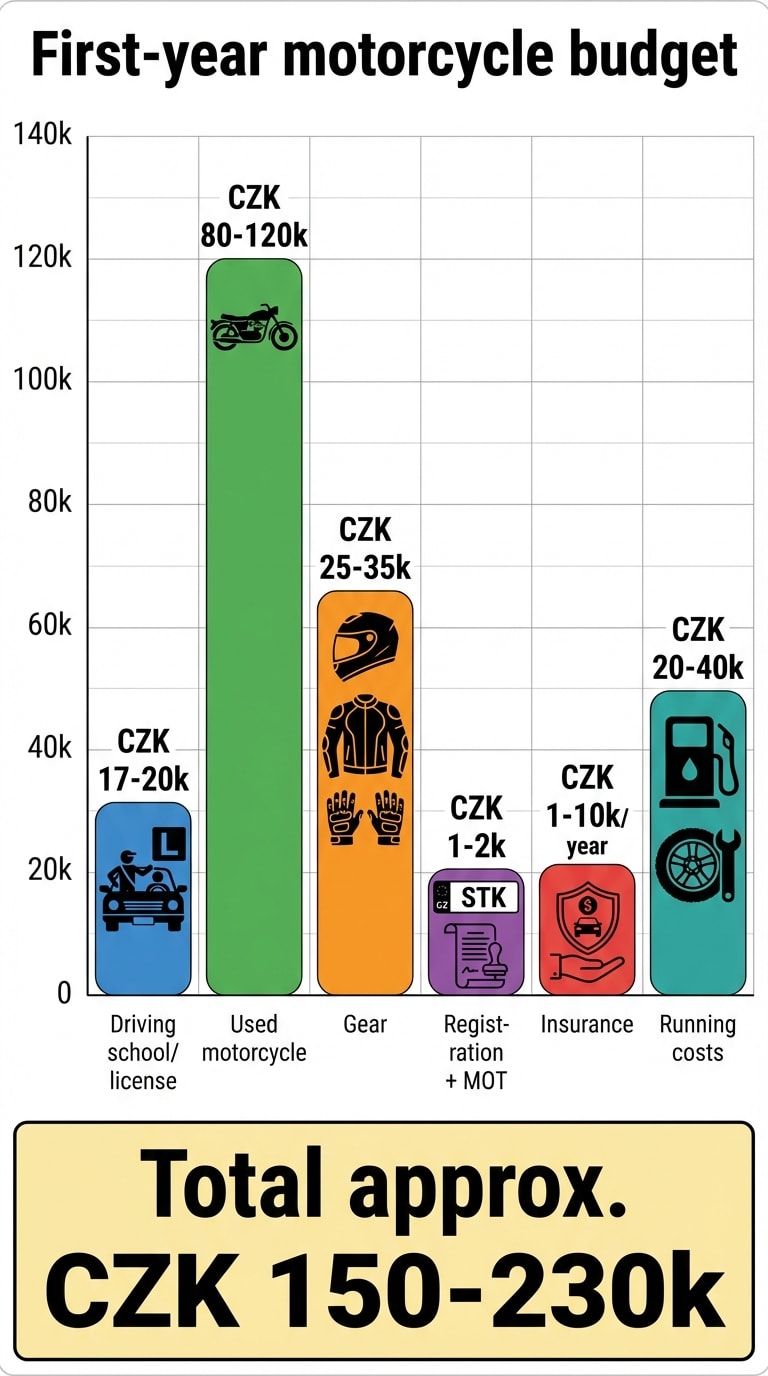
Buying the motorcycle is just the beginning. Several more steps and costs await you, and you need to account for them in your budget.
Registration of a new motorcycle is usually handled by the dealer. For a used bike from a private seller, you handle it yourself — you need the purchase contract, vehicle registration document, green card (insurance), and an administrative vehicle inspection. You do everything at a municipality office with extended jurisdiction. Since 2024, you don't need to carry a physical green card or driver's license — verification is done electronically. MOT (technical inspection) for a new motorcycle comes first after 6 years, then every 4 years. It costs around CZK 400–500.
Don't underestimate protective gear. The law only requires a helmet and a first-aid kit, but reality is different — 80% of motorcycle accidents result in injury, and a cotton t-shirt wears through in less than a second sliding on asphalt. A sensible set (ECE 22.06 helmet, armored jacket, pants, gloves, ankle-high boots) will cost you CZK 25,000–35,000. Details and recommendations are in the Safety and gear chapter.
Mandatory liability insurance is a legal requirement for every registered motorcycle. The price ranges from about CZK 800–2,000 per year depending on engine displacement, your age, and location. Comprehensive insurance is voluntary, but in 2024, 792 motorcycles were stolen in the Czech Republic — 50% more than the year before. Everything about insurance, seasonal options, and saving tips is in the Motorcycle insurance chapter.
And don't forget running costs. An A2-category motorcycle (300–500 cc) will cost you roughly CZK 20,000–40,000 per year — fuel, servicing, insurance, tires. If you add up the license cost and the bike itself, your first year on a motorcycle is an investment. But an investment that's worth it.
Summary
- With A2, you can ride motorcycles up to 35 kW, with a 0.2 kW/kg ratio and the double rule (max 70 kW unrestricted power)
- Naked bikes are the best choice for beginners — light, good visibility, cheap to repair after drops
- A nearly-new used bike (3–5 years old) offers the best price-to-value ratio; scratches on a new bike hurt more
- Always inspect a used bike thoroughly: VIN, cold start, brakes, consumables, legal status
- A restricted motorcycle only makes sense if you plan to upgrade to a full A license soon
- Add gear (CZK 25,000–35,000), insurance, and running costs to the bike's price
Key terms
| Term | Explanation |
|---|---|
| A2 limit 35 kW | Maximum motorcycle power for category A2 — roughly 47.6 horsepower |
| Power-to-weight ratio 0.2 kW/kg | A motorcycle with 35 kW must weigh at least 175 kg |
| Double rule | A restricted bike must not have unrestricted power exceeding 70 kW (2 × 35 kW) |
| Naked bike | A motorcycle without fairings with an upright seating position — ideal for beginners |
| Power restriction | A mechanical modification to lower a bike's power output, recorded in the registration document |
| E-Clutch | Honda technology — an automatic clutch that makes shifting easier for beginners |
| ABS | Anti-lock braking system — mandatory on new motorcycles over 125 cc in the EU since 2017 |
| Wet weight | Motorcycle weight with a full tank and operating fluids — the number you care about when choosing |
| VIN | Vehicle Identification Number — must match on the frame and in the registration document |
| Administrative vehicle inspection | Mandatory inspection when transferring a used vehicle to a new owner |