
How to Fight a Traffic Fine — Appeals & Deadlines
File an objection within 8 days, appeal within 15. When fighting a fine is worth it, your rights as the accused, and what it costs. Practical guide.
A police officer hands you a ticket, you're convinced you did nothing wrong — and yet most drivers just pay on the spot and drive away. Of the more than two million fines issued in 2024, an estimated 80–90% were settled on the spot without a single objection. Yet Czech law gives you a whole range of tools to fight back. But defense comes at a cost — in money, time, and nerves. The key is knowing when fighting is worth it and when it's better to pay.
This chapter shows you exactly the three situations you can find yourself in, your rights in each of them, the specific deadlines you must not miss, and a realistic look at what fighting will cost you. No legal jargon — just a practical step-by-step guide.
Quick summary:
- You can refuse an on-the-spot fine — the case goes to administrative proceedings
- Against a mailed penalty order, file an objection within 8 days — the order is cancelled entirely
- Against a decision in administrative proceedings, appeal within 15 days
- The ban on reformatio in peius applies — if only you appeal, they can't give you more
- Administrative proceedings cost an extra CZK 2,500 in procedural fees (since 1 July 2024)
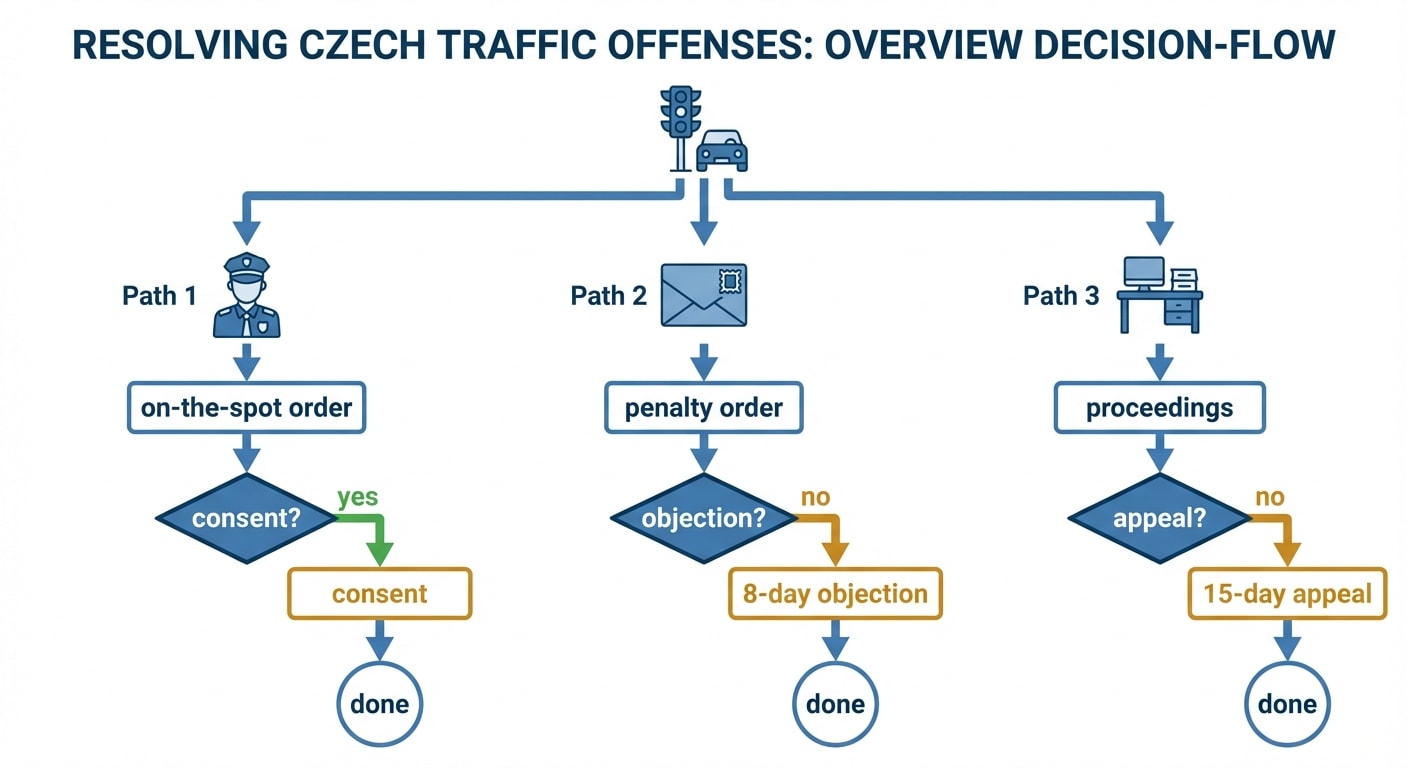
Three ways a traffic offense gets resolved
Before you start thinking about defense, you need to know where in the system you currently are. Czech law recognizes three ways a traffic offense can be processed, and each has different rules of the game.
On-the-spot order is what everyone used to know as a "block fine." Since 2024, it's officially called an on-the-spot order (Section 91 of Act No. 250/2016 Coll.), but the principle is the same. A police officer or municipal officer stops you, tells you what you did, and offers to settle it right there — no paperwork, no office. The maximum on-the-spot fine is CZK 5,500 for specific traffic offenses, or up to CZK 10,000 overall.
The catch is that once you agree and sign, it's final. The Czech Ombudsman confirmed this clearly: consent to an on-the-spot order cannot be revoked later. There's no "I changed my mind." So the first and most important rule is: if you have doubts, don't sign.
Penalty order proceedings are the "desk" variant. The administrative authority sends you a penalty order by mail — typically after a speed camera or traffic camera caught your car and the office tracked you down. You get an envelope containing the order with the fine amount. Against this order, you can file an objection within 8 days of delivery. You don't even need to give reasons — writing "I file an objection against order No. XYZ" and sending it to the office is enough. A timely objection cancels the entire order and the case proceeds to full administrative proceedings.
Administrative proceedings are full-scale offense proceedings with evidence gathering. This is where you have the most rights — but it also takes the longest and costs the most. The authority gathers evidence, you can defend yourself, and at the end comes a decision. You can appeal that decision within 15 days. If you don't succeed in the appeal either, a court action at the regional court remains.
Watch the deadlines — they're non-negotiable
Objection: 8 days from delivery of the order. Appeal: 15 days from delivery of the decision. Court action: 2 months from delivery of the final decision. Miss the deadline by even one day and your right to remedy expires. The delivery date is the day you pick up the letter, or the tenth day after it was deposited at the post office — even if you never collect it.
Your rights as the accused
The word "accused" sounds scary, but it's simply the legal term for the person against whom offense proceedings are running. And that status comes with rights that nobody can take away from you.
First: the burden of proof lies with the authority, not with you. You don't need to prove your innocence — the authority must prove that you committed the offense. This is the principle of presumption of innocence and it applies to traffic offenses too, not just criminal cases.
You have the right to remain silent. If your testimony could put you or your close relatives (spouse, family members, partner) at risk, you can refuse it. You have the right to a lawyer — you can bring one in at any point during the proceedings. You have the right to inspect the entire case file and make copies. You can propose your own evidence: witness testimonies, expert opinions, photographs, GPS records, dashcam footage. And you have the right to question witnesses and experts called by the authority.
Also important is the in dubio pro reo principle — in doubt, rule in favor of the accused. If the authority cannot prove your guilt reliably, it must discontinue the proceedings.
Practical tip: document everything immediately
If a police officer stops you, ask for a copy of the offense report. Photograph the measurement location, signs, traffic lights — anything that could be evidence. Ask about the radar unit number and the date of its last calibration. These details can later determine whether you pay the fine or not.
How to file an objection and appeal — step by step
If you receive a penalty order by mail, you have 8 days to file an objection. An objection is the simplest legal remedy in Czech law. You don't need to state reasons, you don't need to argue, you don't need a lawyer. One sentence is enough: "I file an objection against order No. [order number] dated [date]." Send it by registered mail to the address of the administrative authority that issued the order — the address is on the order itself.
A timely objection cancels the entire order and the case automatically moves to full administrative proceedings. Here's the crucial thing: the ban on reformatio in peius applies (Section 90(3) of Act No. 250/2016 Coll.). In the subsequent proceedings, they cannot impose a higher fine than what was in the order. So you don't need to worry about making things worse by objecting.
Appealing a decision in standard proceedings is a bit more complex. You have 15 days from delivery of the decision. The appeal is filed with the first-instance authority (which forwards it to the appellate body — the regional office). Unlike an objection, simply writing "I disagree" won't do here. You need to present specific arguments: why the decision is wrong, what evidence was overlooked, where the authority made errors.
The appellate body reviews the entire case in full scope — not just what you argue. And again, the ban on reformatio in peius applies: if only you appeal (and not the administrative authority), they cannot give you a harsher penalty.
If you don't succeed in the appeal either, you still have a court action at the regional court. You have 2 months from delivery of the final decision and you'll pay a court fee of CZK 3,000. Legal representation at this stage isn't mandatory, but it's definitely useful — administrative court proceedings have their specifics.
When fighting is worth it — and when it's not
This question matters more than all the deadlines combined. Because you can always fight — but you shouldn't always fight.
Look at it as an equation. On one side, you have the fine, points, and a possible driving ban. On the other side, you have time, stress, and the costs of defense. Since 1 July 2024, the flat-rate procedural costs for administrative proceedings jumped from CZK 1,000 to CZK 2,500 — and they're paid by whoever is found to have committed the offense. If you don't pay on the spot and lose in administrative proceedings, you pay the fine plus CZK 2,500 in costs.
Example: When fighting doesn't pay off
A police officer fines you CZK 1,500 for slightly exceeding the speed limit in town. You refuse, the case goes to the office. In administrative proceedings you get CZK 2,000 + CZK 2,500 in costs = CZK 4,500 total. Plus a few hours of your time. Unless you have a strong argument against the measurement, it's better to pay on the spot.
On the other hand: fighting makes sense when you face a high fine (over CZK 5,000), penalty points that push you closer to losing your license, or a driving ban. Here, the stakes go beyond a few thousand — losing your license means losing mobility, sometimes even your job. If you have reason to doubt the accuracy of the measurement, if you're not sure the offense even happened, or if you have evidence in your favor — fight back.
You'll find a detailed table of fines and points for each offense in the chapter Overview of Offenses and Fines. If you're specifically dealing with a speed camera, check out Speeding — it includes measurement tolerances and tips on challenging radar readings.
Vehicle operator — the special radar situation
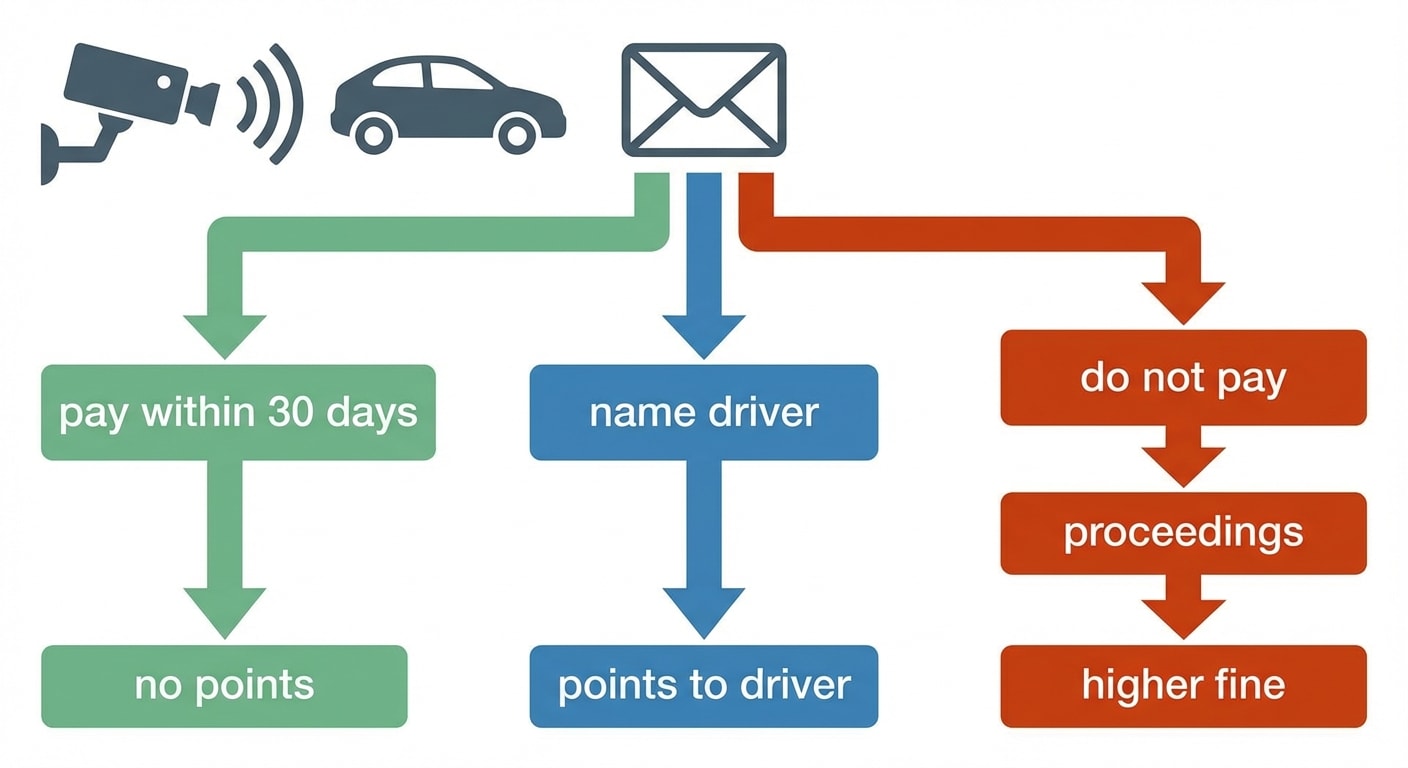
One of the most common situations where drivers ask about defense: a speed camera or traffic camera photographs your car, but you can't identify the driver in the image. The authority in such cases sends a payment notice to the vehicle operator — meaning the person the car is registered to.
This is where Section 125f of the Road Traffic Act comes in: objective liability of the operator. In simple terms: even if you weren't driving, you're responsible for who used your car. You have three options.
First: pay the payment notice within 30 days. The case closes without points, without a record, without proceedings. This is often the cheapest option. Second: tell the authority who was driving. The points and fine go to the actual driver. Third: do nothing — but then administrative proceedings follow with a higher fine plus CZK 2,500 in costs.
There's also the option where you don't want to name the driver because they're a close relative (spouse, family member, partner). The law gives you the right not to identify a close person if they would face penalties. In that case, you receive a fine as the operator — but without points and without a driving ban. It's a deliberate compromise that the law allows.
More about speed camera fines and radars in the chapter Speeding.
Statute of limitations — a safety net you shouldn't count on
Most traffic offenses have a limitation period of 1 year from the date committed (Section 30 of Act No. 250/2016 Coll.). The absolute limit — after which liability for the offense expires regardless of anything — is 3 years. For serious offenses with fines above CZK 100,000, the periods are longer: 3 years limitation and 5 years absolute.
But watch out: the limitation period gets interrupted. As soon as the authority delivers a notice of proceedings initiation, the period starts running again from the beginning. The same happens when a verdict on guilt is issued. In practice, this means you can't count on the statute of limitations as a guaranteed escape — authorities usually manage to act in time. It's more of a safeguard against forgotten cases.
As for enforcing a fine: if a fine is imposed with legal force and you don't pay, the authority can enforce it for 6 years after the year in which the arrears became due. That's effectively up to 7 years.
Offense vs. crime — where defense takes on a different dimension
If your situation approaches the boundary of a criminal offense — alcohol above 1.0‰, an accident with injury or death, fleeing the scene of an accident — then we're no longer talking about fighting a fine. We're talking about defending against criminal charges. That's a completely different world with different rules, where a lawyer is a necessity, not a luxury.
If you want to know exactly where the line between an offense and a crime lies, check the chapter Criminal Traffic Offenses. And if you're dealing with alcohol, the chapter Drunk Driving explains what penalties apply at which blood alcohol level and why refusing a breathalyzer test is paradoxically worse than a positive result.
Summary
- You don't have to accept a fine on the spot — you have the right to refuse and let the office handle it
- Against a mailed penalty order, file an objection within 8 days — one sentence is enough, the order is cancelled entirely
- Against a decision in administrative proceedings, appeal within 15 days — with specific arguments
- The ban on reformatio in peius applies — the appellate body can't give you more if only you appeal
- Administrative proceedings cost CZK 2,500 (since 1 July 2024) — consider whether fighting is financially worth it
- With speed cameras, as the vehicle operator you have three options: pay the notice, name the driver, or risk proceedings
Key Terms
| Term | Explanation |
|---|---|
| On-the-spot order | A fine settled directly with the police officer — used to be called a "block fine." Consent is irrevocable. |
| Penalty order proceedings | The authority sends you an order by mail. You have 8 days to object, otherwise it becomes legally binding. |
| Objection (odpor) | A legal remedy against a penalty order. You don't need to state reasons. The order is cancelled entirely. |
| Appeal (odvolání) | A legal remedy against a decision in administrative proceedings. 15-day deadline, must include arguments. |
| Court action (správní žaloba) | Last resort — a lawsuit at the regional court against a final decision. Court fee CZK 3,000. |
| Reformatio in peius | A ban on harsher punishment on appeal — if only you appeal, they can't give you more. |
| Presumption of innocence | The authority must prove your guilt. You don't have to prove your innocence. |
| Objective operator liability | The car owner is responsible for an offense caught by camera, even if they weren't driving (Section 125f). |
| Statute of limitations | An offense expires after a certain period — usually 1 year, absolute maximum 3 years. |
| Flat-rate procedural costs | A CZK 2,500 fee for administrative proceedings — paid by whoever is found to have committed the offense. |