How to Choose a Driving School — 12 Questions to Ask
What to ask, how to spot a bad driving school, and why the instructor matters more than price. Selection criteria, red flags, manual vs. automatic.
A bad driving school can cost you dozens of extra hours and thousands of crowns. And most people make this mistake — they pick based on price because it's the first number they see. But the difference between a CZK 15,000 school and a CZK 20,000 school vanishes the moment you fail your exam and start paying for extra lessons at CZK 600 per hour.
There are roughly 3,000 registered driving schools in Czechia. Quality varies dramatically — from excellent schools where you pass on the first try and actually enjoy learning to drive, to operators who cut lesson times short and log sessions that never happened. This chapter gives you concrete tools to tell them apart. By the end, you'll know what to ask, what to look for, and when to walk away.
Quick summary:
- Instructor quality matters more than course price — a bad instructor = failing the exam = more money spent
- Ask the school 12 specific questions before enrolling (listed below)
- Watch for red flags: "price by agreement," suspiciously low prices, shortened lessons
- If the school isn't working out, you have a legal right to transfer to another one at any time (Section 19)
Why the Instructor Matters More Than Price
If you take one thing from this entire chapter, let it be this: the quality of your driving instructor is the single most important factor. Not price. Not how close the school is to your home. Not whether they have new cars.
A good instructor explains driving in a way you actually understand. They stay patient when you stall the engine for the fifth time at an intersection. They teach you not just how to operate the car, but how to read traffic and react to situations you'll face both at the exam and in real life. A bad instructor stresses you out, yells, or just doesn't explain things — and then you sit at the exam not knowing what to do.
The first-attempt pass rate in Czechia hovers around 60–70%. That means three out of ten students fail. And a significant portion of them fail not because they can't drive, but because the instruction didn't prepare them properly. Failing the practical exam means a CZK 400 retry fee, another 5–10 extra lessons at CZK 500–800 per hour, and weeks of additional waiting. The difference between a "cheap" school and a "pricier one with a better instructor" easily disappears after one failed attempt.
By law, a driving instructor must be at least 24 years old and hold a professional certificate. But that's just the formal minimum. You'll recognize a good instructor by their ability to explain things in plain language, stay calm in stressful situations, and adapt the pace of teaching to you. If you're up for it, ask whether a trial lesson is available — some schools offer them.
What if your instructor isn't a good fit?
You have the right to request a different instructor within the same school. If that doesn't help, you can transfer to a different driving school at any time — the law guarantees it (Section 19 of Act No. 247/2000 Coll.). Never let anyone convince you that you have to stay.
What to Look for When Choosing
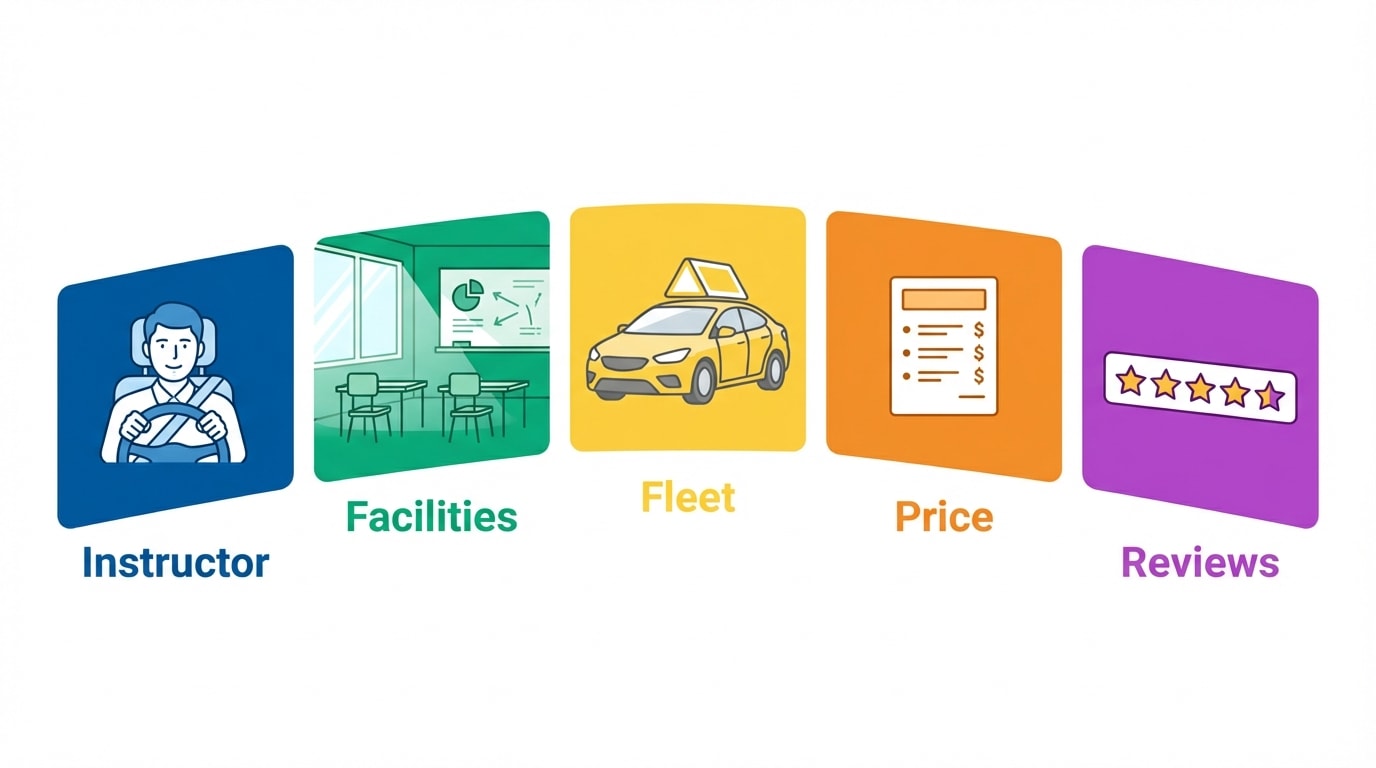
The instructor is the foundation, but you can't evaluate them until you start driving. That's why you also need to look at other things that reveal who you're dealing with.
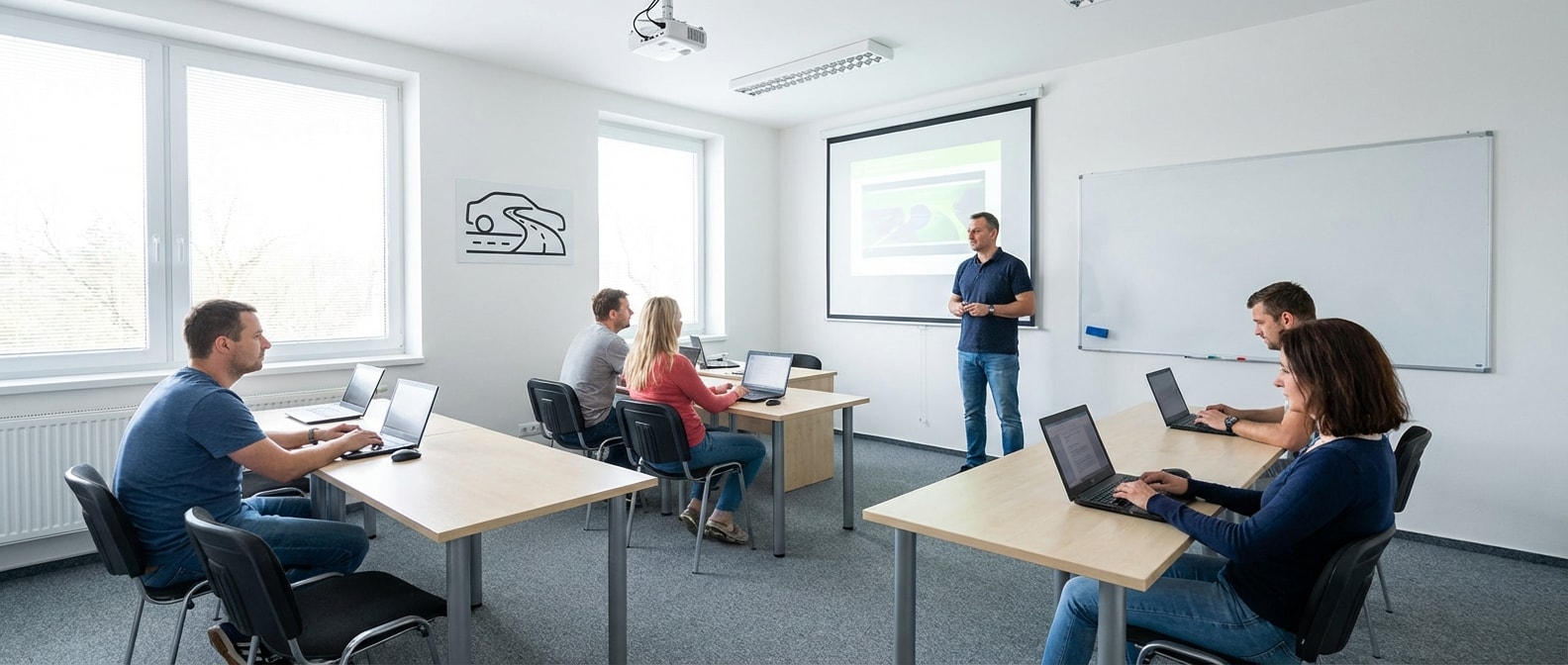
Facilities and premises say a lot. A solid driving school has its own space with regular opening hours where theory classes take place. Modern equipment — a projector, computers, maybe even a simulator — signals that the owner invests in the school. On the other hand, lessons held in a rented café or a bare apartment are a warning sign.
The vehicle fleet matters because you'll spend at least 28 hours in those cars. The age and condition of the vehicles speak for themselves. Modern cars have driver assistance systems that you'll learn to use and encounter in everyday driving. Air conditioning in summer and a clean interior are baseline expectations — if a school can't keep its cars clean, ask yourself what else they're neglecting.
Price and transparency go hand in hand. A standard category B course in Czechia costs CZK 17,000 to 25,000 — regional differences are significant. You'll find a detailed price comparison by region in the chapter How Much Does Driving School Cost. The key question is whether the school tells you exactly what's included in the price and what costs extra. A fair school publishes its price list on its website. If you have to call to ask about pricing and hear "it depends" or "price by agreement," keep looking.
Reviews and references are valuable, but take them with a grain of salt. A personal recommendation from a friend or classmate carries more weight than anonymous online reviews. Only positive reviews may be fake — a few negative ones are actually normal. On Kvalty.cz, you can find reviews from real students to help you form an opinion.
Lesson frequency and organization affect how quickly and how well you learn to drive. Ideally, you drive 1–2 times per week. Long gaps between lessons lead to forgetting — and worse performance at the exam. When a school promises 2–3 lessons per week, verify that with current students, not just the front desk. More on how lessons are organized in the chapter Training Process.
12 Questions to Ask Before Enrolling
Don't be afraid to ask questions. In fact, a driving school that avoids answering them is telling you more than any response ever could. Here are twelve questions you should ask before signing anything.
Start with the most important one: how much does the complete course cost, and what exactly is included? Ask whether the price covers theory, all 28 driving hours, exam preparation, and administration. Right after that, ask how much an extra lesson costs if the legal minimum isn't enough — and for most students, it isn't.
Find out how much a retake costs. The administrative fee is CZK 100 for theory and CZK 400 for the practical exam, but some schools charge their own surcharge on top. Next, ask about lesson frequency and total course duration. If you'll be driving once every two weeks, the course will stretch to six months and you'll forget what you learned between sessions.
Ask who your instructor will be and whether you can switch. Try to find out if they offer a trial lesson or demo session — it's a great way to see if the teaching style suits you. Check what cars they use and whether they offer training on both manual and automatic.
Practical matters: what's the cancellation policy for a missed lesson (most schools require 24 hours' notice), how is theory taught (in-person, online, individually?), and what's their students' first-attempt pass rate — a number that quality schools are happy to share.
Finally: do they offer installment payments? Many schools do, often at no extra charge. And what happens if you need to pause your training? By law, you have 18 months from enrollment to complete the course — after that, you start over.
Red Flags — When to Walk Away
Certain signals should make you immediately wary. Not every school with one of these is a scam — but a combination of two or more is a clear reason to look elsewhere.
"Price by agreement" is a classic. A reputable school has a clear price list because it has nothing to hide. Similarly, a suspiciously low price — if someone offers a category B course for CZK 7,000 or 10,000, they're almost certainly cutting corners at your expense. A spokesperson for the Czech Driving School Association put it bluntly: "At CZK 7,000, it's nearly impossible to profit without shortening lessons."
Shortened lessons are the most common fraud in the industry. A driving lesson must last 45 minutes — not 30, not 40. If you notice your lessons are shorter, demand a correction. And always sign the driving log after each session — it's your proof that the lesson took place.
Also watch out for pressure to reduce the number of lessons. The legal minimum is 28 practical driving hours for category B and it cannot be reduced — not even in an intensive course. If someone tells you "you'll manage in 20 lessons," they're breaking the law.
Uncomfortable but important
In rare cases, a driving instructor may cross professional boundaries — inappropriate comments, unwanted behavior, or harassment. If this happens to you, don't hesitate to leave the lesson and report it. Contact the Driving School Ombudsman (autoskolsky-ombudsman.cz) or the police directly.
Standard Course or Intensive Course?
You have two basic options for completing your training. A standard course lasts 2 to 4 months with 1–2 lessons per week. An intensive course (crash course) lasts 3 to 8 weeks with 3–5 lessons per week.
An intensive course sounds appealing, but it has its pitfalls. It costs significantly more — typically 1.5× to 2× the standard price. The legal minimum of 28 driving hours still applies, so you don't skip anything. Plus, it's an intense workload: you need time off from work or school and must absorb a massive amount of information in a short time.
A standard course gives you more room to let the information sink in. The downside: if you drive too infrequently, you forget things between sessions and learn more slowly. The ideal compromise is to drive at least twice a week, even in a standard course.
Who should choose an intensive course? If you need your license fast for work or a move, it makes sense. But if there's no time pressure, a standard course is more comfortable and cheaper. You'll find a detailed cost comparison in the chapter How Much Does Driving School Cost.
Manual or Automatic?
This decision will affect your entire driving life, so think about it before you enroll.
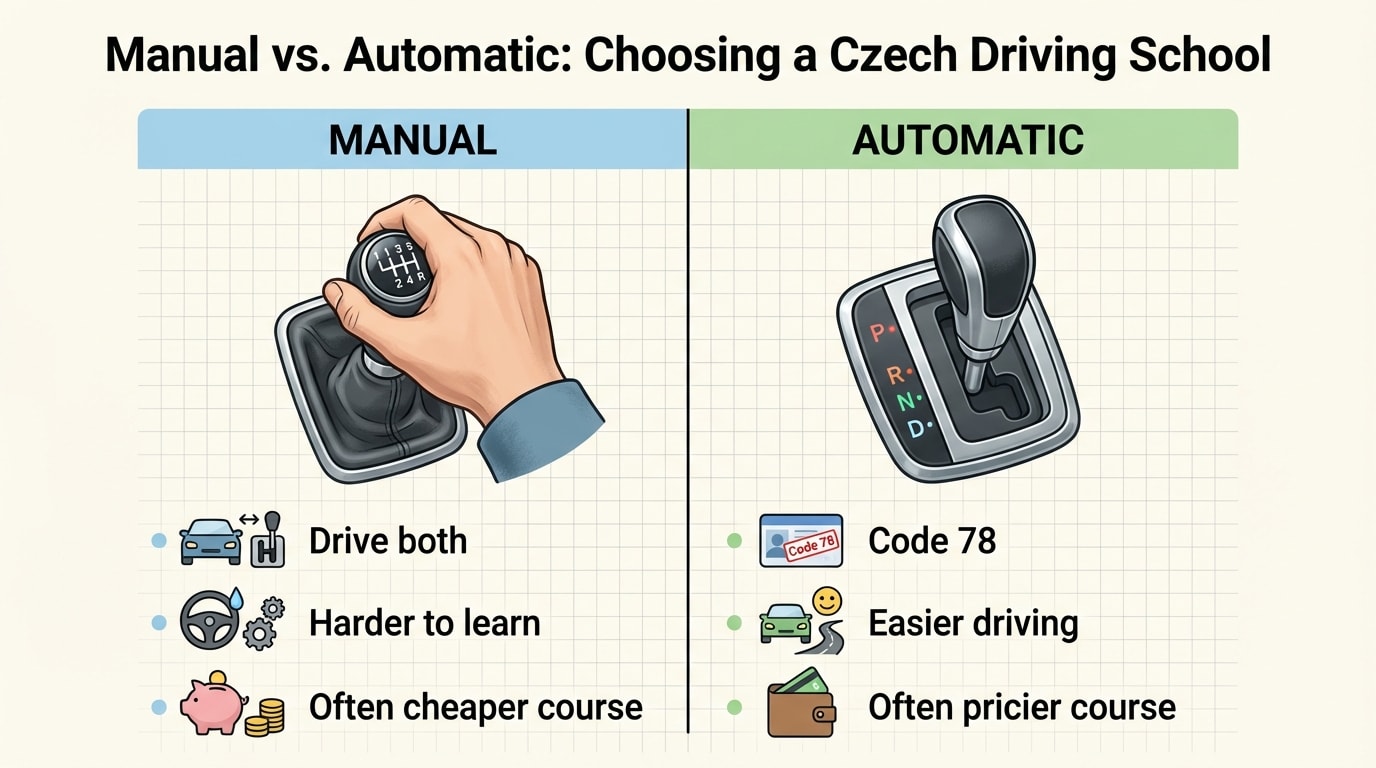
If you pass the exam in a vehicle with an automatic transmission, you'll get code 78 in your license. This means one thing: you may only drive cars with an automatic. If you then get behind the wheel of a manual, it counts as driving without a license — a fine of up to CZK 75,000 and a driving ban of up to 3 years.
Conversely, if you pass the exam on a manual, you may drive both — manual and automatic. That's why most driving instructors recommend taking the exam on a manual if you can manage it.
Training on an automatic typically costs CZK 1,500 to 3,000 more. The driving itself is simpler — you don't deal with the clutch and shifting, so you can focus more on traffic. For people who are anxious about driving or struggle with coordination, an automatic can be a good choice.
The trend is clear: roughly 20% of students now choose automatic, and the number is growing fast. In 2025, Škoda sells the Superb and Kodiaq exclusively with automatic transmission. The EU plans to end combustion engines after 2035 — and electric vehicles only have automatic transmission. In ten years, automatic will likely be the norm.
If you choose automatic and later realize you need manual, you can upgrade your license. All it takes is a practical driving exam (no theory). If you fail, you keep your existing automatic-only license.
Your Right to Leave — Section 19
Many students don't know they can transfer to a different driving school at any time. Act No. 247/2000 Coll., Section 19, is clear: if you're unhappy with your school, you can end your training and continue elsewhere. You don't start from zero.
The process is straightforward. You notify your current school that you're leaving. They must hand over your documents — enrollment application, medical certificate, and records of completed hours. At your new school, you continue exactly where you left off.
As for money: the school calculates your completed hours and refunds the unused portion. The cancellation fee should not exceed 5% of the total course price. If they're charging thousands, it's excessive — and you can file a complaint.
One thing to keep in mind: from the day you enroll, you have 18 months to complete your training and register for the exam. This deadline runs regardless of any transfer. If you're running low on time, factor that in.
Where to File a Complaint
If you have a problem with your driving school, you're not helpless. The Driving School Ombudsman (autoskolsky-ombudsman.cz) is a free advisory service run by the Czech Driving School Association and the Professional Driving School Society. They resolve disputes, advise you on your rights, and will advocate for the student when needed.
Driving schools are registered and supervised by the municipal authority with extended jurisdiction. If a school has serious issues, the authority can revoke its registration. The Czech Trade Inspection Authority handles consumer disputes — deceptive practices, withheld refunds. And if it's a criminal matter (fraud, harassment), contact the Czech Police.
Summary
- Instructor quality matters more than price — a bad instructor costs you more money
- Ask about the full price, lesson frequency, cancellation policy, and first-attempt pass rates
- Red flags: "price by agreement," prices under CZK 10,000, shortened lessons, pressure to do fewer hours
- A standard course (2–4 months) is cheaper and more relaxed; an intensive course (3–8 weeks) is for those in a hurry
- Manual = you may drive both; automatic = code 78, automatic-only vehicles
- You can transfer to a different driving school at any time (Section 19 of Act No. 247/2000 Coll.)
Key Terms
| Term | Explanation |
|---|---|
| Driving instructor | A certified professional who teaches you to drive. Must be at least 24 years old. |
| Code 78 | Restriction in your license — you may only drive vehicles with automatic transmission |
| Section 19 (Act No. 247/2000 Coll.) | Legal right to transfer to a different driving school at any time during training |
| Intensive course (crash course) | An accelerated form of training (3–8 weeks), more expensive but faster |
| Driving log | A document recording every completed lesson — always sign it |
| Driving School Ombudsman | A free advisory service for driving school students, resolves disputes and complaints |
| Cancellation fee | Fee for canceling a lesson or course — should not exceed 5% of the course price |
| Teaching hour | 45 minutes of instruction or driving — never less |
| Administrative exam fee | State fee: CZK 700 for the first attempt, CZK 100 (theory) / CZK 400 (practical) for retakes |