
Category C Truck License — Requirements & Cost
Category C and CE licenses: requirements, training cost, professional driver certificate (CPC), and truck driver salaries in Czechia.
Czechia is short twenty thousand professional drivers. Haulage companies are competing for talent — signing bonuses, paid training, starting salaries above 45,000 CZK. A long-haul truck driver can earn 60 to 85 thousand a month. And the ticket to this career? A category C license and a professional driver certificate. The whole process costs 20 to 45 thousand CZK and takes roughly two months. This chapter explains what exactly you need, how the process works, and what to watch out for.
There are several C-group categories in Czech law — C1, C, C1+E, and CE. Each permits a different type of vehicle and has a different age requirement. Most people are interested in the plain "C" (category C), possibly extended to CE, which allows driving a tractor unit with a semi-trailer. We'll cover all the variants so you know exactly what you need. This guide is based on Act No. 361/2000 Coll. and current data from driving schools on Kvalty.cz.
Quick summary:
- Category C permits driving trucks over 3,500 kg — but not tractor-trailer combinations (that's CE)
- Minimum age is 21 (exception from 18 with a professional driver certificate after extended initial training)
- You must hold a valid category B license — there's no way around it
- A professional driver certificate (code 95) is mandatory for anyone driving trucks commercially
What exactly you can drive — and where the line is
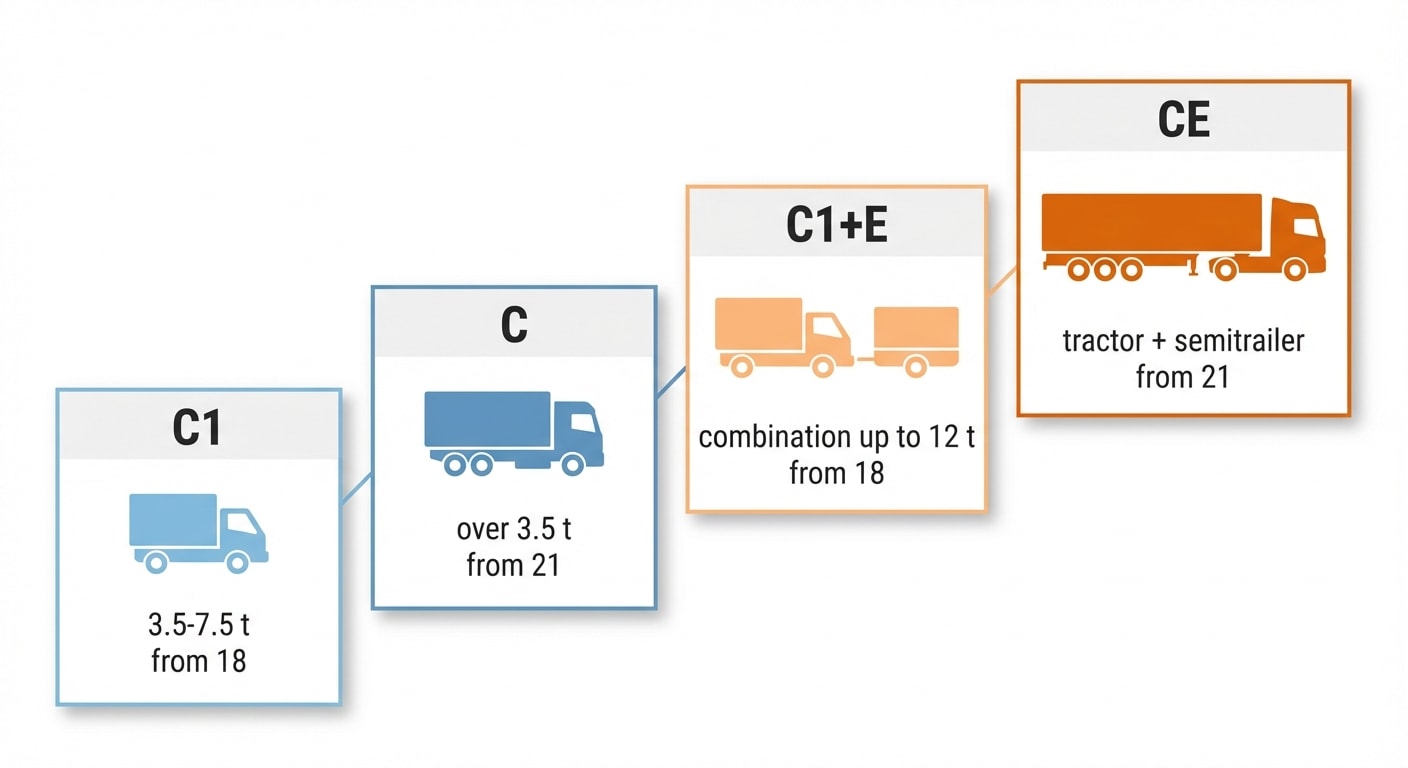
Here's where many people hit their first big surprise. You think "I'll get my C license and drive a truck". But a typical truck — a tractor unit with a semi-trailer, that classic 40-tonne giant on the motorway — requires category CE, not just C. This misunderstanding costs people time and money, so let's clear it up.
Category C (§80a of Act No. 361/2000 Coll.) permits you to drive motor vehicles with a maximum authorized mass exceeding 3,500 kg, designed to carry no more than 8 passengers plus the driver. You can only attach a light trailer up to 750 kg. In practice, this means trucks — from mid-sized lorries to heavy flatbeds and tippers, as long as they're not pulling a trailer. Category C automatically includes C1 and AM.
Category CE is the extension — a vehicle combination consisting of a category C towing vehicle and a trailer over 750 kg. This is where we're talking about tractor-trailers, trucks with heavy trailers — classic long-haul rigs. CE automatically includes C1+E and B+E. And if you also hold category D, you automatically get DE too.
Category C1 is the "small C" — trucks from 3,500 to 7,500 kg. Large vans like the MAN TGL or IVECO EuroCargo. You can get it from age 18. It's a good first step if you need to drive a larger van but aren't ready for a full truck yet.
Category C1+E is a combination: a C1 vehicle plus a trailer over 750 kg, but the total must not exceed 12,000 kg. Or a category B vehicle with a trailer over 3,500 kg (total up to 12,000 kg). If you're interested in trailers in general, check out the chapter on B+E, B96 — towing vehicles.
C license for a truck? Not so fast
A category C license permits driving a truck — but not a tractor with a semi-trailer. A typical long-haul truck (tractor + semi-trailer) requires category CE. Without it, you face a fine of 25,000–50,000 CZK and a driving ban.
Who can apply — requirements and age
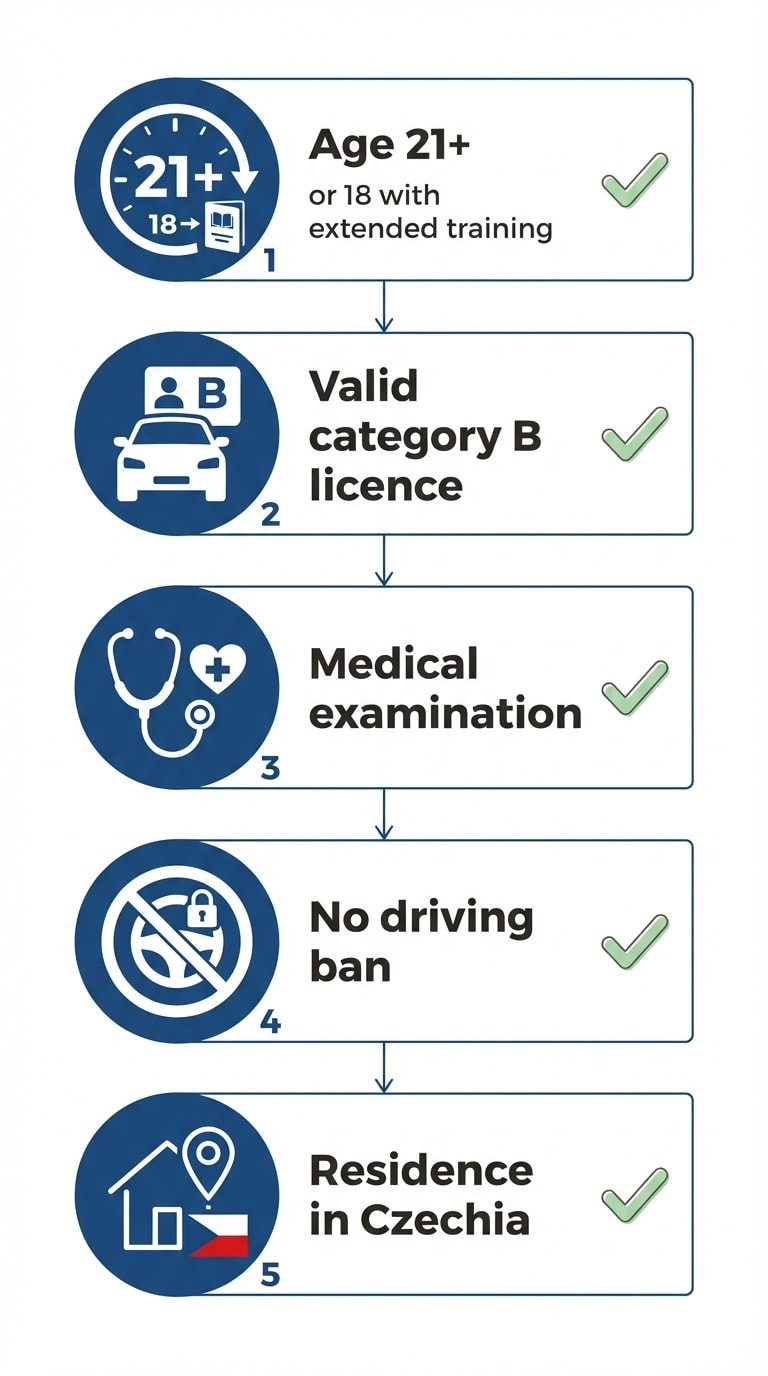
The law (§82 and §83 of Act No. 361/2000 Coll.) sets clear requirements. For category C, you must meet all of them at once — one alone isn't enough.
First: age. The standard threshold for category C and CE is 21. For C1 and C1+E, 18 is enough. But there's an exception — if you complete the extended initial professional driver training (280 hours), you can obtain category C or CE from age 18. This route is mainly used by the military, security forces, and large haulage companies training their own drivers. For the average person, it's fairly exotic.
Second: you must hold a valid category B license. Without B, you cannot get C. The law is uncompromising on this point — C cannot be granted without B. If you don't have B yet, start there. Details are in the category B chapter.
Third: medical fitness. The medical examination for category C is more rigorous than for a car. The doctor checks your vision (acuity, colour perception, visual field), hearing, balance, and performs a neurological examination. The result is "fit", "fit with conditions", or "unfit". You need the certificate before starting training. The examination costs 500 to 1,000 CZK.
Fourth: you must not be serving a driving ban and must not have 12 points in the penalty point system. You also need your usual residence in Czechia (or to have been studying here for at least 6 months).
Training — what to expect at driving school
Category C training is considerably more demanding than B. Act No. 247/2000 Coll. sets a minimum of 37 teaching hours: 11 hours of theory and 26 hours of practice (18 hours of driving, 4 hours of vehicle maintenance, and 4 hours of first aid). One teaching hour is 45 minutes, and you may complete a maximum of 2 practical hours per day.
In practice, most driving schools offer significantly more. For example, Autoškola Omega in Prague lists 38 hours of theory and 26 hours of practice — 64 hours in total. The reason is simple: the legal theory minimum is truly a minimum. Schools add hours on traffic regulations, truck operation, safe driving, and revision because they want you to pass the exam on your first attempt.
The theory component focuses on the specifics of freight transport — rules for driving large and heavy vehicles, permitted weights, dimensions, driving and rest periods, tachograph legislation. If you have a B license and already know the basic rules, theory will go faster. But don't underestimate the new material specific to trucks.
Practical training runs in three stages. You start on the training ground — learning to operate a truck, start, reverse, and park. Then come practice drives outside traffic, and finally drives in real traffic. You'll also learn to disconnect and reconnect a trailer, operate a digital tachograph, secure cargo, and perform daily vehicle checks. These are skills you'll use every single day.
The entire training typically takes 6 to 8 weeks. It depends on how many hours per week you can fit in — some people drive every day, others only on weekends. A step-by-step guide on how to extend your license from B to C is in the chapter How to extend your driving license.
The exam — three parts, three chances
The final professional competence exam for category C has three separate parts. Compared to category B, there's one extra — a practical test on vehicle operation and maintenance.
The theory test is taken electronically (eTesty) at the examining office. You get 25 questions, have 30 minutes, and need at least 43 out of 50 points (86%). Questions cover traffic rules, safe driving, road signs, and category C specifics. You can practise with free mock tests at etesty.md.gov.cz.
The practical test on vehicle operation and maintenance is specific to categories C and D — it doesn't exist for cars. The examiner tests you orally and practically: checking oil levels, tyres, the braking system, lights, and the tachograph. You must demonstrate that you know how to take care of a truck.
The practical driving test lasts at least 30 minutes. You drive in real traffic under the examiner's supervision. They assess driving smoothness, rule compliance, reactions to traffic situations, and above all your feel for the dimensions and weight of a large vehicle. Manoeuvring a truck through narrow streets or a roundabout is a completely different experience from driving a car.
You have a maximum of 3 attempts at each sub-exam (first attempt + 2 retakes). The entire exam must be completed within 6 months of the first attempt. If you fail three times on any part, you must complete the entire training again.
Preparing for the maintenance test
The vehicle operation and maintenance test catches many people off guard. Go through all the checkpoints with your driving instructor — oil, tyres, brakes, lights, tachograph. Pay attention to this even if it doesn't seem as important as the actual driving.
How much does it cost
The price of category C training varies by region and driving school. Prague is more expensive, smaller towns are cheaper. Current prices from driving schools offering category C training are on Kvalty.cz.
Porovnání cen výcviku skupiny C podle autoškol — živá data z Kvalty.cz
| statsTable.columns.license | statsTable.columns.minAge | statsTable.columns.avgPrice | statsTable.columns.minPrice | statsTable.columns.maxPrice | statsTable.columns.schoolCount |
|---|---|---|---|---|---|
| C+E – Truck with heavy trailer | 21 | 37,056 Kč | – | 60,000 Kč | 11 |
| D – Buses | 24 | 28,720 Kč | – | 64,900 Kč | 73 |
| B – Passenger cars up to 3.5 t | 18 | 26,147 Kč | – | 64,500 Kč | 1,067 |
| C – Trucks over 3.5 t | 21 | 25,952 Kč | – | 60,550 Kč | 235 |
| A2 – Motorcycles up to 35 kW | 18 | 25,084 Kč | 3,500 Kč | 64,500 Kč | 496 |
| A – Powerful motorcycles without limits | 20 | 24,744 Kč | 3,500 Kč | 64,500 Kč | 507 |
| C1 – Light trucks | 18 | 24,400 Kč | 19,490 Kč | 28,000 Kč | 7 |
| B+E – Car with heavy trailer | 18 | 24,105 Kč | 10,000 Kč | 35,700 Kč | 8 |
| D1 – Minibuses | 21 | 23,500 Kč | 22,000 Kč | 25,000 Kč | 2 |
| T – Tractors | 17 | 23,287 Kč | – | 59,000 Kč | 214 |
| A1 – Motorcycles up to 125 cc | 16 | 21,241 Kč | 3,500 Kč | 53,500 Kč | 470 |
| B1 – Quadricycles and light motor vehicles | 17 | 19,950 Kč | 17,000 Kč | 22,900 Kč | 2 |
| AM – Mopeds and small scooters | 15 | 18,878 Kč | 3,500 Kč | 53,500 Kč | 422 |
| B96 – Car with medium trailer | 18 | 17,585 Kč | 4,990 Kč | 33,500 Kč | 9 |
Total 3523 schools
On top of the course price, factor in additional costs. The medical examination runs 500 to 1,000 CZK. The administrative exam fee is about 700 CZK and is usually not included in the driving school price. If you plan to drive commercially (which most people getting category C do), you'll also need a professional driver certificate — more on that in the next section.
There's also a package price: C license + professional driver certificate together. For example, Autoškola Omega in Prague offers this bundle for 45,000 CZK. It's better value than buying both separately. If you know you'll be driving commercially, go straight for the package.
And one more tip that few people know about: if you're registered with the Labour Office, you can get the entire C training including the professional driver certificate through a requalification programme — for free. The state invests in requalification because there's a desperate shortage of drivers. Ask at your local Labour Office.
Professional driver certificate — you can't drive commercially without it
This is the "hidden" requirement that catches many people out. You have your C license, you think you can start driving for a haulage company — and then you discover that without a professional driver certificate, you're going nowhere. The Certificate of Professional Competence (CPC) — code 95 in your license — is legally required for anyone driving a truck over 3.5 tonnes for business purposes or as an employee (Act No. 247/2000 Coll., implementing EU Directive 2003/59/EC).
Who doesn't need a CPC? If you're driving a truck purely for private purposes — say, you're moving house and hire a lorry — the CPC isn't required. Exemptions also apply to firefighters, police, military, and certain other forces defined by law.
Obtaining a CPC means completing initial training. The standard variant is 140 hours (a mix of theory and practice) and costs roughly 15,000 to 27,000 CZK. After completing it, you take an exam at the municipal authority with extended jurisdiction, and code 95 is entered in your license. It's valid for 5 years.
There's also an extended initial training of 280 hours. This is the option for people aged 18 to 20 who want category C or CE before turning 21. In practice, it's mainly used by large haulage companies and the military. The shortened initial training (45 hours, roughly 15,000 CZK) is for drivers extending their CPC from one group to another — for example, from C to D or vice versa. That's useful if you're thinking of switching from trucks to buses. More about category D in the chapter Category D — buses.
After five years, you must renew your CPC. Periodic training is 35 hours over the entire five-year cycle (effectively 7 hours per year), costs 5,000 to 6,000 CZK, and is theory-only — no practical exam. If you miss the renewal and your CPC expires, you'll need to complete refresher training (35 hours + exam).
| Training type | Duration | Approximate cost | Who it's for |
|---|---|---|---|
| Standard (140 h) | 140 hours | 15,000–27,000 CZK | Standard route — C/CE from age 21 |
| Extended (280 h) | 280 hours | ~25,000 CZK | Drivers aged 18–20 (lowers age requirement) |
| Shortened (45 h) | 45 hours | ~15,000 CZK | Switching between groups (C→D or D→C) |
Medical examinations — stricter regime than for cars
Category C drivers are subject to stricter medical oversight than you're used to from B. One exam at the beginning isn't enough — your health is checked regularly for as long as you drive professionally.
Medical examinations follow Decree No. 277/2004 Coll. Until age fifty, you go every two years. From fifty onwards, every year. The doctor can shorten the interval or order specialist examinations at any time. From January 2026, medical fitness data is recorded electronically in the drivers' register — you no longer need to carry a paper certificate.
On top of that, there's a traffic-psychological examination. Before starting professional driving, you must be assessed by a traffic psychologist. They evaluate your ability to handle stress, reaction time, and personality profile. Then again no later than your 50th birthday, and every 5 years after that. The examination costs 2,000 to 3,500 CZK — for employed professional drivers, the employer covers the cost.
For employees, all regular medical examinations and psychological assessments are paid by the employer. This is an important detail: health oversight costs you nothing as an employee.
The rules of the game — driving hours, tachograph, and inspections
As a driver of a truck over 3.5 tonnes in commercial transport, you're subject to EU Regulation (EC) No. 561/2006 on driving times and rest periods. These rules exist to prevent tired drivers from endangering themselves and others — and compliance is strictly enforced.
The basic rules are clear: a maximum of 4.5 hours behind the wheel in one stretch, then a mandatory break of at least 45 minutes (you can split it into 15 + 30 minutes). Per day, you may drive a maximum of 9 hours — twice a week you can extend that to 10. Per week, you must not exceed 56 hours, and over two consecutive weeks, 90 hours. Daily rest is at least 11 hours (three times a week you can reduce it to 9). Weekly rest is 45 hours — every other week you can shorten it to 24, but then you must compensate the lost time.
Compliance is monitored by a digital tachograph. It's mandatory for all trucks over 3.5 tonnes in commercial transport. As a driver, you must have your own driver card — issued by the municipal authority with extended jurisdiction, valid for 5 years. The haulier must download data from the tachograph at least every 90 days and from the driver card every 28 days.
Penalties for violations are not trivial. The haulier faces fines up to 350,000 CZK. During a roadside inspection, the inspector can demand a deposit of up to 200,000 CZK (from 1 July 2025). And from that same date, the new Road Transport Inspectorate (INSID) is operational — mobile inspection units actively checking vehicle condition, weight, cargo security, and compliance with driving hours.
ADR certificate — for transporting dangerous goods
If you want to transport chemicals, fuels, or explosives, you'll also need an ADR certificate. Training is organised by the Ministry of Transport, and it's valid for 5 years. For a regular truck driver, ADR is not required.
License validity and renewal
Driving licenses for categories C, C1, CE, and C1+E are valid for 5 years. That's half the validity of categories A and B, which last 10 years. The reason is straightforward — for professional categories, the state requires more frequent health verification.
When your license expires, you exchange the document at the municipal authority with extended jurisdiction. The authorization itself doesn't expire — only the plastic card changes. Exchange upon expiration is free (the 200 CZK administrative fee only applies when changing personal details). But note: you need a valid medical fitness certificate for the application. If yours has expired in the meantime, you'll need to get the examination first. More about the entire category system and validity periods is on the categories overview page.
A career behind the wheel — salaries and prospects
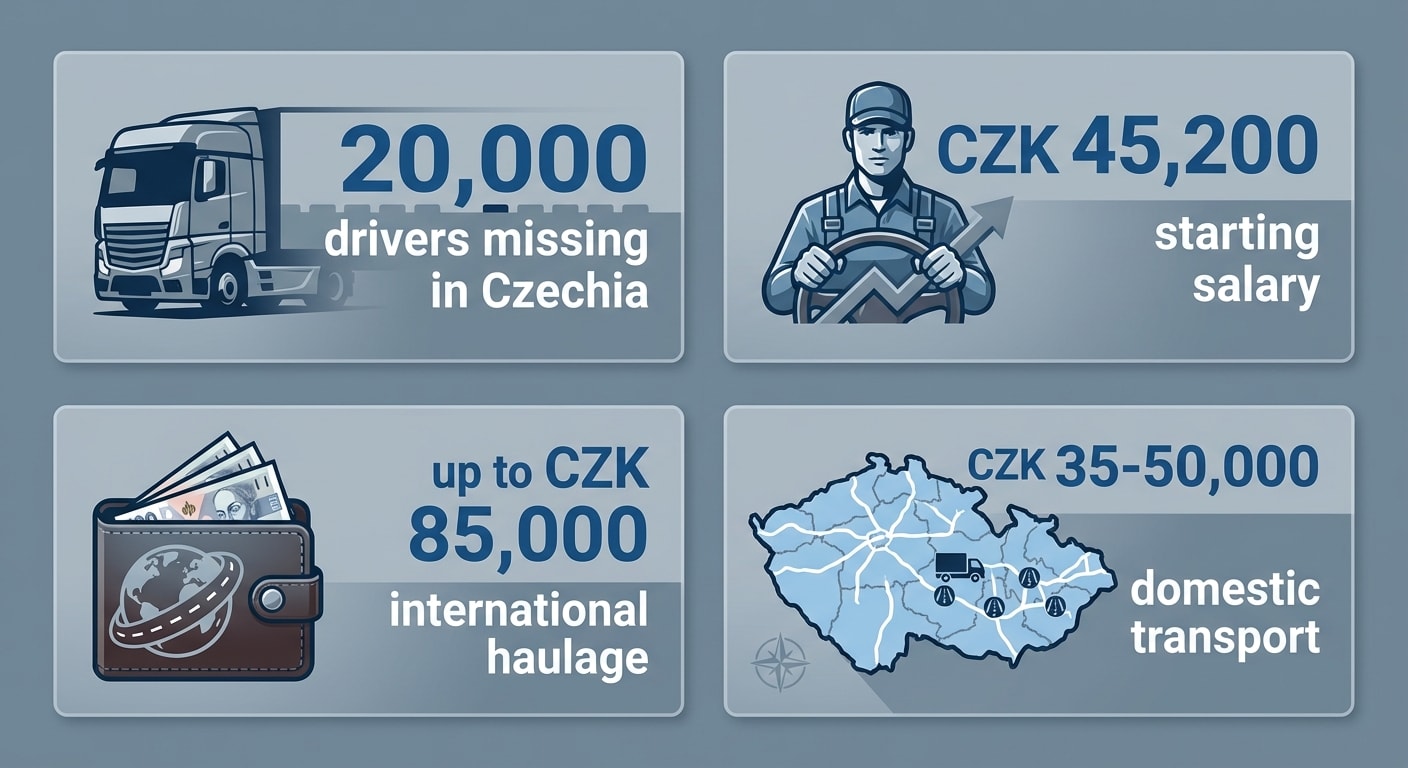
A category C license with a professional driver certificate is more than just a piece of paper — it's a ticket to a labour market that's chronically short of people. Czechia is missing approximately 20,000 professional drivers, and the situation is getting worse: experienced drivers are retiring and young people aren't replacing them fast enough.
The starting salary for a truck driver is around 45,200 CZK gross. The actual take-home pay is typically 20 to 30 percent higher thanks to travel allowances, weekend bonuses, and night shift premiums. Long-haul international drivers — known as MKD drivers — can earn 60 to 85 thousand CZK per month. Domestic transport drivers typically earn 35 to 50 thousand.
Haulage companies are responding to the driver shortage by raising wages and offering benefits. Signing bonuses, housing allowances, paid license training and CPC — these are real offers you'll find in job listings. If you're considering a career change, this is a genuine opportunity.
But let's be honest — this job isn't for everyone. Long hours behind the wheel, weekends away from family, strict rules on driving hours. If it suits you though, the financial conditions right now are exceptionally good.
Summary
- Category C permits driving trucks over 3,500 kg — but a tractor-trailer requires CE
- Minimum age for category C is 21 (18 with extended initial training of 280 hours)
- You must hold a valid category B license and pass a stricter medical examination
- Training lasts at least 37 hours (legal minimum) and takes 6–8 weeks
- A professional driver certificate (code 95) is mandatory for commercial drivers — initial training of 140 hours
- The C license is valid for 5 years, medical exams every 2 years (every year from age 50)
- Czechia is short 20,000 drivers — starting salary over 45,000 CZK, long-haul up to 85,000 CZK
Key Terms
| Term | Explanation |
|---|---|
| Category C | Trucks over 3,500 kg. Trailer only up to 750 kg. From age 21 (or 18 with CPC). |
| Category CE | Vehicle combination — tractor + semi-trailer (trailer over 750 kg). A typical long-haul truck. From age 21. |
| Category C1 | Trucks 3,500–7,500 kg (large vans, smaller lorries). From age 18. |
| Category C1+E | C1 combination + trailer over 750 kg, total max 12,000 kg. From age 18. |
| Professional Driver Certificate (CPC) | Code 95 in the license. Mandatory for commercial drivers over 3.5 t. Initial training 140/280 h, valid 5 years. |
| Digital tachograph | Device recording driving times, work, and rest periods. Mandatory for commercial vehicles over 3.5 t. |
| Driver card | Chip card for the tachograph. Issued by the municipal authority, valid 5 years. |
| INSID | Road Transport Inspectorate — new inspection authority from 1 July 2025 with mobile units. |
| ADR certificate | Special authorization for transporting dangerous goods. Valid 5 years. |
| Equivalence | Category C automatically includes C1 and AM. Category CE includes C1+E and B+E. |