
What Is L17 — Driving at 17 in Czech Republic
How the L17 program works, why it was created, and how it differs from the standard license. Comparison with Germany and Austria.
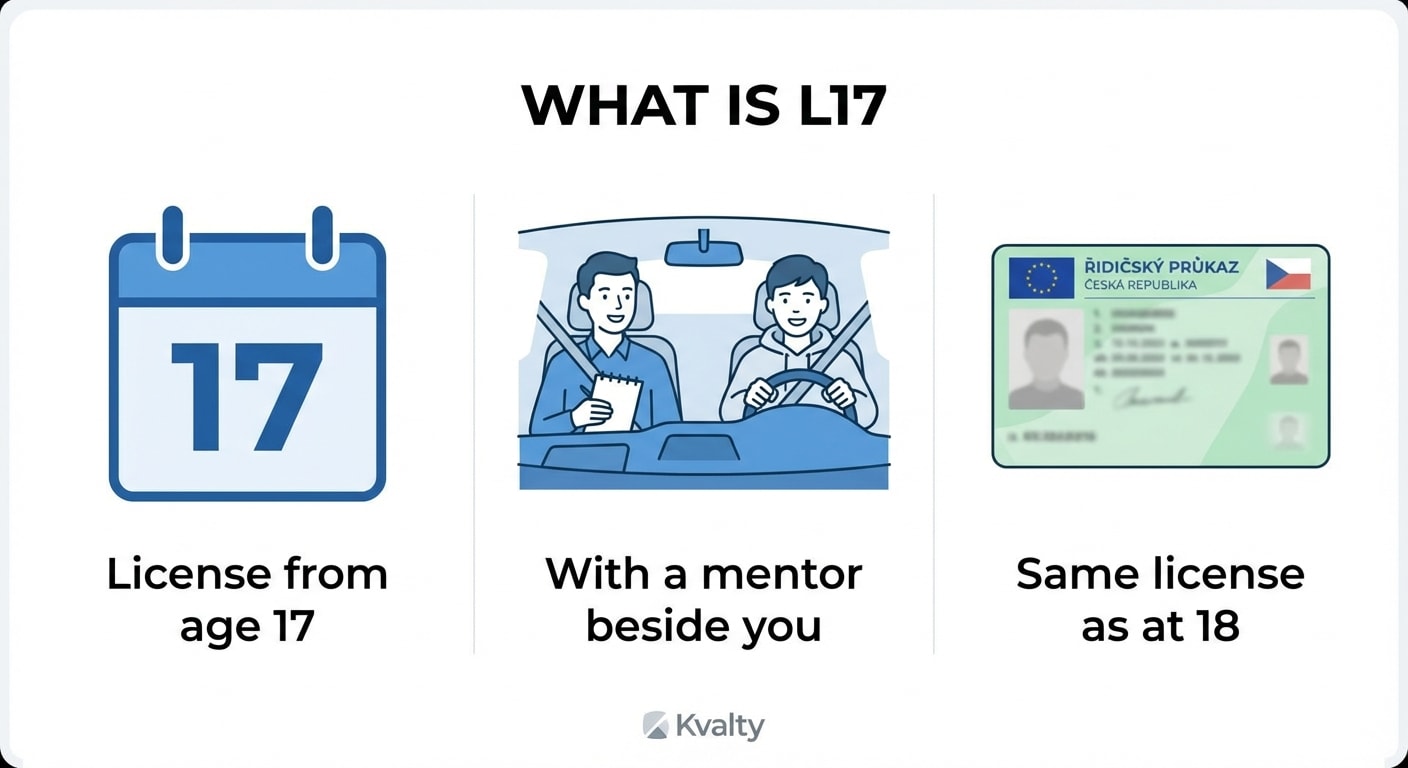
You're only seventeen once. And since January 2024 in the Czech Republic, that means you can legally sit behind the wheel. All you need is to complete driving school, pass the exam, and have a mentor beside you. No special course, no surcharge, no shortened training. The same driver's license as at eighteen — just a year earlier.
This chapter explains exactly what L17 is, why it was created, and how it differs from the standard driver's license. We'll look at how accompanied driving works in Germany and Austria, where Czechia drew its inspiration, and most importantly — whether it makes sense to start driving sooner.
Quick summary:
- L17 is a program allowing a category B driver's license from age 17 — with a mandatory mentor escort until 18
- Driving school training and the final exam are identical to the standard license, as is the price
- Czechia took inspiration from Germany, where accompanied driving at 17 has been running for over twenty years with demonstrably lower accident rates
- In its first year (2024), over 24,000 people used L17 with outstanding safety results
How L17 Works — Step by Step
The whole concept is simpler than the headlines make it sound. You sign up for driving school just like anyone else. You complete the same training — 36 hours of theory and 28 hours of practical driving. You take the same final exam. And you receive the same category B driver's license that every eighteen-year-old gets.
The only difference? Until you turn 18, you can't drive alone. A registered mentor must sit beside you — an experienced driver you choose yourself. It can be a parent, uncle, older sibling, neighbor, or anyone else who meets the legal requirements. And there aren't that many: a category B license for more than 10 years, 5 years continuously, zero penalty points, and no driving ban. A detailed guide to choosing and registering a mentor is in the chapter Choosing and the Role of a Mentor.
You can start training at driving school from age 15 and a half. You can take the exam at the earliest on your 17th birthday. After passing, you submit your license application at the municipal office, attach written parental consent, and register your mentors. Then you drive. With a mentor beside you, on Czech roads, in real traffic. And that's exactly the point — gaining experience under the supervision of someone who knows what they're doing. A complete overview of requirements and documents is in the chapter Requirements and Conditions.
Automatic transition at 18
On your 18th birthday, your license automatically becomes a full one — you don't need to change anything, go anywhere, or pay anything. Mentor records are canceled automatically. Details in the chapter Transition to a Full License.
Why L17 Was Created
L17 wasn't created because teenagers pressured the government. It was created because data from across Europe has been showing the same thing for twenty years: the more kilometers you drive under supervision, the fewer crashes you'll have when driving alone.
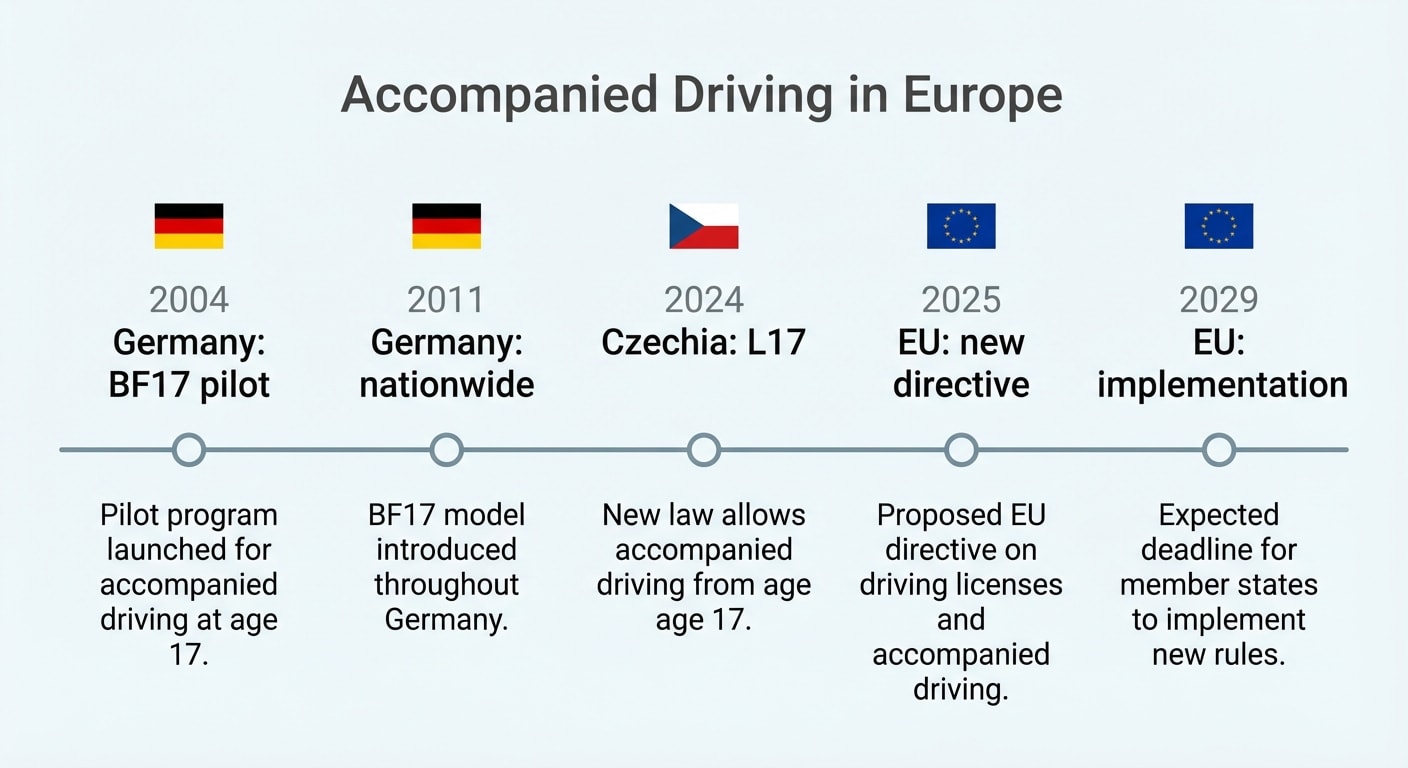
Germany has had the BF17 program (Begleitetes Fahren mit 17) since 2004 — first as a pilot project in Lower Saxony, then as a nationwide standard from 2011. Research from the University of Giessen showed that BF17 participants have 28.5% fewer accidents and 22.7% fewer traffic violations than drivers who started driving at eighteen. For those who drove with a mentor for more than six months, the accident rate dropped by a full 57%. Today, the majority of new category B drivers in Germany use BF17.
Austria has had a similar L17 program for even longer. Sweden, which lowered the learning-to-drive age to 16, saw a 40% drop in new driver accident rates. And when the European Union adopted a new driving license directive in November 2025, it included accompanied driving from age 17 as a Europe-wide standard — all member states must enable it by 2029.
So Czechia is no pioneer. Rather, it's a smart follower learning from others' experience. Act No. 271/2023 Coll. added a new §83a — "Driving with a Mentor" — to the Road Traffic Act, effective January 1, 2024. Czechia deliberately chose the German model, where you first complete driving school and the exam, and only then begin accompanied driving. The Austrian model, where you drive with supervision before the exam, was not adopted.
What's the Same and What's Different from a Standard License
This is the most common misunderstanding: people think L17 is some simplified or shortened course. It's not. Driving school training is absolutely identical — 36 hours of theory in full scope per Annex 3 of Act No. 247/2000 Coll., 28 hours of practical driving, a final exam with a test (43 out of 50 points to pass), and a practical driving test with an examiner. The course price is the same too — it depends on the region and school, but you don't pay extra for L17.
The differences lie elsewhere. Above all: until 18, you always drive with a mentor. Without one, you're not allowed behind the wheel, and violating this can cost you a fine of CZK 2,500–5,000 and a driving ban for 6 to 12 months. Then there's the validity restriction — until 18, you may drive only within the Czech Republic. No road trips to Germany or Croatia. And you need written consent from a legal guardian, since you're a minor.
On the other hand, L17 automatically opens categories AM and A1 — mopeds and motorcycles up to 125 cc. And here's an interesting detail: you can ride AM and A1 vehicles on your own, without a mentor. The mentor requirement only applies to category B (cars).
If you're still not sure whether L17 is right for you or whether it's better to wait until eighteen, read our detailed comparison of L17 vs. waiting until 18.
Comparison with Germany and Austria
When creating L17, Czechia drew inspiration from two neighbors — but took only what made sense from each. To better understand how L17 works here, it helps to know how they handle it elsewhere.
Germany (BF17) operates on a "exam first" principle. You complete driving school, pass the exam, and then drive with an escort. Your escort must be over 30 years old and have held a license for at least 5 years. The car must have a "BF17" sticker. The license is valid only in Germany (and is recognized in Austria and Denmark). Czechia adopted precisely this model — exam first, then accompanied driving.
Austria (L17) takes the opposite approach. After completing part of the training at driving school, you drive privately with an escort — you must log at least 3,000 kilometers. Then you return to driving school for final training and only then take the exam. The escort must be over 28 with a license held for 7 or more years. Austria also requires mandatory multi-phase training after the exam.
Czech L17 has a few unique features. It doesn't require any vehicle marking — other drivers can't tell there's a seventeen-year-old behind the wheel. It doesn't set a minimum number of kilometers with a mentor. And it allows up to 4 mentors per driver, more than most European countries. A detailed overview of what a mentor must meet and how registration works is in the chapter Choosing and the Role of a Mentor.
L17 in Czechia, Germany, and Austria
| Parameter | Czechia (L17) | Germany (BF17) | Austria (L17) |
|---|---|---|---|
| Model | Exam → driving with mentor | Exam → driving with escort | Driving with escort → exam |
| Escort age | No limit (10+ years of license) | 30+ years old | 28+ years old |
| Escort experience | 10+ years license, 5 continuous | 5+ years license | 7+ years license |
| Max. penalty points for escort | 0 | No condition | No condition |
| Vehicle marking | No | Yes (BF17 sticker) | Yes |
| Mandatory mileage | No | No | 3,000 km |
| Max. number of escorts | 4 | Unlimited | 2 |
| Valid abroad | No | Limited | Limited |
Czech Numbers — the First Two Years
The program has only been running since 2024, but the data is already sufficiently compelling. In the first year, over 24,000 seventeen-year-olds obtained a license through L17 — roughly every third new category B driver. More than 22,000 mentors were registered, the majority being parents aged 41 to 50.
The safety record is exceptional. L17 drivers caused just 6 accidents throughout 2024, with 4 minor injuries and zero fatalities. Their peers who got their license at eighteen and drove without a mentor caused 1,106 accidents, 31 serious injuries, and 6 deaths. To be fair, L17 drivers log fewer kilometers (because they need a mentor), but the difference is still dramatic.
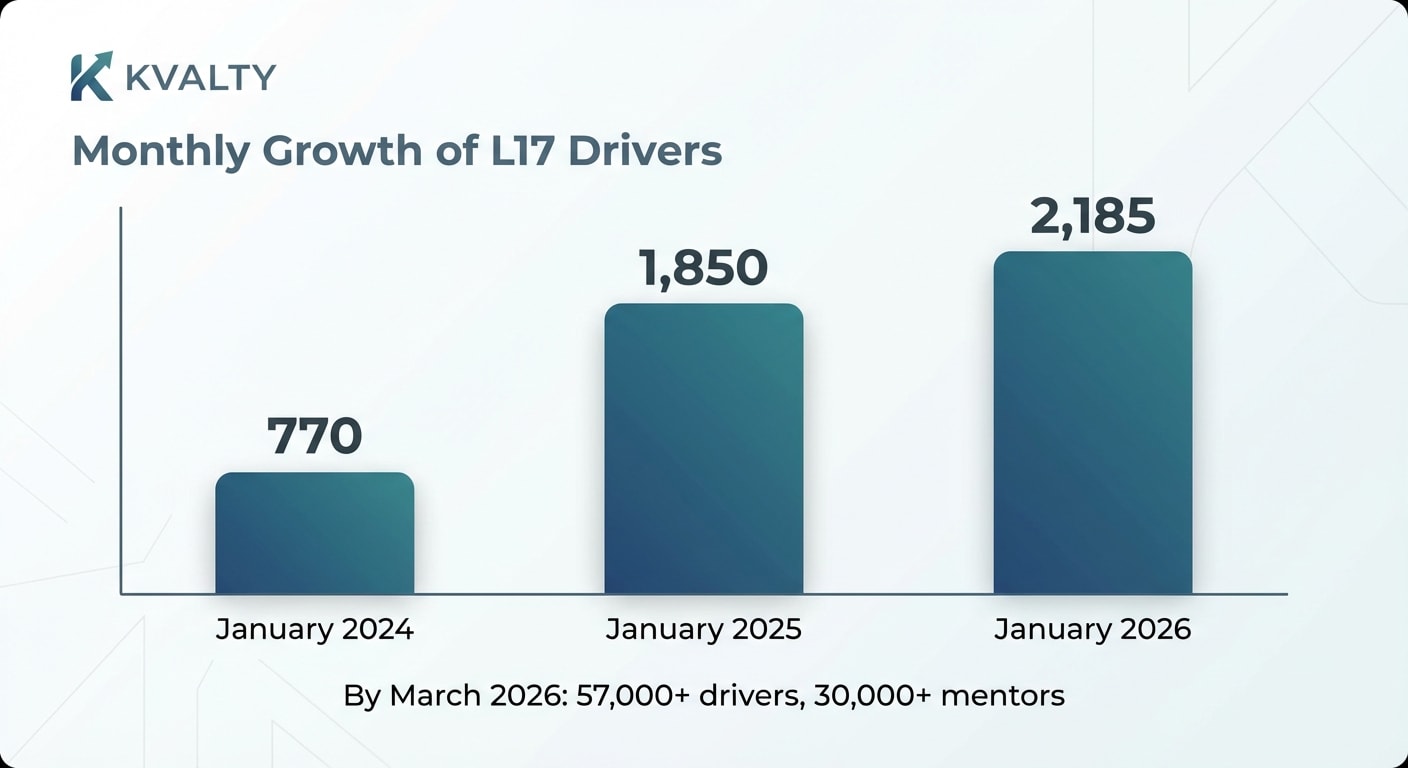
By March 2026, over 57,000 people hold an L17 license and more than 30,000 mentors are registered. Interest continues to grow — in January 2024, just 770 new drivers started with L17; by January 2026, it was 2,185. If you're curious about exactly why accompanied driving is so effective and how it compares to the standard license, read the chapter L17 vs. Waiting Until 18.
Who L17 Is For — and Who It's Not
L17 isn't for everyone, and that's perfectly fine. The program is voluntary — nobody's forcing you into it and nothing happens if you wait until eighteen.
It's right for you if you have someone in your family or circle who meets the mentor requirements and is willing to drive with you regularly. Ideally, the family drives regularly — shopping, weekend trips, school runs. Every such drive with a mentor is valuable real-traffic experience for you. L17 also makes sense if you're planning to go to university — getting your license at seventeen gives you an extra year of experience before you move out.
On the other hand, there's no point forcing L17 if you don't have a qualified mentor available. The conditions are clear: 10 years of license, 0 points, no ban. If nobody around you meets these requirements, L17 isn't for you right now. Likewise, it doesn't make sense if your family doesn't have a car — the mentor needs a vehicle for you to drive. And if you plan to travel a lot by car abroad, keep in mind that the L17 license is valid only within the Czech Republic.
Not sure?
The program is voluntary and nothing at all happens if you wait until 18. But if you have a mentor and your family has a car, the data clearly shows that a year of supervised driving makes you a safer driver. A detailed comparison of pros and cons is in the chapter L17 vs. Waiting Until 18.
Common Myths About L17
Several misconceptions circulate about the program that are worth clearing up.
"L17 is a shortened course." It's not. Driving school training is identical — the same number of theory and practical hours, the same exam. L17 adds a year of accompanied driving; it takes nothing away from the normal course.
"The mentor must be a parent." Not true. The law (§83a) only states that a mentor must meet the conditions — 10 years of license, 0 points, no ban. It can be an uncle, grandmother, an older colleague from work. You can have up to 4 mentors at once.
"The car must have special markings." No, in Czechia there's no vehicle marking requirement. Unlike Germany and Austria, where a sticker is mandatory, Czech L17 requires no markings.
"The L17 license is valid abroad." No. Until 18, you may drive exclusively within the Czech Republic. After your 18th birthday, the restriction drops automatically — without exchanging your license. More about what changes at 18 in the chapter Transition to a Full License.
"Insurance will be more expensive." Not necessarily. Liability insurance is tied to the car and its operator, not the driver. If you drive your parent's car, you're covered by their policy. Some insurers even offer discounts for L17 graduates. Details in the chapter L17 Insurance.
How L17 Differs from Driving School Training
There are two distinct phases to understand here. At driving school — whether you go the L17 route or not — the training is exactly the same. You sit in class, learn traffic regulations, then get behind the wheel with a driving instructor beside you. Everything per Act No. 247/2000 Coll. Driving school prepares you for the exam, and the exam is where your driving school training ends. A detailed description of the training process is in the chapter Training and Progress.
What makes L17 special comes after the exam. A standard eighteen-year-old leaves driving school and drives alone the next day. They have roughly 700 to 1,000 kilometers of practice behind them. An L17 driver instead spends another full year behind the wheel with a mentor. They drive to the shops, to the cottage, to school, on vacation — in different weather, day and night, in the city and on the highway. Over that year, they can rack up thousands of extra kilometers. And that's precisely what makes the enormous difference in accident rates.
Driving school teaches you to drive. A year with a mentor teaches you to be a driver.
Summary
- L17 is a program allowing a category B driver's license from age 17 — with mandatory mentor accompaniment until 18
- Driving school training and the final exam are identical to the standard license, and the course price is the same
- Czechia drew inspiration from the German BF17 model, where accompanied driving demonstrably reduces accident rates by tens of percent
- In the first year (2024), over 24,000 drivers used L17 — with just 6 accidents and 0 fatalities
- At 18, the license automatically becomes a full one, with no exchange and no additional exam
- The program is voluntary — it's suited for families with an active driver who meets the mentor conditions
Key Terms
| Term | Explanation |
|---|---|
| L17 | Program allowing a category B driver's license from age 17 with mandatory mentor accompaniment (since January 1, 2024) |
| §83a | Section of Act No. 361/2000 Coll. on Road Traffic — the legal basis of the entire L17 program |
| Act No. 271/2023 Coll. | Amendment to the Road Traffic Act that introduced L17 and a new penalty point system, effective January 1, 2024 |
| Mentor | An experienced driver (10+ years cat. B license, 0 points, no ban) who supervises L17 drivers until they turn 18 |
| BF17 | Begleitetes Fahren mit 17 — the German accompanied driving model from age 17, on which Czech L17 is based |
| Accompanied driving | A system where a new driver operates under the supervision of an experienced driver — demonstrably reduces accident rates |
| Category B | Driver's license category for passenger cars up to 3,500 kg and trailers up to 750 kg |
| AM and A1 | Categories for mopeds (AM) and light motorcycles up to 125 cc (A1) — L17 drivers can ride these independently |
| Probationary license | Two-year trial period for all new drivers — at 6 points, mandatory psychological interview and training |
| Initial mentor registration | Registering a mentor at the municipal office together with the license application — free of charge |