Motorcycle License in Czechia — AM, A1, A2, A
Which motorcycle license do you need? Overview of AM, A1, A2, and A categories — age limits, cost, training hours, and the progressive access system.
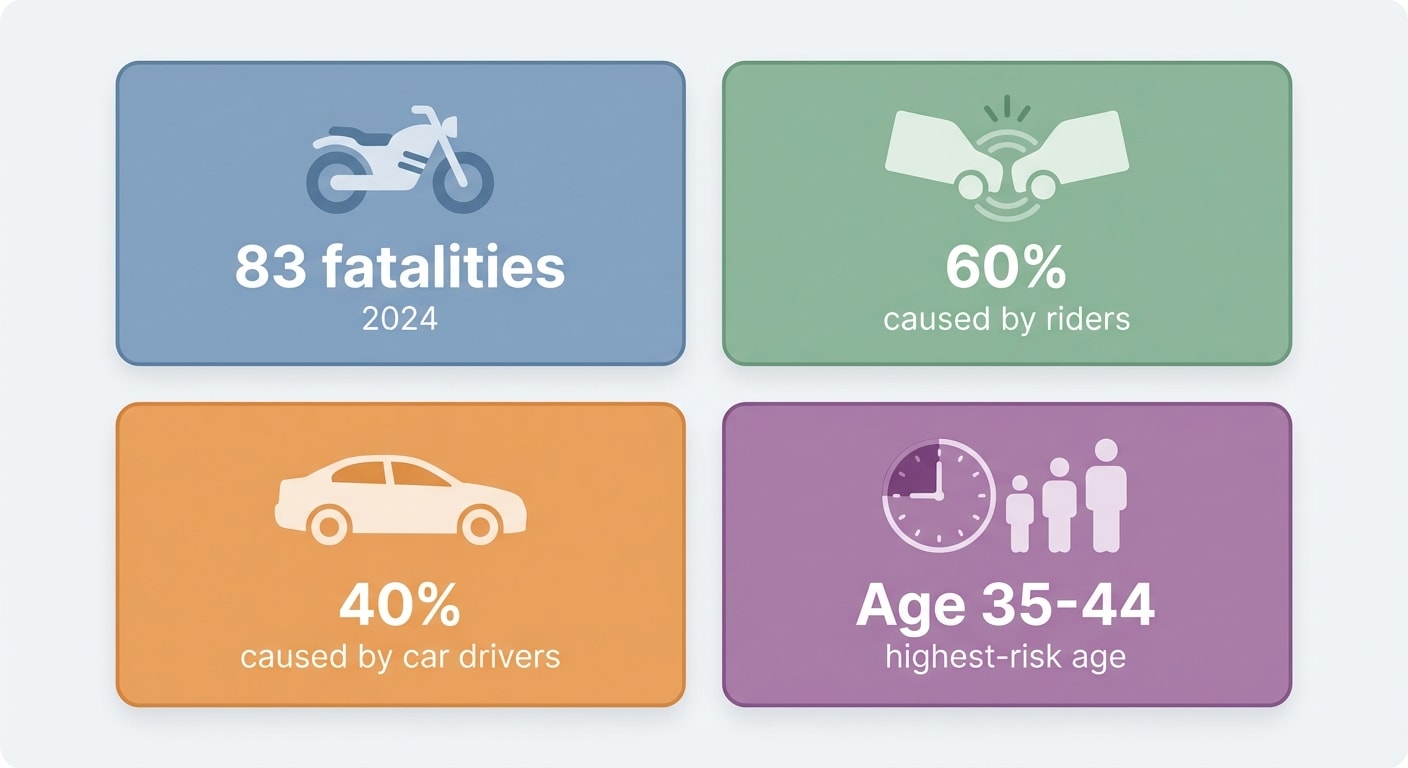
In 2024, 83 motorcyclists died on Czech roads. Surprisingly, it's not young beginners who crash the most — statistically, the highest-risk group is experienced riders aged 35 to 44 who overestimate their skills. If you want to ride a motorcycle, the first step toward safe riding is choosing the right license category and going through proper training. Not quick, not cheap — proper.
The Czech motorcycle licensing system works like a ladder. You start at the bottom and climb toward more powerful machines. From a moped at fifteen to a light motorcycle at sixteen to an unrestricted bike at twenty — if you take the progressive route. Or you wait until twenty-four and start on anything you want. This article explains how the whole system works, what it costs, and what to watch out for. It's based on Act No. 361/2000 Coll. and data from driving schools on Kvalty.cz.
Quick summary:
- Czechia has 4 motorcycle categories: AM (mopeds from age 15), A1 (125cc from 16), A2 (35 kW from 18), and A (unrestricted from 24 — or from 20 with a previous category)
- The progressive route A1 → A2 → A saves you 4 years — you can have an unrestricted license at 20 instead of 24
- With a category B license you can ride a 125cc automatic scooter in Czechia, but this doesn't work abroad
- Full training is 27 hours and costs CZK 10,000–30,000 depending on category and region
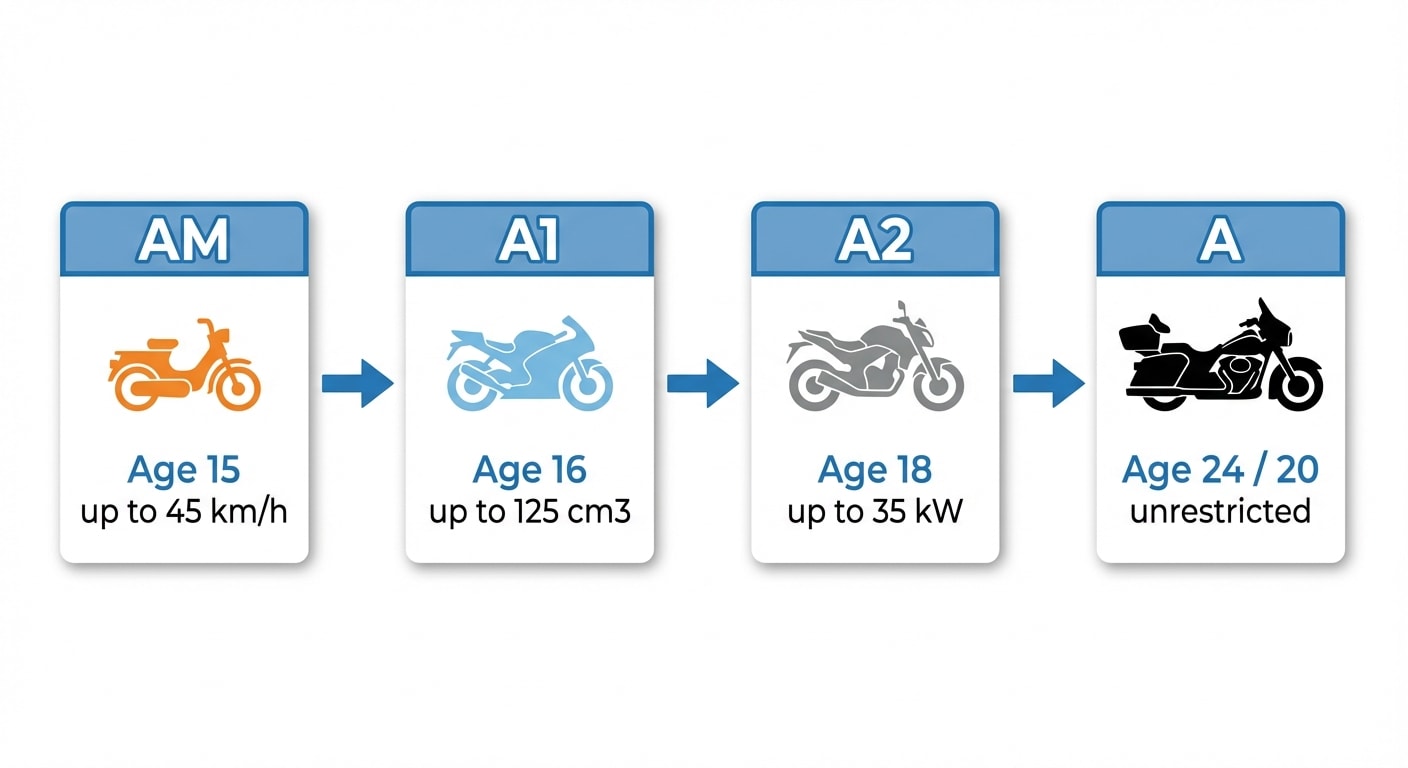
Four categories — from moped to full motorcycle
Act No. 361/2000 Coll. (§80a) distinguishes four motorcycle groups. Each has precisely defined limits for power, engine displacement, and minimum age. Let's walk through them one by one.
Category AM is the entry gate to the world of two wheels. It lets you ride mopeds and scooters with a maximum design speed of 45 km/h and engine displacement up to 50cc (or up to 4 kW for electric motors). Light three-wheelers and quadricycles with the same speed limit are also included. You can get it from age 15 with parental consent. It's the cheapest motorcycle category — training costs CZK 5,000 to 8,000.
Category A1 is the first "real" motorcycle license. You can ride motorcycles up to 125cc with a maximum power of 11 kW and a power-to-weight ratio of up to 0.1 kW/kg. Also three-wheelers up to 15 kW. The minimum age is 16 (with parental consent). In practice, these are lightweight bikes like the Honda CB125R or KTM 125 Duke — great for commuting and learning road skills.
Category A2 is the most popular entry point for adult riders. From age 18, you can ride motorcycles with up to 35 kW (roughly 48 horsepower) and a power-to-weight ratio of up to 0.2 kW/kg. An important detail: the motorcycle must not be derived from a model with more than double the power. That means you can't take a 90 kW sport bike and just "restrict" it to 35 kW. Typical A2 bikes include the Honda CB500F, Yamaha MT-03, and KTM 390 Duke.
Category A is the top tier — no power restrictions, no limits. You can ride any motorcycle and three-wheelers over 15 kW. Direct access is available from age 24. But if you take the progressive route and have held A2 for at least 2 years, you can get A as early as age 20.
AM cannot be upgraded to A1
Category AM is a standalone license — you cannot 'upgrade' it to A1. For A1, you need to complete a separate training course. The progressive ladder starts at A1.
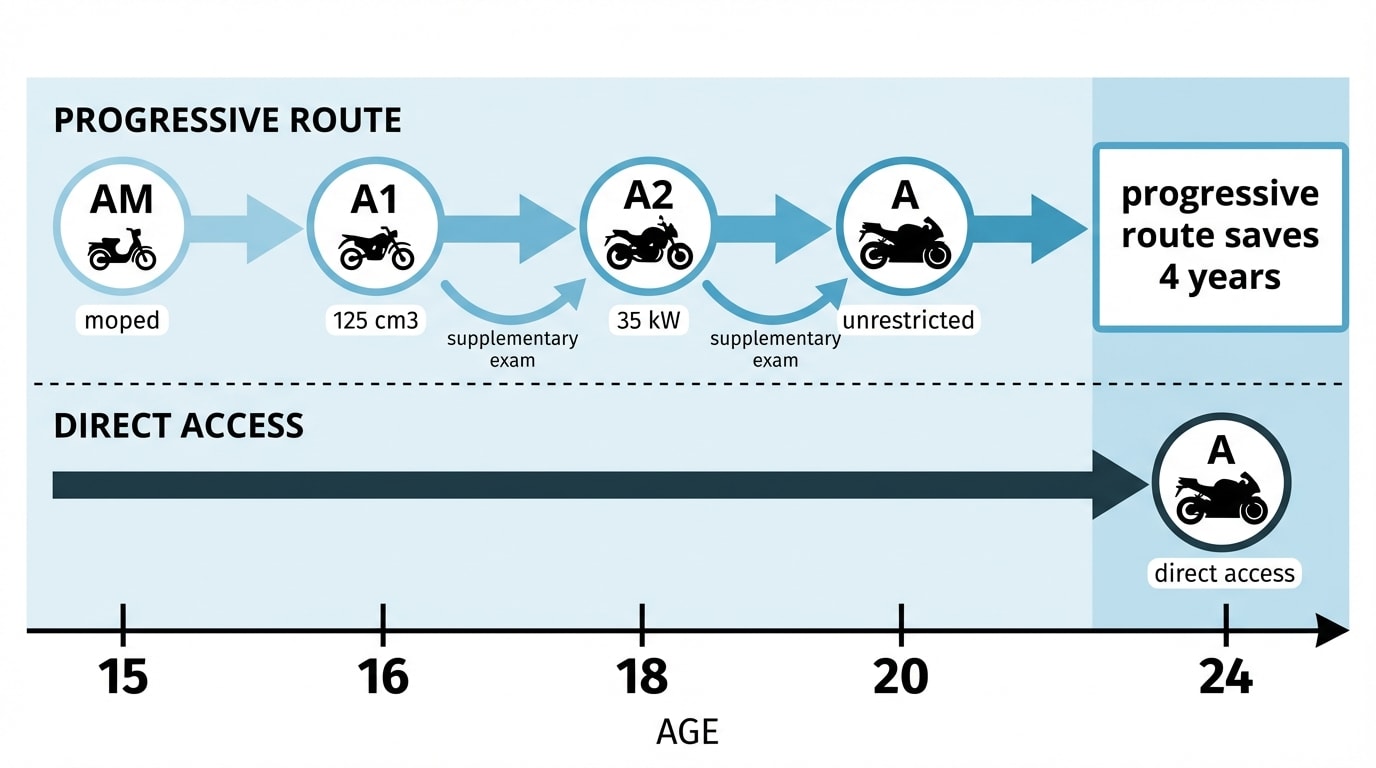
Progressive access — how to get an unrestricted license at 20
The entire EU (Directive 2006/126/EC) uses a progressive access system for motorcycle licenses. The principle is simple: you start on a weaker machine, learn to ride safely, and gradually gain access to more powerful bikes. Czechia adopted this into Act No. 361/2000 Coll. (§82).
The fastest route to an unrestricted license looks like this. At 16, you get A1 and ride a 125cc bike for two years. At 18, you upgrade to A2 — and because you've held A1 for at least 2 years, you only take a supplementary exam: no written test, just a practical riding test. For the next two years, you ride a mid-range motorcycle up to 35 kW. At 20, you upgrade to full A — again, just a supplementary exam. Result: at 20, you can ride anything on two wheels. If you waited for direct access, you'd have to wait until 24.
Each transition after two years is significantly easier and cheaper than full training. No theory classes, no written tests. You sign up at a driving school, ride a few hours on the more powerful machine to get used to it, and then pass a practical exam — manoeuvres on the test area and a ride in traffic. The supplementary exam costs around CZK 5,000 to 16,900. You'll find the detailed step-by-step process in the chapter How to Extend Your License.
If you've held the lower category for less than 2 years, you can still upgrade — you just complete a shortened training course (16 hours instead of 27) and take the full exam including the written test. It's more expensive, but you don't have to wait.
Riding a motorcycle with a category B license — equivalences and code 79
Many people believe a category B license lets them ride a motorcycle anywhere. The truth is more complicated. The law (§81, Act No. 361/2000 Coll.) states that a B license authorises you to ride A1-category vehicles — but only with an automatic transmission. Your license gets marked with A1 and harmonisation code 79. In practice, this means you can ride a scooter or motorcycle up to 125cc and 11 kW, as long as it has no clutch lever.
Here's the catch. This equivalence is valid only within the Czech Republic. Abroad — whether in Italy, Greece, Croatia, or Germany — a B license only lets you ride AM-category vehicles, meaning mopeds limited to 45 km/h. Anyone who takes a 125cc scooter to Croatia with just a Czech B license risks a fine and vehicle confiscation. Plenty of Czech tourists discover this the hard way every summer. More about category B and its benefits in the chapter Category B — Cars.
Another trap: code 79 from the B equivalence does not allow the simplified upgrade to A2. If your A1 entry comes solely from your B license (code 79), you cannot use the supplementary exam — you must go through full training and the complete exam like a total beginner. The progressive system only works for those who earned A1 properly at a driving school. More about codes 78 and 79 in the chapter Automatic vs. Manual — Code 78.
One more exception: from age 21, a B license lets you ride A-category three-wheelers (such as the Can-Am Ryker or Harley-Davidson Tri Glide). This is a specific rule that doesn't concern motorcycles in the strict sense, but it's worth knowing.
B → 125cc equivalence is Czechia-only
With a B license, you can ride a 125cc automatic scooter only within Czechia. Abroad, only AM applies (mopeds up to 45 km/h). If you want to ride a motorcycle outside the country, you need an A1, A2, or A license.
Training — how many hours and what to expect
Full training for categories A1, A2, and A is identical: 27 teaching hours (one hour = 45 minutes). That's 9 hours of theory and 18 hours of practice. Category AM requires slightly more — 28 hours (10 theory + 18 practice).
Theory covers traffic regulations (4 hours), vehicle operation and maintenance (1 hour), driving theory and safe riding (2 hours), first aid (1 hour), and a final review (1 hour). If you already have a B license and are familiar with traffic rules, theory will be a quick refresher. But don't underestimate motorcycle-specific topics — riding on two wheels has its own rules.
The practical part includes 13 hours of riding (training area + traffic), 1 hour of maintenance, and 4 hours of practical first aid. On the training area, you'll learn the basics: clutch control, slow slalom, U-turns in tight spaces, starting and braking. In traffic, you ride on regular roads — city, countryside, intersections. The driving instructor follows you on a companion motorcycle or in a car, communicating via headset.
For shortened training (upgrading from a lower category held less than 2 years), the course is 16 hours: 6 theory and 10 practice. For the supplementary exam (after 2+ years), the law doesn't prescribe a minimum number of hours — arrange with your driving school how many rides you need to get comfortable on the more powerful machine. Most schools recommend 4 to 7 hours.
The exam — manoeuvres on the test area and riding in traffic
The final exam for motorcycle categories has two parts: a written test and a practical riding test. For the supplementary exam (A1→A2 after 2 years or A2→A after 2 years), you only take the practical part — no written test (§45b, Act No. 247/2000 Coll.).
The written test is the same format as for category B: 25 questions, 50 points, minimum 43 points (86%), 30 minutes on a computer. You can practice for free at etesty2.mdcr.cz.
The practical exam is what sets a motorcycle license apart from other categories. It has two phases. The first takes place on the test area — the so-called manoeuvres. You start with the slow section: taking the motorcycle off its stand, walking it forward and backward through turns, parking in a confined space, riding a U-turn, slow slalom, and a figure eight. Then comes the fast section: slalom at a minimum of 40 km/h, obstacle avoidance at 50 km/h, and emergency braking from 50 km/h to a set distance.
The second phase is riding in traffic — at least 25 minutes. You ride the motorcycle alone while the examiner follows in a companion vehicle. They assess your starts, cornering, intersections, lane changes, overtaking, and overall smoothness and safety.
You get a maximum of 3 attempts at each part. Retaking the written test costs CZK 100, retaking the practical exam costs CZK 400. All parts must be passed within 12 months of the first attempt — otherwise you repeat the entire training.
Preparing for manoeuvres
The test area manoeuvres are the hardest part of the exam. It's worth paying for a few extra practice hours on the training ground. Most driving schools offer additional hours for CZK 500–1,000. The investment pays off — retaking the entire exam costs more.
What does it cost
The price of a motorcycle license depends on the category, region, and whether you're doing full training or an upgrade. Prague and larger cities are traditionally more expensive. You can find current prices for driving schools offering motorcycle training on Kvalty.cz.
Porovnání cen motocyklového výcviku podle kategorií — živá data z autoškol na Kvalty.cz
| statsTable.columns.license | statsTable.columns.minAge | statsTable.columns.avgPrice | statsTable.columns.minPrice | statsTable.columns.maxPrice | statsTable.columns.schoolCount |
|---|---|---|---|---|---|
| C+E – Truck with heavy trailer | 21 | 37,056 Kč | – | 60,000 Kč | 11 |
| D – Buses | 24 | 28,720 Kč | – | 64,900 Kč | 73 |
| B – Passenger cars up to 3.5 t | 18 | 26,147 Kč | – | 64,500 Kč | 1,067 |
| C – Trucks over 3.5 t | 21 | 25,952 Kč | – | 60,550 Kč | 235 |
| A2 – Motorcycles up to 35 kW | 18 | 25,084 Kč | 3,500 Kč | 64,500 Kč | 496 |
| A – Powerful motorcycles without limits | 20 | 24,744 Kč | 3,500 Kč | 64,500 Kč | 507 |
| C1 – Light trucks | 18 | 24,400 Kč | 19,490 Kč | 28,000 Kč | 7 |
| B+E – Car with heavy trailer | 18 | 24,105 Kč | 10,000 Kč | 35,700 Kč | 8 |
| D1 – Minibuses | 21 | 23,500 Kč | 22,000 Kč | 25,000 Kč | 2 |
| T – Tractors | 17 | 23,287 Kč | – | 59,000 Kč | 214 |
| A1 – Motorcycles up to 125 cc | 16 | 21,241 Kč | 3,500 Kč | 53,500 Kč | 470 |
| B1 – Quadricycles and light motor vehicles | 17 | 19,950 Kč | 17,000 Kč | 22,900 Kč | 2 |
| AM – Mopeds and small scooters | 15 | 18,878 Kč | 3,500 Kč | 53,500 Kč | 422 |
| B96 – Car with medium trailer | 18 | 17,585 Kč | 4,990 Kč | 33,500 Kč | 9 |
Total 3523 schools
On top of the course fee, add the medical examination (CZK 400–800) and the administrative fee for issuing the license (CZK 200). If you don't pass the exam on the first try, a test retake costs CZK 100 and a practical exam retake costs CZK 400.
The progressive route (A1 → A2 → A via supplementary exams) costs more overall than direct access to A at age 24 — you're paying for two or three training courses instead of one. But you ride a motorcycle years earlier. And more importantly: each level teaches you to ride a weaker machine before stepping up to a stronger one. That's an investment in safety you can't put a price on.
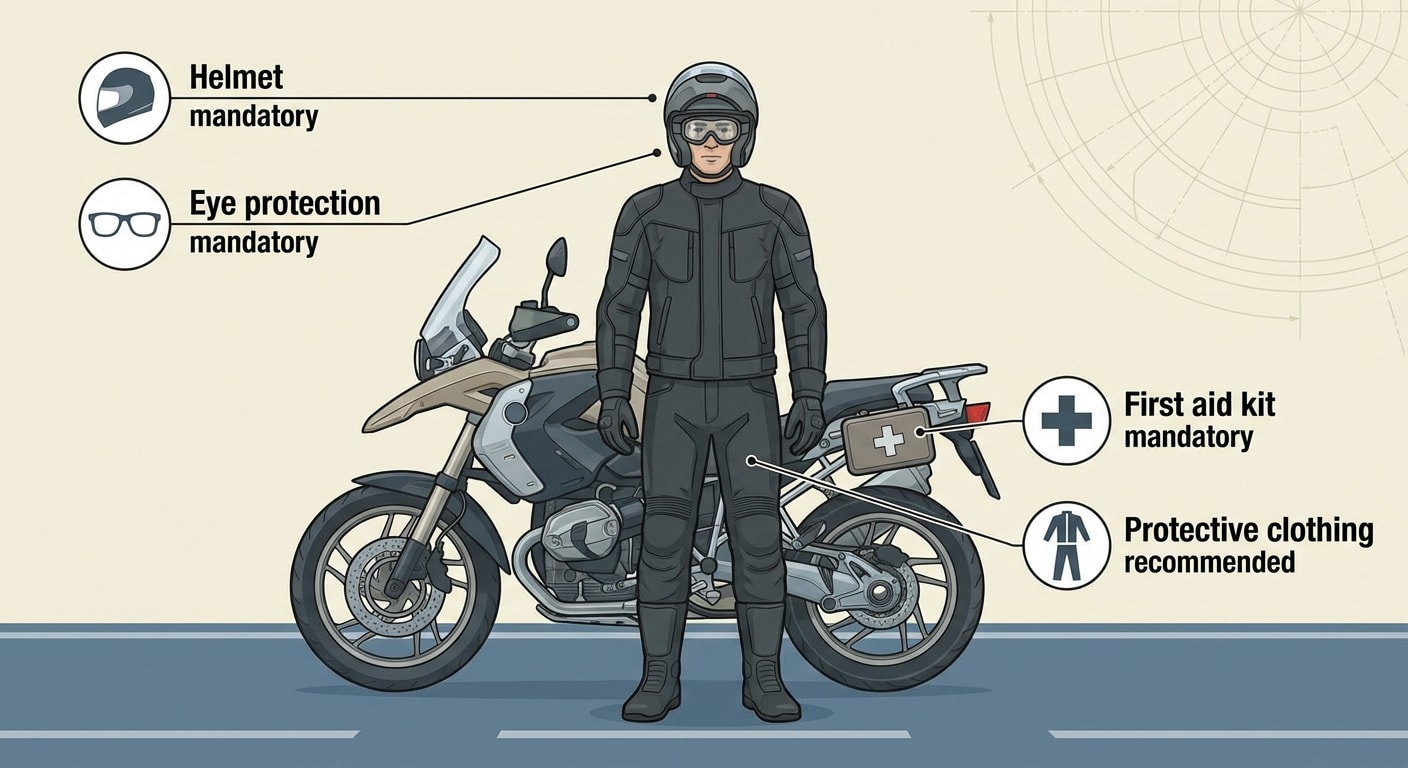
What you need on a motorcycle — mandatory equipment
The law is fairly brief but clear on motorcycle equipment. A helmet is mandatory for both rider and passenger — it must be properly worn and fastened. Riding without a helmet can cost you up to CZK 5,000 and 4 penalty points. Eye protection is also mandatory — either goggles or a visor on the helmet.
Since 2024, you must carry a motorcycle first aid kit: one bandage with a single pad, one bandage with two pads, a tourniquet, and gloves. The expiry date doesn't matter — what counts is that the contents are intact. As of October 2024, you no longer need to carry the green insurance card, as coverage is verified electronically.
Protective clothing — jacket, trousers, gloves, boots — is not legally required. But riding without it is gambling with your health. Crash data is clear: protective gear significantly reduces the severity of injuries. A reflective vest is also not required on a motorcycle.
Safety — numbers worth reading
According to BESIP (the Czech road safety organisation), Czechia is a "motorcycling powerhouse" — the number of registered motorcycles grows every year. In 2024, over 30,000 new single-track vehicles were added. But with that growth comes a rise in accidents.
In 2024, 83 motorcyclists died on Czech roads. A further 344 were seriously injured in 2022. Czechia ranks 7th worst out of 19 monitored European countries in motorcyclist fatalities per million inhabitants (IRTAD 2021). That's not a statistic you want to hear — but it's worth knowing.
Sixty percent of motorcycle accidents are caused by the riders themselves. Excessive speed, improper overtaking, overconfidence. The remaining 40% are caused by car drivers — most often failing to see the motorcyclist or misjudging their speed. Spring is particularly dangerous, when motorcyclists hit the road after winter and car drivers are still adjusting to sharing the road with them.
Training at a driving school is your first line of defence. Don't jump on a motorcycle just because you meet the age requirement. Go through proper training, ride cautiously during your first season, and invest in quality gear. On Kvalty.cz, you'll find driving schools offering motorcycle training in your region — compare ratings and read reviews from people who've been through them.
Summary
- Czechia has 4 motorcycle categories: AM (from age 15, mopeds), A1 (from 16, 125cc), A2 (from 18, 35 kW), and A (from 24 or 20 via the progressive route)
- Progressive access A1 → A2 → A lets you get an unrestricted license at 20 instead of 24 — transitions after 2 years require only a practical exam
- A category B license allows riding a 125cc automatic scooter, but only in Czechia — abroad, only AM applies
- Code 79 from the B equivalence does not allow the simplified upgrade to A2 — full training is required
- Full training is 27 hours and costs CZK 10,000–30,000 depending on category and region
- Helmet, eye protection, and first aid kit are mandatory — protective clothing is not, but riding without it is risky
Key Terms
| Term | Explanation |
|---|---|
| Category AM | Mopeds and scooters up to 45 km/h, engine up to 50cc. From age 15. |
| Category A1 | Light motorcycles up to 125cc and 11 kW. From age 16. |
| Category A2 | Motorcycles up to 35 kW (48 hp). From age 18. |
| Category A | Motorcycles with no power restrictions. From age 24 (or 20 with 2 years of A2). |
| Progressive access | EU tiered system: you start on a weaker machine and upgrade to a stronger one after 2 years. |
| Supplementary exam | Simplified exam (practical riding only) when upgrading after 2+ years of holding the lower category. |
| Code 79 | Harmonisation code on the license — restricts A1 to automatic only (from B equivalence). Valid in Czechia only. |
| Equivalence | Legal rule that a higher category automatically includes lower ones (A includes A2, A1, AM). |
| Power-to-weight ratio | Legal limit on how powerful a motorcycle can be relative to its weight (A1: 0.1 kW/kg, A2: 0.2 kW/kg). |
| Motorcycle first aid kit | Mandatory equipment: bandages, tourniquet, gloves. Since 2024, expiry date doesn't matter. |