Category B96: Trailer License Without Written Tests
Get B96 in just a few hours — no written tests, only a practical exam. What it allows, how much it costs, and how to get it.
You've calculated your vehicle combination weight and it comes out to 3,700 kg. Category B only covers up to 3,500. You don't have the time or ten thousand crowns to spare for a full B+E. And that's exactly the situation B96 was made for — an extension you can get in a single morning, without a single written test. Just a practical driving exam.
B96 is a harmonized code that gets added to your existing license. No new license card, no months spent at a driving school. This article explains exactly what B96 covers, how to get it, what it costs, and whether you actually need it — because a standard category B might be enough.
Quick summary:
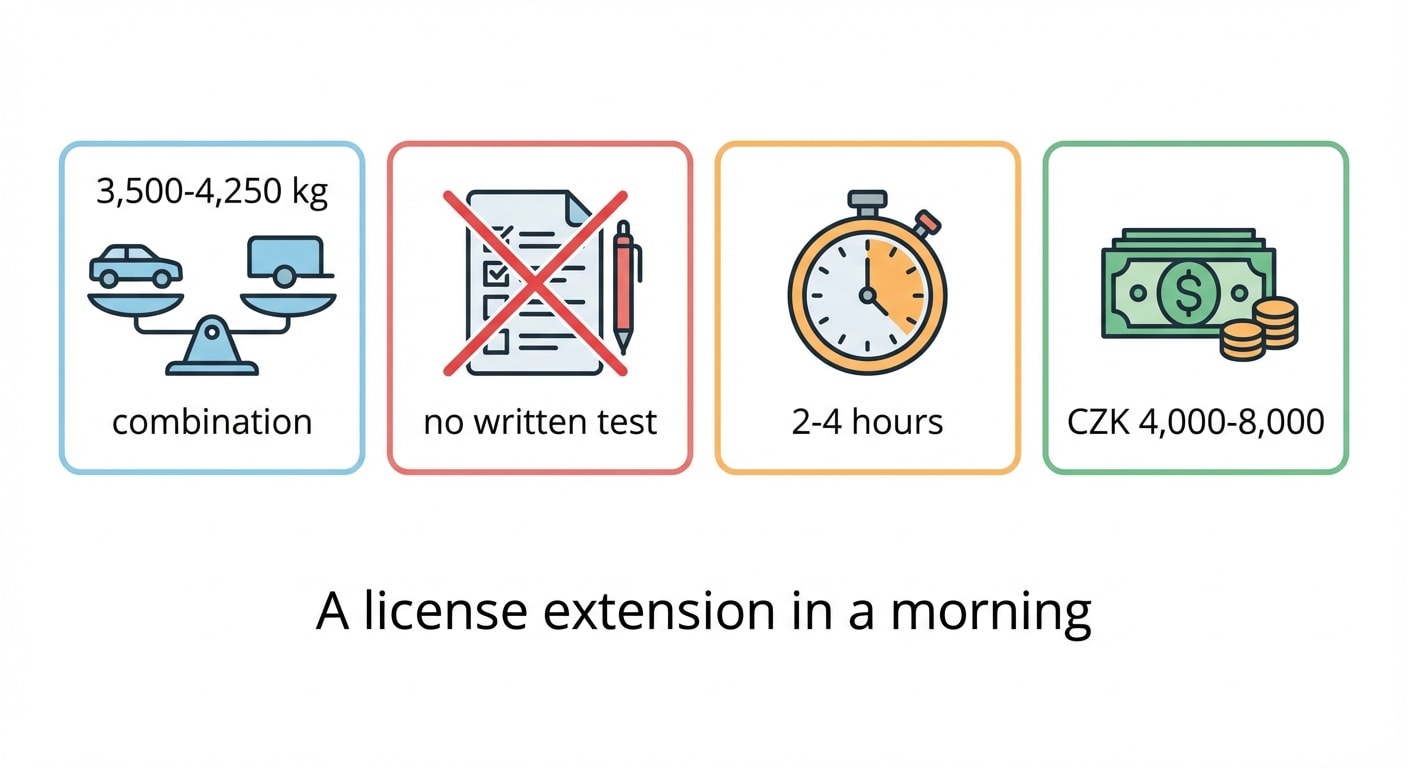
- B96 covers vehicle combinations with a total MAW between 3,500 and 4,250 kg (trailer over 750 kg)
- No written tests required — you only take a practical driving exam
- The entire process takes 1–3 weeks, with 2–4 hours of training
- Cost: CZK 3,500–8,000 for the course + CZK 700 administrative fee for the exam
What exactly B96 allows
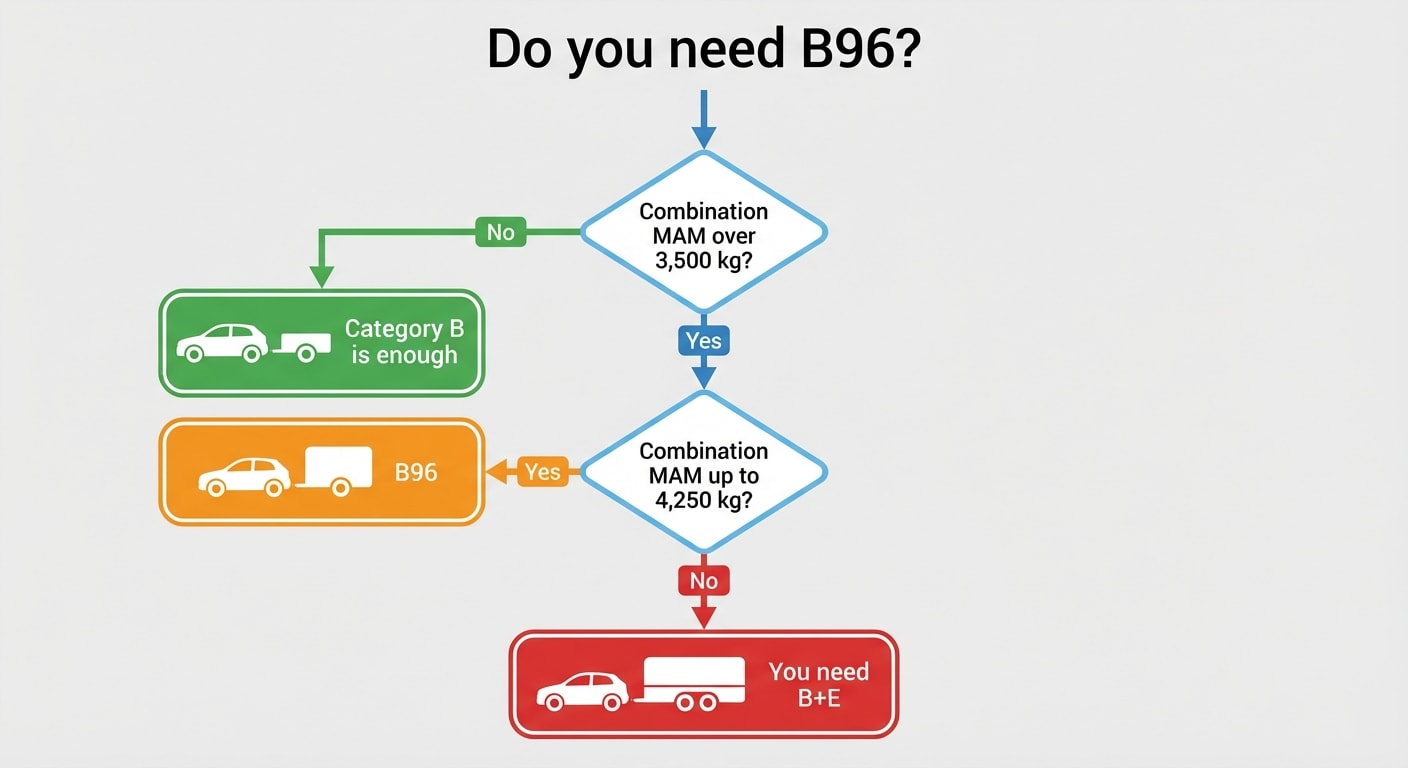
Category B lets you drive combinations where the total MAW doesn't exceed 3,500 kg (with a braked trailer over 750 kg). Once you go over that limit, you need an extension. B96 adds another 750 kg — pushing the ceiling to 4,250 kg.
The Road Traffic Act (Section 80a(6)(f) of Act No. 361/2000 Coll.) defines it precisely: B96 authorizes you to drive combinations consisting of a category B motor vehicle and a trailer with a MAW exceeding 750 kg, provided the total MAW of the combination exceeds 3,500 kg but does not exceed 4,250 kg. In the EU, this is called "harmonized code 96" — a number written on the back of your license.
In practice, this is what it means: a car with a MAW of 2,300 kg and a braked trailer with a MAW of 1,800 kg add up to 4,100 kg. With just category B, you couldn't legally drive this. With code 96 on your license, you can. But if that trailer had a MAW of 2,000 kg, the combination would weigh 4,300 kg — and that's over the limit even for B96. In that case, you'd need a full B+E license.
When you don't need B96
If your combination's total MAW is under 3,500 kg, a standard category B is enough — even with a braked trailer over 750 kg. Details and examples are in the chapter [What Can You Tow Without an Extension](/trailers-and-caravans/towing-with-category-b/).
Who typically needs B96
B96 isn't for drivers with a small garden trailer. They're fine with a standard B license. And it isn't for owners of massive trailers either — they need B+E. B96 sits right in the middle, and it's typically relevant for four groups of people.
Caravan owners are the most common candidates. A mid-size caravan with a MAW of around 1,400–1,800 kg behind an SUV with a MAW of 2,200–2,500 kg adds up to 3,600–4,300 kg. That's exactly the B96 range. If you're planning a caravan purchase, check out the chapter Caravans and Motorhomes for specific examples of which caravans fit within B96.
Horse owners are the second major group. A horse trailer for one or two horses has a typical MAW of 1,500–2,000 kg. Behind a heavier SUV, that easily exceeds 3,500 kg. B96 is a quick and affordable solution — more about horse transport in the chapter Towing Boats, Horses & Motorcycles.
Boat owners deal with B96 when using trailers for medium-sized boats. A trailer for a 5–6 meter boat has a MAW of around 1,200–1,500 kg. Behind a car with a MAW of about 2,300 kg, you'll easily go over the limit. And since you're typically towing the boat to the lake just a few times per season, investing in B96 makes more sense than hiring a transport service each time.
Small business owners need B96 when hauling materials or equipment on a larger braked trailer. A tradesman with a van and a trailer for a mini excavator, a small farmer with a bale trailer — these are typical situations where B isn't enough, but B+E would be overkill.
How to get B96 — step by step
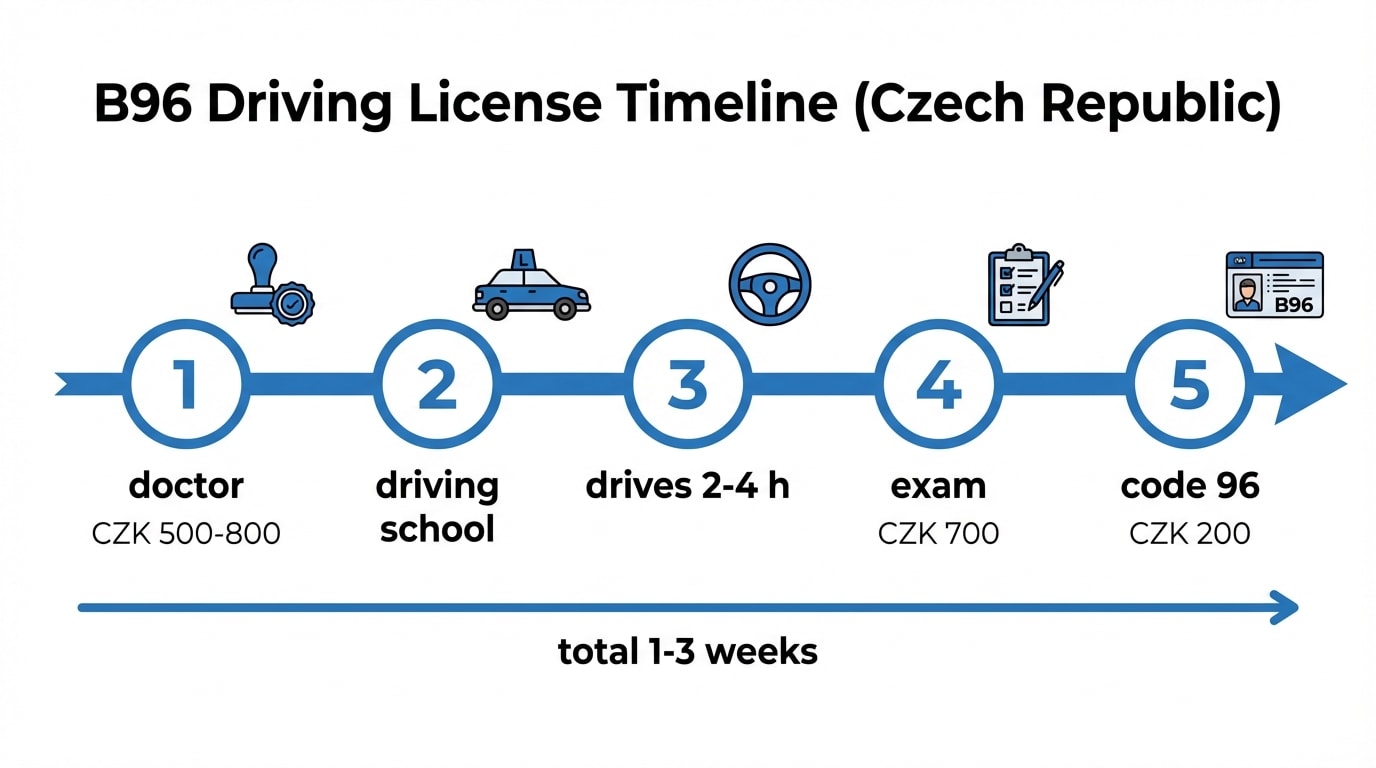
The entire process from decision to code 96 on your license takes 1–3 weeks. It mainly depends on how quickly you can schedule the exam in your region. Here's the exact procedure.
First, verify you meet the requirements. You need a valid category B license, be at least 18 years old, have permanent residence in the Czech Republic (or work or study here for at least 6 months), and must not have an active driving ban. You'll also need a medical fitness certificate — your GP will issue one for CZK 500–800.
Then choose a driving school. On Kvalty.cz, you can compare driving schools in your area that offer B96 courses. Prices vary — from CZK 3,500 in smaller towns to CZK 8,000 in Prague. The driving school will help you fill out the application for the supplementary exam and arrange a date.
Complete the preparatory driving lessons. Act No. 247/2000 Coll. requires a minimum of 2 training hours of practical driving. Most schools offer 2–4 sessions of 45 minutes each. You'll drive a combination in real traffic — city intersections, parking, reversing. This is hands-on training, not classroom theory. No sitting in a lecture hall, no computer tests.
Pass the supplementary exam. This is the only test you need to pass. It's purely practical — you drive a combination under the supervision of an examiner. The exam lasts 30–45 minutes and includes driving in city traffic, parking (parallel and perpendicular), reversing with a trailer, and checking the trailer connection.
Get code 96 recorded. After passing, the driving school issues a confirmation. Take it to your local municipal office (transport department), where they'll record code 96 on your license. You'll need a new license card — the replacement fee is CZK 200.
What to expect at the exam
The B96 exam is purely practical. No written tests, no computer questions. You sit behind the wheel of a combination and drive. The examiner sits next to you and evaluates whether you can handle the combination safely.
Driving in traffic is the first part. You navigate the combination through normal city traffic — intersections, one-way streets, turning. The examiner watches whether you check your mirrors (the blind spot with a trailer is significantly larger), maintain safe distances, and maneuver the combination smoothly. A heavier trailer behind the car changes the behavior of the entire combination — longer braking distance, wider turning radius, different dynamics.
Parking tests whether you can park the combination. Parallel parking, perpendicular parking, from both sides. With just the car, it's routine. With a trailer behind you, it's a different world — and the examiner knows it.
And then comes reversing. According to driving school experience, this is the hardest part of the exam and the most common reason for failure. A trailer behaves counter-intuitively when reversing — turn the wheel right and the trailer goes left. Journalists from Auto.cz who tried B96 firsthand described reversing with a trailer as "a total disaster." If you have no experience reversing with a trailer, make the most of your training hours — this isn't something you can learn from YouTube videos.
The final part is a connection check. The examiner will ask you to disconnect and reconnect the trailer — and verify that everything is in order. The tow coupling, safety cable, electrical connector, trailer handbrake.
Prepare for reversing
Reversing with a trailer is the hardest part of the exam. The trailer moves opposite to what you'd expect. The legal minimum is 2 hours of training — but if you've never reversed with a trailer, go for 4 hours. An extra few thousand CZK invested is better than retaking the exam for CZK 1,600.
What it all costs
The price of a B96 course in the Czech Republic ranges from CZK 3,500 to 8,000. It depends on the region, the driving school, and how many training sessions they include. Prague is traditionally the most expensive, smaller towns significantly cheaper.
On top of the course fee, add mandatory charges. The administrative fee for the exam is CZK 700 — paid to the municipal office, not the driving school. A medical certificate from your GP costs CZK 500–800. And replacing your license with a new one showing code 96 costs CZK 200.
Total costs come to around CZK 5,000–9,500. Compare that with the fine for driving without the proper license — CZK 25,000 to 50,000, a driving ban of 12–24 months, and 4 penalty points (Section 125c of Act No. 361/2000 Coll.). The investment in B96 pays for itself at the first inspection you avoid.
What if you don't pass on the first attempt? A retake costs approximately CZK 1,200 for the driving school and CZK 400 for the administrative fee. You have three attempts and must use them within 12 months of the first date. Most candidates pass on their first try — the exam isn't that difficult if you practice reversing properly.
Total B96 costs
| Item | Cost |
|---|---|
| Driving school course (2–4 sessions) | CZK 3,500–8,000 |
| Medical certificate | CZK 500–800 |
| Administrative exam fee | CZK 700 |
| License replacement | CZK 200 |
| Total | approx. CZK 5,000–9,500 |
B96 vs. B+E — which is right for you
This is the question nearly everyone asks when they exceed the 3,500 kg limit. The answer depends on one number: the total MAW of your combination.
If your combination doesn't exceed 4,250 kg, B96 is clearly the better choice. It's faster (1–3 weeks vs. 4–6 weeks), cheaper (CZK 5,000–9,500 vs. 8,500–17,000), and simpler (practical exam only vs. theory + practical). Most mid-size caravans, horse trailers for one to two horses, and boat trailers fit within this limit.
But if your combination exceeds 4,250 kg, B96 won't help. You need B+E, which covers combinations up to 7,000 kg. This typically includes large family caravans with a MAW over 2,000 kg, trailers for two or more horses, or heavy boat trailers. B+E requires a full course — 6 hours of theory, 8 hours of driving, 2 hours of maintenance — and both a theory and practical exam.
There's one important detail though: if you get B96 today and buy a heavier trailer in a few years, you'll still need to complete B+E. So if you're planning a heavier combination in the future, it may be worth going straight for B+E to avoid paying twice. On the other hand — if you need to drive now and B96 is sufficient, why wait?
B96 vs. B+E — comparison
| Parameter | B96 | B+E |
|---|---|---|
| Max. combination MAW | 4,250 kg | 7,000 kg |
| Theory / written tests | No | Yes (6 hours + exam) |
| Practical training (min.) | 2 hours | 8 hours + 2 h maintenance |
| Exam | Practical driving only | Theory + practical driving |
| Total costs | CZK 5,000–9,500 | CZK 8,500–17,000 |
| Time from registration to license | 1–3 weeks | 4–6 weeks |
What the exam doesn't cover
This needs to be said openly: the B96 exam teaches you basic combination handling, but it doesn't prepare you for everything you'll encounter on the road. It doesn't include driving in crosswinds (with a trailer acting like a sail), proper load distribution, or emergency maneuvers.
That's why we recommend spending time on the chapter Trailer Towing Safety after getting your B96 — you'll find everything the exam didn't cover there: trailer stabilization, braking distances with a combination, speed limits (with a combination over 3,500 kg MAW, you're limited to 80 km/h outside built-up areas), and proper loading.
Driving schools know this, and some offer optional "safety" sessions — driving on wet roads, reversing into tight spaces, emergency braking. If you have the option, take them. Especially if you plan to travel long distances with a caravan or transport horses, where smooth driving literally determines the animals' comfort.
Upcoming rule changes
EU Directive 2025/2205 is set to raise the category B limit from 3,500 kg to 4,250 kg for all fuel types. If this change is reflected in Czech law, a large portion of drivers who currently need B96 would manage with just category B. Member states must implement the rule by November 26, 2027 — in the Czech Republic, it's expected to take effect around 2027–2029.
But be careful: as of 2026, the current rules still apply. The exception for the higher 4,250 kg limit exists only for vehicles running on alternative fuels and requires at least 2 years of driving experience. For standard petrol or diesel cars, the limit remains 3,500 kg. If you need a trailer now, B96 is the way. Waiting for a law change that might come in a year or three isn't a strategy — it's a gamble.
Directive 2025/2205 and B96
If the EU raises the category B limit to 4,250 kg for all fuels, B96 will lose most of its purpose — its range would overlap with category B itself. But even if that happens, B96 holders won't lose anything — the code stays on your license and remains valid.
Summary
- B96 extends category B to cover combinations with a total MAW of 3,500–4,250 kg
- No written tests — you only take a practical driving exam with a combination
- The entire process takes 1–3 weeks and costs CZK 5,000–9,500
- The hardest part of the exam is reversing with a trailer — practice it beforehand
- If your combination exceeds 4,250 kg, you need B+E
- The EU is planning a change that could make B96 unnecessary — but as of 2026, current rules still apply
Key Terms
| Term | Explanation |
|---|---|
| B96 (harmonized code 96) | An extension of category B recorded on your driving license. Allows you to drive combinations with a MAW of 3,500–4,250 kg. |
| Supplementary exam | A practical driving exam with a combination — the only test needed for B96. No theory. |
| Combination MAW | The sum of the car's MAW (F.1) and the trailer's MAW (F.1) from the vehicle registration documents. Determines the required license category. |
| Administrative fee | A fee of CZK 700 for the supplementary exam, paid to the municipal office. |
| Overrun brake | The braking system of braked trailers — activates automatically through inertia when the towing vehicle brakes. |
| Horse trailer | A trailer for transporting horses — typical MAW of 1,500–2,500 kg. For 1–2 horses, B96 is often sufficient. |
| Section 80a of Act No. 361/2000 Coll. | The section of the Road Traffic Act that defines weight limits for individual driving license categories. |
| EU Directive 2025/2205 | An upcoming directive that would raise the category B limit to 4,250 kg for all fuel types (transposition by 2027). |