Which License for a Caravan? Guide by Weight
Find out which license you need for your caravan or motorhome. Category overview, parking rules, and highway tolls.
You buy a caravan for a quarter million crowns, spend all winter planning the route to the coast — and at the first police check, you find out you don't have the right license for your combination. A fine of CZK 25,000 to 50,000, a driving ban for two years, and your holiday is over before it started. This happens more often than you'd think. Most people don't realize that the license category you need is determined by a single number: the MAW (Maximum Authorized Weight) listed in the vehicle registration document.
On top of that, caravans and motorhomes follow completely different rules. For a caravan (towed trailer), you add up the MAW of your car and the trailer. For a motorhome, you look only at the MAW of the vehicle itself. Mixing up this logic is the second most common mistake. This article walks you step by step through which category you need for your specific type of caravan or motorhome — plus everything else you need to know about speed limits, tolls, and parking.
Quick summary:
- The license category is determined by the MAW from the registration document — not actual weight
- Small caravans (combination up to 3,500 kg) work with category B, medium with B96, large with B+E
- Motorhomes over 3,500 kg require category C1 — category B alone isn't enough
- EU Directive 2025/2205 will raise the B limit to 4,250 kg for motorhomes from 2027 onward
Caravan vs. motorhome — the key difference
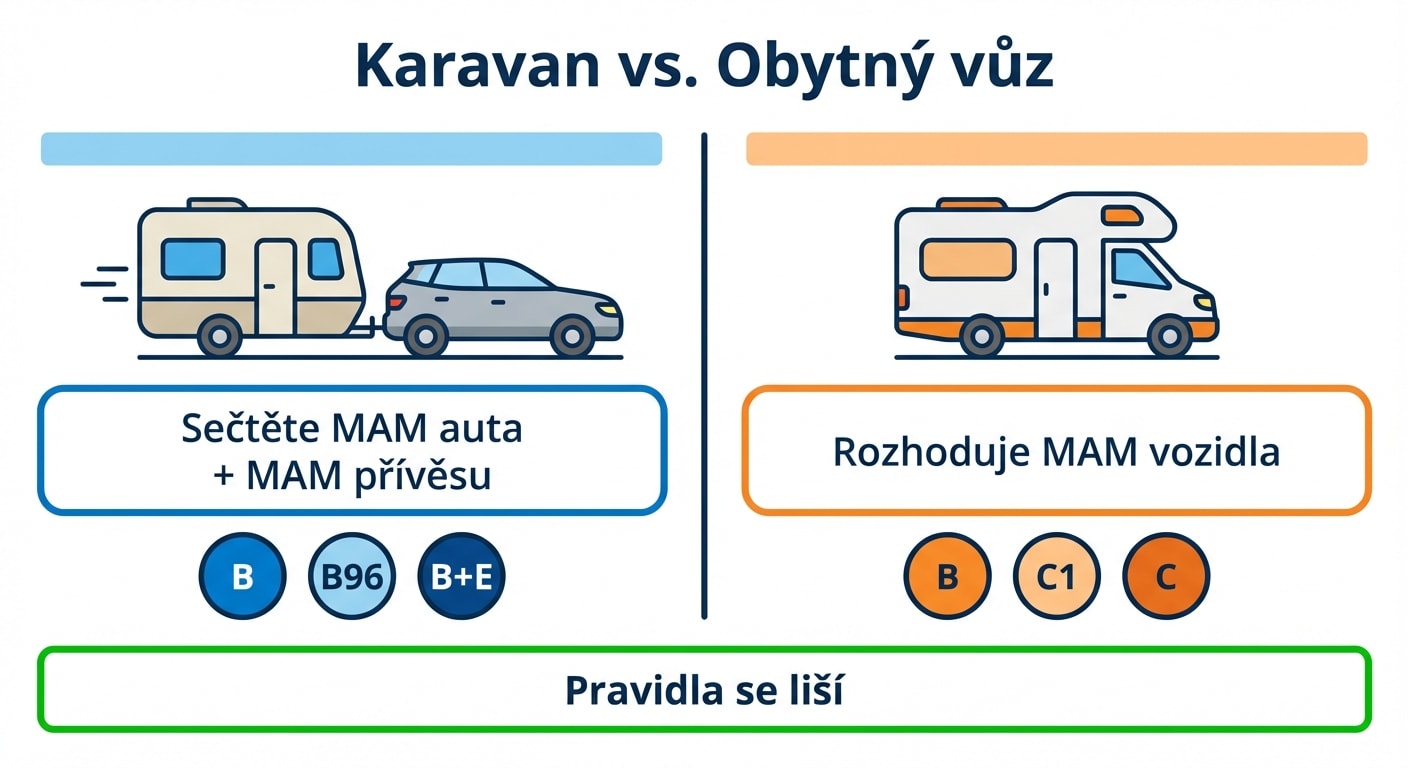
Before diving into weight tables, you need to understand one thing: the law treats a caravan (towed trailer) and a motorhome as two completely different vehicle categories. And the license you need is calculated differently for each.
A caravan is a towed vehicle. It has no engine of its own — you pull it behind your car. For legal purposes, it's a combination — and what matters is the sum of both vehicles' MAW from their registration documents (Section 80a of Act No. 361/2000 Coll.). Your car has a MAW of 2,200 kg, the caravan 1,500 kg — the combination is 3,700 kg. With category B (max 3,500 kg), you can't drive. You need at least B96.
A motorhome is a self-propelled vehicle. It has its own engine and you drive it like any other car. Don't worry about combinations here — only the MAW of the vehicle itself matters. A van conversion (VW California, Pössl) with a MAW under 3,500 kg? Category B is fine. A full-profile motorhome (integrated) with a MAW of 4,200 kg? You need category C1.
This mix-up is dangerous. A caravan owner used to calculating combination weights buys a motorhome over 3.5 tons and assumes B+E will do. It won't. B+E is for trailers, not for heavy motor vehicles. For a motorhome over 3,500 kg, you need C1 — and that's an entirely different course.
Which category for a caravan (towed trailer)
With a caravan, it all comes down to one calculation: your car's MAW + the caravan's MAW = the combination's MAW. You'll find both numbers in the registration document under field F.1. Never calculate with actual weight — the law always uses the maximum authorized figure.
Small caravans of the "tent on wheels" type (Adria Action, Lifestylecamper) have a MAW around 750 kg. Behind a regular car with a MAW of 1,800 kg, your combination is 2,550 kg — category B is more than enough. Similarly, two-person caravans (Weinsberg, Caravelair Alba) with a MAW of 1,000–1,200 kg behind a car with a MAW up to 2,300 kg stay under 3,500 kg.
Medium caravans for four people (Hobby De Luxe, Fendt Bianco) have a MAW of 1,300–1,600 kg. Hitch one to an SUV with a MAW of 2,200 kg and the combination reaches 3,500–3,800 kg. This is where category B runs out — you need B96, which covers combinations up to 4,250 kg. The good news: you can get B96 in just a few hours, no written tests required.
Large family caravans (Hobby Prestige, Dethleffs Beduin) with a MAW of 1,800–2,500 kg behind a heavier SUV exceed even the B96 limit. A combination around 4,500–5,000 kg requires B+E — a full towing license for combinations up to 7,000 kg. And tandem (twin-axle) caravans with a MAW of 2,500–3,500 kg? B+E is almost always necessary.
Which license for which caravan?
| Caravan type | Typical caravan MAW | Combination MAW (example) | Category |
|---|---|---|---|
| Mini caravan (tent on wheels) | 500–750 kg | 2,100–2,350 kg | B |
| Small caravan (2 people) | 1,000–1,300 kg | 2,800–3,100 kg | B |
| Medium caravan (4 people) | 1,300–1,600 kg | 3,500–3,800 kg | B or B96 |
| Large caravan (4–6 people) | 1,600–2,200 kg | 4,100–4,700 kg | B96 or B+E |
| Large family / tandem | 2,200–3,500 kg | 5,000–6,500 kg | B+E |
How to find your combination's MAW
Take your car's registration document (field F.1 — MAW) and your caravan's registration document (field F.1 — MAW). Add both numbers. The result determines which license category you need. It doesn't matter how much the caravan actually weighs — the law always uses the maximum from the registration document.
Motorhomes — different rules
For a motorhome, forget about adding weights. You only look at the MAW of the vehicle itself — that's the number that determines your license category.
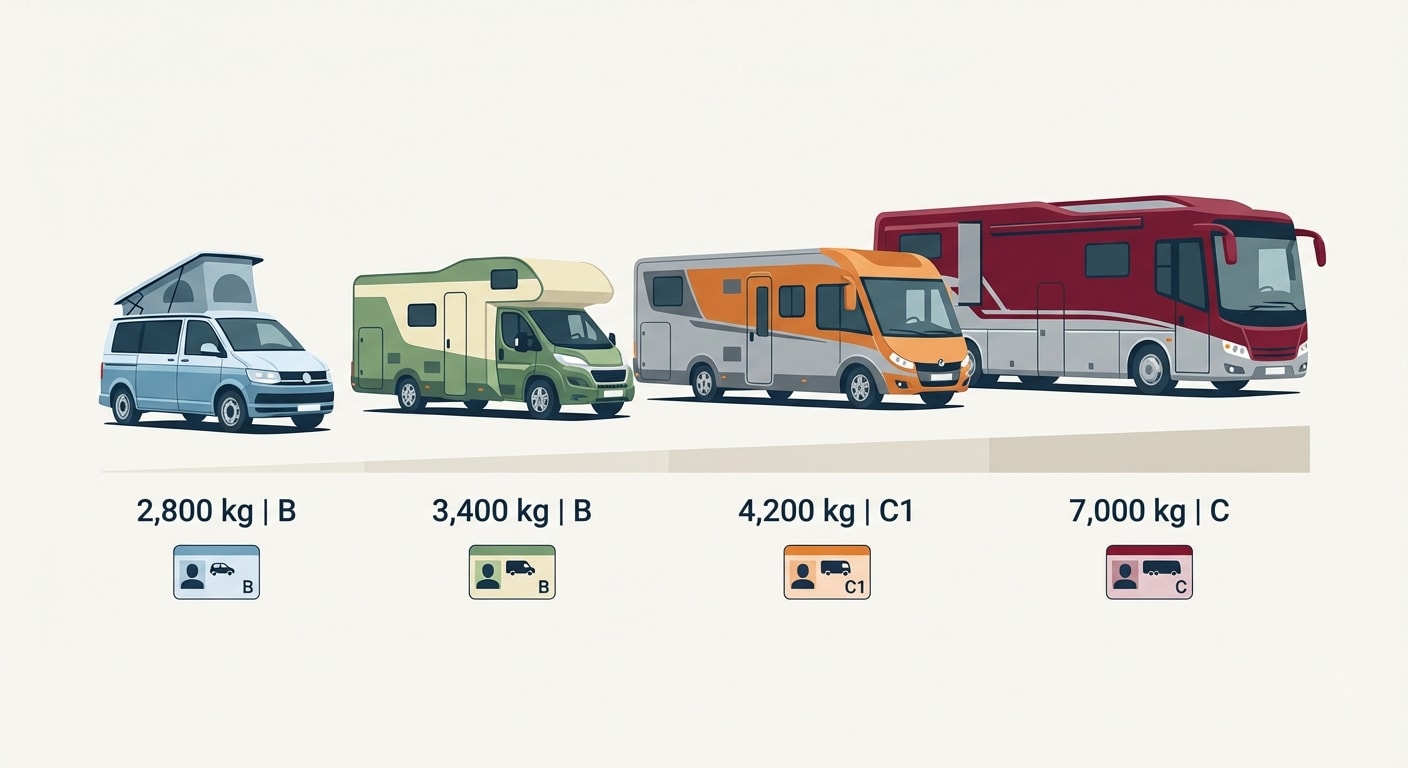
Most motorhomes on Czech roads fit within category B. Van conversions (VW California, Citroën SpaceTourer, Pössl) have a MAW around 2,800–3,200 kg. Semi-integrated models from Adria, Sunlight, or Carado typically hover around 3,300–3,500 kg. As long as the MAW doesn't exceed 3,500 kg, you drive on a B license.
The problem starts with full-profile (integrated) motorhomes. Models with a MAW of 3,500–4,500 kg require category C1 — a license for vehicles up to 7,500 kg. And note: C1 is not the same as B+E. C1 is for motor vehicles, B+E is for combinations with a trailer. If you have B+E for towing a caravan and then buy an integrated motorhome over 3.5 tons, B+E won't help you.
The C1 course is considerably more demanding: 24 training hours (theory + practice), a medical examination with stricter criteria, and both a theory and practical exam. It costs around CZK 15,000–25,000. That's why most caravan enthusiasts find it more practical to stick with motorhomes under 3,500 kg — or get a caravan and tow it with B96 or B+E.
And what if you want to hitch a trailer behind your motorhome — say for a motorcycle or boat? Then the weights add up again. A motorhome with a MAW of 3,200 kg + a trailer with a MAW of 750 kg = 3,950 kg. With category B, that doesn't work — you need B96 or B+E. More about motorcycle and boat trailer combinations in the chapter Towing Boats, Horses & Motorcycles.
Speed limits, highway tolls, and road charges
With a caravan behind your car, the usual speed limits for a solo car don't automatically apply. The law (Section 18 of Act No. 361/2000 Coll.) distinguishes two situations based on the combination's total weight.
If the combination's MAW doesn't exceed 3,500 kg, you drive like a regular car: 50 km/h in built-up areas, 90 km/h outside built-up areas, 110 km/h on expressways, and 130 km/h on motorways. That's the case for small caravans with category B. In practice, though, most experienced caravanners recommend staying under 100 km/h on the motorway — a caravan in crosswinds becomes unpredictable at higher speeds. More on stability and safe driving with a combination in the chapter Trailer Towing Safety.
Once the combination's MAW exceeds 3,500 kg — and that's the case for most caravans requiring B96 or B+E — the limit is 80 km/h on all roads outside built-up areas. No motorway exception. Eighty means eighty.
Highway tolls are simpler. Combinations up to 3,500 kg pay the electronic highway vignette — the same as a regular car. In 2026, the annual vignette costs CZK 2,300, monthly CZK 430, and ten-day CZK 270. The caravan itself doesn't need a vignette — it's the towing vehicle that pays.
Motorhomes over 3,500 kg fall under the electronic toll system (OBU unit). Rates are paradoxically often lower than the vignette when calculated per kilometer. And an important perk: motorhomes are exempt from tachograph requirements and weekend driving bans — the law classifies them as recreational vehicles, not commercial transport.
Highway vignette vs. electronic toll
Combination up to 3,500 kg = electronic highway vignette (CZK 2,300/year). Motorhome over 3,500 kg = electronic toll (OBU unit, pay per kilometer). Motorhomes are exempt from weekend driving bans and tachograph requirements.
Where you can (and can't) park
Parking with a caravan in the Czech Republic is tricky. Officially, you can park in regular parking lots as long as you follow the general rules — meaning at least a 3-meter lane remains clear for traffic. On your own property, you can park a caravan without restrictions (but note: permanently placing a caravan on a plot can be classified as a structure by the building authority).
The problem is overnight parking. Many Czech cities have ordinances prohibiting overnight parking of motorhomes and caravans on public roads. Prague prohibits overnight parking of recreational trailers across the board. Olomouc bans it from 10 PM to 6 AM. Other cities have similar rules — always check the local ordinance.
"Wild" camping — sleeping in a caravan at a random spot by the road — is generally prohibited in the Czech Republic. You risk a fine for unauthorized use of public space. On the other hand, services like Bezkempu.cz offer overnight stays on private properties, and the international app Park4Night has a database of stellplatz locations.
The safest option outside the season? Paid, supervised caravan parking or garages. During the season, campsites and certified stellplatz locations.
What's changing — EU Directive 2025/2205
A major change is coming for caravan and motorhome owners. EU Directive 2025/2205 plans to raise the category B limit from 3,500 kg to 4,250 kg for all fuel types — not just electric and hydrogen vehicles, as is currently the case. Member states must implement the rules by November 26, 2027.
For motorhome owners, this is huge news. Most semi-integrated models with a MAW of 3,500–4,250 kg, which currently require C1, will fit under category B. The directive also introduces a new code 96.03: a motorhome up to 4,250 kg + trailer (boat, motorcycle) in a combination up to 5,000 kg.
For caravan owners, this means combinations that currently require B96 will work with a plain B license. The B96 extension could lose its relevance for most common combinations. Meanwhile, B+E will remain relevant for heavy combinations over 4,250 kg.
But note: as of 2026, the 3,500 kg limit still applies. The 4,250 kg exception exists only for alternative fuels (electric, hydrogen, CNG) and requires at least 2 years of driving experience. Until the Czech Republic implements the directive, follow the current rules.
Until the law takes effect, stick with current limits
EU Directive 2025/2205 will take effect in the Czech Republic no earlier than around 2027–2029. Until then, the 3,500 kg limit for category B applies. Don't buy a motorhome over 3.5 tons assuming 'it'll be covered by B soon' — you could be waiting years.
Practical tips when buying a caravan
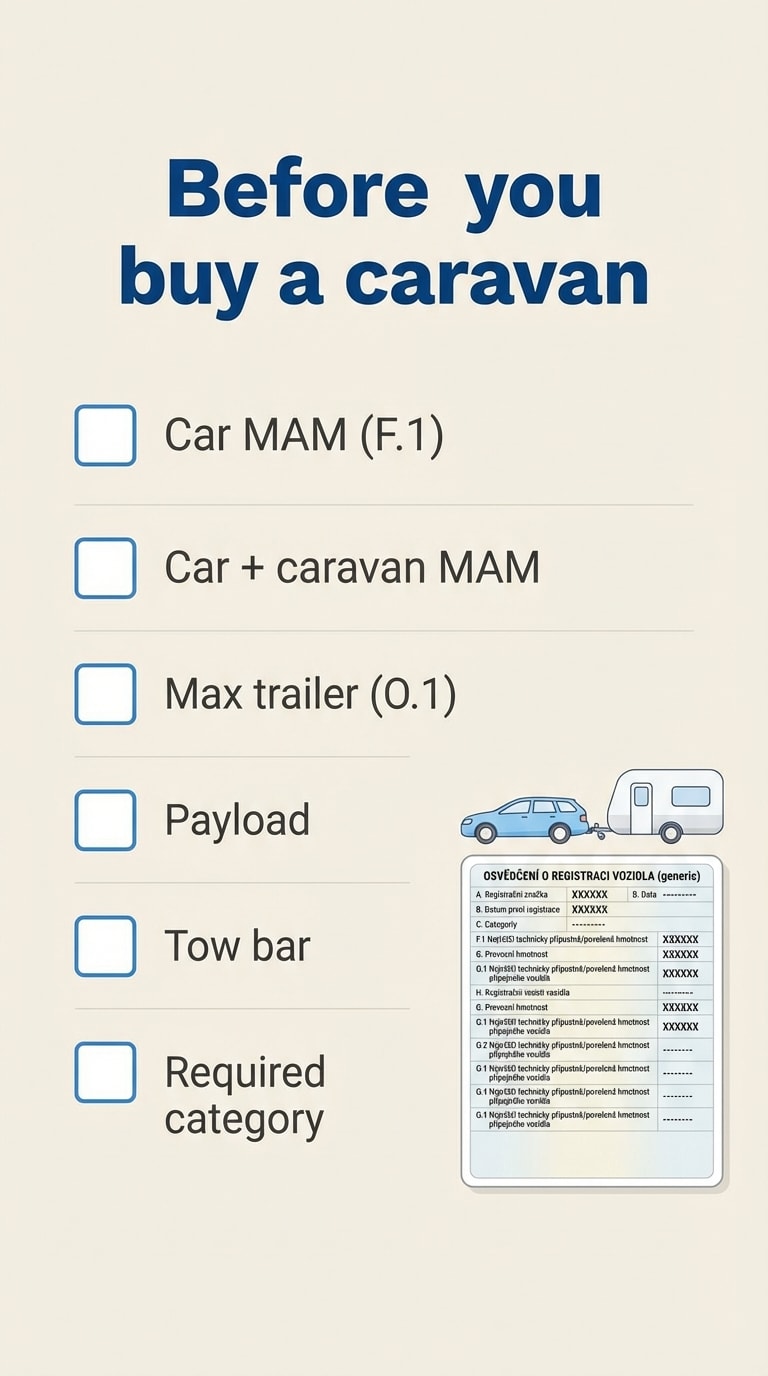
If you're still choosing a caravan, sort out the license question first. Open your car's registration document and note the MAW (field F.1). Then look for a caravan whose MAW, added to your car's, fits within your license category.
Don't forget to check field O.1 in your car's registration document — that's the maximum weight of a braked trailer the car is allowed to tow. Even if the combination's weight fits within your license category, the car simply might not be built for towing. Then there's the caravan's payload capacity — the difference between MAW and unladen weight. Typically 150–300 kg of "extra" for clothes, food, gear, and water. Sounds like a lot, but with a family, that space fills up surprisingly fast.
If your combination comes out just over the category B limit, consider B96 — you can get it in a few hours and it costs CZK 3,500–8,000. Peace of mind. If you're planning a large family caravan or want headroom for the future, invest straight away in B+E.
One more important detail: the tow bar. You need a type-approved tow hitch with a 50 mm ball and a 13-pin electrical connector (modern standard). Older 7-pin connectors don't support fridge charging while driving or a reversing camera. Installing a tow bar costs CZK 5,000–15,000 depending on the car.
Summary
- The license category is determined by MAW from the registration document — always add car MAW + caravan MAW
- Small caravans (combination up to 3,500 kg) → category B, medium (up to 4,250 kg) → B96, large → B+E
- Motorhomes over 3,500 kg require category C1 — not B, not B+E
- Combinations over 3,500 kg → speed limit 80 km/h outside built-up areas
- Highway vignette applies to combinations up to 3,500 kg; motorhomes over 3,500 kg pay electronic tolls
- Overnight caravan parking is banned in many cities — check the local ordinance
- EU Directive 2025/2205 will raise the B limit to 4,250 kg, but no earlier than 2027
Key Terms
| Term | Explanation |
|---|---|
| MAW (Maximum Authorized Weight) | The maximum weight of a vehicle or trailer from the registration document — field F.1. For license categories, MAW is always used, not actual weight. |
| Caravan (towed trailer) | A towed vehicle without its own engine, pulled behind a car. The license category depends on the MAW of the entire combination (car + trailer). |
| Motorhome | A self-propelled vehicle with its own engine. The license category depends on the MAW of the vehicle itself — not of any combination. |
| C1 | A driving license category for motor vehicles with a MAW of 3,500–7,500 kg. You need it for motorhomes over 3,500 kg. |
| Payload capacity | The difference between MAW and unladen weight — how much cargo (clothes, food, water) you can load into the caravan. |
| Field O.1 (registration document) | The maximum weight of a braked trailer the car is allowed to tow. Even if you have the right license, the car may not be able to handle the trailer. |
| Electronic highway vignette | A toll for using motorways for vehicles up to 3,500 kg. A caravan combination under 3,500 kg pays the same vignette as a regular car. |
| Stellplatz | A designated spot for overnight stays with a caravan or motorhome — usually with basic amenities (electricity, water). |
| EU Directive 2025/2205 | An upcoming European directive raising the category B limit to 4,250 kg for all fuel types and introducing special rules for motorhomes. Effective from November 26, 2027. |