Motorcycle License Categories: AM, A1, A2, and A
Overview of motorcycle license categories — AM, A1, A2, and A. Age limits, power restrictions, upgrade paths between categories, and the B → 125cc rule.
Four letters, four completely different worlds. A fifteen-year-old on a moped and a forty-year-old on a BMW R1300GS have one thing in common — they both need a motorcycle license. But definitely not the same one. Choosing the wrong category can cost you a year of waiting, thousands of crowns extra, or the realization that you're not legally allowed to ride the bike you had your eye on. And you don't want that.
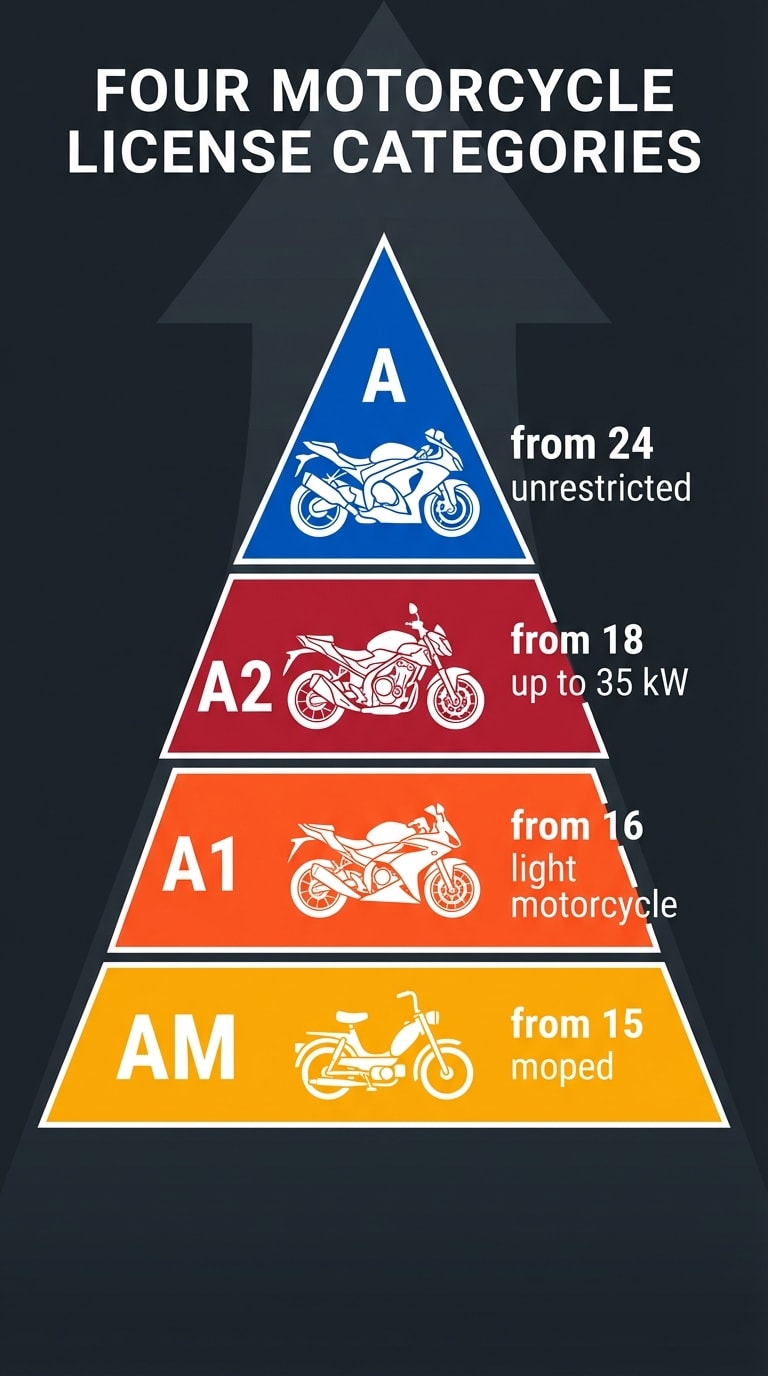
In Czechia, there are four motorcycle license categories: AM, A1, A2, and A. Each one has different age requirements, different power limits, and different rules. This chapter gives you a clear overview of what each category allows, what age you need to be, and how you can upgrade from one to the next — without having to pay for a full course every time.
Quick summary:
- Category AM (from age 15) covers mopeds and small scooters up to 45 km/h
- A1 (from 16) opens up lightweight 125cc motorcycles up to 11 kW
- A2 (from 18) is the most popular choice — bikes up to 35 kW
- A (from 24, or from 20 with two years of A2 experience) has no power limit
Category AM — the entry point from fifteen
Category AM is the lowest rung. You can get it at just fifteen years old, but you'll need parental consent. AM covers two-wheeled motor vehicles with a maximum speed of 45 km/h and an engine up to 50 cc (for combustion engines) or up to 4 kW (for electric motors). In practice, that means mopeds, small scooters, and light quadricycles.
Sounds like not much? For a fifteen-year-old, it's a revolution. Suddenly you don't have to rely on the bus or your parents. Piaggio Zip 50, Honda Dax 50, or Peugeot Kisbee 50 — these are typical AM category machines. Don't expect any races, but for getting to school or to a friend's house, it does the job.
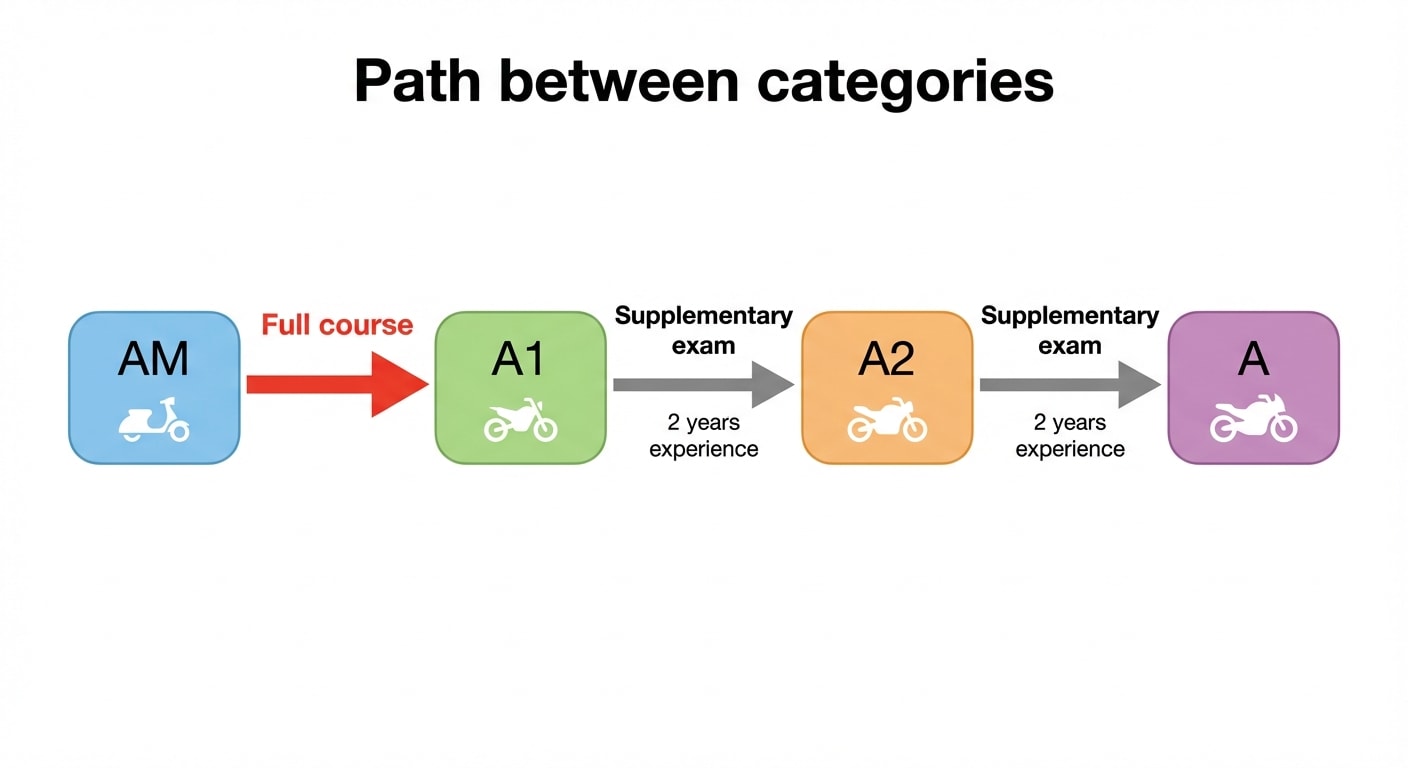
What's important to know is that AM is the foundation everything else builds on. Anyone with a higher category (A1, A2, A, or even B) is automatically allowed to ride AM vehicles. But it doesn't work the other way — with AM, don't reach higher. If you want to move up to A1, you'll have to complete a full driving school course and pass the exam. There's no supplementary exam from AM to A1.
AM and the law
Category AM is defined in §80a of Act No. 361/2000 Coll. It also includes three-wheeled vehicles and light quadricycles with the same parameters. The age limit of 15 is set by §83 of the same act.
Category A1 — lightweight motorcycle from sixteen
One year later, a whole new world opens up. A1 lets you ride lightweight motorcycles up to 125 cc with a maximum power output of 11 kW and a power-to-weight ratio of no more than 0.1 kW/kg from age sixteen (again with parental consent). You can also ride three-wheeled vehicles up to 15 kW.
In practice, category A1 is about two things: small street bikes and the popular 125cc scooters. Honda CB125R, Yamaha MT-125, KTM 125 Duke, or Honda PCX 125 — these are the machines you see on the road most often. They have enough power to ride comfortably around town and on country roads. Riding the motorway won't be ideal, but the law doesn't explicitly prohibit it.
Compared to AM, there's one crucial difference: A1 is a real motorcycle category. When upgrading to higher levels (A2, A), your A1 counts as a foundation. After holding A1 for two or more years, you can upgrade to A2 through a supplementary exam — no new course required. That's a huge advantage over never extending beyond AM.
One more thing. If you hold a category B license (car), you're also allowed to ride A1 category motorcycles — but only with an automatic transmission. And watch out: this rule applies exclusively within the Czech Republic. More on that below in the section about the B → 125cc rule.
Category A2 — the most popular choice from eighteen
A2 is the best-selling motorcycle category in Czechia. From eighteen, it lets you ride motorcycles up to 35 kW with a power-to-weight ratio of no more than 0.2 kW/kg. Engine displacement is not limited — what matters is the power output.
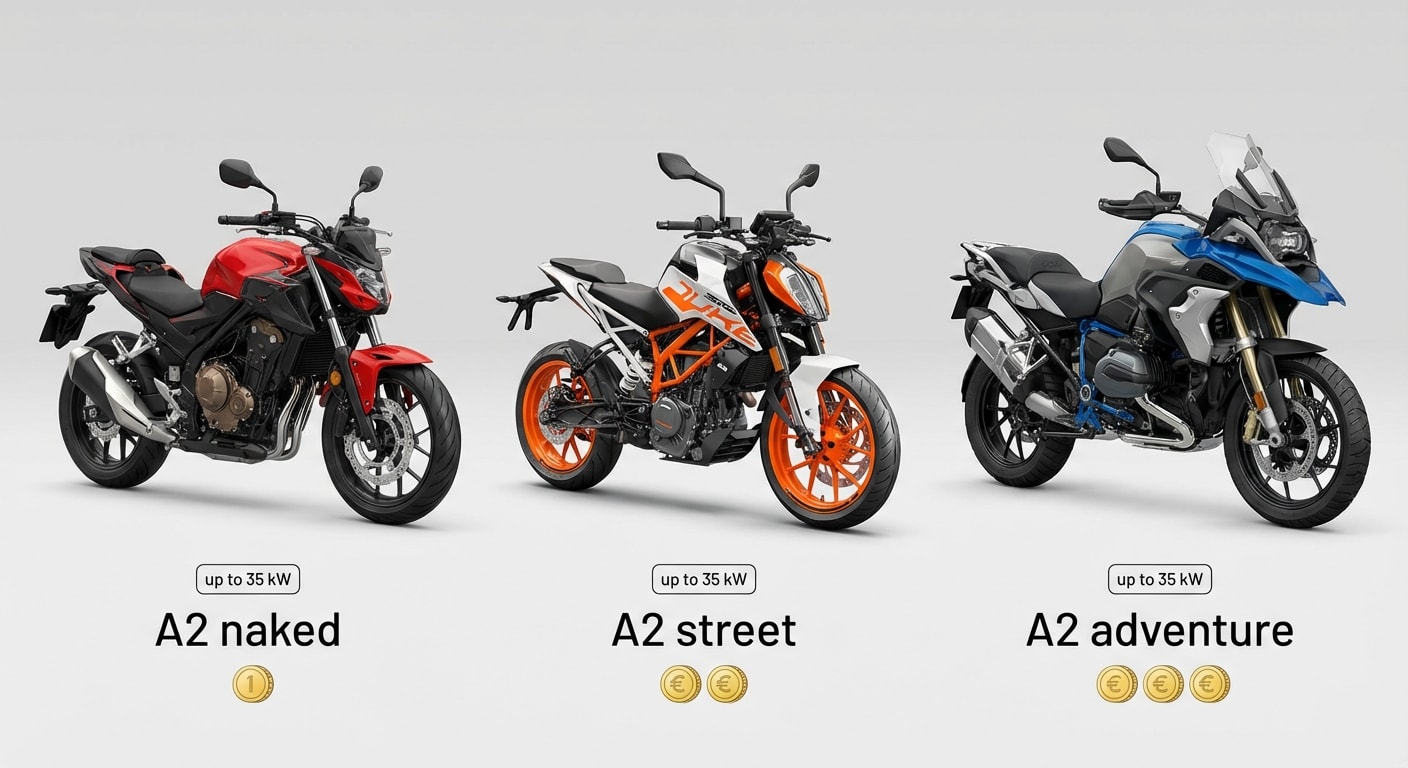
Thirty-five kilowatts doesn't sound like much on paper, but in practice it's more than enough. Honda CB500F, Yamaha MT-07 (restricted), Kawasaki Z400, KTM 390 Duke, or CFMoto 450MT — these are all bikes you can comfortably ride on the motorway, take on weekend trips, or use for daily commuting. A2 is not some "beginner compromise." It's a full-fledged category for motorcycles you'll genuinely enjoy riding.
But there's one rule you need to know: the double rule. A motorcycle for A2 must not have an original (unrestricted) power output higher than 70 kW. In other words, you can't take a supersport with 150 kW, have it restricted to 35 kW, and ride it on A2. This rule exists so that A2 riders don't end up on machines designed for an entirely different power class. That's why manufacturers offer models built specifically for category A2 — and there's a surprisingly large selection.
After two years with A2, the path to a full A license opens up through a supplementary exam. More on that in the section about upgrading between categories.
Category A — no limits from twenty-four
The full category A is the goal for anyone who wants to ride anything on two (or three) wheels. No power limit, no displacement restriction, no top speed cap beyond what traffic law dictates.
The direct path to category A goes through a full driving school course and exam, but you're only eligible from age 24. There is, however, a faster and cheaper option: if you've held an A2 license for at least two years, you can upgrade to full A at just 20 through a supplementary exam. You'll save time, money, and won't have to sit through classroom theory again.
BMW R1300GS, Honda Africa Twin, Yamaha MT-09, Kawasaki Z900, Ducati Multistrada, Harley-Davidson — with category A, you can choose from everything manufacturers offer. Plus three-wheeled motor vehicles over 15 kW (from age 21).
Looking at sales statistics, the best-selling motorcycle in Czechia in 2025 was the BMW R1300GS with approximately 830 units sold. That's a machine you need a full category A for.
The smart path to full A
Get your A2 at eighteen, ride for two years, and upgrade to full A at twenty through a supplementary exam for CZK 5,000–10,000. Compared to a direct A course at twenty-four, you'll save years of waiting and thousands of crowns.
Motorcycle license categories in Czechia
| Category | Min. age | Engine | Max. power | Typical machines |
|---|---|---|---|---|
| AM | 15 | up to 50 cc | 4 kW (5.4 hp) / 45 km/h | Mopeds, small scooters |
| A1 | 16 | up to 125 cc | 11 kW (15 hp) | Lightweight bikes, 125cc scooters |
| A2 | 18 | no limit | 35 kW (48 hp) | Honda CB500F, KTM 390 Duke |
| A | 24* | no limit | no limit | Anything — from cruisers to supersports |
Category comparison table
*or 20 after 2 years with A2; three-wheelers from 21
Upgrading between categories — the step-by-step path up
One of the best features of the Czech system is that you don't have to start from scratch every time you want a higher category. The law allows gradual upgrading through supplementary exams — and that's significantly cheaper and faster than a full course.
From A1 to A2 works like this: after holding A1 for at least two years, you go to a driving school, register for the supplementary exam, and take only the practical part. No written tests, no theory, no first aid training. You ride the course maneuvers and take a road test. The price? Typically around CZK 5,000 plus CZK 700 for the administrative fee. Details on what exactly the practical exam involves can be found in the chapter Motorcycle Driving Test.
From A2 to A works exactly the same way. Two years with A2, a supplementary practical exam, and you have full A. The price ranges from CZK 5,000 to 10,000 — depending on the driving school. A complete price overview is in the chapter Motorcycle License Cost.
But watch out for two exceptions. From AM to A1, you cannot upgrade through a supplementary exam. You must complete the full course and pass all exam parts. And if your A1 license has harmonization code 79 in it (this applies to category B holders who have A1 restricted to automatic), you also can't upgrade to A2 through a supplementary exam. Again, full training and exam required. This is a frequently asked question on forums, and the answer surprises a lot of people.
You get three attempts at each supplementary exam (one regular and two retakes). If you don't pass by the third try within twelve months of the first attempt, you'll have to complete new training. Details about the entire exam process are in the chapter Motorcycle Driving Test.
The B → 125cc rule — what actually applies
This is one of the most discussed topics on forums. A category B license has, since January 19, 2013, entitled you to ride motorcycles classified as A1 — but with several significant restrictions.
First, you're only allowed to ride motorcycles with an automatic transmission. Manual shifting is not permitted with just a B license. Second, standard A1 limits apply: maximum 125 cc and 11 kW. Third — and this is the most important part — the entitlement applies exclusively within the Czech Republic. If you cross the border into Germany, Austria, or anywhere else on a 125cc scooter with just your B license, you're riding illegally.
There's no mandatory training or exam. The entitlement is automatic — you simply have it. In your driving license, it's recorded as A1 with harmonization code 79. But that code 79 has a consequence few people know about: if you later decide to upgrade to A2, the supplementary exam won't help you. You'll need to complete full training and examination as a new category.
Don't confuse this Czech rule with Germany's B196. Germany has a similar option, but it works differently — requiring a minimum age of 25, five years with B, and a mandatory course of 9×90 minutes. Czechia chose the simpler route, but at the cost of it only being valid on home soil.
Watch out abroad
With a B license on a 125cc motorcycle, you're only allowed to ride in Czechia. Cross the border and you risk a fine for riding without the proper license. If you plan to travel by motorcycle, you need an A1 license or higher.
The double rule for A2
This rule deserves its own section because people often run into it only when they want to buy a specific bike. The law states (§80a of Act No. 361/2000 Coll.) that a motorcycle for category A2 must not be derived from a vehicle with more than double the power. In practice: the bike's original power output must not exceed 70 kW.
What does that mean? The Yamaha MT-07 has a factory power output of 54.5 kW. Half of that is 27.25 kW — less than 35 kW. But 54.5 kW is also less than 70 kW. So you can have the MT-07 restricted to 35 kW and ride it on A2. On the other hand, the Yamaha MT-09 has a factory output of 119 kW. That's more than 70 kW, so you can't ride it on A2, even if you had it restricted.
Manufacturers know these rules and offer models designed specifically for A2. The Honda CB500F has a factory output of 35 kW — you don't even need to restrict anything. The KTM 390 Duke puts out 32 kW. The CFMoto 450MT has 34 kW. More on choosing a specific motorcycle for A2 is in the chapter Choosing Your First Motorcycle.
What's changed in recent years
The AM/A1/A2/A category system has been in effect in Czechia since January 19, 2013, when the amendment to Act No. 361/2000 Coll. (enacted by Act No. 297/2011 Coll.) took effect. Previously, only groups AM, A1, and A existed — the A2 category was added as an implementation of EU Directive 2006/126/EC.
From January 1, 2024, a new penalty point system applies (Act No. 271/2023 Coll.). For motorcyclists, the key change is that riding without a helmet is now a serious offence — with a fine of CZK 1,500–2,000 on the spot (CZK 2,000–5,000 in administrative proceedings) and 4 penalty points. Previously, the penalties were milder.
From 2026, practical improvements have arrived. You can ride immediately after your entitlement is recorded in the central registry — no need to wait for the physical card. Electronic applications for driving licenses go through the Transport Portal, and you can collect your license at pickup points, not just government offices.
At the EU level, a new driving license directive (the so-called fourth directive) is being discussed that could change age limits and power restrictions. There's also talk of extending the B196 rule (B → 125cc) across the entire EU. However, it's not yet clear when or in what form it will be adopted.
How to choose the right category
The right choice depends on your age, what you want to do on a motorcycle, and your budget. If you're fifteen and just want to get to school, AM will serve its purpose. At sixteen with A1, you can already ride a decent 125cc bike that handles longer rides too. At eighteen, A2 is the smartest investment — in two years you can upgrade to full A without a full course.
If you're over twenty-four and don't have any motorcycle category, you have two options: go straight for full A (full course, higher price, but no restrictions), or start with A2 and upgrade in two years. The second option is cheaper, but you'll be limited to 35 kW for two years. A complete budget breakdown for the license and motorcycle is in the chapter Motorcycle License Cost.
Whatever path you choose, the first step is always the same — finding a driving school that offers motorcycle courses. On Kvalty.cz, you can compare them by price, reviews, and location. A step-by-step description of the entire process from application to license issuance is in the chapter How to Get a Motorcycle License.
Summary
- Czechia has 4 motorcycle license categories: AM (age 15), A1 (16), A2 (18), and A (24, or 20 with two years of A2 experience)
- Each higher category automatically includes the lower ones — with A2 you can ride AM and A1 vehicles too
- You can upgrade from A1 to A2 and from A2 to A via supplementary exam after 2 years — practical riding only, no written tests
- There's no supplementary exam from AM to A1 — you must complete the full course
- With a B license you can ride a 125cc automatic motorcycle, but only in Czechia
- A motorcycle for A2 must not have an original power output above 70 kW (double rule)
- Driving licenses are valid for 10 years, then renewal without a new exam
Key Terms
| Term | Explanation |
|---|---|
| Category AM | Mopeds and small scooters up to 50 cc / 45 km/h, from age 15 |
| Category A1 | Lightweight motorcycles up to 125 cc / 11 kW, from age 16 |
| Category A2 | Motorcycles up to 35 kW with 0.2 kW/kg ratio, from age 18 |
| Category A | Motorcycles with no power limit, from age 24 (or 20 with A2) |
| Supplementary exam | Practical exam (no theory) for upgrading A1→A2 or A2→A after 2+ years |
| Double rule | A2 motorcycle must not have original power above 70 kW (2× 35 kW) |
| Harmonization code 79 | License code restricting A1 to automatic 125cc (for B holders) |
| Equivalence | Higher category automatically entitles you to ride lower-category vehicles |
| Power-to-weight ratio | Max 0.1 kW/kg for A1, max 0.2 kW/kg for A2 — limits "light but powerful" bikes |
| B → 125cc | Rule allowing riding a 125cc automatic with a B license, valid only in Czechia |