
Driving Theory — How to Study for the Test
What theory classes cover, the trickiest test questions, new video questions since 2025, and a study plan that works. Pass your theory exam.
About a third of driving school students fail the theory exam on their first attempt. Not because they don't know the material — most of them are brought down by stress and poor preparation. The test has clear rules, a predictable structure, and a question database you can go through entirely in advance. Those who prepare systematically pass. Those who rely on luck risk unnecessary retakes that cost extra money and weeks of waiting.
This article explains what exactly you learn in theory classes, how questions are scored on the test, which ones are tricky, and how to build a study plan so you can pass without unnecessary stress. No blind memorization — it's about understanding the principles that keep you safe on the road.
Quick summary:
- Theory classes cover 36 hours (group format) or 11 consultation hours (individual plan) — both lead to the same exam.
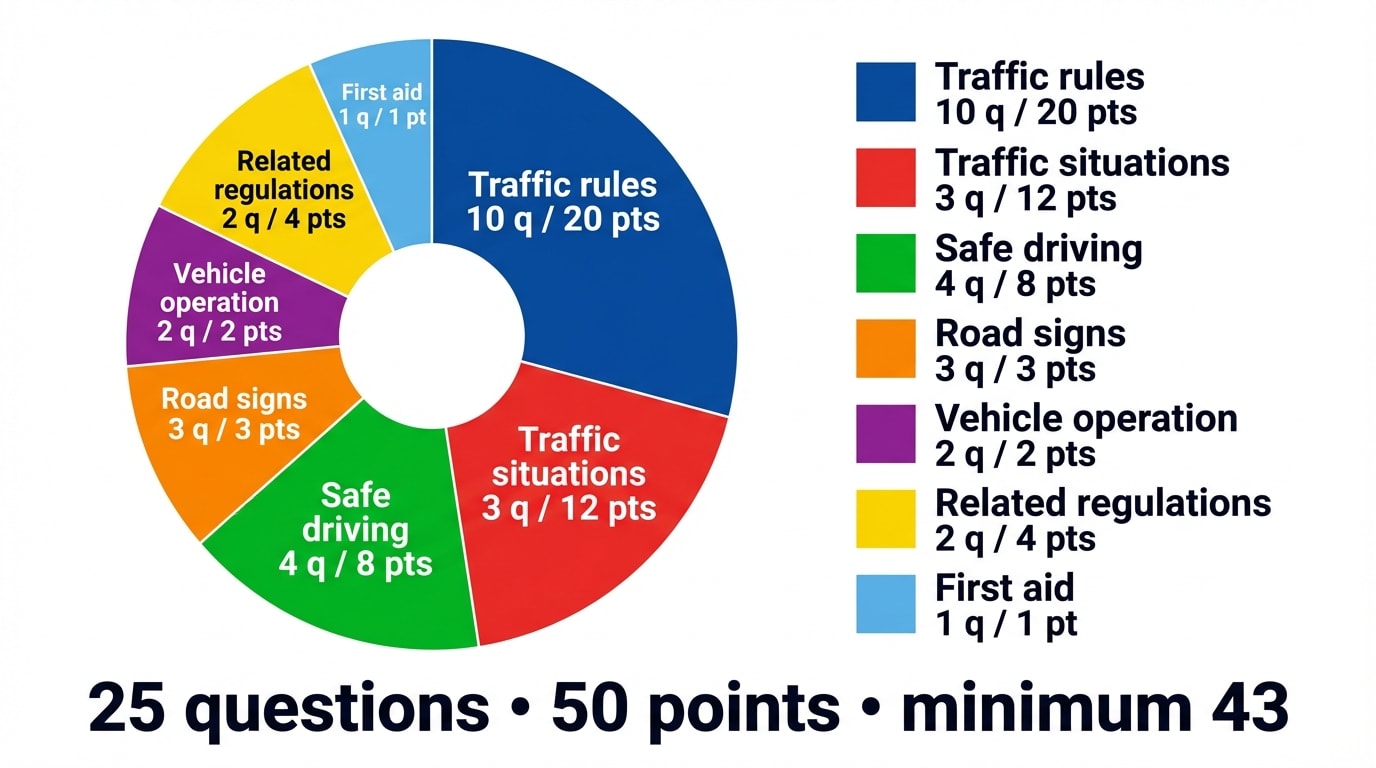
- The test has 25 questions, a 30-minute time limit, and you need at least 43 out of 50 points. The highest-scoring category (12 points) comes from just 3 traffic situation questions.
- The question database contains over 1,100 questions, including video questions and drone footage — and new ones are added regularly.
- Studying questions systematically by category is 6× faster than taking random practice tests.
What You Actually Learn in Theory Classes
Theory classes in driving school aren't a single subject — they cover five areas that together encompass everything you need to know as a driver. Act No. 247/2000 Coll. (Appendix 3) specifies exactly how many hours you must complete in each area.
The largest block is traffic regulations — a full 18 hours out of 36. This is where you learn road traffic rules, road signs, navigating intersections, right of way, speed limits, overtaking, stopping, and parking. It forms the backbone of the entire theory curriculum and the backbone of the final test.
The second largest block is driving theory and safe driving principles — 10 hours. This isn't about memorizing paragraphs but about how to think behind the wheel. Defensive driving, reacting to hazards, driving in reduced visibility, the effects of alcohol and drugs on driving, decision-making in traffic. Many test questions from this section are framed as scenarios — "What do you do when…" — and test your judgment, not just your memory.
The remaining hours cover vehicle operation and maintenance (2 hours — dashboard warning lights, tires, fluids), first aid training (2 hours — basic first aid, recovery position, when to call 155), and review and assessment (4 hours — practice tests, exam simulations).
Each class hour lasts 45 minutes, not 60. So 36 hours total means 27 hours of actual study time. If you chose the individual study plan, the number drops to 11 consultation hours — but the material is the same, you just study it at home on your own. You can read more about both formats in the chapter Training Process.
Individual study plan
If you're studying or working and can't regularly attend lectures, ask your driving school about the individual study plan. Instead of 36 hours of classes, you only attend 11 hours of consultations — the rest you study at home from a textbook or online. It's faster, cheaper, and most driving schools offer it today.
What the Test Looks Like — 25 Questions, 50 Points, 30 Minutes
The final theory exam takes place on a computer using the eTesty system operated by the Ministry of Transport. You take it at a municipal office (municipality with extended competence) — you verify your identity, sit down at a computer, and simply answer questions.
The test contains 25 questions with a maximum of 50 points. To pass, you need 43 points — that's 86%. At first glance it seems strict, but in practice it means you can only afford to lose 7 points. One wrong answer worth 4 points and one worth 2 points — and you're already on the edge.
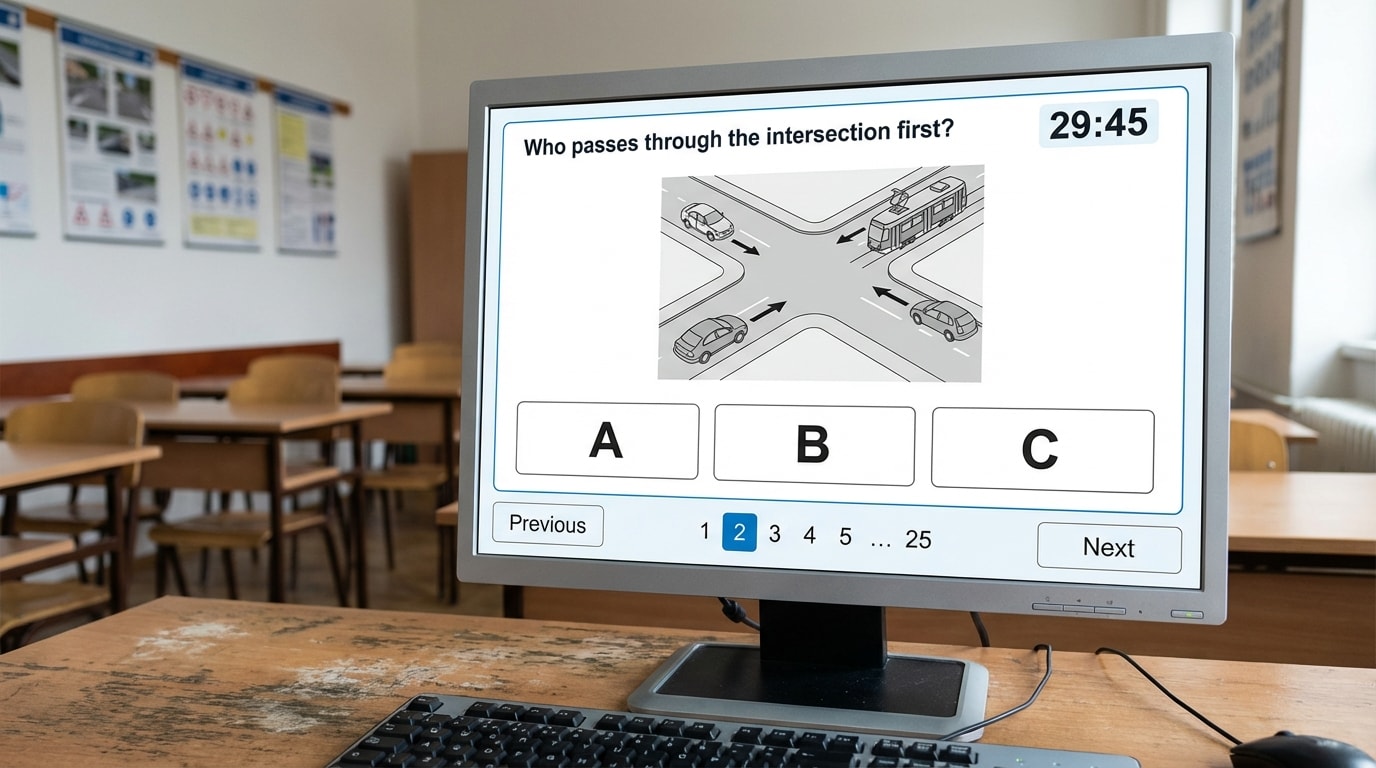
Why does this matter? Because not all questions carry the same weight. Three traffic situation questions are worth 4 points each — 12 points out of 50 combined. These are typically images or videos of intersections where you determine the order of passage. If you get these three right, you've secured nearly a quarter of your points. If you don't, you're practically guaranteed to fail.
On the other end, road sign questions (3 questions at 1 point each) and first aid (1 question for 1 point) won't save you, but they won't sink you either. Traffic rules questions make up the largest group (10 questions at 2 points each), so they deserve the most study time.
During the test, you can go back to questions, change answers, and skip ones you're unsure about. After 30 minutes, the test automatically ends. You see the result immediately on screen.
How to Study — A Study Plan That Works
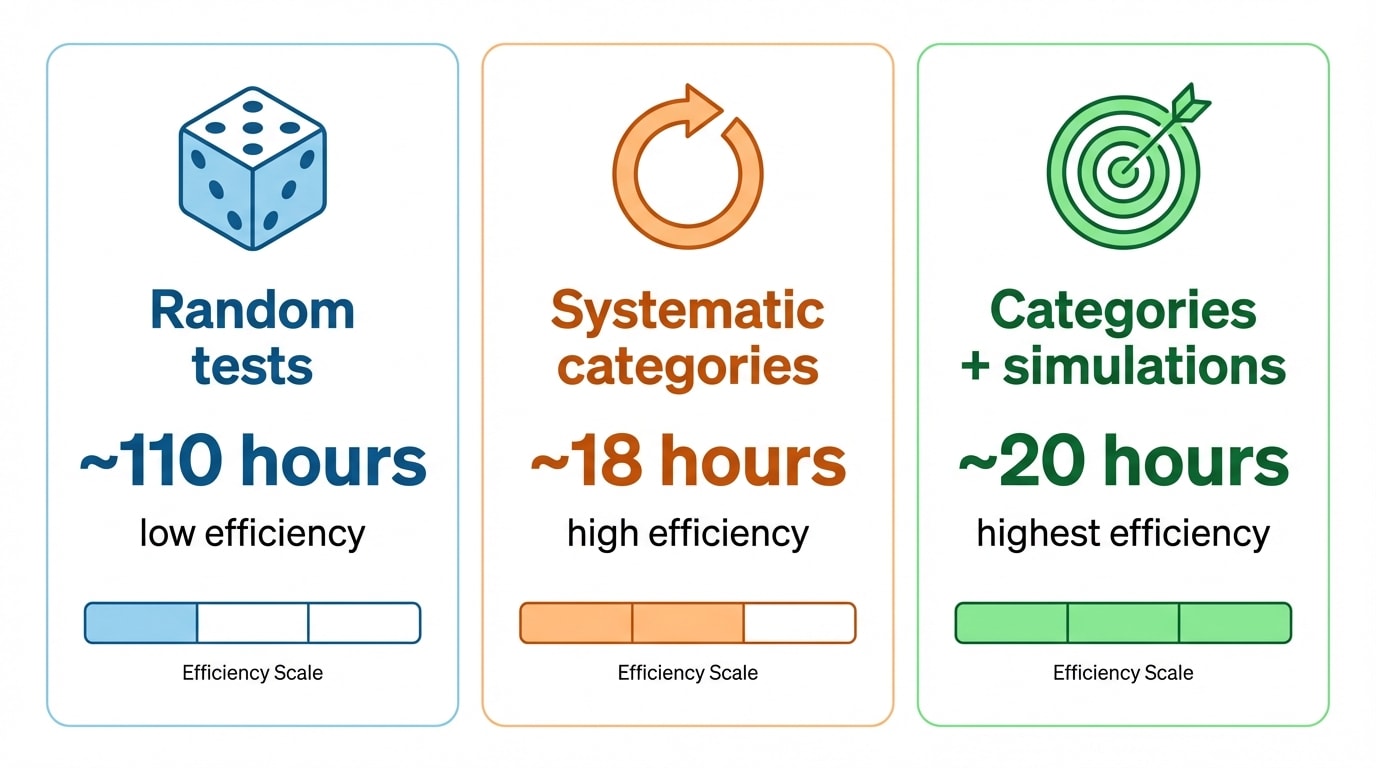
Most students make one critical mistake: they run random online test after random online test, hoping it'll "somehow stick." The problem? The database contains over 1,100 questions. With random generation, you'd need an estimated 410 tests — about 110 hours of pure time — to see every question at least once. That's absurd.
A far more effective approach is studying questions systematically by category. On portals like autoskola-testy.cz, you can sort questions by category — traffic rules, road signs, safe driving, first aid. You go through an entire category, mark the questions you got wrong, and then practice those specifically. This way you can cover the entire database in about 18 hours — six times faster than random testing.
The forgetting curve also matters. When you learn something and don't review it within 24 hours, you'll remember only about 40%. If you review it the same day or the next, retention jumps to 80%. That's why it's better to study short sessions every day than to cram all weekend.
Here's a 3-week study plan that covers the entire material:
Week 1: Go through the entire "Traffic Rules" category (the largest, worth 10 questions on the test). One subcategory per day — speed limits, right of way, overtaking, intersections. Mark problematic questions.
Week 2: Cover the remaining categories — safe driving, road signs, vehicle operation regulations, first aid. At the same time, review problematic questions from the first week.
Week 3: Full review. Do complete test simulations (25 questions, 30 minutes) — at least two tests per day. Focus on questions you're getting wrong. Practice traffic situations (intersections), as they carry the most points.
Start studying theory before your first lesson
Ideally, start learning theory before your first driving lesson. When you know why right-of-way rules apply or how safe following distance works, you'll apply it better behind the wheel. Theory and practice reinforce each other.
Where to Study — The Best Resources
The Ministry portal etesty2.mdcr.cz is the closest to what you'll face at the exam — the interface is identical and the questions are official. But be careful: the ministry portal doesn't contain absolutely all questions from the database. Don't rely on it as your only source.
The most complete database is on autoskola-testy.cz — you can practice by category, see difficulty statistics for individual questions, and mark the ones you're getting wrong. The portal bezpecnecesty.cz is similarly useful, collecting data from millions of tests and showing which questions are the hardest.
For mobile study, there are apps like Autoškola 2026 CZ – eTesty+ (iOS and Android) or Autoškola Testy – eTesty (Android) — both work offline and have up-to-date questions. They're handy for practicing on the bus or while waiting in line.
You can practice video questions on noveotazky.cz and hazardperception.cz. They don't have hundreds of them yet, but every one you go through will make you more comfortable at the exam.
Strategy During the Actual Exam
You have 30 minutes for 25 questions — that's more than enough. The average question takes 30 to 60 seconds. There's no need to rush, and clicking the first answer that "looks right" definitely doesn't pay off.
A proven method is the four-pass approach. On the first pass, go through all 25 questions and only answer the ones you're absolutely certain about. Skip the rest. On the second pass, return to questions where you're fairly confident — usually a moment's thought is enough. On the third pass, work through the harder questions carefully. Only on the fourth pass fill in the remaining answers — even if you're unsure, always select something (an unanswered question is automatically zero points).
This approach has two advantages. First, you won't waste time getting stuck on a hard question right at the start. Second, answers to easy questions often provide context for the harder ones — your brain works in the background.
If you're interested in details about exam day — what to bring, what it's like at the office, what to do after the exam — check out the chapter Exams.
What If You Don't Pass
Failing the theory test isn't the end of the world. You get 3 attempts total — the exam plus 2 retakes. You can retake it after at least 5 business days, and a theory retake costs CZK 100. If you don't pass even on the third attempt, you must complete supplementary training and then get another 3 chances. All attempts must be completed within 12 months of your first attempt (§39(6) of Act No. 247/2000 Coll.).
But honestly — if you prepare according to the plan above, the chance of failing is minimal. Most failures stem from stress and from students practicing random tests instead of studying systematically. Knowledge of the material + calm during the exam = success.
Summary
- Theory covers 5 subjects totaling 36 hours (group format) or 11 hours (individual plan). Both lead to the same exam.
- The test has 25 questions worth 50 points. You need 43 points (86%) to pass. Traffic situations carry the most weight — 3 questions at 4 points each.
- The database contains over 1,100 questions including video questions and drone footage. New ones are added regularly.
- Systematic study by category is many times more effective than random tests — you can cover the entire database in ~18 hours.
- Three-week study plan: week 1 traffic rules, week 2 remaining categories, week 3 simulations and review.
- A third of failures are due to stress, not lack of knowledge. Good preparation = less stress = success.
Key Terms
| Term | Explanation |
|---|---|
| eTesty | The Ministry of Transport's computer system used for the theory exam. 25 questions, 30 minutes. |
| Traffic situations | Questions with an image or video of an intersection — you determine the order of passage. Highest point value (4 points per question). |
| Individual study plan | A flexible theory format — self-study at home + consultations at the driving school (11 h instead of 36 h). |
| Video question (Hazard Perception) | A dynamic question with a short traffic video clip. In the database since March 2024, with drone footage since September 2025. |
| Forgetting curve | A psychological principle — without review within 24 hours, you'll remember only ~40% of what you learned. |
| Class hour | 45 minutes — not 60. The legal unit for instruction in driving school. |
| Retake exam | An additional attempt after failing. You get 2 retakes (3 chances total). Theory: CZK 100, earliest after 5 business days. |
| Supplementary training | Required after 3rd failed attempt — complete it and you get another 3 chances. |